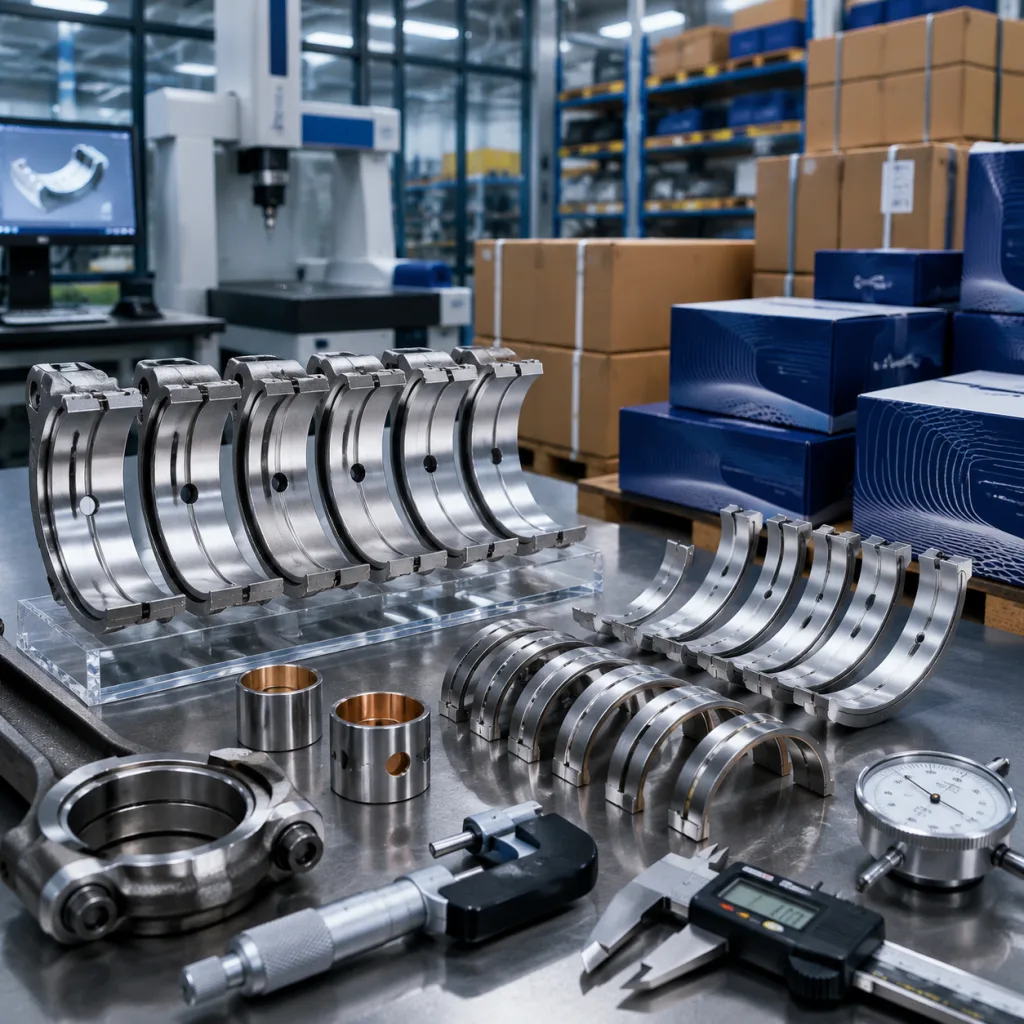
Selecting a crankshaft Acura supplier is a purchasing decision that affects engine durability, warranty exposure, inventory accuracy and landed cost. For distributors, repair-chain buying teams and OEM service-channel programmes, the issue is not only whether a crankshaft fits a K-series, J-series or related Acura application. It is whether the manufacturer can prove material control, machining capability, dimensional consistency, packaging discipline and stable export execution. Driventus manufactures engine and powertrain components in Taizhou, Zhejiang, and exports to more than 60 countries. Our crankshaft supply model is built for B2B buyers that need repeatable specification control, clear cross-reference management and factory documentation before issuing blanket orders or container-level purchase orders. Driventus is an independent aftermarket manufacturer; brand names are referenced for fitment only.
What Procurement Teams Should Verify First
A crankshaft is a high-liability engine component, so supplier selection should start with process evidence rather than catalogue claims. For Acura-fitment applications, procurement teams usually need confirmation of journal geometry, flange position, oil-hole finish, balance correction method, hardness profile and packaging resistance during sea freight.
A qualified crankshaft Acura supplier should be able to document four areas:
Fitment control: engine-code mapping, OE-style cross-reference discipline, sample measurement records and drawing revision control.
Manufacturing control: forging or casting source traceability, CNC turning and grinding records, fillet radius control and final inspection reports.
Quality management: certification to IATF 16949:2016 and ISO 9001:2015, incoming material inspection, non-conformance handling and corrective action records.
Export readiness: HS code support, neutral packaging options, carton and pallet specifications, and documentation for destination-market customs requirements.
Buyers can review Acura-fitment crankshaft coverage through our catalog, including related engine components for consolidated sourcing.
Typical Acura-Fitment Crankshaft Supply Scope
Driventus supports crankshaft sourcing for aftermarket programmes where buyers need stable availability across multiple engine families. Fitment is managed by application data, engine code, sample confirmation and customer-supplied OE cross-reference lists. We do not claim approval or endorsement by any vehicle manufacturer.
Sourcing item
Typical procurement requirement
Driventus supply approach
Application range
Acura passenger car and SUV engine families
Cross-reference by engine code, displacement, year range and customer sample
MOQ by part number, with mixed-container planning where feasible
Material route
Forged steel or cast iron, depending on application
Material confirmation by drawing, sample or buyer specification
Machining process
Main journals, pin journals, flange, keyway and oil passages
CNC turning, grinding, polishing, oil-hole finishing and final dimensional inspection
Documentation
Audit files, inspection reports, packing list, invoice and origin documents
Supplied according to purchase order and destination requirements
Branding
Neutral, distributor brand or programme-specific packaging
Packaging artwork and label control under agreed approval process
</tr></thead><tbody> </tbody></table>For new part numbers, customers usually send an OE-style reference, sample part, technical drawing or fitment list. Generic references may appear in buyer files as formats such as OE 06A107065 or OE 11251...; final confirmation must be based on the exact customer data, not an assumed catalogue match.
Manufacturing Controls That Matter for Crankshafts
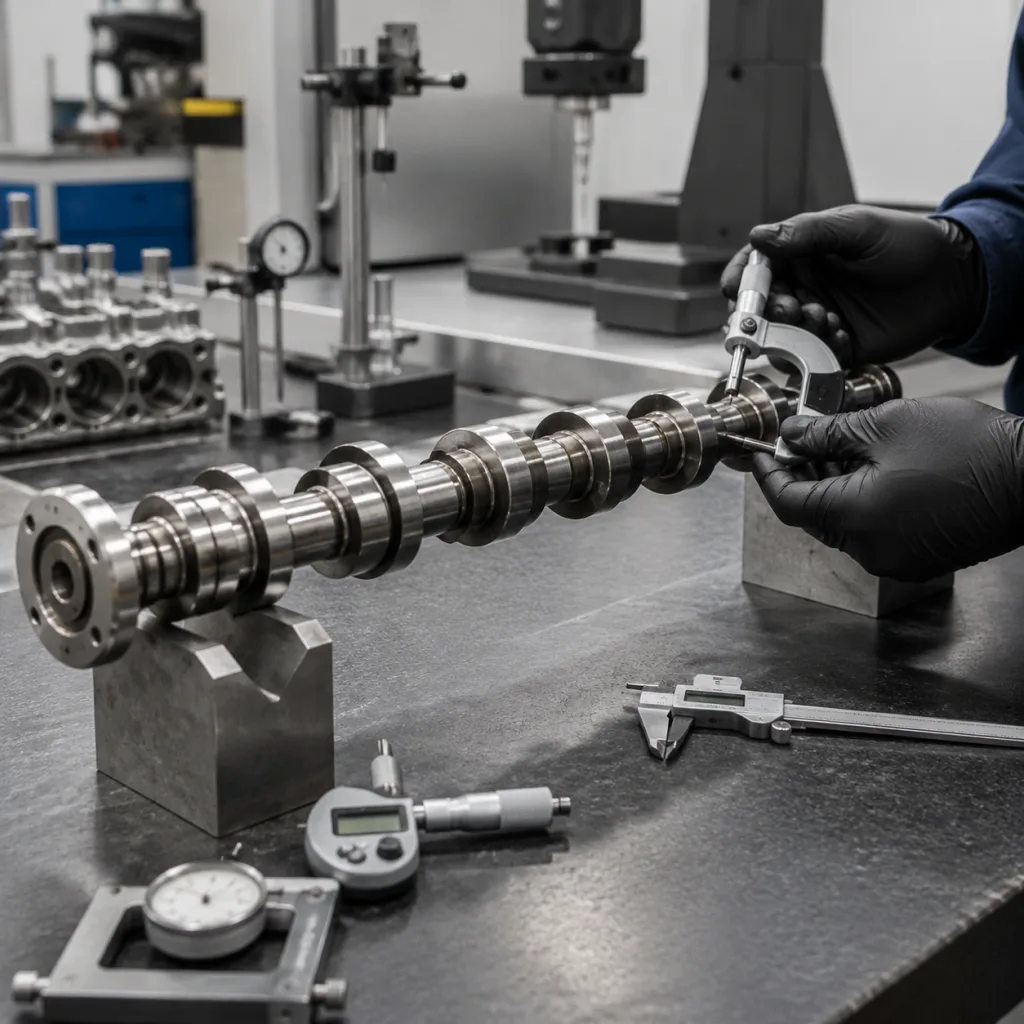
Crankshaft performance depends on geometry, metallurgy and surface integrity. Small deviations in journal diameter, roundness or fillet radius can increase bearing wear, oil-pressure instability and vibration. Procurement teams should therefore request process evidence that covers more than final appearance.
Important control points include:
Main journal and crankpin diameter measurement against agreed tolerance.
Roundness, cylindricity and taper checks after grinding.
Fillet radius verification to reduce stress concentration risk.
Surface roughness inspection for bearing contact areas.
Runout inspection at defined datum points.
Dynamic balancing according to buyer specification.
Magnetic particle inspection or equivalent crack detection where specified.
Hardness and material test records for each production batch.
Driventus applies controlled machining and inspection steps within a documented quality system aligned with IATF 16949:2016 and ISO 9001:2015. For buyers selling into regulated markets, we also support material and documentation discussions related to REACH (EC) No 1907/2006 where relevant to supplied components and packaging materials.
MOQ, Lead Time and Audit Preparation
For distributor and repair-chain programmes, the commercial structure often matters as much as the unit price. A low quotation is not useful if the supplier cannot maintain part-number continuity, carton strength or shipment timing. Driventus normally evaluates MOQ by crankshaft model, machining complexity, packaging type and whether the item is existing production or a new development.
Typical sourcing sequence:
1. Buyer sends application list, OE-style cross-references, annual forecast and target market. 2. Driventus checks existing tooling, sample availability and production route. 3. Commercial team confirms MOQ, sample cost if applicable, estimated lead time and packaging options. 4. Engineering team confirms critical dimensions and inspection criteria. 5. Buyer approves sample, inspection report, label format and carton specification. 6. Mass production proceeds under agreed purchase order and shipment schedule.
Lead time varies by stock status and production load. Existing crankshaft items may move faster than new developments requiring sample reverse engineering, tooling validation or PPAP-style documentation. Factory audits can be supported with certification files, process-flow information, inspection equipment lists and production-site review materials. Buyers with private-label or programme-specific requirements can also discuss custom manufacturing.
Packaging, Logistics and Landed-Cost Control
Crankshafts are dense, machined components with finished bearing surfaces. Poor packaging can create claims even when machining quality is acceptable. Procurement teams should specify export packaging requirements at quotation stage, especially for mixed shipments and long sea routes to the EU, UK, US, Canada, Australia or Brazil.
A practical crankshaft packaging specification should cover:
Rust-prevention oil or VCI protection suitable for transit duration.
Protective sleeves or contact barriers on machined journals.
Individual carton strength and internal support method.
Pallet dimensions, gross weight limits and stacking restrictions.
Barcode, batch label and customer part-number format.
Neutral or customer-branded packaging approval procedure.
Drop, compression or handling expectations if required by the buyer.
Import managers should also compare the effect of MOQ, carton volume, pallet utilisation and consolidation with related engine parts. A crankshaft shipment planned with gaskets, pistons, water pumps or other powertrain components may reduce administrative cost per SKU, but only when packaging and load planning prevent surface damage.
How to Qualify Driventus as a Supplier
A sourcing engineer or category buyer can qualify Driventus through a structured review rather than a price-only comparison. The process normally begins with part identification, then moves to sample validation, commercial review and order planning.
Recommended buyer checklist:
Confirm target application, engine code and customer part number.
Provide OE-style cross-reference data without assuming manufacturer endorsement.
Request drawing-level confirmation or sample measurement where risk is high.
Review certification scope for IATF 16949:2016 and ISO 9001:2015.
Check inspection report format and critical dimensions before sample approval.
Agree MOQ, Incoterms, packaging specification and delivery schedule.
Define claim-handling expectations, traceability fields and batch documentation.
This approach helps buyers compare suppliers on measurable capability: process control, responsiveness, repeatability, documentation and export execution. It also reduces the risk of catalogue mismatch, especially where different engine variants use similar-looking crankshafts with different journal, flange or reluctor features.
Frequently asked questions
Yes. Driventus supplies Acura-fitment crankshafts for B2B aftermarket sourcing based on engine code, customer part number, sample confirmation and OE-style cross-reference data. Driventus is an independent aftermarket manufacturer; brand names are referenced for fitment only.
Available documents may include IATF 16949:2016 and ISO 9001:2015 certification files, inspection reports, material records, process-flow information, packaging specifications and export documents. The exact package depends on the part number, order type and buyer audit requirements.
MOQ depends on the crankshaft model, stock status, packaging requirement and whether the item is an existing production part or a new development. Buyers should send the application list, annual forecast and target market so Driventus can confirm practical order quantities.
For Acura-fitment crankshaft sourcing, send your application list, forecast, packaging requirement and audit documents needed. Our team will review the programme and respond with a practical supply proposal: [request a quote](/contact.html)