Control Arm Replacement Cost for Trade Buyers
Control arm replacement cost is not just a workshop labour calculation. For distributors, repair chains, fleet suppliers, and importers, the commercial figure includes the purchase price, bushing and ball-joint configuration, packaging, freight, warranty exposure, and the inspection effort needed at goods-in. A low unit price can quickly become expensive when bushing bonding is weak, ball-joint preload is inconsistent, geometry is out of tolerance, or coating fails after one winter season. This guide breaks down the cost elements that matter when sourcing aftermarket control arms at scale. It covers front lower and upper arms, aluminium and stamped-steel designs, bonded rubber and hydraulic bushings, complete assemblies, and the validation checks used to reduce returns. Driventus is an independent aftermarket manufacturer; brand names are referenced for fitment only. Buyers can use this article to compare supplier quotations, define sampling requirements, and estimate total acquisition cost before issuing a purchase order.
What Drives Control Arm Replacement Cost
For a repair invoice, the visible cost is usually the control arm, workshop labour, and wheel alignment. For a B2B buyer, the more useful number is the delivered, inspected, and saleable cost per usable unit. The spread can be wide because control arms vary by material, joint integration, bushing design, left/right complexity, platform volume, and packaging density.
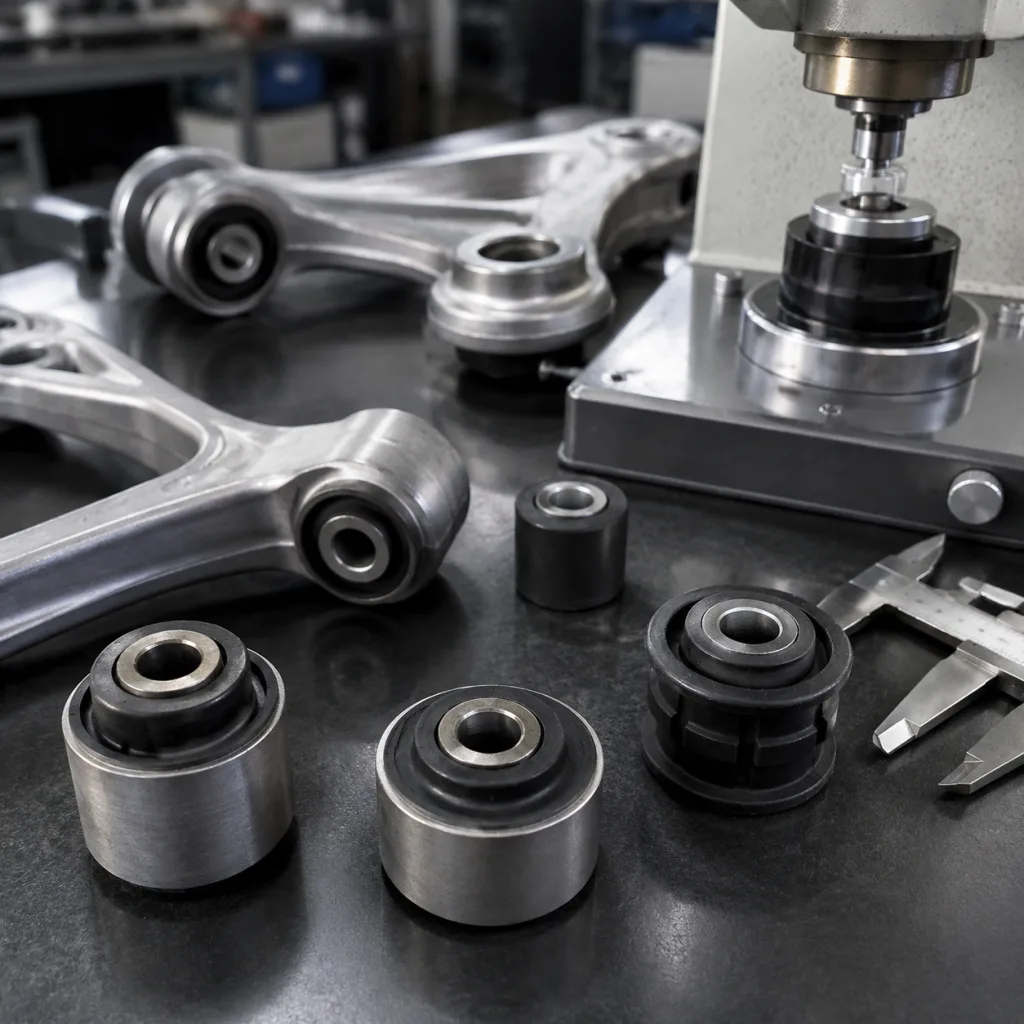
A basic stamped-steel lower arm for a high-volume passenger car is typically economical to manufacture and ship. A forged aluminium multi-link arm with an integrated ball joint, hydraulic bushing, heat shield bracket, and tight geometry tolerance costs more at each step, from tooling and machining to inspection and damage-resistant packaging. The quotation should state whether the arm includes bushings, ball joint, mounting hardware, protective caps, and individual packaging.
| Cost element | Typical impact | What buyers should verify |
|---|---|---|
| Arm material | Medium to high | Stamped steel, forged aluminium, cast aluminium, or forged steel |
| Ball joint included | High | Stud taper, thread, boot material, grease fill, preload range |
| Bushing type | Medium to high | Solid rubber, voided rubber, or hydraulic bushing design |
| Coating system | Medium | E-coat, powder coat, zinc flake, galvanised layer, or treated aluminium |
| Packaging | Low to medium | Protection for studs, boots, machined bores, and coated surfaces |
| Warranty return rate | High | Supplier PPM history, claim review discipline, and corrective-action process |
| Freight density | Medium | Carton dimensions, pallet pattern, stack height, and container utilisation |
| Product configuration | Common sourcing profile | Cost sensitivity |
|---|---|---|
| Stamped-steel arm with bonded rubber bushings | High-volume compact and mid-size platforms | Material thickness, weld quality, coating coverage |
| Aluminium arm with pressed bushing | Multi-link suspension and weight-sensitive platforms | Forging/casting quality, bore tolerance, corrosion protection |
| Complete arm with ball joint | Fast-moving aftermarket SKUs | Joint preload, boot sealing, taper accuracy |
| Arm with hydraulic bushing | NVH-sensitive vehicles | Fluid sealing, rubber compound, ageing resistance |
| Control arm kit | Repair-chain and distributor programmes | Completeness, carton labelling, fitment accuracy |
| Field issue | Likely root cause | Commercial effect |
|---|---|---|
| Bolt holes do not align | Incorrect fixture, weld distortion, or wrong application | Installer rejects part or modifies procedure |
| Clunk after installation | Ball-joint clearance, bushing void orientation, or loose sleeve | Warranty claim and brand damage |
| Uneven tyre wear | Geometry deviation or incorrect arm variant | Repeat alignment and customer complaint |
| Premature corrosion | Inadequate coating coverage or damaged packaging | Early visual failure in winter markets |
| Torn ball-joint boot | Poor boot material or packaging contact | Grease loss and early joint wear |