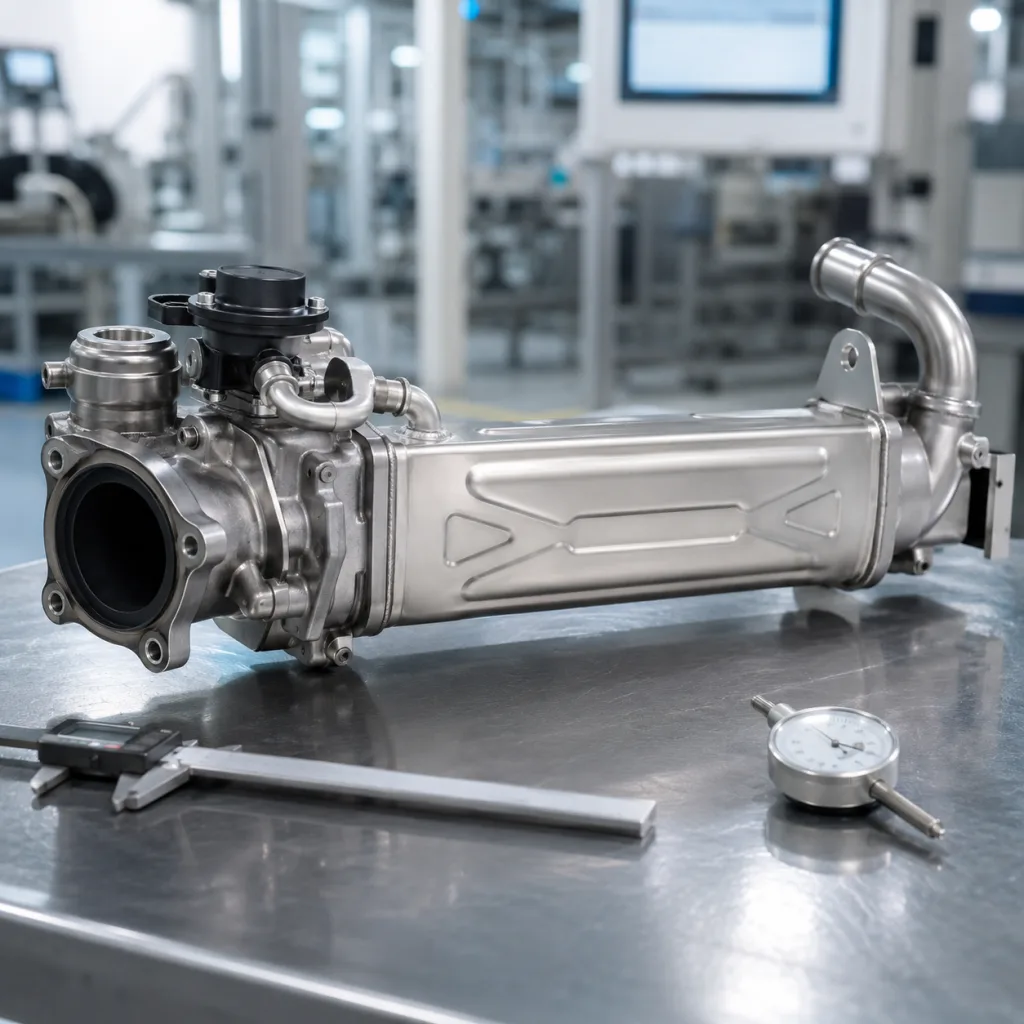
Coolant in the engine oil is a high-risk fault. It can reduce oil-film strength, attack bearing surfaces, create sludge, and accelerate wear after only a short period of running. When the problem is traced to the oil filter housing area, the usual causes are an internally leaking oil cooler core, a cracked housing, a distorted sealing face, incorrect seals, or assembly errors after service. Common signs include milky oil, an unexplained rise in oil level, coolant loss without an external leak, or oil residue in the expansion tank.
Driventus is an independent aftermarket manufacturer; brand names and OE references are used for identification and fitment only. For procurement teams, distributors, and workshop buyers, the priority is to confirm the leak path before ordering parts, then match the replacement by OE reference, port layout, seal profile, sensor positions, and mounting geometry. This guide explains the fault chain, inspection sequence, and sourcing checks for applications where the concern is coolant in oil oil filter housing failure.
What coolant in oil usually means
Coolant in the lubricating circuit usually means there is a breach between a coolant passage and an oil gallery. In an oil filter housing assembly, that breach is commonly located inside the integrated oil cooler, at the housing-to-block interface, or around a sealing stack that has been damaged, overheated, or assembled with the wrong gasket profile. The contamination may begin gradually, so the engine can still run while the oil is already losing viscosity stability and additive performance.
Typical symptoms include:
Light tan or milky residue on the dipstick or under the filler cap
Oil level rising without a corresponding top-up
Coolant level dropping with no visible external leak
Cooling-system pressure loss after shutdown
Oil traces in the expansion tank or radiator neck
Sludge on the oil filter element or inside the housing cap
A small amount of condensation under the filler cap can be normal on engines used only for short trips, but it should not be confused with confirmed coolant contamination in the sump. If the dipstick, drained oil, or laboratory sample shows coolant in the oil, continued operation can expand the repair from a housing replacement to bearings, turbocharger lubrication lines, hydraulic lifters, and the oil pump. For fleet buyers and service networks, quick isolation of the leak source helps control downtime, parts cost, and warranty exposure.
Common failure points in the oil filter housing
The fault is not always the housing body itself. Many coolant-to-oil leaks originate in the cooler element or in the sealing system between stacked components. Installation damage is also common: an O-ring can be pinched, a seal can be installed dry, or bolts can be tightened unevenly and distort the assembly.
Failure point
What happens
Inspection method
Oil cooler core
Internal plate, tube, or brazed-joint leakage allows coolant and oil to mix
Pressure-test oil and coolant circuits separately where possible
Housing casting
Cracks develop at thin-wall sections, threaded bosses, or mounting ears
Visual inspection, dye penetrant where suitable, pressure test
Gasket face
Overheating, corrosion, or over-torque creates an uneven sealing surface
Hardened, swollen, cut, flattened, or wrong-section seals allow cross-leakage
Measure section, inspect grooves, confirm material and hardness
Bolts / torque sequence
Over-tightening or uneven tightening distorts the housing or cooler stack
Verify torque value and tightening sequence against service data
Connector or sensor bosses
Cracks or damaged threads create external leaks that may be misread as cross-contamination
Inspect threads, sealing washers, and adjacent staining
</tr></thead><tbody> </tbody></table>An internally leaking oil cooler is often mistaken for a head gasket fault. The distinction is important. Combustion-gas evidence in the cooling system, misfire after startup, or cylinder-to-coolant pressure transfer may point toward the cylinder head or head gasket. If there is no combustion-gas evidence and the contamination appears concentrated around the housing and cooler circuit, the oil filter housing assembly should be tested before major engine teardown is approved.
Inspection sequence before replacement
A structured inspection prevents unnecessary engine disassembly and reduces the chance of ordering the wrong component. Use a clean sample, avoid cross-contaminating the drain pan, and document each finding before the system is flushed or stripped.
1. Check the engine oil condition on the dipstick, under the filler cap, and in the first part of the drain stream. 2. Inspect the coolant for oil sheen, brown sludge, suspended particles, or abnormal discolouration. 3. Pressure-test the cooling system to the vehicle service specification and monitor pressure decay. 4. Check for combustion gases in the cooling system if a head gasket or cylinder-head issue is suspected. 5. Isolate the oil filter housing and cooler circuit if the design allows bench or in-vehicle separation. 6. Inspect the housing mounting face, seal grooves, cooler interface, adjacent hoses, and fasteners. 7. Confirm whether the unit is an integrated oil filter housing with cooler, a serviceable housing with a separate core, or a modular stack using multiple seals. 8. Record application data, including engine code, OE reference, sensor layout, and hose orientation.
If the housing uses a replaceable oil cooler core, test the core independently before replacing the full assembly. If the casting is cracked, the machined face is distorted, or the cooler is internally leaking, replacement is normally the safer repair than attempting to reseal a compromised component. For sourcing teams, the inspection notes should be linked to the purchase request so the replacement can be checked against OE part number, coolant port size, connector orientation, thermostat position, and sealing profile before approval.
Replacement checks for procurement and workshop teams
When a replacement is ordered, dimensional compatibility matters as much as the part description. Two housings can look similar but differ in hose angle, seal-seat depth, filter cap style, cooler stack height, or sensor thread. Any of these differences can cause installation delays, external leakage, or repeat coolant in oil oil filter housing complaints.
Verify these points before purchase:
OE cross-reference, for example OE 06A107065 where applicable
Engine code, production date range, and market-specific application notes
Number, diameter, and angle of coolant ports
Oil passage layout and gasket interface to the cylinder block
Filter thread, cartridge size, cap style, and bypass-valve arrangement
Mounting hole pattern, centre distance, and bolt length requirements
Sensor boss locations, thread forms, and blanking-plug requirements
Presence and position of thermostat, bypass valve, heat exchanger, or integrated cooler
Seal kit contents, seal profile, and compatibility with coolant, oil, and operating temperature
Surface finish and cleanliness of machined sealing faces
For validation, request material traceability, critical-dimension inspection records, and leak-test results from the supplier. Driventus manufactures under IATF 16949:2016 and ISO 9001:2015 controlled processes, with validation aligned to customer requirements and applicable material and environmental regulations such as REACH (EC) No 1907/2006. For B2B buyers, these records are not paperwork only; they help confirm that the supplied housing has been controlled for repeatable fit, sealing performance, and production consistency.
Once coolant enters the oil, lubrication performance changes immediately. The mixture can reduce film strength, promote sludge, and compromise the additives that protect against wear and corrosion. Bearing surfaces are especially vulnerable because they rely on a stable oil wedge under load. Turbocharged engines face additional risk because the turbocharger bearing system depends on a clean, uninterrupted oil supply at high temperature.
The main consequences are:
Bearing wear, bearing overlay damage, and low oil pressure after contamination
Sludge formation in oil galleries, the filter element, and cooler passages
Corrosion on ferrous components if the vehicle is stored with contaminated oil
Restricted oil flow to pressure-fed components
Secondary failures in the turbocharger, camshaft journals, hydraulic lifters, and timing components
Repeat filter blockage if the system is not cleaned correctly after repair
If the engine was run for a long distance with coolant in the oil, replacing the oil filter housing alone may not restore reliability. A complete repair plan should include the correct oil drain and refill procedure, filter replacement, coolant renewal, inspection of pressure-fed components, and a controlled recheck after the engine reaches operating temperature. In severe cases, multiple short-interval oil and filter changes may be required according to workshop practice and service guidance. For fleet buyers, setting this process in advance reduces repeat claims and prevents disputes over whether the part, the installation, or residual contamination caused a later failure.
Sourcing control points for replacement housings
For B2B buyers, the objective is a housing that fits correctly the first time and maintains sealing performance through heat, pressure, vibration, and repeated service cycles. A stable supply programme should combine controlled drawings, validated seal materials, machining control, assembly checks, and repeatable leak testing.
Dimensional checks on critical sealing surfaces, port diameters, and mounting points
Heat-cycle validation on assembled units where required by the application
Incoming inspection of gasket material, O-ring dimensions, and casting finish
Thread and sensor-port verification before packing
Cleanliness control to prevent machining residue from entering oil passages
Packaging that protects machined faces, hose ports, sensor bosses, and seal grooves
Clear labelling for OE references, engine codes, and application notes
If you need a quotation for a replacement programme, pilot batch, or catalogue cross-reference review, include the OE number, engine code, photos of the removed housing, and measured port dimensions. When available, also provide the failure description, sample quantities, target annual volume, and any required validation standard. Complete input data shortens sampling time, reduces misbuild risk, and helps confirm whether the requirement is for a direct replacement, an improved sealing package, or a custom manufacturing project.
Frequently asked questions
No. Coolant can enter the oil through a head gasket, cylinder-head crack, engine block issue, oil cooler, or related coolant-to-oil interface. If testing shows no combustion-gas evidence and the contamination is concentrated around the housing or cooler circuit, the oil filter housing assembly should be inspected early.
Minor external seal issues may be corrected with the correct gasket kit and proper torque procedure. Cracked castings, distorted sealing faces, and internally leaking cooler cores should normally be replaced because the leak path is structural or internal.
Confirm the OE reference, engine code, production range, port layout, mounting pattern, sensor positions, seal specification, and whether the unit includes an integrated oil cooler, thermostat, or bypass valve. These checks prevent fitment errors and repeat leakage.
If you are sourcing a replacement oil filter housing or validating an OE cross-reference, send the part details, engine code, photos, and application data through /contact.html.