Control Arm Front Lower: A Practical B2B Sourcing Framework
A control arm front lower assembly is not a part to buy on catalogue fitment and price alone. It is a safety-critical suspension component that affects wheel location, steering stability, braking feel and tyre wear, so small gaps in geometry or assembly quality tend to show up quickly in the field.
For distributors, repair-group buyers and private-label programmes, the real sourcing question is simple: which supplier can deliver repeatable fitment and durability at scale, not just an attractive opening quote? Most problems trace back to a short list of issues—dimensional drift, weak bushings, inconsistent ball joints, poor coating coverage or loose process control. The visible outcomes are familiar: installation difficulty, NVH complaints, uneven tyre wear, corrosion claims and early warranty returns.
This article is built as a decision framework for B2B buyers of control arm front lower assemblies and bare arms. It focuses on what to verify, what tends to fail first, which specifications matter most and how to compare suppliers using measurable criteria rather than broad fitment claims. Where relevant, buyers should request drawing-level data, test reports and traceability records aligned with IATF 16949:2016 and ISO 9001:2015. Driventus is an independent aftermarket manufacturer; any brand names are referenced only for fitment identification.
A strong sourcing file for a control arm front lower programme should be finished before final price negotiation, not after. That file should define key dimensions, tolerance limits, rubber and metal specs, corrosion targets, packaging requirements, MOQ logic, sample timing and batch traceability. Done well, it reduces the risk of approving parts that install correctly on day one but generate claims after 10,000-30,000 km, especially in rough-road or road-salt markets.
Start with a four-point go/no-go screen
Before comparing quotes, screen every supplier on four basics: geometry, joint performance, corrosion protection and process control. Most control arm front lower failures in the aftermarket come back to one of these.
Fast first-pass checklist
- Dimensional match: pivot centre distance, ball joint stud position, arm offset, bracket angle and mounting-face parallelism should match approved drawings or validated benchmark parts.
- Material route: stamped steel, forged steel and cast aluminium each change cost, tooling, fatigue behaviour and machining requirements.
- Bushing specification: hardness, void design, bonding method, sleeve finish and angular orientation affect NVH and service life.
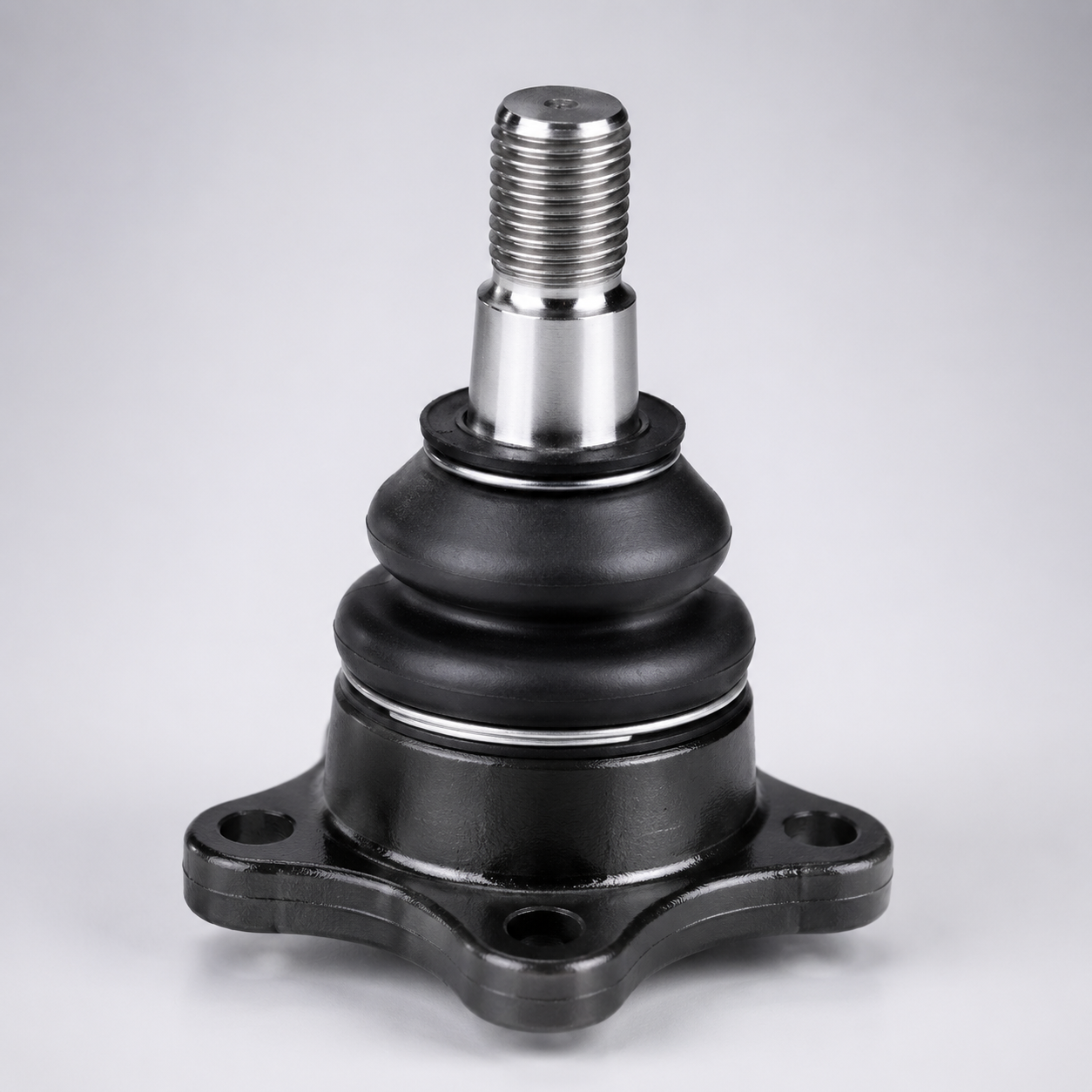
- Ball joint integrity: stud hardness, housing retention, articulation torque, boot sealing and grease compatibility must be verified early.
- Surface protection: e-coat, phosphate plus paint, powder coat or zinc flake should match the target market climate.
- Packaging control: stud caps, boot protection, separators and carton strength matter more than many buyers expect in export shipments.
If you source across a broad range, separate high-volume runners from low-volume tail items from the start. That makes MOQ, tooling amortisation and stocking logic easier to manage across our catalog.
Also confirm whether the supplier is quoting a true like-for-like replacement or an alternative design. Two parts can share catalogue fitment and still differ in bushing stiffness, casting profile or included hardware. Those differences belong in the technical file, not in the warranty data six months later.
A useful first request is a one-page technical summary for each control arm front lower reference covering arm material grade, net weight, key centre-to-centre dimensions, bushing hardness range, ball joint attachment method, coating type, salt-spray target, included hardware and standard carton quantity. If a supplier struggles to provide that within 24-72 hours, post-award technical support is often weak too.
For first-round approval, compare three things side by side: the incumbent part, the new sample and the drawing or benchmark measurement sheet. Many importers start with 10-15 critical characteristics such as pivot distance, ball joint centre position, bracket width, mounting hole true position, stud taper, stud thread and bushing orientation. Single-sample checks are not enough on safety-related dimensions. If a supplier cannot show a batch study across multiple pieces, risk remains high.
At the same stage, lock the commercial basis as well: EXW, FOB or CIF; hardware included or excluded; MOQ per SKU, per side or per set. A quoted MOQ of 300 pieces can mean very different things depending on whether the buyer needs left-hand parts only or 150L/150R sets.
Compare construction routes by use case, not by habit
Not every control arm front lower programme should default to the same build route. Construction choice should reflect vehicle segment, warranty exposure, market positioning and expected road conditions.
| Construction type | Typical material | Main advantages | Main trade-offs | Common buyer use case |
|---|---|---|---|---|
| Stamped and welded arm | Low-carbon or HSLA steel | Competitive cost at volume, good repeatability, efficient coating process | Weld quality and fixture control are critical; stiffness may be lower than forged designs | Broad aftermarket coverage |
| Forged steel arm | Medium-carbon alloy steel | High strength, strong fatigue resistance, good impact performance | Higher piece cost, higher forming load, more machining in some designs | Heavy-duty use, rough-road markets |
| Cast aluminium arm | Aluminium alloy | Lower mass, strong corrosion resistance, OE-style lightweight design | Porosity control required, scrap sensitivity higher, fitment precision is critical | Premium passenger car platforms |
| Failure-prone area | What buyers typically see in the field | What to verify |
|---|---|---|
| Arm geometry | Hard installation, steering pull, uneven tyre wear | Pivot distances, ball joint centre position, bracket alignment |
| Bushing package | NVH, cracking, separation, sleeve movement | Rubber spec, bond strength, orientation, press-fit control |
| Ball joint | Play, noise, pull-out risk, stiff articulation | Stud hardness, retention method, torque window, boot sealing |
| Coating system | Early rust, edge corrosion, cosmetic claims | Coating type, thickness, adhesion, salt-spray performance |
| Packaging and handling | Torn boots, damaged threads, chipped coating | Stud caps, separators, carton design, pallet stability |
| Item to verify | Why it matters | Typical control method |
|---|---|---|
| Pivot-to-pivot centre distance | Affects subframe fit and wheel location | CMM or dedicated gauge |
| Ball joint centre position | Influences camber, caster and steering geometry | CMM, fixture check |
| Mounting hole diameter and true position | Prevents installation interference and bolt-loading issues | Plug gauges, coordinate check |
| Bushing press-fit and sleeve concentricity | Reduces NVH, creep and premature movement | Press-force record, gauge report |
| Ball joint stud taper and thread | Ensures mating accuracy and torque retention | Taper gauge, thread gauge |
| Coating thickness and adhesion | Extends corrosion resistance in service | Thickness meter, cross-hatch or adhesion test |
| Commercial factor | Typical buyer expectation | What often drives it |
|---|---|---|
| MOQ for stocked runner SKU | 50-300 pcs per side or 50-150 sets | Standard material, shared tooling, regular line slots |
| MOQ for low-volume tail SKU | 300-1,000 pcs or mixed-container consolidation | Special fixtures, lower demand, packaging setup, coating batch size |
| Sample lead time | 2-6 weeks if tooling exists; 6-12+ weeks for new tooling | Tooling readiness, gauge prep, lab scheduling |
| Repeat-order lead time | 30-60 days is common | Material arrival, machining, coating queue, packing plan |
| New-tooling lead time | Often 45-90+ days depending on route | Dies, moulds, gauges and validation |