connecting rod · 2026-06-17

Choosing a Connecting Rod Supplier Without Guesswork

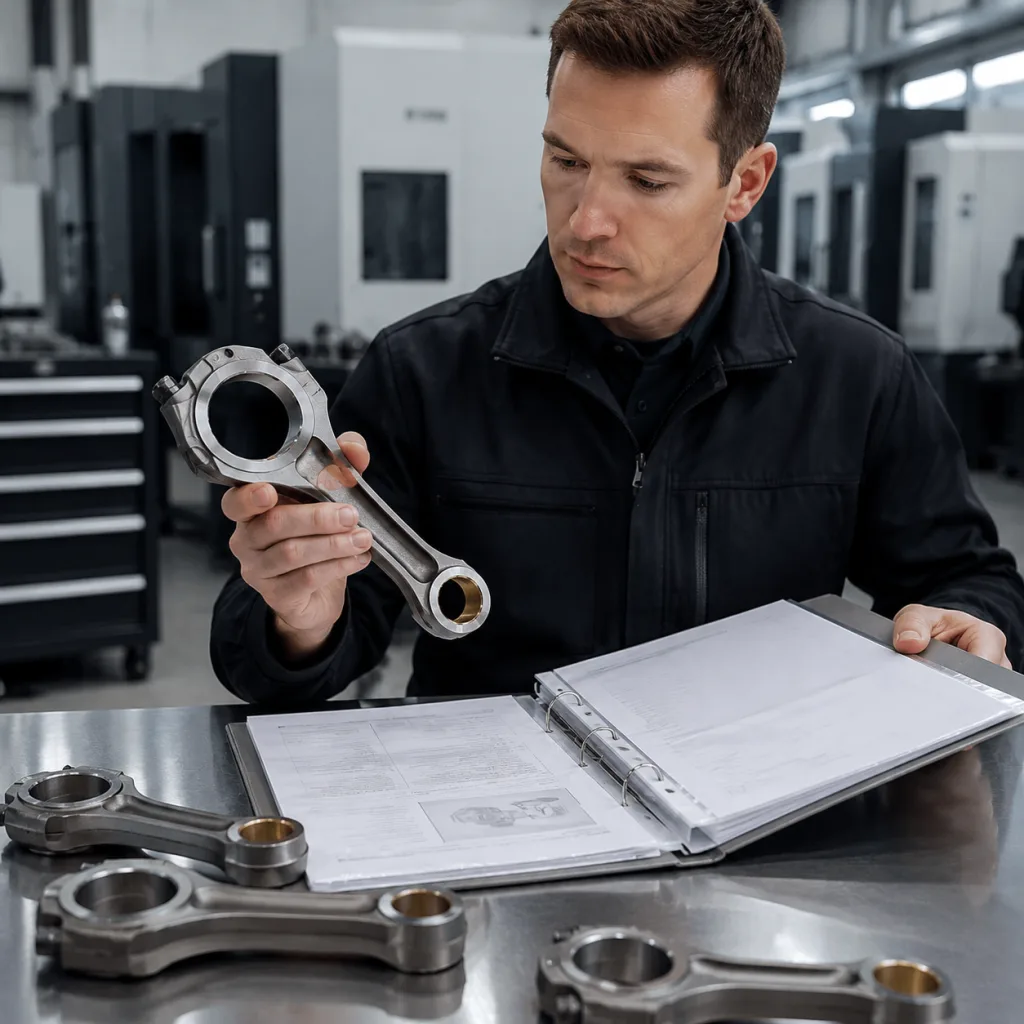
A connecting rod looks simple until it fails. Then the cost moves from the part price to bearing damage, engine claims, downtime, stock returns and lost customer confidence. That is why a B2B buyer should not approve a connecting rod supplier on catalog coverage or sample appearance alone.

The right review asks three questions. Can the supplier build the rod to the required load case? Can it hold big-end, small-end, weight and bolt-joint controls in production? Can it prove what was made, from steel lot to packed carton?

Driventus manufactures engine and powertrain components in Taizhou, Zhejiang, including connecting rods for independent aftermarket and custom programmes. We export to more than 60 countries and operate under IATF 16949:2016 and ISO 9001:2015 certified systems. This guide gives distributors, Tier-1 sourcing teams and repair-chain buyers a practical way to compare Chinese connecting rod manufacturers, check validation evidence and avoid weak sourcing decisions. Driventus is an independent aftermarket manufacturer; brand names are referenced for fitment only.

Start With the Rod’s Risk Class, Not the Quote

The first sourcing decision is not price. It is load case. A naturally aspirated 1.6 L passenger-car rod, a turbocharged 2.0 L gasoline rod, a 3.0 L light-commercial diesel rod and a motorsport rod may share a similar shape, but they do not carry the same stress at the beam, cap joint, bearing housing or fasteners.

Ask the connecting rod supplier to classify the part before quoting: service replacement, high-load diesel, turbocharged gasoline, performance upgrade, low-volume special, or custom engineering programme. That classification should drive material route, heat treatment, inspection level, weight matching, bolt specification and documentation depth.

For the first technical screen, ask the supplier to mark each critical-to-function feature on the drawing and state the inspection method, sample size and normal production tolerance. Typical aftermarket drawings use centre-to-centre length controls around ±0.02–0.05 mm, big-end bore controls around ±0.005–0.015 mm after final honing, small-end bush ID controls around ±0.005–0.012 mm and side-width controls around ±0.02–0.05 mm. Actual limits must follow the buyer drawing, engine design and bearing system. If a supplier cannot discuss these ranges clearly, treat the quotation as unproven.

Qualification evidence should cover:

  • Material route: forged 40Cr, 42CrMo, C70S6 or equivalent steel, sintered steel, cast steel or billet steel, selected by application load and cost target.
  • Heat treatment record: hardness range such as 28–36 HRC for many forged steel rods, with ductility requirements where applicable and batch traceability.
  • Critical dimensions: centre-to-centre length, big-end bore, small-end bore, pin bush ID, housing width and side clearance.
  • Surface finish: big-end bore typically Ra 0.4–0.8 μm, small-end bush ID often Ra 0.2–0.6 μm and deburred oil holes with no raised edges.
  • Weight control: total rod mass plus big-end and small-end balance range, commonly within ±1–3 g per rod for service sets and tighter where specified.
  • Cap separation method: conventional machined cap, fracture-split cap or dowel-located design, with cap-to-body matching control.
  • Bolt specification: grade, coating, thread condition, torque-angle procedure and preload or stretch validation.
  • NDT requirement: magnetic particle inspection or equivalent flaw check for forged high-load applications.

For stocked aftermarket ranges, buyers can review available applications through our catalog. For non-standard geometry, revised weight targets or private-label programmes, custom manufacturing is the correct route.

Where Connecting Rod Production Usually Goes Wrong

Most connecting rod problems do not start at final inspection. They start earlier, when the process does not protect fatigue strength or when final bore geometry is checked without reproducing the assembled condition. A rod must hold shape after cap assembly, bolt tightening and service loading; a good-looking loose component is not enough.

Common failure modes include big-end bore distortion after tightening, poor bearing crush, uneven oil film, loose or tight small-end bush fit, cap mismatch, hardness variation, missed surface discontinuities, wrong bolt preload and excessive weight spread within a set. Each has a process cause. The audit should look for that cause, not just ask whether the supplier has shipped similar parts before.

A practical process flow for forged steel rods is steel incoming inspection, billet cutting, heating, forging, trimming, normalising or quench-and-temper treatment where required, shot blasting, rough machining, cap splitting or cap machining, bolt-hole machining, bush installation, cap assembly with production bolts, final big-end honing under specified torque, small-end finish sizing, weight sorting, cleaning, corrosion protection and final inspection. Verify which steps are in-house and which are subcontracted. Outsourced forging, heat treatment or NDT still needs approval records and traceability.

</tr></thead><tbody> </tbody></table>For process capability, request at least a 30-piece study during approval for big-end bore, small-end ID, centre distance and rod weight. A mature line should be able to show Cp/Cpk targets, often 1.33 or higher for stable production characteristics and 1.67 or higher for agreed safety or fit-critical characteristics when the tolerance and measurement system support it. If the supplier cannot provide Cpk, ask for raw readings, gauge resolution and inspection frequency so your engineering team can judge risk.

A Factory Audit Test: Trace One Carton Backward

Certificates matter, but they do not replace a line audit. Driventus operates under IATF 16949:2016 and ISO 9001:2015 certified management systems. These standards support control plans, corrective action handling, document control and process monitoring. Buyers should still audit the specific production line and product family being sourced.

Use a simple test during the audit: pick one finished carton and ask the team to trace it back to finished inspection, machining batch, heat-treatment load, forging lot and steel certificate. The answer should not depend on one person’s memory. A robust system identifies production date, line or cell, operator or shift, inspection status and carton quantity. For matched sets, it should also show how rods are grouped by weight and how a replacement or rework rod is prevented from entering the wrong set.

Audit the controls that make that trace possible:

  • Incoming steel verification, positive material identification where required and lot segregation from bar or billet to finished rod.
  • Forging, heat treatment and machining process flow, including subcontractor control if any step is external.
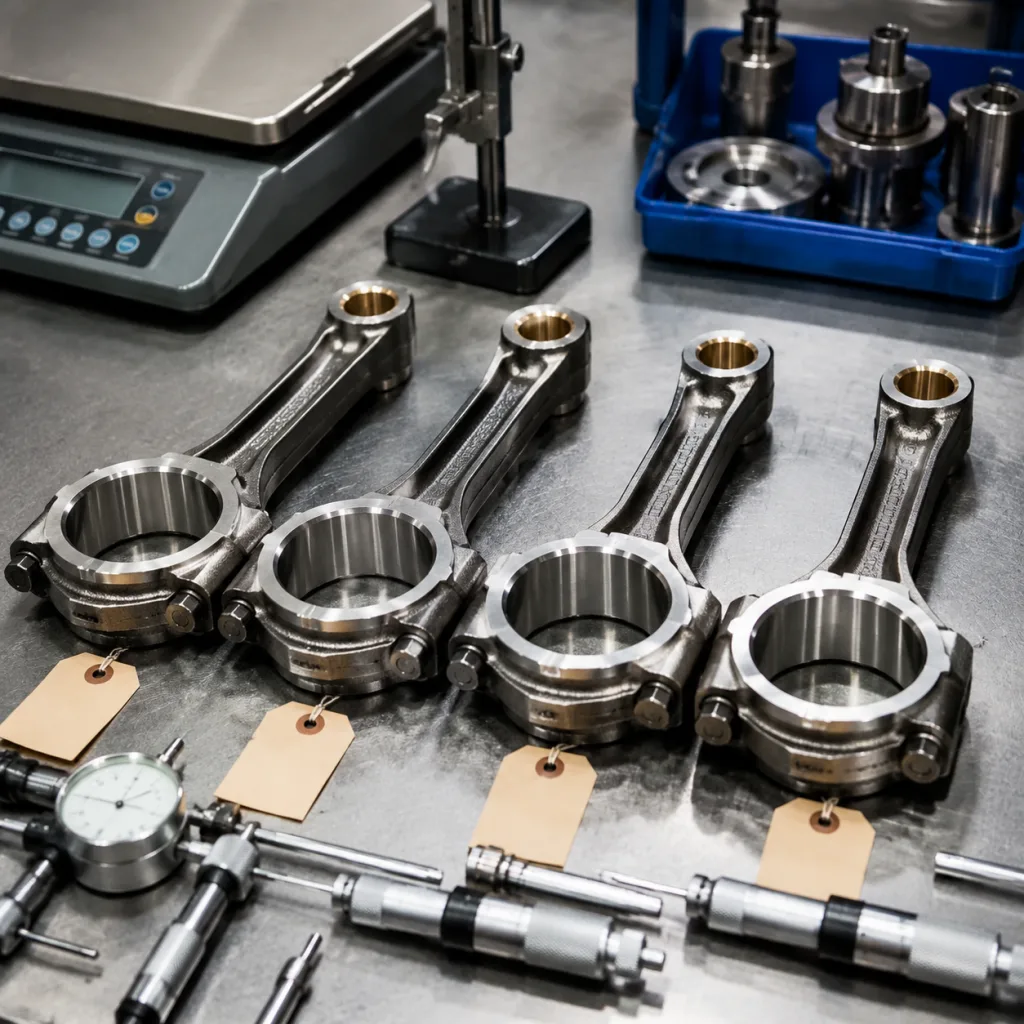
  • Calibration status of bore gauges, air gauges, CMM equipment, surface roughness testers, hardness testers and torque tools.
  • Gauge resolution appropriate to the tolerance, for example 0.001 mm or better for tight bore checks.
  • Control plan linkage to inspection records, reaction plans and operator work instructions.
  • First-off, in-process and final inspection frequency, including what triggers line stop or 100% sorting.
  • Non-conforming product isolation, rework approval rules and evidence of corrective action closure.
  • PPAP-style documentation where required by the buyer, including process flow, PFMEA, control plan, MSA and dimensional results.
  • Packaging controls to prevent mixed sets, surface damage or corrosion during export.

Environmental and substance compliance can also affect EU and UK importers. Buyers may request material declarations aligned with REACH (EC) No 1907/2006 where applicable to supplied parts and packaging, plus confirmation of rust-preventive oil and packaging material compliance for the target market. More detail on Driventus process governance is available through our quality system.

A Factory Audit Test: Trace One Carton Backward

Commercial Terms That Reveal Production Reality

MOQ and lead time are not just purchasing terms. They reveal whether the connecting rod supplier understands tooling status, forging batch size, machining setup, inspection workload and packing constraints. Treat a single flat MOQ with no explanation as a warning sign.

Separate the programme type before negotiating:

  • Existing aftermarket item: MOQ commonly 100–300 sets per part number when tooling and fixtures are active, with shorter sampling and lower engineering cost.
  • Stock-supported item: trial orders may be possible from available inventory, but repeat price should be based on the next production batch, not only stock clearance.
  • Low-volume special application: MOQ commonly 300–800 sets or a defined forging/machining batch because setup, heat treatment and inspection costs are spread across fewer parts.
  • New drawing or sample development: tooling review, drawing confirmation, sample validation and pilot batch before serial production, often with separate tooling or fixture charges.
  • Private-label packing: artwork approval, carton specification, barcode or label control and a packaging MOQ that may differ from the part MOQ.
  • Mixed-container programme: coordination across pistons, gaskets, pumps and other engine components to reduce freight cost and improve landed margin.

Lead times depend on raw material availability, forging capacity, machining slots, inspection requirements and export packing. Existing catalog items often ship in 30–45 days after deposit and packing approval when materials are available. New or inactive items may require 45–75 days for first production. New tooling or revised geometry can require 8–12 weeks before a validated pilot batch. Repeat orders are usually more stable when the buyer shares a rolling 3-month or 6-month forecast and freezes the first 4–6 weeks for production planning.

Price needs a specification behind it. Key drivers include steel grade, rod weight, forging yield, cap design, bush material, bolt grade, NDT level, weight-matching tolerance, inspection reporting and packaging. A quote that is 8–15% lower than competing offers may reflect a lighter specification, or it may mean missing inspection, lower-grade bolts, no NDT, looser weight grouping or simplified packing.

A practical RFQ should state annual volume, first-order quantity, target market, packing requirements, inspection expectations, Incoterms preference and whether samples must be supplied for local validation. Ask the supplier to price alternate quantities, such as 100, 300, 500 and 1,000 sets, so the cost break from setup and material purchasing is visible. For export costing, confirm whether the offer is EXW, FOB Ningbo or Shanghai, CIF destination port or DAP warehouse, and whether inspection reports, pallets, fumigation-free plywood cases, neutral boxes or private-label cartons are included.

The Approval File: What Belongs in It

A clean approval file prevents arguments after shipment. It also helps purchasing, engineering and quality teams approve the same source for the same reasons. For connecting rods, the file should focus on evidence that protects bearing fit, piston pin fit, engine balance and cap-joint reliability.

Recommended RFQ and approval package:

  • 2D drawing or approved sample reference, with revision level, datum scheme and critical characteristics marked.
  • Application list and engine code reference where available.
  • OE part-number cross-reference only when supplied by the buyer, using formats such as OE 06A… for fitment mapping.
  • Material certificate or material declaration, including steel grade, heat number and relevant chemical or mechanical data.
  • Dimensional inspection report for critical-to-function features, including big-end bore, small-end ID, centre distance, width, bolt-hole position and oil-hole condition.
  • Hardness and heat treatment record, with sample quantity, test location and acceptance range.
  • Surface finish record for big-end bore and small-end bush ID where specified.
  • Weight data for each rod or matched set, including total mass and big-end/small-end split if required.
  • Bolt specification, tightening method and torque-angle or stretch verification record.
  • NDT report where magnetic particle inspection or equivalent flaw detection is required.
  • Packing specification, inner protection method, carton quantity, gross weight, pallet plan and corrosion-protection period.
  • Batch traceability format and date-code method.

For first-article approval, request a minimum dimensional layout from 3–5 sample rods per cavity, die or machining fixture where applicable. For production shipments, a certificate of conformity can reference the purchase order, part number, batch number, quantity, inspection date, drawing revision and any agreed deviations.

If the buyer requires PPAP, define the submission level in the RFQ. Many aftermarket programmes only need a partial PPAP file. OEM or Tier-1 programmes may require a full Level 3-style package.

Driventus does not claim approval or endorsement by any vehicle manufacturer. OE and brand references are used only to identify fitment and dimensional equivalence. Driventus is an independent aftermarket manufacturer; brand names are referenced for fitment only.

The Approval File: What Belongs in It

How to Compare Two Shortlisted Suppliers

Once two or three manufacturers look technically possible, stop comparing brochures. Compare evidence. The best connecting rod supplier is usually the one that can explain its limits, show raw data and give realistic commercial assumptions.

Use this table during quotation review, supplier shortlisting or factory audit preparation.

Control point Typical working target Evidence to request
Steel grade and forging lotChemistry within mill certificate limitsMill certificate, incoming inspection record and lot ID
Heat treatmentHardness commonly 28–36 HRC, drawing-dependentFurnace chart, hardness results and batch ID
Big-end bore sizeOften held within ±0.005–0.015 mmCMM, air-gauge or bore-gauge report after final honing
Big-end bore roundnessCommonly ≤0.005–0.010 mmRoundness or multi-point bore measurement record
Small-end bush IDOften held within ±0.005–0.012 mmBore-gauge report and surface finish record
Centre distanceOften held within ±0.02–0.05 mmCMM report or dedicated fixture record
Rod weight matchingCommonly ±1–3 g per set, or per drawingMass data by rod and set grouping rule
Bolt preloadTorque-angle or stretch target per fastener designTorque audit, angle record or bolt stretch validation data
Crack and flaw inspection100% or sampled, depending on risk classMagnetic particle inspection or equivalent record

</tr></thead><tbody> </tbody></table>A simple scoring model can align purchasing and engineering: assign 30% to quality system and traceability, 25% to dimensional capability, 20% to commercial fit, 15% to delivery capacity and 10% to engineering responsiveness.

If two suppliers are close on price, favour the one that provides raw inspection data, clear MOQ assumptions, realistic lead times and a defined reaction plan for bore, weight or hardness deviations. For distributors, repeatability often beats a low trial price. For OEM and Tier-1 sourcing teams, audit openness, traceability discipline and corrective action response are usually decisive.

Frequently asked questions

Send drawings or samples, application data, annual volume, first-order quantity, target market, packing requirements and inspection expectations. If OE cross-references are used for fitment, provide them in the RFQ so the supplier does not infer brand-owned numbers. Include target tolerances, material grade, weight range, Incoterms and whether PPAP-style documents are required.

Yes. Driventus can review drawings, samples, material targets, weight requirements and packing needs for custom programmes. Sampling and production timing depend on tooling status, forging route, machining complexity and validation requirements. For new geometry, buyers should plan for drawing review, sample inspection, test feedback and pilot-batch approval before serial orders.

IATF 16949:2016 and ISO 9001:2015 are relevant quality management standards for automotive production control. Buyers may also request material declarations aligned with REACH (EC) No 1907/2006 for applicable markets. For engineering approval, ask for control plans, dimensional reports, material certificates, hardness results, traceability records and MSA or capability data where needed.

If you are qualifying a connecting rod source for distribution, repair-chain supply or an OEM programme, share your drawings, samples or application list and [request a quote](/contact.html).

Request a Quote
Evaluation item Acceptable baseline Stronger sourcing position
CertificationISO 9001:2015IATF 16949:2016 plus ISO 9001:2015, with product-line audit access
Dimensional controlFinal inspection reportControl plan, gauge R&R evidence, CMM capability and raw readings
Bore capabilitySupplier states tolerance can be met30-piece study showing stable big-end bore and small-end ID results
TraceabilityCarton label onlyBatch link from steel lot to forging, heat treatment, machining and finished set
SamplingVisual sample onlyDimensional report, hardness record, surface finish result and weight data
CapacityStated monthly outputLine capacity by process, bottleneck disclosure and realistic loading calendar
MOQ logicSingle MOQ without explanationQuantity breaks tied to forging batch, machining setup and packing MOQ
Export supportStandard invoice and packing listMarket-specific documents, pallet plan and consolidated shipment planning
Engineering supportFitment listDrawing review, manufacturability feedback and tolerance-risk comments