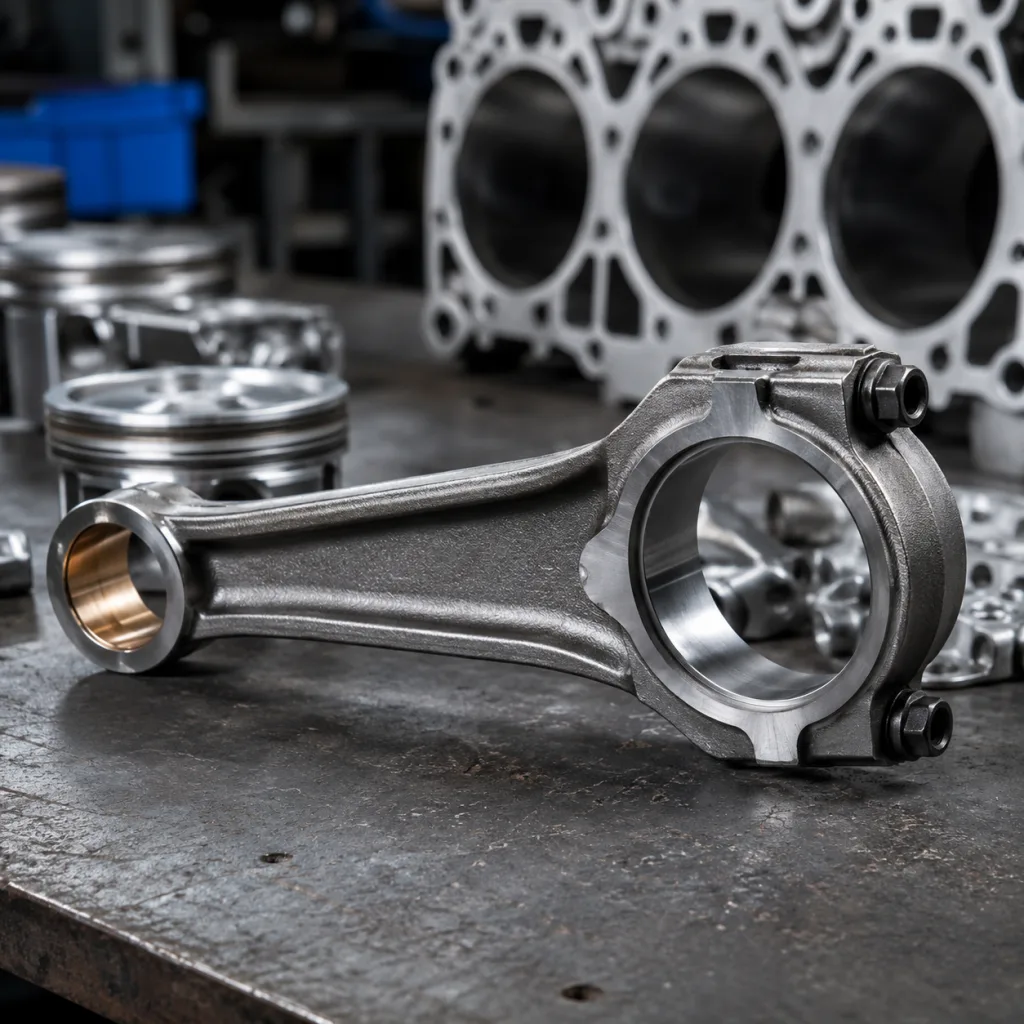
Procurement teams sourcing connecting rod seat components usually care less about catalog breadth and more about stable housing-bore geometry, repeatable cap location, traceable heat-treatment history, and predictable release timing. When a buyer searches for a **connecting rod seat OEM supplier**, the term itself can mean different things: the big-end bearing housing bore, the cap seating faces, or a complete machined rod-and-cap assembly. That ambiguity creates familiar sourcing trouble, including incomplete RFQs, quotations that are impossible to compare, and later disputes over inspection scope, warranty responsibility, or ownership of a dimensional failure.
A factory that can forge and machine steel parts is not automatically a source that can hold big-end bore size and roundness after cap assembly, control housing bore under specified bolt preload, or preserve matched sets through washing, rust prevention, and packing. In this category, the real screening criteria are process capability, gauging discipline, MOQ logic, engineering change control, and lot-level traceability. This checklist is designed for sourcing engineers, import managers, quality teams, and category buyers who need to qualify a connecting rod seat OEM supplier, compare quotes on equal terms, and lower launch risk before nomination.
Define the exact scope before sending RFQs
Most RFQ problems start before pricing ever begins. One supplier assumes a semi-machined forging, another prices a finish-bored rod with cap and bolts, and a third quotes only the cap seating faces. On paper those offers may share the same part number, but commercially and technically they are not comparable.
Before requesting pricing, define the part and process boundary in writing:
Whether the scope is the big-end housing bore only, the cap seating faces, a fully machined rod and cap, or a complete assembly with bolts, nuts, bushing, and weight grading
2D drawing with GD&T to ISO 1101, surface texture callouts to ISO 4287/4288 where relevant, revision level, and any approved deviation list
Which dimensions must be verified in the assembled-and-torqued condition, especially big-end bore diameter, roundness, cylindricity, side width, bore taper, and centre-to-centre length
Bolt specification, tightening condition, and inspection condition, because a housing bore measured at hand-snug condition is not equivalent to a bore measured at final torque or torque-angle
Material grade, forging or powder-metal route, required grain flow or minimum density, heat-treatment window, hardness range, and any metallographic acceptance criteria
Critical features beyond the big end, such as small-end bush ID, wrist-pin bore, bolt seat perpendicularity, oil hole location, chamfers, edge-break, and burr limits
Validation plan covering dimensional report, hardness, microstructure, magnetic particle inspection or other crack detection, fatigue testing where required, and any first-article or PPAP-style submission level
Annual volume by SKU, release pattern, target Incoterm, destination country, and whether MOQ is per shipment, per heat-treatment batch, per machining lot, or annual blanket volume
Packaging standard, VCI or oil rust-prevention requirement, barcode format, lot traceability, and how rod-and-cap matching must be preserved through packing and shipment
It also helps to state what is *not* included. If bolts are customer-supplied, bushing installation is excluded, balancing happens downstream, or final honing will be done at the buyer site, spell that out. Buyers should also confirm whether the supplier is quoting to a frozen production drawing or to a development print that may still change after sample review.
If you are screening market options, start from our catalog or the relevant engine components page, then narrow the RFQ to the exact machined surfaces and assembly status you need. The tighter the RFQ, the cleaner the cost comparison and the fewer surprises after sample approval.
Audit process capability at the big end
Certificates alone will not tell you whether cap alignment stays stable after bolt preload, whether bearing shell crush is consistent from lot to lot, or whether the finished housing bore still holds size after heat-treatment distortion. To judge that, buyers need to review the real manufacturing route: raw material receiving, forging, trimming, rough machining, cap split or fracture split, bolt seat machining, heat treatment, cap assembly, finish boring or honing, washing, final gauging, and packing.
Typical audit checkpoints
Checkpoint
Evidence to request
Typical buyer target*
Big-end bore diameter, roundness, and cylindricity
Cpk/Ppk data, air-gauge records, gauge calibration, MSA or gauge R&R study
Drawing compliance; many programs control housing bore within about +/- 0.005 to +/- 0.015 mm, with roundness often <= 0.003-0.005 mm
Cap-to-rod joint integrity
Split-face flatness report, serration or fracture-split inspection record, contact-pattern check
No visible mismatch step; stable bore geometry after specified tightening condition
Commonly +/- 0.02 mm or tighter, depending on engine family
Small-end bush ID or pin bore
Final honing records, surface-finish report, bushing press-fit control
Size and geometry to print; Ra commonly around 0.2-0.8 um where honing is specified
Heat treatment and crack detection
Furnace batch records, hardness traverse, metallography, magnetic particle inspection where required
Hardness and microstructure to print; no unreviewed indications
Weight grading
End-weight and total-weight report, sorting method, lot records
Typical service or aftermarket grouping may be 2-4 g per set; tighter grouping may be required by print
</tr></thead><tbody> </tbody></table>*Targets vary by engine family and must follow the released drawing and validation plan.
On the shop floor, look for signs of controlled serial production rather than carefully staged sample work:
Rods and caps should be serialized, match-marked, laser-marked, or physically kitted immediately after splitting so the pair cannot be mixed later
The final housing bore should be measured with a mastered air gauge, bore gauge with defined MSA, or equivalent system that the quality team can explain and defend
Tightening tools should be calibrated and linked to lot records, especially where final bore size depends on clamp load
Rework limits should be documented; operators should not decide case by case whether a bore can be re-honed, a cap can be swapped, or a pair can be reclassified
Washing, rust prevention, and packing should preserve identification marks and keep matched components together
A capable connecting rod seat OEM supplier should also be able to walk you through its machining sequence clearly. For example, whether the housing bore is semi-finished before heat treatment and finish-honed after cap assembly, how distortion is compensated, and whether the bore is checked 100% or by statistical sampling. If the supplier cannot show stable data across multiple lots, a wall of certificates does not do much to reduce sourcing risk.
Check MOQ, tooling and lead-time logic
MOQ and lead time usually have more to do with the process route than with the drawing alone. A finish-machined rod from an existing forging die behaves very differently from a new forged-steel design, a powder-metal route, or a program that adds special bolts, bushings, or weight-grading requirements. Buyers should expect different commercial logic for forgings, semi-finished parts, and fully validated matched sets.
For established aftermarket references, many Asian factories quote roughly 500-1,000 pieces per SKU for repeat production. Some high-volume families, however, run in larger economic batches because forging, heat treatment, and honing setup costs need to be spread across the lot. A very low MOQ may be real, but it can also mask a high unit premium, mixed-lot production, or long replenishment intervals after the first shipment.
Ask suppliers to break the quotation into visible cost elements:
Tooling, fixtures, gauges, air-gauge masters, and sample cost
Forging blank or powder-metal compact cost
Heat treatment, shot blasting, crack detection, and cleaning
Machining, honing, balancing, and final inspection cost
Bolts, nuts, bushings, or other bought-out components
Export packaging, pallet standard, labels, and corrosion protection
Buyers should also clarify the commercial logic behind the MOQ:
Is the MOQ per SKU, per forging batch, per machining lot, per shipment, or per annual blanket order?
Does the supplier hold finished inventory, work-in-process, or only raw forgings?
Are fasteners and bushings sourced on the same lead time, or do they create a separate bottleneck?
Who owns the forging die, fracture-split tooling if applicable, and inspection fixtures if the program moves later?
What happens to piece price if releases become more frequent but smaller?
A realistic timeline is often 4-6 weeks for samples after drawing approval when tooling already exists, then around 30-45 days for repeat production once samples are accepted. If a new forging die, new fixtures, new gauges, or additional validation are required, 8-12 weeks for tooling and samples plus 45-60 days for serial production is generally more believable. Faster promises should be backed by machine-capacity data, subcontractor lead times, and heat-treatment capacity from the audit, not just by sales claims.
For critical programs, ask exactly what sample stage you are receiving. A part machined from an existing blank, a soft-tool sample, and a serial-process sample do not carry the same risk profile. The safest quotation from a connecting rod seat OEM supplier is the one that makes those assumptions explicit.
Require lot traceability and compliance documents
Traceability matters more than brochure language. For each lot, request a document pack that links raw-material heat, forging batch, heat-treatment furnace load, machining date, inspection record, and carton or pallet ID. If a field failure shows up months later, that genealogy is what makes containment, root-cause analysis, and a defensible warranty discussion possible.
A supplier serving OE-adjacent or large distributor programs should be ready to show a documented quality system aligned with IATF 16949:2016 or, at minimum for lower-complexity aftermarket supply, ISO 9001:2015. The certificate is only the starting point. Buyers should also verify that engineering change control, nonconformance handling, calibration, document revision control, and sub-supplier management work in daily practice.
The shipment file should normally include:
Material certificate with steel grade and heat number, and if required a 3.1-style certificate format agreed in advance
Dimensional report on critical characteristics with actual values, sample size, measuring method, and drawing revision reference
Hardness and microstructure record, plus decarburization or metallography results where specified
Crack-detection results, such as magnetic particle inspection, where required by the drawing or validation plan
Coating or chemical compliance statement, including REACH (EC) No 1907/2006 and other customer-specific substance declarations where relevant
Sampling-plan reference, commonly aligned to ISO 2859-1 for incoming inspection agreements
Any concession or deviation disclosure approved before shipment
Beyond the shipment file, define traceability rules early in the RFQ. Buyers should specify how lots are coded, whether rod and cap pairs require individual serialization, how long records must be retained, and what labels must appear on inner and outer packaging. For higher-control programs, it is reasonable to require lot-level linkage from raw material through finished cartons, with retention periods often set at several years according to customer policy.
Change control deserves the same attention. If the supplier changes steel source, forging source, heat-treatment subcontractor, bolt supplier, tool location, machining line, or inspection method, that should trigger customer notification and approval rules. If you need PPAP-style documentation, annual layout inspection, or retained samples, define the submission level and retention period before SOP rather than after the first shipment issue.
A disciplined connecting rod seat OEM supplier should be able to pull a lot record quickly and show the exact relationship between material heat, bore inspection, and shipped pack IDs without having to reconstruct it manually.
Use a manufacturing partner when the drawing is still moving
When drawings are incomplete, validation criteria are still under discussion, or the same base rod needs market-specific machining, a manufacturing partner is usually a better fit than a pure trading company. The practical question is not whether the source can produce one acceptable sample. It is whether the source can stabilize critical geometry, document the process, and repeat that result at serial volume across multiple revisions.
A capable partner for this category should be able to:
Review the drawing and flag conflicts between datums, tightening condition, inspection method, and final functional geometry
Advise on process route, such as forged steel versus powder metal, conventional split versus fracture split, and when bushings or bought-out bolts should be integrated
Build prototype or pre-production samples using a route that can realistically transfer into serial production
Manage revision history, validation evidence, and traceability when dimensions or machining content change during development
Support variant programs where different markets require different bolts, bushing materials, weight groups, packaging, or labeling
This matters because moving drawings create hidden risk. A tolerance that looks simple on paper may force a different honing strategy, a different tightening station, a different fixture datum, or tighter control of heat-treatment distortion. A supplier that participates in DFM review can raise those issues early, before the program is locked into an unrealistic piece price or launch date.
For a meaningful technical review, send the latest drawing, target OE-equivalence, annual demand, validation plan, and any known open issues, then request a quote. If the supplier also offers custom manufacturing, ask how they handle drawing changes, sample approvals, and matched-set control between prototype and series production. Driventus is an independent aftermarket manufacturer; brand names are referenced for fitment only.
Frequently asked questions
Not in every aftermarket program, but it is a strong indicator that the factory runs structured control plans, traceability, change management, and corrective action. For OEM or Tier-1 supply, it is often expected or strongly preferred. For lower-volume aftermarket sourcing, ISO 9001:2015 may be acceptable if the process audit, inspection evidence, and validation package are strong. If a supplier is not IATF-certified, buyers should compensate by requesting deeper proof of process control, including MSA, lot traceability, calibrated gauging, and documented customer-notification rules for process changes.
MOQ depends on whether the forging die already exists, the machining route, and whether bolts, bushings, balancing, or crack detection are included. Existing aftermarket references may start around 500-1,000 pieces per SKU, but the true economic batch may be higher if forging and heat treatment are run in larger lots. A new forging program usually needs a higher MOQ or a separate tooling charge because die cost, heat-treatment batch economics, and setup time drive the numbers. Buyers should also confirm whether MOQ applies to forgings, machined parts, or final matched rod-cap sets, because those are different commercial assumptions.
In most cases, yes. The big-end housing bore is created or finalized after the cap is paired and tightened, so interchangeability should not be assumed unless the design and process specifically allow it. Buyers should confirm how the factory preserves rod-cap matching through splitting, machining, washing, packing, and shipment, and whether each pair is serialized, match-marked, or otherwise controlled. If the supplier cannot explain that system clearly, the risk of bore mismatch, bearing crush variation, and warranty failures rises quickly.
If you are evaluating a connecting rod seat OEM supplier, send the drawing, annual volume, target pack specification, validation requirements, and any current quality concerns through [request a quote](/contact.html) for technical review.