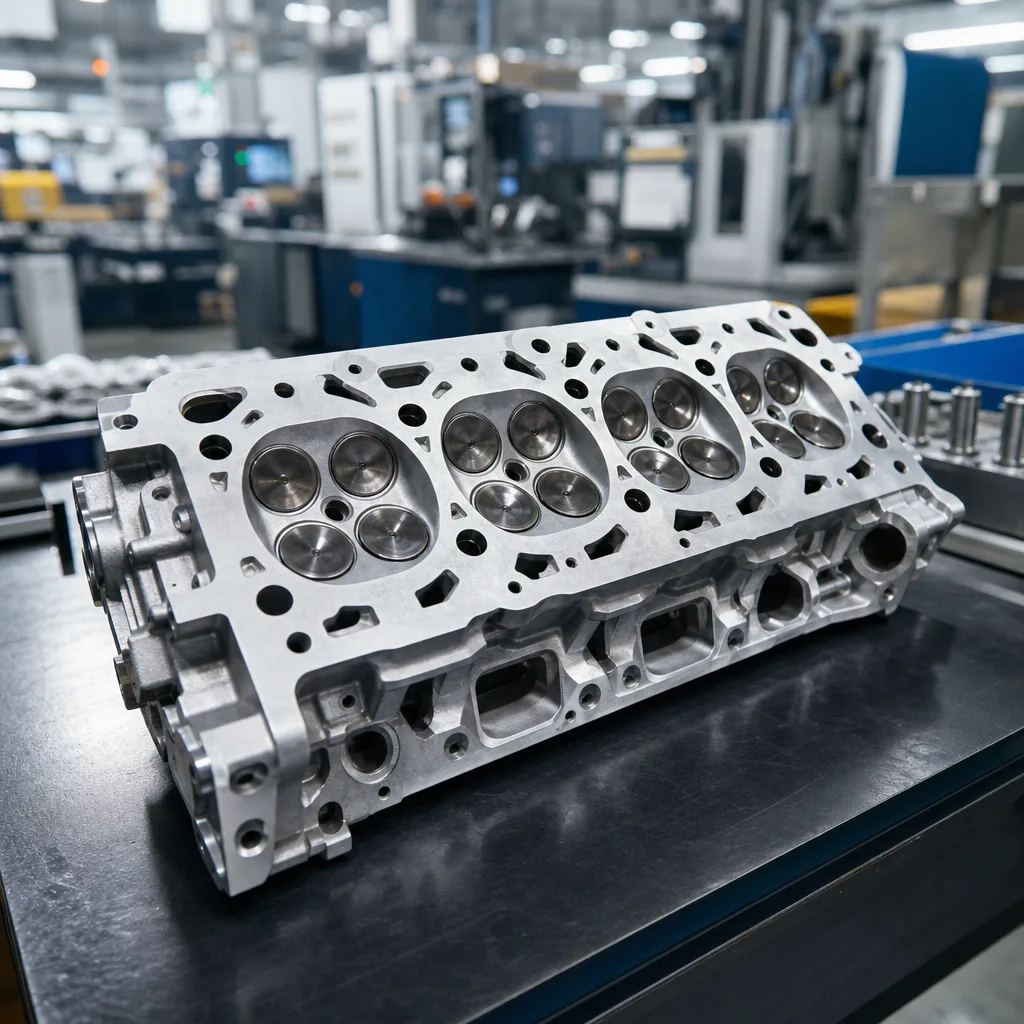
Connecting Rod Seat Manufacturer China: Sourcing Guide
Choosing a connecting rod seat manufacturer in China should come down to capability, repeatability, and records that stand up to audit—not simply the lowest unit price. In an engine programme, the rod big-end seating interface has to remain stable under cap-bolt clamp load, preserve housing-bore roundness after finish machining and assembly, and provide inspection data that can be traced by heat, batch, operation, and shipment lot. A low quotation quickly loses value if the housing bore moves after torque, the cap split face varies, or the supplier cannot show how material, heat treatment, machining, and final gauging are controlled.
Before annual volume is discussed, buyers usually ask for the alloy route, heat-treatment specification, CNC machining capability, gauge plan, Cp/Cpk evidence for critical characteristics, and sample approval data. Driventus is an independent aftermarket manufacturer; brand names are referenced for fitment only. A suitable supplier should support catalogue sourcing, drawing-based custom work, controlled revision management, and export packaging for distributors, OEM/Tier-1 supply chains, and repair networks. This guide outlines the checks procurement teams should make before awarding business to a connecting rod seat manufacturer China sourcing partner.
What buyers should verify first
Start with the drawing and application data, not the catalogue photo. A connecting rod seat is a precision load-bearing interface, so the first review should identify the functional characteristics that affect cap location, bearing crush, oil-film stability, and service life. A credible supplier can explain the material grade, forming route, heat treatment, rough and finish machining sequence, torque-state inspection method, and the control points used to keep big-end geometry stable under clamp load.
For catalogue purchasing, review our catalog and the broader engine components range to confirm the part family before asking for price. For custom sourcing, send a complete drawing pack with GD&T, material standard, heat-treatment requirement, coating or oiling specification, assembly torque, mating-part information, and acceptance criteria. If only a sample is available, the supplier should propose reverse measurement, material verification, master-sample approval, and a controlled pilot run before serial production.
Key checks:
- Big-end housing bore size, bore position, centre distance, and cap-to-rod alignment to the released drawing.
- Roundness, cylindricity, parallelism, perpendicularity, and split-face flatness checked in the specified condition, ideally after cap bolts are tightened to the drawing torque.
- Housing-bore stability after cap-bolt tightening and, where relevant, repeated assembly/disassembly checks.
- Bearing-seat surface finish and edge condition; buyers commonly specify Ra values rather than visual acceptance only.
- Burr control at oil passages, chamfers, split lines, bolt holes, and dowel or locating features.
- Thread quality, bolt-seat squareness, counterbore condition, and proof of go/no-go gauge use where applicable.
- Lot traceability from raw material heat number through machining, finishing, inspection, packing, and shipment.
- Compatibility with the buyer’s gauge plan, CMM programme, functional checking fixtures, and AQL or 100% inspection requirements.
Procurement should also confirm MOQ, sample lead time, serial-production lead time, payment terms, Incoterms, and whether the factory will support a remote or on-site audit. A strong supplier will share a process flow diagram, control plan, inspection template, gauge list, packaging specification, and change-control procedure early in the review. That makes supplier comparison more objective and moves the conversation away from headline price toward manufacturing risk, launch readiness, and lot-to-lot repeatability.
Materials, machining, and tolerances
Material and machining decisions need to match the engine load case, duty cycle, operating temperature, and the buyer’s drawing standard. A connecting rod seat manufacturer in China should not treat the part as a generic machined component. The full chain matters: raw material condition, heat treatment, rough machining, stress relief if specified, finish machining, deburring, surface protection, and final inspection.
For most programmes, procurement should request:
- Mill test certificate or material certificate with grade, chemistry, mechanical properties where specified, and heat-number traceability.
- Defined manufacturing route: forged steel, cast iron, powder-metal, or bar-stock machining depending on the drawing and load requirement.
- Controlled heat treatment with batch records, furnace or lot identification, hardness range, sampling quantity, and test method such as HRC, HRB, or HBW as specified.
- CNC milling, boring, honing, drilling, tapping, and facing capability with in-process checks at roughing, semi-finish, and final operations.
- Dedicated fixtures to control cap alignment, split-face location, bore position, and repeatability under clamping load.
- CMM final inspection for GD&T characteristics, supplemented by air gauges, bore gauges, thread gauges, and functional fixtures where production volume justifies them.
- If specified, shot peening, phosphate, black oxide, anti-rust oil, vapour-phase corrosion inhibitor packaging, or another coating route with validation records.
The most important tolerances are often system-level relationships, not isolated dimensions. Buyers should review how the supplier controls housing-bore geometry after torque, centre distance consistency, split-line registration, bearing-seat finish, bolt-hole position, and perpendicularity between functional faces. The inspection plan should also define the measurement condition, including whether the part is measured free-state or assembled with cap bolts tightened to a specified torque and lubricant condition. Without that detail, inspection data may look acceptable but still fail to predict engine assembly performance.
As a practical benchmark, procurement teams often expect critical housing-bore and centre-distance tolerances to be controlled in the micron range according to the released drawing, with capability studies on special characteristics rather than only first-piece approval. If Cp/Cpk is required, agree the target before sampling; many automotive buyers use Cpk ≥ 1.33 for stable production characteristics and higher targets for safety or critical features. Surface-finish requirements should be numerical, for example Ra on bearing seats and split faces, instead of relying on appearance inspection.
The supplier should also define inspection frequency for critical dimensions, reaction plans for out-of-control trends, tool-wear offset rules, and the permitted rework path. Rework needs to be documented and traceable, especially when additional material removal could affect bore geometry, bearing crush, or surface integrity. If the rod seat is being developed from an existing sample, custom manufacturing should include dimensional confirmation against the agreed master part before pilot release. For a new drawing, the supplier should provide manufacturability feedback before tooling, fixture, or gauge investment so tolerance risks can be addressed before sampling.
Supply routes compared
Different buying routes suit different programmes. A distributor replenishing fast-moving aftermarket part numbers may value catalogue stability, interchange confirmation, and export-ready packing. An OEM or Tier-1 engineering team may need drawing control, PPAP-style documentation, capability data, and formal change management. A repair-network buyer may prioritise smaller batches, mixed SKUs, and consistent carton labelling. The right route depends on annual volume, programme risk, validation burden, and the level of engineering control required.
| Supply route | Best for | What to confirm | Main trade-off |
|---|---|---|---|
| Catalogue part | Fast replenishment, established applications, and stable aftermarket demand | Dimensions, fitment, interchange data, pack size, MOQ, stock status, and current revision | Less flexibility on drawings, materials, and engineering changes |
| Drawing-based build | New programmes, dimensional correction, and controlled replacement parts | Drawing revision, GD&T, material, torque-state inspection, tooling or fixture ownership, sample approval, and lead time | Higher setup effort and longer qualification time |
| Contract manufacturing | Repeat orders at scale, private-label supply, and planned production programmes | Forecast, audit access, quality agreement, PPAP or FAI level, change control, packaging standard, and safety stock | Requires tighter planning and clearer demand visibility |
| Sample-based development | Legacy parts, discontinued components, and reverse-engineering projects | Master sample condition, 3D scan or CMM report, material verification, heat-treatment check, and buyer sign-off standard | Higher risk if the original sample is worn, modified, or incomplete |