Connecting Rod Porsche Manufacturer China: Sourcing Guide
Procurement teams looking for a connecting rod Porsche manufacturer China typically have three priorities: confident fitment, repeatable quality, and a supply base that will not drift after approval. For engine rebuilders, aftermarket distributors, and OEM-linked buyers, the common failure points are dimensional mismatch, uneven heat treatment, poor lot traceability, and undocumented process changes. A rod can look right in photos and still fail a programme if center-to-center length, big-end bore geometry, small-end bore alignment, bolt seating, surface finish, or end-to-end weight balance moves between lots.
Driventus produces engine and powertrain components in Taizhou, Zhejiang, under IATF 16949:2016 and ISO 9001:2015 systems. We support B2B buyers in the EU, UK, US, Canada, Australia, and Brazil. Driventus is an independent aftermarket manufacturer; brand names are used for fitment reference only. This guide outlines what sourcing teams should check before RFQ, how to read supplier claims, and which documents to request for audit and sample approval. If you are cross-referencing OE 06A107065 or a similar application, base decisions on dimensional data, material records, and validation results rather than sales language.
What buyers should verify before sourcing
Before you shortlist a connecting rod Porsche manufacturer in China, define the application boundary in writing. Confirm the OE cross-reference, engine family, model year range, piston pin diameter, crank journal diameter, bearing shell requirement, bolt specification, and any known supersession history. If your team is working from a used sample, record whether it is an original part, an aftermarket replacement, or a modified rebuild component. That distinction matters: a copied sample may include wear, previous machining, or nonstandard weight correction.
Set your own incoming inspection plan and align it with published standards where relevant. At minimum, procurement and engineering teams should request a controlled specification covering center-to-center length, big-end bore diameter and roundness, small-end bore diameter, bore alignment, side clearance width, surface roughness, weight range, and bolt thread details. On controlled aftermarket programs, buyers often ask for center-to-center length within ±0.02 mm, bore roundness and taper within 0.01-0.02 mm, and weight matching within 1-2 g. The final limits, however, should come from the engine build requirement. Ask whether the supplier checks these features with calibrated micrometers, bore gauges, CMM equipment, air gauges, or dedicated fixtures, and confirm measurement system capability and calibration intervals.
For corrosion resistance and market access, ask whether materials, coatings, marking inks, packaging materials, and any supplied hardware are aligned with REACH (EC) No 1907/2006 requirements for restricted substances. For validation, request evidence of durability testing, including load cycling, fatigue evaluation, bolt clamp-load verification, and dimensional stability after heat treatment. A useful supplier file links the drawing, material batch, heat treatment lot, machining batch, inspection report, and shipment lot without relying on verbal assurance.
Commercial readiness should be checked before samples are ordered. Confirm the supplier's export experience, Incoterms, HS code handling, packaging method, label format, pallet configuration, warranty process, and claim response timing. If the rod will be sold through distributors, ask for neutral packaging, visible batch coding, and carton protection that prevents bore dents, thread contamination, and mixed-lot confusion.
If your team needs a broader component shortlist, review our catalog and the related engine components category before issuing an RFQ.
Specification points that affect fit and durability
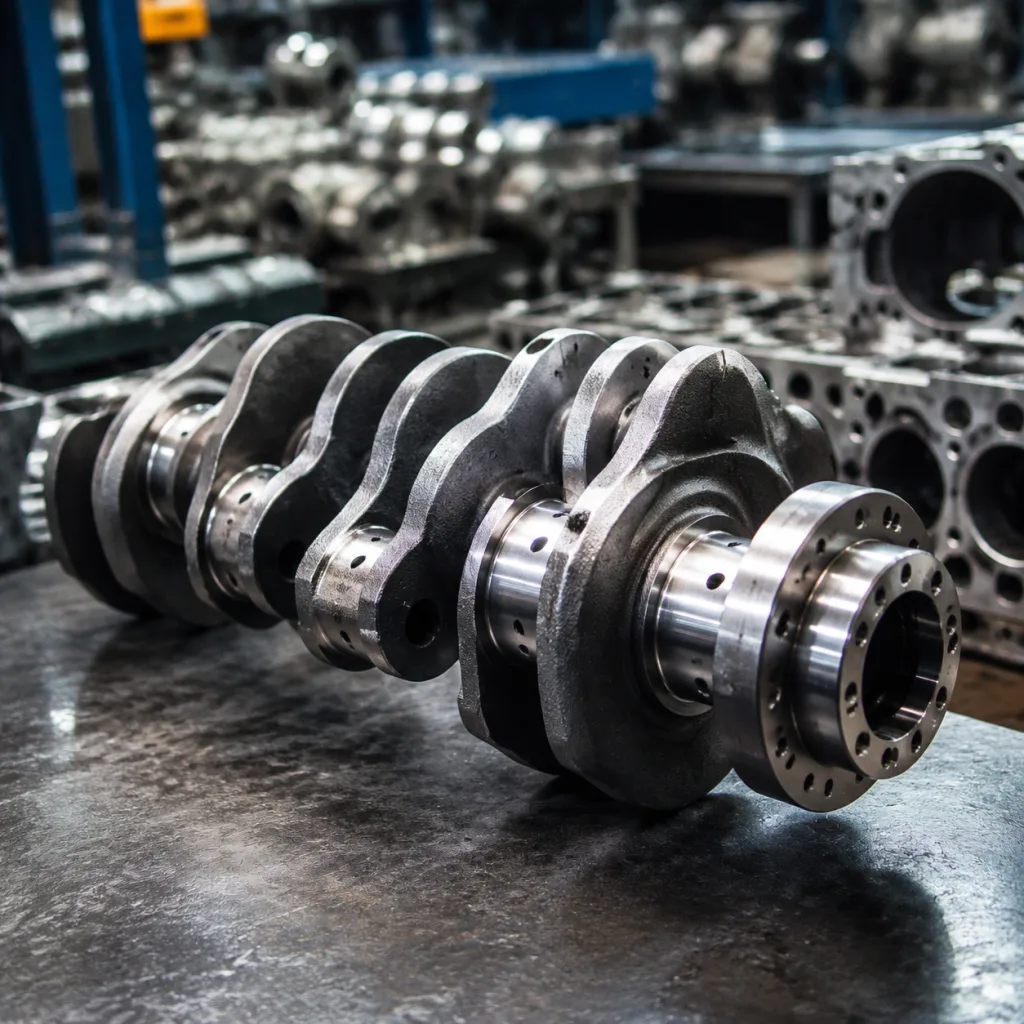
Connecting rods are tolerance-sensitive engine parts, so an RFQ needs more than a part number. The critical fitment dimensions include center-to-center length, big-end bore size, small-end bore size, big-end width, pin-end width, bearing tang location, bolt diameter, thread pitch, and cap joint geometry. Even small variation can affect bearing crush, oil clearance, piston deck position, or side clearance. For Porsche-related aftermarket sourcing, these details should be controlled through drawings, sample approval, and repeatable inspection rather than catalog descriptions alone.
Material and heat treatment carry the same weight as dimensions. Ask whether the rod is forged steel, powder metallurgy, or another specified construction, and request the actual material grade instead of a generic phrase such as high strength steel. The supplier should provide material certificates, hardness results, heat treatment records, and evidence that the process achieves the required strength without causing bore distortion or cap mismatch. A typical control window for forged steel rods is a hardness band defined on the drawing or control plan and often verified by heat lot. If the supplier cannot state that band, the process is not yet well controlled. If shot peening, surface treatment, or anti-corrosion oil is used, confirm the process parameters and whether they are applied before or after final machining.
Fastener control deserves its own review because rod bolts carry high cyclic load. Confirm bolt grade, coating, thread form, seating surface, recommended torque method, and whether torque-angle or stretch measurement is required during assembly. If bolts are supplied with the rods, they should be traceable as a matched hardware lot. If buyers will use their own bolts, the supplier should confirm compatibility with the cap design and clamp-load assumptions. For performance applications, preload or stretch data is often more useful than torque alone, since torque can vary with thread lubrication and friction scatter.
Published standards should be visible in the supplier file. IATF 16949:2016 supports process control, corrective action, production part approval discipline, and traceability. ISO 9001:2015 supports document control, management review, internal audit, and supplier management. For export programmes, ask how the supplier manages restricted substances, customer-specific requirements, and documentation retention for markets including the EU, UK, US, Canada, Australia, and Brazil.
Write inspection expectations into the purchase file. Common checkpoints include 100% visual inspection, key-dimension sampling, hardness sampling by heat lot, weight grouping, bolt thread checks, bore roundness checks after bolt tightening, and final packaging inspection. For higher-risk programmes, ask for process capability data such as Cpk on critical dimensions, and agree in advance which dimensions require containment if a deviation is found.
Comparing supplier options in China
Chinese suppliers vary widely in volume capacity, tolerance control, and validation depth. Compare them side by side before shortlisting, and separate a fast quotation from proven manufacturing capability. A low unit price can become expensive quickly if the supplier cannot explain its forging source, heat treatment control, inspection method, or corrective action process.
| Supplier type | Typical strength | Main risk | Best use case |
|---|---|---|---|
| Trading company | Fast quotation and broad sourcing reach | Limited process control visibility and weak batch traceability | Spot buying, catalog parts, low complexity |
| Small machine shop | Flexibility and quick machining changes | Capacity limits, outsourced processes, inconsistent documentation | Prototype, engineering trial, low volume |
| Integrated manufacturer | Process control, tooling ownership, inspection discipline | Longer qualification cycle and more formal sample approval | Serial supply, audit-led sourcing, distributor programmes |