Connecting Rod Opel Manufacturer China: Sourcing Guide
A search for a connecting rod Opel manufacturer China should not end with a photo match or an OE-number claim. For B2B buyers, the risk sits in repeatability: metallurgy, heat treatment, bore geometry, cap alignment, bolt control, corrosion protection, and whether the same specification can be supplied again six months later. Engine rebuilders, distributors, and OEM-linked aftermarket programmes need proof that the rod fits the intended engine family and survives normal audit scrutiny. Driventus is an independent aftermarket manufacturer; brand names are referenced for fitment only. We manufacture engine and powertrain components in Taizhou, Zhejiang, and supply B2B customers across the EU, UK, US, Canada, Australia, and Brazil. This guide gives procurement and quality teams a practical way to judge Chinese connecting rod suppliers before placing an order: what to specify, what can go wrong, which documents to request, and how to structure MOQ, lead time, validation, and custom manufacturing decisions.
Start With Fitment: What Must Match Before Price Matters
Opel fitment is not a broad label. It is a controlled match to a specific engine family, displacement, bore/stroke combination, piston pin diameter, crankpin journal size, and OE geometry. A rod that looks similar can still be wrong by enough to create bearing wear, piston height problems, imbalance, or assembly delays.
Before comparing quotations, build one shared fitment file for engineering, purchasing, and quality. It should include the exact engine code, OE reference where available, centre-to-centre length, big-end and small-end bore, beam section, cap design, bolt thread, bolt grade, and fastener tightening method.
When a supplier uses OE cross-reference data, treat it as a dimensional and application reference. It does not mean brand approval, an authorised supply relationship, or permission to imply OE endorsement. That distinction should be clear in RFQs, catalogue listings, packaging copy, and customs documents. Driventus is an independent aftermarket manufacturer; brand names are referenced for fitment only.
Keep these data points together in the RFQ pack:
Engine code, displacement, fuel type, and production year range
OE part number cross-reference, when available
Centre-to-centre length, checked from bore axis to bore axis
Big-end bore, small-end bore, and piston pin diameter
Crankpin journal size and bearing shell reference, where known
Rod cap style, bolt thread, bolt length, and tightening specification
Weight class or balance range, often controlled within 2 g to 5 g per set when specified
Surface finish, shot peening requirement, and anti-rust packaging method
Material Route Comparison: Where Cost, Fatigue Margin, And Repairability Split
A connecting rod quotation is incomplete until the supplier states the material grade and production route. Broad phrases such as forged steel or OE-equivalent are not enough. The right route depends on peak cylinder pressure, engine speed, production volume, cost target, machining allowance, and the expected service interval.
Construction
Typical use
Main advantage
Main trade-off
Forged steel, such as 40Cr, 42CrMo, C70S6, or equivalent grades
High-load applications and broad aftermarket coverage
Strong fatigue performance, good machining allowance, and repair flexibility
Higher material and machining cost
Powdered metal
OE-style high-volume production
Consistent near-net shape, stable weight, and repeatability
Less flexible for resizing and some rebuild workflows
Fracture-split
OEM-style cap alignment
Accurate cap location and repeatable assembly
Requires controlled handling, matched caps, and stricter process discipline
Cast steel / iron variants
Low-cost replacement programmes
Lower unit cost and simpler sourcing
Lower fatigue margin and narrower suitability range
</tr></thead><tbody> </tbody></table>Ask the supplier to confirm raw material grade, heat-treatment route, hardness target, and any secondary process such as shot peening, bushing insertion, cap grinding, or final honing. For forged rods, buyers commonly request quenching and tempering records, hardness results in the approximate 28-36 HRC range where applicable, and evidence that decarburisation, cracks, folds, and forging laps are controlled.
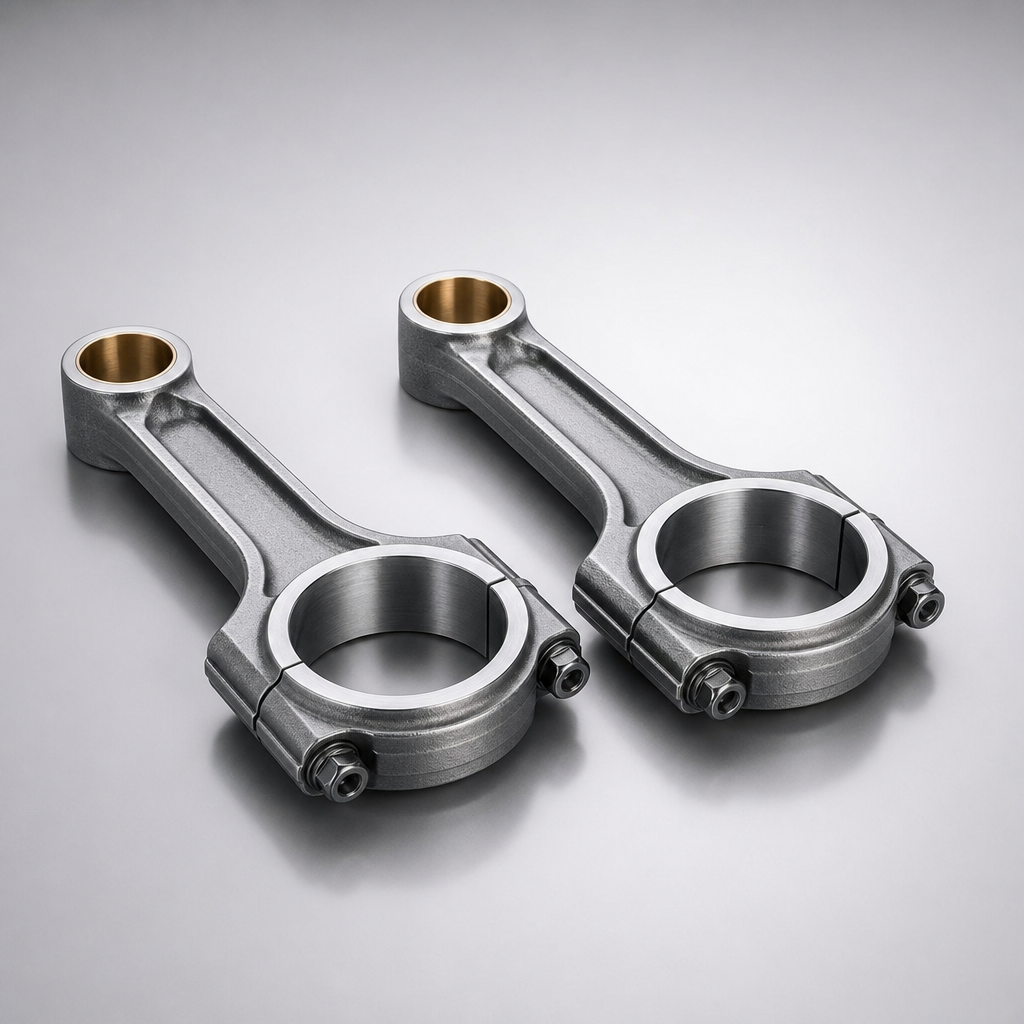
For bushed small ends, check whether the supplier uses bronze alloy bushings and whether the final ID is honed after press fitting. That detail matters. A pressed bushing without final ID control can pass a visual check and still create pin clearance problems during assembly.
If a rod is described as OE-equivalent, request hardness data, material traceability, and evidence that fatigue-related process controls are monitored. This is where a documented quality system carries more weight than catalogue language.
For custom engine programmes or private-label lines, custom manufacturing is the right route when the standard catalogue does not cover the required geometry, load target, material route, or packaging specification.
Spec Deep-Dive: Bore Geometry, Weight, Bolts, And Surface Finish
Connecting rods often fail procurement review because the datasheet is too vague. A usable supplier file should show nominal dimensions, tolerance bands, inspection method, measuring equipment, and the condition under which the feature is measured.
Big-end bore is the classic example. It should be checked after the cap is assembled with the specified bolts and torqued by the approved method. An unassembled cap measurement does not represent the working bore.
Control these features before approving a supplier:
Centre-to-centre length, often within +/-0.02 mm to +/-0.05 mm depending on the drawing
Big-end bore after torquing, commonly held in a 0.010 mm to 0.025 mm total tolerance band for aftermarket programmes
Small-end bore or pin bush diameter, usually tighter when the bushing is final honed
Rod twist and bend, checked in mm per 100 mm or by dedicated fixture limits
Weight variation between matched sets, often 2 g to 5 g when balancing is specified
Fastener torque, torque-angle, or bolt stretch method, if applicable
Bearing seat surface finish, defined by Ra value rather than appearance
Cap alignment, parting-face condition, and cap-to-rod matching marks
Typical values depend on engine family and drawing requirement. In many aftermarket programmes, big-end and small-end bores are controlled within micrometre-level limits, while rod-to-rod mass matching is managed in grams. Surface finish on bearing seats is often specified around Ra 0.4 to 0.8 micrometres, but the drawing should set the final value.
First Sample Pack Checklist
1. 2D drawing with controlled dimensions and revision status 2. First article inspection report with at least 3 to 5 measured samples per part number 3. Material certificate tied to heat number or batch number 4. Heat-treatment record and hardness test result 5. Bolt specification, tightening method, and cap matching control 6. Packaging specification, including oil, VCI bag, carton, and pallet method
Two rods can look identical in photographs but differ in bore geometry, surface finish, alignment, or fastener quality. Visual inspection can screen obvious defects. It cannot approve a load-bearing engine component.
Qualification Sequence: From Sample Rod To Repeatable Production
A serious sourcing programme defines validation before mass release. The goal is not to prove that one sample looks correct. The goal is to prove that the supplier can repeat the same rod across production batches.
For a new China sourcing project, separate sample approval, pilot order approval, and regular production approval. Moving from one sample directly to a container order increases the chance of hidden process drift.
Use this sequence during supplier qualification:
1. Verify drawing revision, OE reference, engine code, and interchange limits. 2. Confirm material grade, heat-treatment route, hardness range, and traceability method. 3. Check big-end bore after torque or cap assembly using the approved fastener method. 4. Measure bend, twist, centre distance, bore roundness, bore cylindricity, and weight spread. 5. Review surface finish on the bearing seats and pin end with a profilometer where specified. 6. Confirm bolt specification, torque method, cap matching, and thread cleanliness. 7. Confirm packaging prevents corrosion and impact damage during 30 to 60 days of sea freight and warehouse handling.
Where the programme requires it, ask for endurance, fatigue, or process capability evidence. Test methods vary, but the supplier should be able to explain how fatigue risk is controlled through material selection, heat treatment, shot peening where specified, magnetic particle inspection or crack detection where specified, and final dimensional inspection.
For critical dimensions, buyers may request Cp/Cpk evidence from a pilot run. A practical target is often Cpk 1.33 or higher for stable production features, though the final requirement should come from the customer's quality plan.
REACH (EC) No 1907/2006 may also be relevant for EU-market chemical compliance, especially for coatings, oils, rust preventives, and packaging materials. ECE R-83 is normally linked to vehicle emissions programmes rather than to a connecting rod alone, but it can matter in wider engine or vehicle-level documentation.
Confirm whether the supplier can support document packs for incoming inspection, PPAP-style submissions, or customer-specific approval workflows. A stable rod supplier provides traceability before there is a field issue, not only after a claim appears.
Driventus Workflow: How A B2B Rod Programme Is Controlled
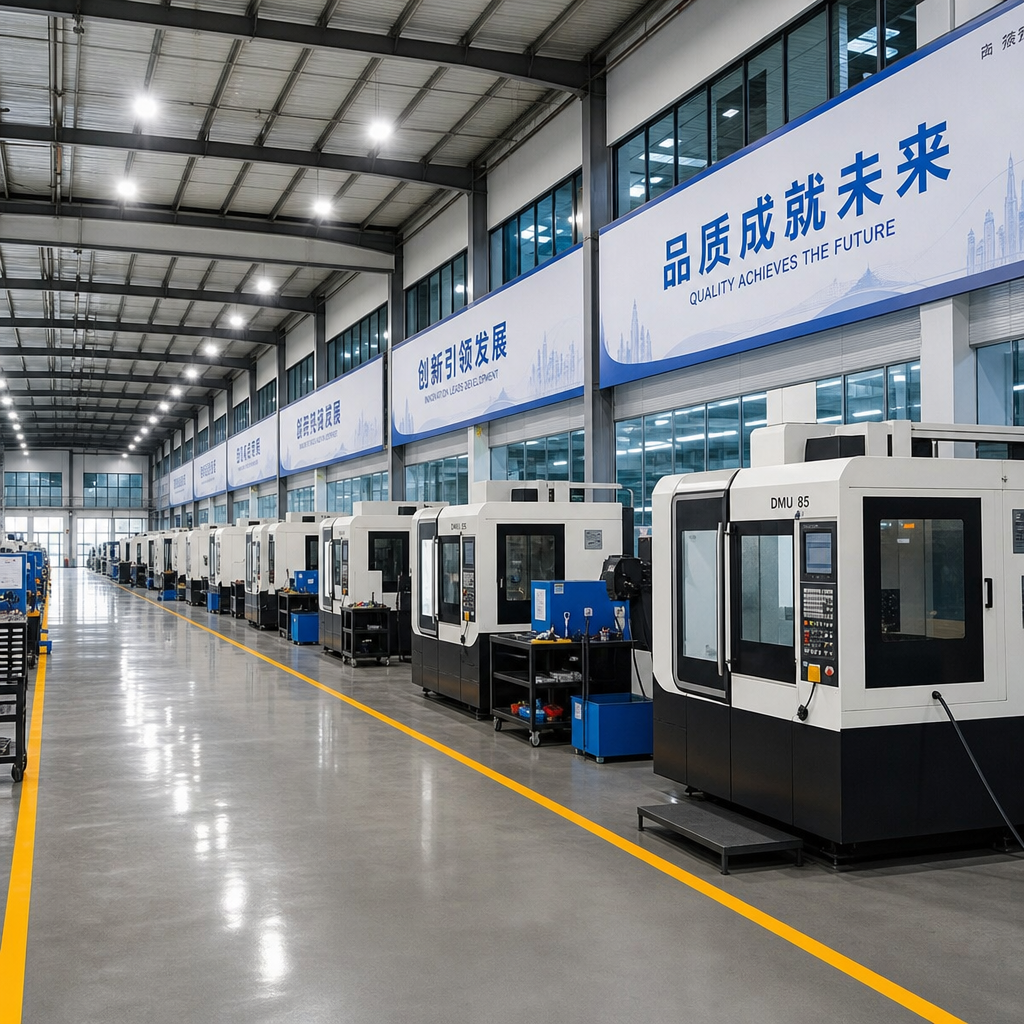
Driventus supplies connecting rods as part of a wider engine and powertrain range manufactured in Zhejiang, China. For procurement teams, the value is controlled repeatability across repeat orders. One-off availability is not enough.
We work from controlled drawings, batch traceability, and in-process inspection aligned with IATF 16949:2016 and ISO 9001:2015.
A typical B2B workflow includes:
Drawing or OE-reference review within the quotation stage
Feasibility check against existing tooling, forging route, machining fixtures, and inspection gauges
Sample confirmation and dimensional report before bulk release
Pilot order planning where the buyer needs production-run evidence
Bulk order planning by annual demand, forecast, and warehouse replenishment rhythm
Final packaging, labelling, carton marks, palletisation, and export document preparation
Lead time depends on stock status, tooling condition, sample requirements, and order volume. Catalogue items with available semi-finished or finished stock can usually be planned faster than a new programme. Made-to-order or custom rods need time for drawing confirmation, tooling or fixture preparation, sample machining, inspection, approval feedback, and bulk production.
As a working calendar, allow 2 to 4 weeks for sample preparation on existing tooling and 45 to 90 days for new or revised tooling, depending on complexity and approval speed.
For procurement managers, the decision is not simply whether a rod can be supplied. The stronger question is whether the supplier can hold the same specification across repeat orders, after-sales claims, and export documentation for multiple destination markets.
Commercial Decision Framework: MOQ, Lead Time, And Landed Cost
A connecting rod programme is often won or lost on supply discipline. MOQ should support your stock policy, sales forecast, and replenishment model. It should not be accepted only because it matches the supplier's preferred batch size.
Clarify three numbers early: MOQ by part number, sample quantity, and replenishment lead time after approval. The right MOQ depends on whether the part is stocked, made from existing tooling, or newly developed.
Common commercial variables include:
MOQ by engine family or part number; catalogue replenishment may start around 100 to 300 sets, while new production can require 500 to 1,000 sets depending on tooling and material batch
Sample lead time for first order validation; existing tooling is commonly 2 to 4 weeks, while new development can take longer
Production lead time after sample approval; many export programmes plan around 30 to 60 days for regular production, subject to order size and season
Packing units per carton and per pallet, including gross weight limits for warehouse handling
Incoterms such as EXW, FOB Ningbo or Shanghai, CFR, CIF, or DAP depending on the buyer's logistics model
Mixed-container or consolidated-shipment options with other engine components
Compare price against specification. A lower unit price may reflect a different material route, no bushing, looser bore control, unbranded bolts, lighter inspection, thinner anti-rust protection, or packaging that will not survive export distribution.
Ask suppliers to separate sample cost, tooling cost, unit price by quantity break, packaging cost, inspection cost where special reports are required, and freight basis.
Best practice is to compare total landed cost rather than unit price alone. Include freight, duty, inspection cost, warehouse handling, claim exposure, and any rework risk caused by dimensional drift. If your branch network or distributor base needs regular replenishment, lead time stability may be worth more than a small saving on the piece price.
A qualified China supplier should also be able to support mixed-order consolidation where several connecting rods or related engine components move in the same shipment. This can reduce inbound handling cost, lower administrative workload, and help purchasing teams manage slower-moving part numbers without creating unnecessary stock pressure.
Document Pack: What Should Be Treated As Part Of The Product
Documentation is not an afterthought. For a serious aftermarket sourcing programme, the minimum file should show material traceability, dimensional inspection, and compliance statements appropriate to the destination market.
Agree the document set before production, especially when the goods are moving into regulated or audit-heavy channels. List required documents on the purchase order so they are treated as deliverables.
Expected documents often include:
Commercial invoice and packing list with part number, quantity, net weight, gross weight, and carton count
Certificate of conformity or internal compliance statement
Material certificate tied to batch, heat number, or lot number
Dimensional inspection report with drawing revision and measured values
Heat-treatment or hardness record when required
Traceability label format for cartons, pallets, and inner packs
Country-specific import documents, where applicable
Driventus operates under a quality system built around IATF 16949:2016 and ISO 9001:2015. For EU-bound shipments, chemical compliance under REACH (EC) No 1907/2006 may be requested depending on coatings, oils, rust-preventive compounds, labels, or packaging materials.
Buyers should also confirm whether surface treatments and preservation methods are acceptable in their market and compatible with their warehouse process. For long sea shipments, a common specification is oiled parts in VCI bags, protective separators or sleeves, export cartons, and pallet wrapping that prevents both corrosion and cap-edge impact.
Supplier claims should be supported by records. A valid programme needs evidence that can be reviewed during a customer audit, customs review, incoming inspection, or internal corrective-action cycle. If the buyer needs PPAP-style submission, dimensional layout, control plan, process flow, FMEA, or IMDS-related material data, raise those requirements before quotation because they affect time, cost, and engineering workload.
When Custom Manufacturing Is The Better Sourcing Route
Not every engine programme should be forced into a stock rod. Custom manufacturing is justified when OE geometry is no longer available, the application has been uprated, the buyer needs a controlled private-label item, or the catalogue part does not meet the target market's quality and packaging requirements.
It is also relevant when a distributor wants one controlled specification for several markets instead of buying inconsistent parts from multiple spot suppliers.
Request custom manufacturing when you need:
A non-standard centre-to-centre length or compression-height compensation
A revised big-end or small-end dimension for a specific crankshaft, bearing, or piston pin
Different bolt hardware, cap design, bushing material, or shot peening requirement
Weight matching for a performance, heavy-duty, or fleet rebuild application
Branded packaging, barcode labels, carton marks, or private-label documentation
A defined inspection plan for a private-label range, including AQL, sample size, and report format
Define the target drawing, sample approval stage, and acceptance criteria before tooling starts. This prevents later disputes over dimensional interpretation, material route, or surface treatment.
A practical custom programme normally moves through RFQ data review, drawing confirmation, tooling or fixture review, first sample inspection, buyer approval, pilot order, and then repeat production. For new tooling, budget extra lead time and a separate tooling or development charge if the part cannot be made from existing fixtures.
For established distributors, custom rods can reduce stock complexity by replacing several low-turn variants with a consolidated specification, provided the application window is correctly defined and validated.
For quotation requests, include engine code, OE reference if available, annual usage, target market, packaging requirements, target MOQ, forecast by quarter, and any special compliance needs. You can request a quote once those details are ready.
Frequently asked questions
No. Opel fitment is one application area. We also support other engine families where the dimensions, material route, quality requirements, and demand profile match the programme.
Yes, when the reference is supplied by the buyer or appears in reliable source data. We use it for fitment control, not for any manufacturer approval or authorised-supplier claim.
Typical documents include commercial invoice, packing list, material traceability data, and dimensional inspection records. Heat-treatment, hardness, or market-specific compliance papers can be added where required.
Send the engine code, OE reference if available, annual volume, target market, packing requirements, target MOQ, and any requested tolerance, material, validation, or documentation notes. That is enough for a first commercial review.
Review the fitment data, volume target, validation needs, MOQ assumptions, lead-time window, and documentation requirements, then send your part details for commercial review at [request a quote](/contact.html).