Buying connecting rods in small volumes is not just a price comparison. It is a sourcing, validation, and repeatability exercise. Procurement teams need a supplier that can maintain dimensional consistency, document material traceability, and keep packing and export timelines predictable even when order quantities are modest. For mini orders, the main risks are weak batch control, unclear OE cross-reference handling, inconsistent inspection records, and delays on forged or machined parts that are produced in limited runs. Driventus supplies engine and powertrain components from Taizhou, Zhejiang, with production aligned to IATF 16949:2016 and ISO 9001:2015. Driventus is an independent aftermarket manufacturer; brand names and OE numbers are referenced for fitment only. If you are comparing vendors for a pilot programme, low-volume distribution, or a repair-chain replenishment list, focus first on MOQ, inspection data, packing method, lead time, and whether the factory can support custom labelling or part-number mapping without adding avoidable cost.
How to judge a mini supplier quickly
A small-order connecting rod programme should be treated as a controlled supply item, not a generic commodity purchase. Before requesting samples or pricing, buyers should lock the technical baseline that will govern quotation, inspection, and repeat production.
Start with the facts that change the outcome:
Material grade and heat-treatment route
Finished bore size, centre distance, and big-end roundness controls
Surface finish requirements on the shank, cap face, and bearing seats
Shot peening, crack-splitting, or conventional cap style
Weight range or mass-matching requirement, if applicable
Rust prevention, carton protection, and transit-damage controls
Documentation: COA, inspection report, and batch traceability
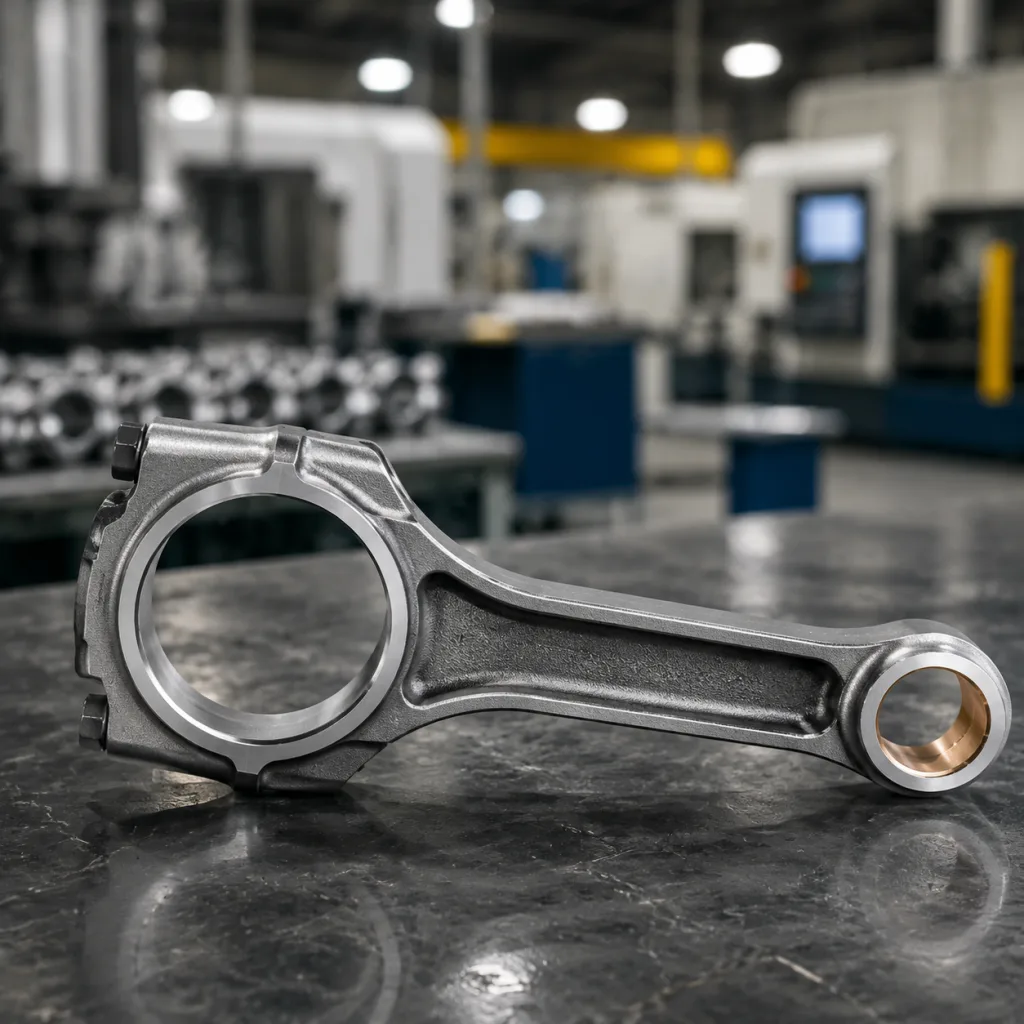
The real test is repeatability. A supplier can pass one sample and still fail a program if the next batch drifts on bore size, cap alignment, or rod weight. So the sourcing spec should name the drawing revision, target alloy or material standard, heat-treatment condition, and measurable acceptance limits. State the critical tolerances up front: centre-to-centre length, big-end bore, small-end bore, cap alignment, rod weight, and surface roughness.
If you need OE 06A107065 or any similar cross-reference handling, treat it as a fitment identifier only. The supplier should map the part correctly without implying vehicle manufacturer approval.
Where mini orders usually break down
Mini-order purchasing often looks simple until the commercial terms collide with the factory’s real process flow. The most common failure mode is a supplier quoting a low unit price while hiding the actual constraints behind forging, machining, heat treatment, or final inspection.
Item
What to confirm
MOQ
Minimum pieces per part number, rod family, or production lot
Lead time
Sample timing, production timing, and any queue for forging or machining
Packing
Individual bagging, oil paper, desiccant, carton strength, and pallet option
Labelling
Part number, batch code, quantity, country of origin, and private-label needs
Export docs
Invoice, packing list, CO, and any special declarations required by market
</tr></thead><tbody> </tbody></table>Ask for three separate timing answers: sample lead time, first production lead time, and repeat-order lead time. Those numbers are rarely the same. A stock-supported sample may ship in 7-14 days. A machined low-volume batch may take 20-35 days. A forged-and-machined custom run can stretch to 30-45 days or longer if heat treatment or outsourced finishing is involved.
Packing is another frequent weak point. If the parts arrive with oil residue on the box, poor separation between rods, or no anti-rust protection, the order is already costing more than the quote suggests. For stable replenishment, ask whether the factory can reserve a fixed monthly or quarterly production slot so repeat orders do not restart from zero each time.
The control points that matter most
Connecting rods run under high cyclic load, so quality has to be visible at both part and batch level. Driventus operates under an audited quality framework aligned with IATF 16949:2016 and ISO 9001:2015, supporting controlled incoming material checks, in-process measurement, and final inspection before shipment.
Use the inspection list that matches the risk:
Dimensional inspection of centre-to-centre length, bore diameter, and cap alignment
Big-end and small-end roundness checks after machining
Hardness verification after heat treatment
Magnaflux or crack detection where the part design and process require it
Mass matching within the specified production window
Visual checks for burrs, scoring, dents, and machining marks
Packing inspection to confirm rust prevention and part separation
The buyer should define the acceptance data before production starts. That means sample size, measurement equipment, gauge resolution, and whether 100% inspection or AQL sampling applies. For mini orders, a buyer-controlled tolerance sheet is often the most useful document. It ties the supplier’s report to actual tolerances instead of vague pass/fail language.
If your specification includes chemical or material compliance, keep it separate from performance validation. Standards such as REACH (EC) No 1907/2006 apply to substance compliance and reporting, while durability targets are usually validated at assembly, engine, or vehicle level rather than on the bare connecting rod alone. Where the market requires it, ask for mill certificates, hardness logs, and the batch’s heat number so the material path can be traced from bar stock to finished shipment.
What a factory review should uncover
Mini suppliers are often compared on unit price, but audit readiness is a better predictor of supply stability. The useful questions are not about marketing claims. They are about how the factory actually controls raw material, gauges, nonconforming stock, and engineering change.
Driventus can support buyer reviews with documentation tied to the factory quality system and production flow. That matters when the goal is to validate a multi-SKU programme, a repeat replenishment list, or a private-label range rather than a one-off sample request.
A practical review should confirm:
The forged or machined route for each reference
Gauge calibration records and measurement frequency
Traceability back to heat number, batch number, or lot number
Packaging controls for sea freight, inland transport, and warehouse storage
The corrective-action process for rejected or disputed batches
How engineering changes, drawings, and part-number revisions are recorded
If fitment risk is high, ask for dimensional reports before shipment and keep an approved reference sample on file. That is usually more useful than relying on a generic declaration of conformity, especially when several similar rod designs share close dimensions. A strong supplier should also be able to isolate a hold lot quickly, issue a corrective action report with root cause and containment, and repeat the batch with the same machine program, fixture, and inspection sequence.
When custom work is the better route
Custom work makes sense when a standard catalogue item does not match the required centre distance, pin size, big-end geometry, cap style, marking, or packing requirement. In those cases, Driventus supports custom manufacturing for defined drawings, sample-based development, and controlled repeat production.
Custom manufacturing is the right path when:
The OE cross-reference is incomplete, regional, or obsolete
A drawing or sample needs to become a repeatable production part
You need a private-label packing format or customer-specific carton layout
A repair chain wants a house part-number system
The standard rod needs a different coating, marking, or traceability format
A low-volume range needs stable replenishment without excessive inventory
For broader range planning, review our catalog and the wider engine components range. Keep the commercial scope clear from the start: Driventus is an independent aftermarket manufacturer, and brand names or OE references are used for identification and fitment only.
A good custom brief should include target annual volume, initial pilot quantity, required tolerance stack, label format, carton count per master carton, and any special corrosion-protection request. If tooling is needed, confirm whether the charge is one-time, amortized across the first order, or refundable after a minimum buy commitment. That detail often changes the real economics more than the quoted unit price.
Frequently asked questions
MOQ depends on the rod family, machining route, material availability, and packing requirement. Small batches may be possible for pilot orders, but the exact minimum should be confirmed per part number and production slot. For quoting, ask the supplier to separate sample MOQ, repeat MOQ, and any tooling or setup threshold so the commercial floor is clear.
Yes. Use the OE number as a fitment reference, such as OE 06A107065, and confirm the dimensional match separately through drawings, samples, or inspection data. Driventus does not claim vehicle manufacturer approval. For sourcing control, request the OE reference, corresponding drawing revision, and the measured critical dimensions in the same document set.
Ask for the inspection report, batch traceability, material confirmation, packing details, and confirmed lead time. For regulated markets, also confirm REACH (EC) No 1907/2006 handling where applicable. If the order is a new launch, add first-article data, hardness results, and carton/pallet specifications before approving mass production.
If you are shortlisting a connecting rod mini supplier, send your target part number, annual volume, drawing or OE reference, and packaging requirement. Use our [request a quote](/contact.html) page to start the review.