Connecting Rod Manufacturer China for Land Rover Sourcing
If you are sourcing a connecting rod land rover manufacturer china, the main procurement questions are consistency, fitment control, and supply stability. Driventus supplies engine and powertrain components from Taizhou, Zhejiang, with export experience in more than 60 countries and production aligned to IATF 16949:2016 and ISO 9001:2015. We supply B2B buyers in aftermarket distribution, OEM and Tier-1 supply chains, and multi-site repair networks.
For Land Rover-related programmes, the critical point is dimensional match to the target OE reference, not brand association. Driventus is an independent aftermarket manufacturer; brand names are referenced for fitment only. Buyers should verify big-end bore, centre distance, pin bore, beam offset, weight class, and surface finish against the sample or drawing before release. This article explains how procurement teams evaluate connecting rod suppliers in China, what documentation to request, and which quality checks reduce return risk on imported engine parts.
What procurement teams should verify first
For connecting rods, the lowest-risk buying decision starts with dimensional control and traceable process data. When comparing suppliers, ask for the target application, OE cross-reference, and the full drawing revision before discussing price.
Minimum buying checklist
Material grade and heat-treatment route
Finished weight range and weight matching method
Small-end and big-end bore tolerance
Centre-to-centre length and rod ratio
Surface treatment, if specified
Batch traceability and inspection report format
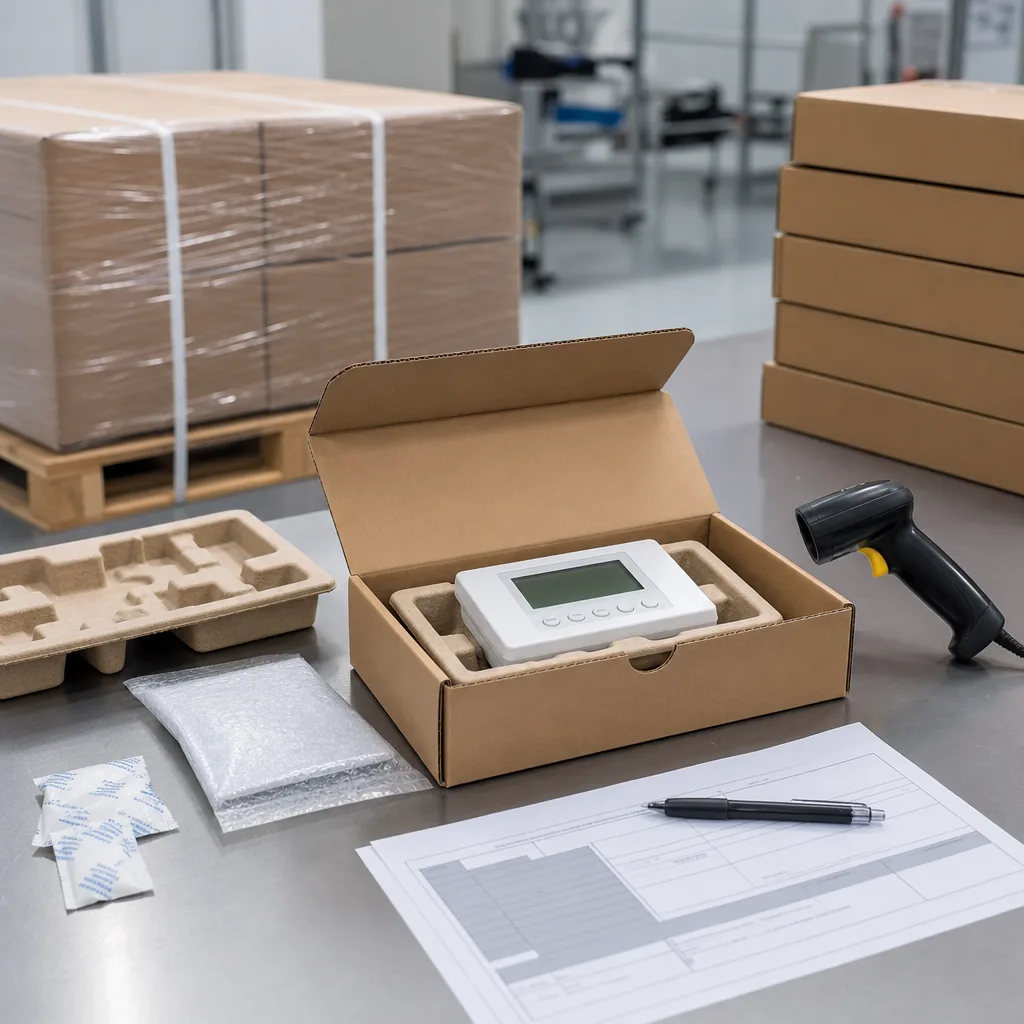
Packaging standard for export transport
For Land Rover fitment programmes, the supplier should confirm the exact application by engine family and OE reference such as OE 06A107065 only when the customer already uses that reference in the RFQ. Do not accept a quotation that only says “fits Land Rover” without dimensional evidence. If you need a broader product overview, see our catalog.
Dimensional and material controls for connecting rods
A connecting rod is not a generic forging. The supplier must control geometry, metallurgy, and machining stability across production lots. Buyers should request measured samples and the inspection standard used for each critical feature.
Control item
Typical procurement focus
Why it matters
Centre-to-centre length
Drawing match within specified tolerance
Direct effect on compression height and piston position
Big-end bore
Roundness, taper, and surface finish
Bearing life and oil film stability
Small-end bore
Pin fit and concentricity
Reduces wrist-pin wear and noise
Beam straightness
Bend and twist limits
Prevents side loading and fatigue risk
Mass matching
Set-to-set variation control
Keeps cylinder balance consistent
Material verification
Forging grade and heat lot
Impacts strength and fatigue resistance
</tr></thead><tbody> </tbody></table>Typical export buyers ask for material certificates, hardness results, and first-article inspection records. If the rod is made to an OEM-equivalent specification, the supplier should also provide dimensional inspection on the first production lot and maintain records under IATF 16949:2016 and ISO 9001:2015. This is where our quality system becomes relevant to audit teams.
Factory audit points for Chinese suppliers
A proper factory audit should confirm that the manufacturer controls both incoming material and final machining. For procurement teams, the goal is not a visual tour; it is evidence that the plant can repeat the same part three months later.
Audit items to confirm
1. Forging and machining separation — verify whether the forging source is internal or external. 2. Gauge control — inspect calibration records for bore gauges, micrometers, and CMM equipment. 3. Heat-treatment control — request furnace charts, hardness range, and quench process documentation. 4. Lot traceability — confirm batch coding from raw material to finished cartons. 5. Nonconformance handling — review containment, corrective action, and reinspection procedure. 6. Export packing — check rust prevention, separator design, and carton drop resistance.
For buyers in the EU and UK, it is also reasonable to ask how the supplier manages REACH (EC) No 1907/2006 obligations for relevant substances in coatings, oils, and packaging materials. For US, Canada, Australia, and Brazil, the audit should confirm document retention, packing consistency, and stable lead-time performance across repeated orders.
Lead time, MOQ, and sourcing structure
China sourcing decisions usually come down to order size, programme stability, and validation cost. A specialist connecting rod manufacturer should be able to support both sample orders and recurring production.
Typical sourcing structure
Sampling: engineering sample set for fitment and measurement review
Pilot lot: controlled batch for bench validation and teardown inspection
Production order: repeatable lot size with locked drawing revision
Reorder support: same tooling, same traceability format, same packaging spec
For procurement teams, MOQ should be discussed together with tooling status, machining setup, and packaging requirements. A lower MOQ may be available for catalogue items, while custom applications may require a higher launch quantity. Lead time depends on material availability, machining queue, inspection demand, and export booking. Driventus can also support custom manufacturing when the target application requires a specific rod design, coating, or weight range.
A practical sourcing file should include RFQ drawings, target annual volume, required inspection reports, destination port, and the acceptance standard used by your internal quality team. That reduces back-and-forth and shortens quotation time.
Validation testing before release
Before a connecting rod is approved for stock or programme use, it should pass a structured validation plan. Procurement teams should ask what tests were run, on how many samples, and to which acceptance limits.
Common validation checks
Dimensional inspection against drawing and sample master
Hardness testing after heat treatment
Magnetic particle or similar crack-screening method where specified
Concentricity and parallelism checks on critical bores
Mass variation and weight matching across a set
Bench or engine build verification, if the customer requires it
If the rod is for a performance-sensitive or fleet application, the buyer may also request supplier alignment with published test references such as SAE J2527 for durability-related exposure methods where applicable to surrounding components, and any customer-specific internal validation plan. For emissions-adjacent engine assemblies, some buyers also reference ECE R-83 in the broader programme file, although the connecting rod itself is not homologated under that regulation.
The right question is simple: can the supplier prove dimensional repeatability and controlled metallurgy on every batch, not just on the sample set?
Why buyers use Driventus for rod sourcing
Driventus is set up for export B2B supply, not retail replacement. We manufacture engine and powertrain parts in Taizhou, Zhejiang, with a focus on repeatable machining, inspection discipline, and packaging suitable for containerised export.
For procurement teams, the main advantages are:
One-source coordination across engine component families
Documented quality controls under IATF 16949:2016 and ISO 9001:2015
Support for OE cross-reference review and drawing-based sourcing
Export experience to more than 60 countries
Custom programme support for special dimensions or volumes
If your team is building a sourcing shortlist for connecting rods, we recommend sending the target application, OE reference if available, annual demand, and required test plan. That allows us to confirm feasibility quickly and avoid quoting the wrong part family. You can request a quote once the RFQ pack is ready, and we will reply with technical and commercial details.
Frequently asked questions
Use the engine family, OE reference if available, and full drawing dimensions. Check centre distance, bore sizes, weight, and beam geometry before approving samples.
Request material certificates, inspection reports, hardness data, traceability records, packing specification, and the quality standard used for production control.
Yes, when the drawing and target volume are clear. We support custom manufacturing for qualified B2B buyers and can align production to your release requirements.
If you need a technical quotation for a Land Rover connecting rod programme, send your RFQ pack and target volume. We will review fitment, documentation, and lead time with you here: /contact.html