connecting rod · 2026-06-20

Connecting Rod for Jeep Compass Aftermarket Replacement: Sourcing

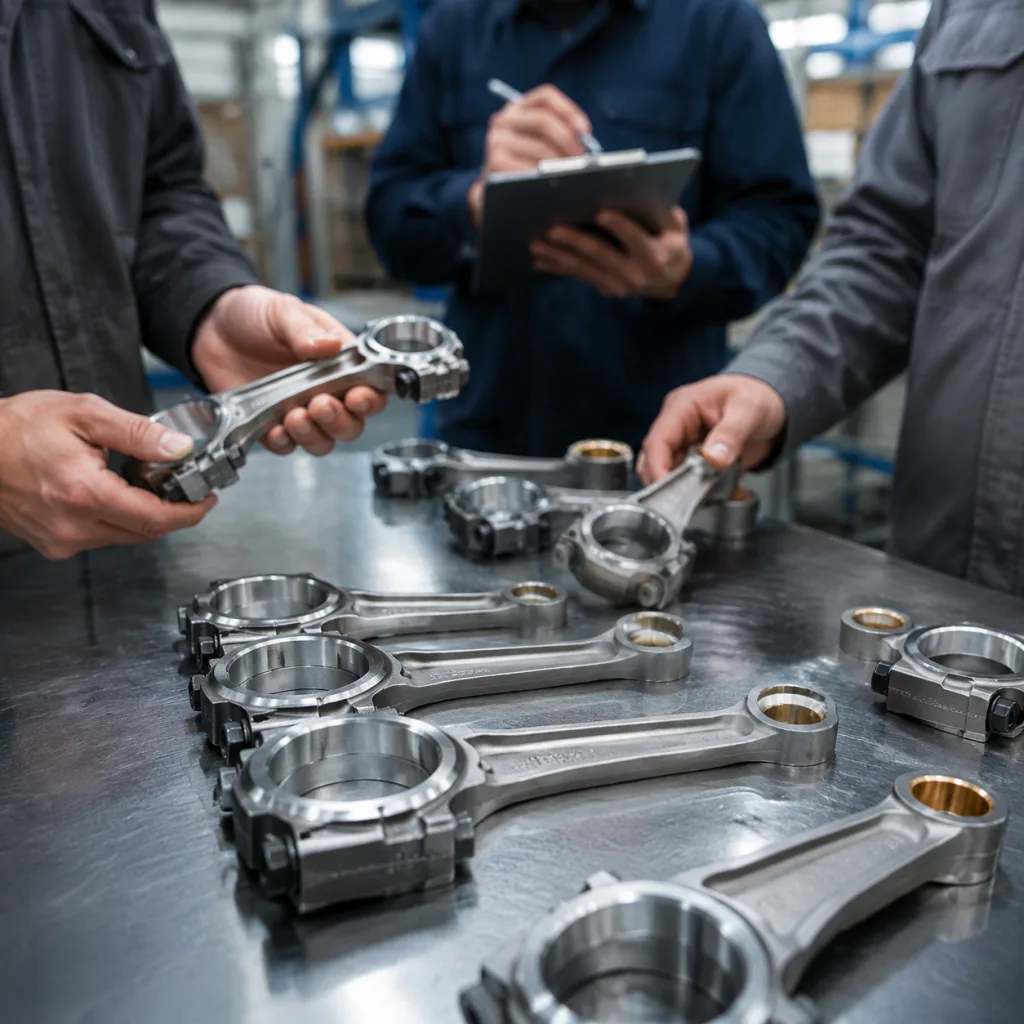
A connecting rod for Jeep Compass aftermarket replacement has to clear a few hard checks before it belongs in a sourcing file: geometry, mass balance, joint design, and traceable process control. The vehicle nameplate is not enough. The deciding factor is whether the rod matches the exact engine family, tolerances, and durability expectations tied to that application.

Driventus is an independent aftermarket manufacturer; brand names are referenced for fitment only. For buyers, the practical review starts with bore size, centre-to-centre length, big-end and pin-end tolerance, bolt specification, and material traceability. Those are the core requirements for OE-equivalent replacement, whether the part is bought for wholesale distribution, workshop supply, or validation. Published quality frameworks such as IATF 16949:2016, ISO 9001:2015, and REACH (EC) No 1907/2006 should also be included in the approval file.

Start with the engine, not the badge

For a connecting rod for Jeep Compass aftermarket replacement, the first decision is fitment discipline. If the rod length, centreline alignment, or bearing housing geometry falls outside the engine’s design window, the result can be accelerated wear, oil film instability, or piston deck-height variation.

Minimum procurement checks

  • Centre-to-centre length: verify against the engine code and rod family; typical automotive rods are controlled within about ±0.02 mm to ±0.05 mm depending on design class
  • Big-end bore and roundness: confirm after torquing the cap fasteners; watch for bore distortion above 0.01 mm to 0.02 mm
  • Pin-end bore: match the piston pin diameter and bushing design; commonly held to ±0.005 mm to ±0.015 mm on final machining
  • Beam mass and matched-set variation: control balance across cylinders; set variation is often kept within 1 to 3 g for aftermarket packing, tighter for performance programmes
  • Bolt grade and tightening method: confirm stretch, torque, or angle spec; rod bolts are often specified by proof-load, not just nominal size
  • Cap fit and parting-line finish: verify cap register contact and no mismatch at the joint

Buyers should also ask for the exact engine code, displacement, and production range before approving an order. A catalogue claim that a rod fits the Jeep Compass is not sufficient if the engine family changed between model years or markets. Driventus supports OE cross-reference review without claiming manufacturer endorsement. If your team is comparing options across the aftermarket, start with our catalog and narrow by engine family before moving to sample approval.

Where aftermarket rods win or fail

Replacement rods are generally specified by forged steel chemistry, heat treatment, and machining finish rather than by appearance. A forged rod with stable grain flow and controlled hardness is preferred for durability in passenger-car use.

Typical buyer-side specification targets for an OE-equivalent rod include a forged steel body, controlled hardness in the HRC 28 to 38 range for many passenger-vehicle applications, and a shot-peened surface on the beam to improve fatigue resistance. If the part uses a fractured cap, buyers should confirm that the cap interface is produced and assembled as a matched pair and that the joint is not reworked after fracture.

</tr></thead><tbody> </tbody></table>For most procurement files, a practical machining target is a big-end and pin-end surface finish around Ra 0.4 to 1.6 μm, with final dimensional reports tied to a calibrated CMM or bore gauge. Ask for the hardness map if the supplier can provide it, because a single spot check is weaker than a controlled process record.

For import programmes, compliance documents should reference IATF 16949:2016, ISO 9001:2015, and REACH (EC) No 1907/2006 where applicable. The objective is repeatable production, not a cosmetic match.

How to validate a sample before stock release

Replacement approval should include test evidence, especially when a part crosses from one engine code to another within the same model line. A Jeep Compass application can differ by engine displacement, fuel system, and market year, so the rod must be validated against the exact engine build.

A practical approval sequence is: 1. Verify OE part-number cross-reference by engine code and production range. 2. Measure sample rods against drawing data for length, bore sizes, and cap fit. 3. Check bolt preload method, fastener lot number, and tightening angle or stretch specification. 4. Review fatigue or endurance testing data from the manufacturer, including cycle count and failure criteria. 5. Confirm packing, rust protection, and labelling for warehouse handling. 6. Record sample size, measurement method, and acceptance limits in the approval file.

A buyer should not release stock until the sample report shows the actual values against nominal. Common acceptance logic is to set a dimensional tolerance band, confirm that no sample is outside the drawing limit, and require repeatability across at least one pilot lot. Where available, request comparative dimensions, sample reports, and serialised inspection records. That reduces the risk of mix-ups when the same vehicle nameplate uses more than one engine family.

Comparing suppliers without getting trapped by price

The lowest unit price is not a useful decision rule for an engine component with tight geometric tolerance. Buyers should compare suppliers on repeatability, documentation, and response time for engineering questions.

Useful comparison points

  • Drawing control: revision history, approval status, and whether the supplier will build to your revision
  • Inspection equipment: CMM, bore gauges, hardness testing, and measurement calibration dates
  • Sample policy: pre-production, golden sample, and retained sample availability
  • Packaging: corrosion prevention, tray design, and transit protection
  • Lead time: standard production window, sample lead time, and capacity for urgent replenishment
  • Support: ability to supply technical data for workshop and distribution channels
  • Commercial terms: MOQ, tiered pricing, and whether packaging changes affect unit cost

For planning, many B2B buyers compare on three numbers at once: MOQ, price break, and lead time. A useful model is to ask for one price at sample quantity, a second price at production MOQ, and a third price at annual contract volume. If a supplier cannot quote those tiers cleanly, the quoting process is usually not mature enough for repeat supply.

Driventus offers quality system documentation for buyers who need a controlled sourcing file. For projects requiring non-standard dimensions, custom manufacturing can be used to align rod specification with a defined engine programme.

Comparing suppliers without getting trapped by price

Inventory rules for fitment-heavy warehouses

Inventory managers often need a simple rule: do not stock by vehicle badge alone. The Jeep Compass nameplate can cover multiple engine variants, so fitment must be tied to the specific engine code and OE reference.

For clean warehouse control:

  • Label parts by engine family, not only by model name
  • Keep OE 06A-style references only when the catalogue already cites them
  • Separate complete engine sets from single-piece replenishment stock
  • Record country-market differences where they affect emissions, engine build, or rod specification
  • Store the accepted measurement sheet with the bin location so picks can be checked quickly
  • Apply FIFO rotation on coated parts to reduce storage-related corrosion risk

When building a regional parts list, use the engine code, rod length, and bolt specification as the release key before purchase-order approval. If the supplier’s catalogue shows more than one rod variant for the same vehicle family, request a line drawing with the exact dimensions and part-number mapping. When the match is confirmed, a controlled aftermarket part can serve distribution, repair-chain, and remanufacturing demand without rework.

Frequently asked questions

Yes, if it matches the OE geometry, material specification, fastener design, and validation data for the exact engine code. Fitment by model name alone is not enough. Buyers should also confirm the dimensional tolerance report, hardness range, and fastener lot control before release.

Request dimensional reports, material traceability, hardness results, sample approval records, and certification evidence such as IATF 16949:2016 and ISO 9001:2015 where applicable. A complete file should also include the engine code, drawing revision, inspection method, MOQ, quoted lead time, and packaging specification.

Yes. For defined engine programmes, Driventus can support custom manufacturing with controlled dimensions and documentation. Brand names are referenced for fitment only. Buyers can submit target length, bore sizes, surface finish, and annual quantity so the quotation can reflect the required spec and commercial terms.

If you need an OE-equivalent connecting rod matched to a Jeep Compass engine family, send the engine code, target quantity, required tolerance limits, and desired lead time through /contact.html for a quick review.

Request a Quote
Checkpoint What procurement should confirm Why it matters
Material traceabilityHeat number, melt route, and batch recordSupports incoming inspection and claims handling
Heat treatmentHardness range, case depth if applicable, and process recordReduces risk of brittle failure or soft spots
Surface finishMachined, deburred, and shot-peened surfacesImproves fatigue resistance
Bore integrityFinal honing, roundness, and surface roughnessProtects bearing life and oil pressure stability
Corrosion protectionPacking, oiling, and VCI specificationPrevents storage damage in transit
Fastener supplyRod-bolt grade, lot code, and tightening instructionEnsures consistent clamp load