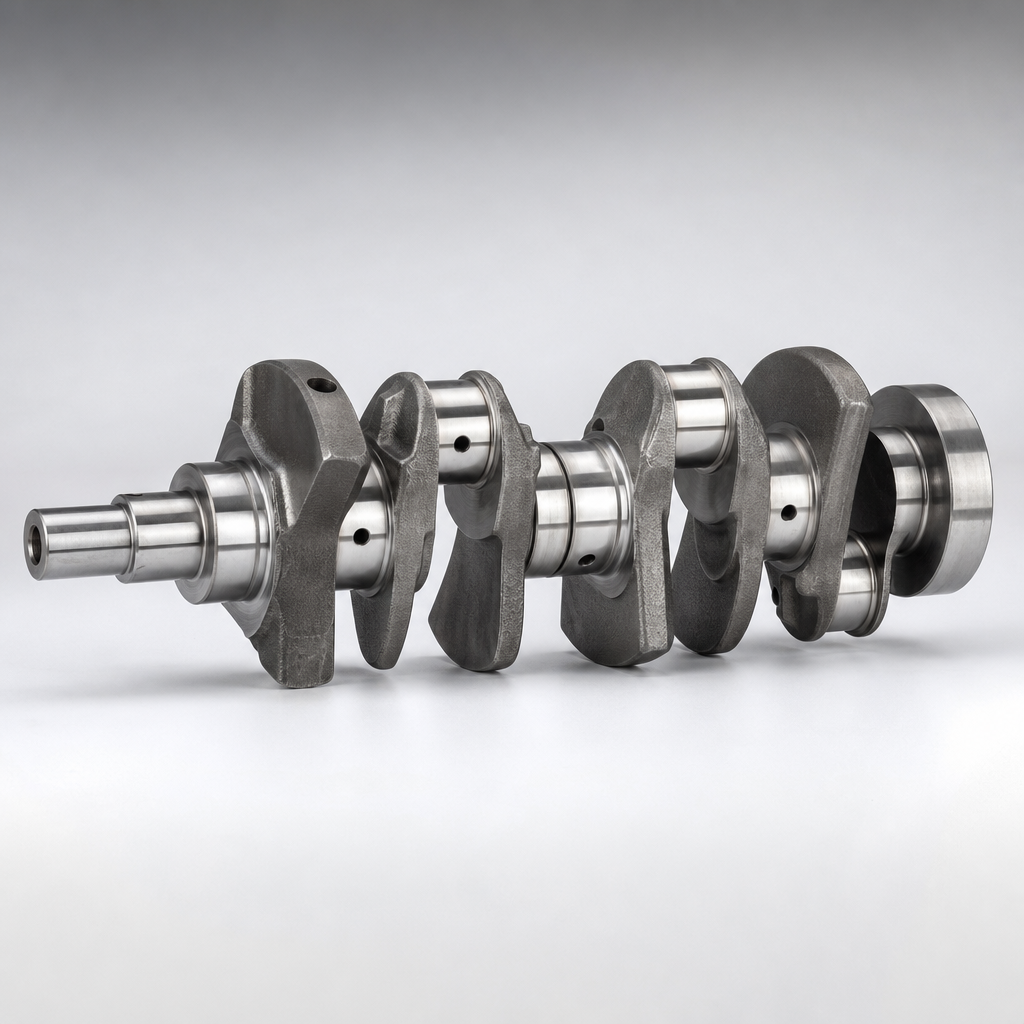
A connecting rod for Infiniti QX60 replacement is not a catalogue-only purchase. It is a load-bearing engine component that has to match the original design in centre distance, big-end geometry, small-end fit, mass balance, material condition, cap location, and bolt clamp behavior. If one of those details is wrong, the issue may not appear at goods-in inspection. It may appear later as bearing noise, poor oil clearance, cap movement, pin wear, or a warranty claim after installation.
For B2B buyers, the decision is therefore not simply whether the rod can be installed. The question is whether it can be installed repeatedly, with predictable assembly results, across distributor stock, rebuild programmes, and repair-chain workflows. That requires measured fitment data, controlled production records, packaging that prevents cap mixing, and documents that can survive buyer audit and import review.
Driventus manufactures connecting rods and related engine components for aftermarket distributors, repair-chain programmes, and OEM/Tier-1 sourcing projects. Our work is centred on OE-equivalent dimensional control, material traceability, process discipline, and validation evidence rather than retail packaging claims. Driventus is an independent aftermarket manufacturer; brand names are referenced for fitment only.
Decision Point: Are You Buying One Service Rod or a Controlled V6 Set?
The Infiniti QX60 has used V6 powertrain configurations across different markets and model years, including applications associated with Nissan’s VQ-series engine family. That makes the first sourcing decision very specific: confirm the exact engine code, production year, crankshaft journal specification, piston pin diameter, bearing set compatibility, and any mid-cycle part changes before a quotation is treated as meaningful.
A connecting rod for Infiniti QX60 replacement should be sourced as a precision engine component, not as a generic forging or casting. The rod must assemble with the specified crankshaft, piston, wrist pin, rod bearing shells, and cap bolts without distributor-side machining or repair-chain correction. If a supplier cannot confirm the core dimensions and assembly interfaces, the risk moves downstream to installers, warranty teams, and inventory managers.
The RFQ should answer these questions before price comparison starts:
Which vehicle platform, market, and model year range is covered?
What engine displacement and engine code are being supported?
Is the buyer replacing one failed rod, stocking loose rods, or building six-rod service sets?
What are the big-end bore diameter and housing width with the cap torqued?
What crankpin journal diameter and bearing shell reference apply?
What small-end bore diameter, bushing design, and wrist pin diameter are required?
What centre-to-centre length is accepted, and what tolerance applies?
What rod weight target and matching tolerance are required, for example within 2 g per set?
Is the cap fractured, machined, dowelled, or otherwise located?
What bolt thread, length, grade, and tightening procedure are specified?
Is there an approved sample, drawing, or OE part-number cross-reference for fitment review?
The programme type changes the supply format. A distributor buying loose rods may need carton-level traceability, unit labels, and warehouse-friendly packaging. A rebuild-kit buyer may need six rods grouped by weight, bagged separately, and packed with compatible bearings and bolt instructions. A repair-chain programme may care less about decorative packaging and more about installation notes, batch control, and fast claim investigation.
As a quotation baseline, Driventus normally asks for annual demand, first sample quantity, target Incoterm, destination port, packaging format, and whether the buyer needs PPAP-style documents. Custom connecting rod projects are commonly quoted with sample lead time, tooling or fixture charge if needed, MOQ by production lot, and mass-production lead time after approval. Driventus can review customer drawings, samples, and fitment tables through custom manufacturing, including private-label or programme-specific part development.
Failure Modes Hidden in Small Dimensional Errors
Most connecting rod problems do not start with an obviously wrong-looking part. They start with small errors in geometry. A big-end bore that is slightly out of round can disturb bearing contact. A centre distance error can change piston deck position. Excessive housing width variation can affect side clearance and the oil escape path. In a V-type engine, inconsistent rod weight can also contribute to imbalance, noise, vibration, and harshness concerns.
For first article inspection, the key rule is simple: big-end geometry must be measured with the correct bolts installed and tightened to the defined condition. The housing bore changes under clamp load. A loose-cap measurement does not prove that the rod will hold the bearing correctly in service.
Feature
Procurement check
Practical acceptance logic
Centre-to-centre length
Confirm against drawing or approved sample
Controls piston height; many buyers require CMM data on all first-article samples
Big-end bore size
Measure after cap bolts are torqued to the specified condition
Supports bearing crush and oil clearance; report actual bore, not pass/fail only
Big-end bore roundness
Check with calibrated bore gauges or roundness equipment
Affects bearing contact; roundness and taper should be stated in microns where possible
Big-end housing width
Compare with crankshaft journal width
Controls rod side clearance and oil escape path
Small-end bore
Confirm pin fit, bushing size, and surface finish
Helps prevent pin noise, seizure, and abnormal wear
Rod weight
Match set weight range or define individual tolerance
Six-cylinder service sets often need controlled total and end-to-end weight variation
Bolt seat geometry
Inspect contact face, perpendicularity, and thread engagement
Maintains clamp load during operation
Cap alignment
Verify parting face, fracture location, or dowel interface
Prevents bearing bore distortion and cap shift
Surface finish
Measure bearing and pin contact areas
Reduces wear risk during initial operation
</tr></thead><tbody> </tbody></table>A useful production control plan does not rely on visual similarity. It normally includes coordinate measuring machine inspection, air or dial bore gauges, roundness measurement, hardness checks, surface roughness measurement, and 100% visual inspection for machining defects. Buyers should request a sample inspection report covering at least the big-end bore, small-end bore, centre distance, housing width, weight, surface finish, hardness, and material batch. For prototype approval, 3 to 5 measured rods may be enough. For a complete V6 matched-set review, 6 rods are more useful.
Acceptance rules should be agreed before sampling: measurement method, gauge calibration status, sample quantity, reporting units, and whether data must be supplied for every cavity, forging lot, or machining line. A buyer may require 100% big-end bore gauging, 100% weight recording for matched sets, hardness checks per heat-treatment lot, and CMM layout once per shift or per machining batch. That clarity prevents arguments when a sample looks acceptable but sits outside the practical assembly window.
For assembly-sensitive features, buyers should specify tolerances in the drawing or purchase specification instead of relying on supplier defaults. If no drawing exists, use the approved OE sample as a master and require a reverse-engineering report with nominal dimensions, proposed tolerances, and gauge method. Driventus connecting rod programmes are managed under our quality system, aligned with IATF 16949:2016 and ISO 9001:2015 requirements for process control, traceability, nonconforming product handling, and corrective action.
Spec Deep-Dive: Material, Cap Design, and Surface Integrity
Material selection cannot be separated from the original rod design. Modern passenger-vehicle connecting rods are commonly forged steel or powder metal, depending on the OE construction. For Infiniti QX60 fitment, the specific engine variant should be reviewed before material or process assumptions are made. A forged replacement for a powder-metal fractured-cap design, or a changed cap interface, needs engineering review rather than commercial approval alone.
The purchasing specification should identify:
Base material grade or customer-approved equivalent, with chemical composition limits
Forging or powder-metal process route
Heat treatment condition and hardness range, such as a controlled HRC or HBW window agreed from the drawing
Shot peening, stress relief, or other fatigue-enhancing process where specified
Surface roughness limits for bearing and pin areas, reported as Ra values rather than subjective finish
Magnetic particle inspection or another crack detection method
Cleanliness expectations after machining and washing, including residual chip and abrasive control
Rust prevention method for storage and sea freight, normally anti-rust oil, VCI paper, sealed bag, or combined protection
Batch traceability from raw material to finished rod
The target is not maximum tensile strength at any cost. A serviceable connecting rod needs strength, ductility, dimensional stability after machining, and fatigue performance in the right balance. Excessive hardness, poor heat-treatment uniformity, decarburisation, grinding burns, or aggressive machining marks can create new failure risks even when the part passes a basic dimensional check. Buyers should require hardness readings from the rod body or approved test location and define how many pieces are tested per heat-treatment lot.
The cap and rod body must remain a matched pair. Mixing caps from different rods is not acceptable in service, warehouse rework, or repacking because the big-end bore is finished as a matched assembly. Bulk supply does not remove that requirement. A practical control is to laser-mark or stamp matching identification on rod and cap, keep bolts installed after final machining, and bag each rod individually before carton packing.
Surface integrity controls should cover the beam, bolt seats, parting faces, bearing bore, pin bore, and oil holes if present. Export shipments add another variable: corrosion. Protection should match the route, whether it is short air shipment, consolidated sea freight, or long warehouse storage. If REACH (EC) No 1907/2006 documentation is required for EU import, confirm it during supplier qualification. Buyers importing to the United States, Canada, Australia, the UK, Brazil, or the EU should also align packaging labels, material declarations, tariff descriptions, and customs invoice wording before shipment.
Validation Sequence: From Bench Checks to Release Approval
Static dimensions are necessary, but they do not fully validate a replacement connecting rod. Engine loads are cyclic. Failures may begin at the bolt, the bearing housing, the beam, the cap interface, a surface discontinuity, or an assembly condition that was never checked during sampling. A credible sourcing project therefore combines dimensional evidence with material, process, and assembly validation.
A practical approval sequence is:
1. Confirm fitment inputs: engine code, bearing reference, piston pin diameter, crankshaft journal data, and cap bolt specification. 2. Approve sample dimensions with torque-state measurements of the big-end bore. 3. Verify material, heat treatment, hardness, and crack inspection records. 4. Assemble the rod with the intended bearing shells, piston pins, pistons, and bolts. 5. Check weight grouping, bearing crush, side clearance, pin fit, and free rotation after torque. 6. Review fatigue data, comparable programme evidence, or customer-required test results. 7. Freeze the drawing, inspection plan, packaging specification, and change-notification rules before mass production.
A robust validation package may include the following evidence:
Material certificate with heat number traceability
Hardness test records by batch or heat-treatment lot
Metallographic structure report, where required
Magnetic particle inspection records for crack control
Surface roughness report for big-end and small-end functional areas
Big-end bore measurement before and after bolt torque, where specified
Fatigue test data from representative samples or comparable programme data
Bolt proof-load, torque-angle, or clamp-load validation
Assembly check with the intended bearing shells, piston pins, and cap bolts
Salt spray test for coated or packaged components where corrosion protection is specified under ASTM B117, if required by the customer
First article inspection report with drawing references
For aftermarket distribution, practical assembly checks matter because installation time, bay occupancy, and comeback risk are direct cost factors. A rod that is inexpensive to buy but inconsistent during assembly can become a high-cost item through labour claims, stock quarantine, and customer dissatisfaction. One complete six-cylinder pilot set is often more revealing than one clean-looking individual sample.
Revalidation rules should also be defined. Common triggers include a new forging supplier, heat-treatment furnace change, machining fixture change, bolt supplier change, cap separation process change, process relocation, or production suspension longer than 12 months. Private-label programmes should state how engineering changes are notified, approved, and recorded before stock is shipped under the buyer’s brand.
Validation cost belongs in the commercial plan. A simple distributor replenishment using an approved sample may only need first-article inspection and batch records. A new custom programme may require sample machining, destructive testing, fatigue comparison, PPAP-style documentation, and packaging trials, which affect sample price and lead time. Buyers can review available engine parts in our catalog and related engine components, including pistons, piston rings, crankshaft-related components, gaskets, water pumps, and turbocharger parts.
RFQ Scenario: What a Distributor Should Lock Before Purchase Order
A common sourcing failure is treating the commercial quotation and the technical file as separate tracks. For a connecting rod for Infiniti QX60 replacement, they need to move together. A low unit price is not useful if bearing housing variation causes assembly rejects, installer complaints, or warranty exposure. The RFQ should tie application data, inspection requirements, packaging expectations, and claim-handling rules to the quoted price.
Before releasing a purchase order, confirm:
Application data by engine code, model year, and market
Drawing-based dimensions or a reverse-engineered sample report
Whether rods are supplied individually or in weight-matched sets
Whether cap bolts are included, pre-installed, or specified separately
Torque method, torque-angle requirements, lubrication condition, and bolt reuse policy for service documentation
Batch traceability and inspection records
Anti-corrosion oil, VCI paper, sealed bags, or other protection for sea freight
Carton labelling, palletisation, barcodes, and country-of-origin marking
Whether the part is packed as a single rod, set, or engine rebuild kit component
MOQ, sample lead time, mass-production lead time, and shipment terms
Claim handling for dimensional nonconformity, mixed caps, corrosion, or transit damage
Ask the supplier to separate sample pricing, mass-production unit price, tooling or fixture cost, inspection-document cost, and private-label packaging cost. Existing-platform parts may support lower MOQs when raw forgings, bolts, or machining fixtures are already available. A new or modified rod usually needs enough volume to absorb fixture setup, gauge preparation, sample inspection, and production changeover. Practical price breaks might be requested at 100, 300, 500, and 1,000 pieces or at 50, 100, and 200 six-rod sets.
Packaging deserves early attention. Each rod and cap should remain paired through machining, inspection, packing, and final shipment. If the programme requires private-label cartons, customer-specific labels, QR codes, batch stickers, or kitting with bearings and bolts, confirm this at RFQ stage rather than after sample approval. Define carton quantity, gross weight limit, pallet height, moisture protection, and barcode format before artwork is released.
Repair-chain buyers should also check installation notes. Even when the rod is dimensionally correct, unclear bolt torque instructions or missing information about bolt replacement can create inconsistent field results. Where the buyer has its own service manual or technician network, the supplier’s dimensional and assembly data should be reviewed against that internal procedure. Driventus supplies B2B customers in more than 60 countries from Taizhou, Zhejiang. Typical buyer reviews include factory audit documents, process flow charts, control plans, inspection reports, export packing specifications, and shipment documentation.
Q-and-A for Fitment Claims, Import Files, and Change Control
Can the catalogue say the rod is for Infiniti QX60 applications?
Yes, fitment references help buyers identify application scope. They should be used accurately and supported by engine code, model year, measured dimensions, and bearing or piston compatibility notes where available. Fitment language should not imply vehicle manufacturer approval, sponsorship, or endorsement.
What wording is safer for an independent aftermarket listing?
Use neutral language such as “replacement connecting rod suitable for Infiniti QX60 applications.” Avoid catalogue entries that state or imply genuine, original, authorised, or approved status unless the buyer has separate legal authority to use those claims. Driventus is an independent aftermarket manufacturer; brand names are referenced for fitment only.
Which documents should sit behind the quotation?
Commercial and technical documentation normally includes:
Quotation with part description, MOQ, lead time, currency, payment terms, and Incoterms
Dimensional drawing or approved sample reference
Material and heat treatment specification
Inspection report format and sampling plan
Packaging specification, including corrosion protection and labelling
Quality certificates, including IATF 16949:2016 and ISO 9001:2015 where applicable
Compliance statements requested for the destination market
Shipping documents, carton information, and customs description
What should the purchase order control?
The purchase order should match the approved quotation and technical file. Recommended PO fields include part description, buyer part number, supplier part number, quantity, unit price, Incoterm, delivery address, packaging revision, inspection-document requirement, and latest approved drawing or sample reference. For recurring orders, buyers should require the supplier to disclose changes to material source, heat-treatment route, machining process, bolt source, inspection method, or packaging specification before shipment.
How are customer drawings or OE references handled?
Where a buyer provides a proprietary drawing, OE sample, or OE part-number reference, Driventus treats the information as customer-controlled input for fitment verification and production planning. We do not claim approval by any vehicle manufacturer. Clear documentation protects both sides: it helps the buyer list the part correctly, and it gives the supplier measurable acceptance criteria for production and quality control.
Frequently asked questions
Yes. Depending on the programme, rods can be supplied individually or as weight-controlled sets. Buyers should specify the acceptable weight range, engine configuration, cap bolt requirement, and whether the parts are for single-service replacement, rebuild kits, or distributor inventory.
Request a first article inspection report, material certificate, hardness results, process flow, control plan, packaging specification, and corrosion-protection details. For audited supply chains, IATF 16949:2016 and ISO 9001:2015 certificates should also be reviewed.
No. Driventus is an independent aftermarket manufacturer; brand names are referenced for fitment only. Fitment information identifies application compatibility and does not represent endorsement, sponsorship, or approval by the vehicle manufacturer.
For drawings, samples, or a distributor RFQ, send application data, engine code, measured dimensions, and target volume so our engineering team can review dimensional feasibility. You can [request a quote](/contact.html).