Crankshaft Skoda Wholesale Sourcing Guide
Crankshaft Skoda wholesale sourcing should start with risk, not price. A buyer is not only purchasing a rotating shaft; they are taking responsibility for fitment accuracy, metallurgy, journal finish, balance, export packing, and claim evidence after the part reaches an engine builder. Skoda-related demand may cover 3-cylinder and 4-cylinder petrol and diesel engines, several displacement ranges, manual and automatic markets, and region-specific catalogue references. One catalogue match is rarely enough. The supplier has to prove repeatable geometry, controlled heat treatment, stable batch records, and a workable MOQ model. Driventus manufactures engine and powertrain components in Taizhou, Zhejiang, and exports to more than 60 countries. Our supply model supports aftermarket wholesale programs, private-label ranges, and selected OE-style development projects. Driventus is an independent aftermarket manufacturer; brand names are referenced for fitment only.
Start With the Fitment Map, Then Talk MOQ
A wholesale crankshaft program for Skoda fitments fails early when the buyer treats the part number as the whole specification. The first decision is application control: engine code, displacement, fuel type, journal layout, flange pattern, nose configuration, trigger wheel or gear features, and the vehicle population in each market. Regional catalogues can conflict, so drawings, samples, or controlled OE-style references should be checked before any blanket order.
Build the sourcing brief around the questions that change cost, risk, and availability:
- Target monthly demand by application and warehouse location, such as 20, 50, or 100 pieces per SKU per month
- Initial MOQ by part number and total order value, with trial orders separated from replenishment orders
- Packaging format: neutral, private label, customer carton, or wooden case for heavy export lanes
- Forecast visibility for 3, 6, and 12 months, with high-runner and slow-mover SKUs identified separately
- Incoterms, consolidation needs, preferred port routing, and whether partial shipment is acceptable
- PPAP-style documentation needs for Tier-1, fleet, engine rebuilder, or program customers
- Warranty process, evidence requirements, inspection photos, claim time window, and credit-note timing
Do not group slow-moving crankshafts with high-turnover SKUs without a stock logic. Crankshafts are heavy, expensive to store, and costly to move. A single unit may weigh roughly 10-25 kg depending on the engine family, so carton strength, pallet loading, warehouse handling, and sea-freight cube affect landed cost. Adding a new application to a container can make sense, but only after the buyer has confirmed fitment confidence, expected sales rate, and aftersales evidence requirements.
Driventus can support mixed-SKU wholesale orders where crankshafts are consolidated with related engine parts from our catalog, including pistons, gaskets, water pumps, and other rotating components. This helps distributors reduce freight fragmentation and build broader engine repair coverage without managing multiple single-category suppliers.
Spec Deep-Dive: Journals, Hardness, Balance, and Finish
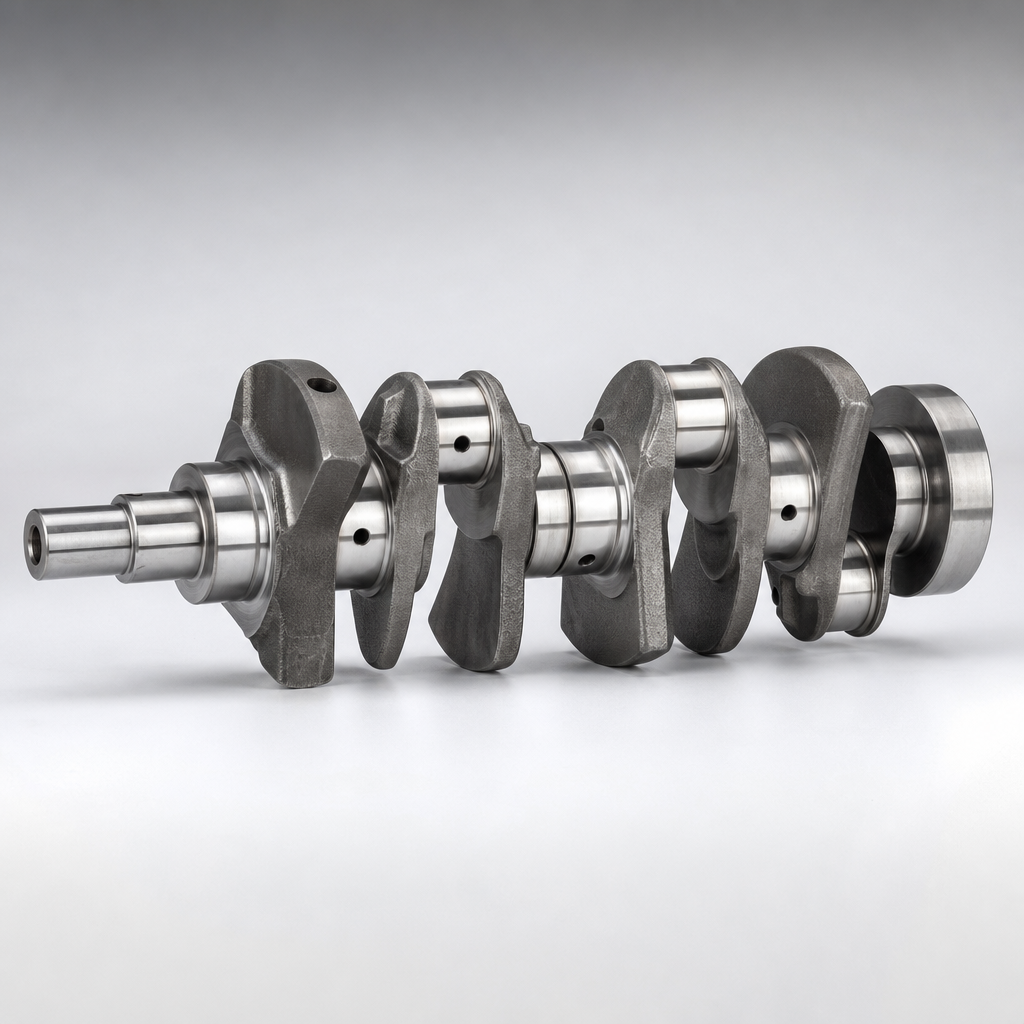
Crankshaft durability is decided in the details: material, machining allowance, heat treatment, surface finish, oil-hole cleaning, and final inspection. For Skoda-related aftermarket programs, Driventus reviews each application by duty cycle and OE-equivalent geometry before confirming the production route. Depending on the part family, production may use forged steel or cast iron specifications aligned with validated aftermarket requirements.
Before comparing price, define the inspection points that determine whether the part can survive service:
| Parameter | Procurement relevance | Typical control method |
|---|---|---|
| Main journal diameter | Bearing oil clearance, oil pressure, and noise risk | Micrometer and roundness inspection, often controlled within micron-level drawing tolerance |
| Connecting rod journal diameter | Bearing fit and oil film stability | Dimensional check under batch inspection plan, with each journal position recorded where required |
| Runout | Vibration, seal wear, and bearing load | V-block or centre-based measurement, commonly reviewed against a tight runout limit such as 0.03-0.05 mm where specified |
| Surface roughness | Bearing bedding and oil retention | Profilometer inspection, commonly targeting Ra 0.2-0.4 um on finished journals when required by drawing |
| Fillet radius | Fatigue strength at journal transition | Radius gauge or optical profile check, with no sharp transition or grinding burn |
| Hardness depth | Wear resistance and service life | Hardness test after heat treatment, plus case-depth verification where induction hardening is specified |
| Dynamic balance | NVH and bearing load reduction | Balancing machine verification, with residual imbalance limits agreed by part family |
| Item | Standard wholesale order | Project or private-label order |
|---|---|---|
| MOQ | Commonly 20-50 pieces per SKU when blanks are available, or mixed-SKU MOQ by total order value | Often 100+ pieces per SKU if tooling, special marking, or custom packaging is required |
| Sample lead time | Commonly 15-30 days after confirmation when existing tooling is available | 30-60 days when drawings, fixtures, new blanks, or validation reports are required |
| Mass production lead time | Often 35-60 days depending on schedule and material status | Usually agreed after sample approval, with 45-75 days common for controlled project batches |
| Packaging | Neutral export carton, VCI bag or anti-rust oil, journal sleeves, wooden case or pallet | Custom label, carton, barcode, pallet plan, and photo approval before shipment |
| Documentation | Invoice, packing list, inspection summary, material or hardness evidence when agreed | Additional dimensional report, control plan, sample approval file, or PPAP-style file |