Connecting Rod Opel Wholesale: Practical Supplier Audit Guide
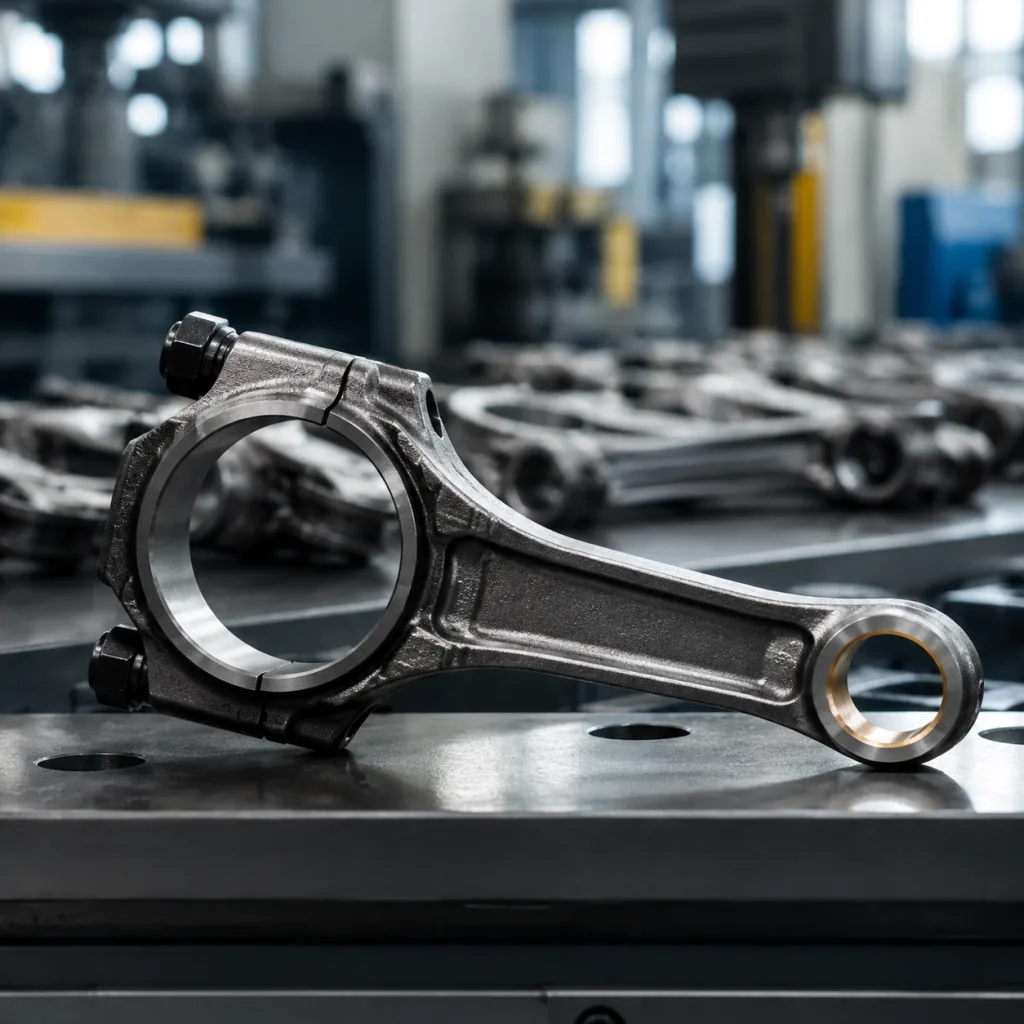
For importers and category buyers, sourcing an Opel-fit connecting rod is less about catalogue breadth and more about process control, dimensional consistency, and supply reliability. A rod can match nominal drawing dimensions and still fail in service if big-end bore geometry, cap alignment, bolt-seat machining, or heat-treatment consistency drift from lot to lot. In rebuild and aftermarket channels, those issues can show up as bearing crush loss, abnormal pin wear, noise, or early fatigue cracking, and the cost scales quickly across multiple markets.
That is why a wholesale assessment should cover raw material traceability, forging source control, machining capability, inspection records, packaging discipline, and export support. For connecting rods, checking overall length and bore size is not enough. Buyers should also verify bore roundness and cylindricity, bend and twist, cap split-face condition, hardness range, and lot identification discipline.
This guide explains what to verify when reviewing a supplier for connecting rods used in Opel-compatible petrol and diesel engine applications. It focuses on B2B criteria: MOQ, lead times, PPAP-style documentation, compliance expectations, and factory audit points. Driventus is an independent aftermarket manufacturer; brand names are referenced for fitment only. Buyers looking across our range can review related engine parts in our catalog and engine component ranges at /products/engine-components.html.
Searches for connecting rod opel wholesale supply are often driven by margin targets, so it is easy to compare quotations on unit price alone. In practice, the stronger sourcing decision comes from comparing the full supply model: how forgings are sourced, which steel grade is specified, how bores are bored and honed, how lots are identified, how packaging survives export handling, and how quickly a supplier can support containment and corrective action if a market issue appears. The sections below are designed to help wholesale buyers build that full qualification picture before placing production orders.
What wholesale buyers should verify first
A connecting rod is a high-cycle fatigue part. It sees alternating tensile and compressive loads, bearing loads at the big end, and oscillating pin loads at the small end. Even small variation in steel cleanliness, heat treatment, cap alignment, or machining datum control can shorten service life, even when nominal dimensions appear acceptable. That is why procurement teams should qualify suppliers on manufacturing controls before discussing price.
Early in the review, buyers should establish whether the supplier is a true manufacturer, a machining integrator, or only a trading company sourcing from outside plants. That distinction affects lead-time control, process accountability, technical response speed, and warranty ownership. A direct manufacturer, or a supplier with controlled subcontractors and documented incoming inspection, can usually provide stronger traceability and more stable repeatability.
Priority checks include:
Material grade and traceability: forged steel chemistry certificates by heat number; common connecting-rod materials in aftermarket programmes include microalloy forging steel or quenched-and-tempered alloy steel such as 40Cr/4140-type grades, depending on the design basis
Process route: closed-die forging, trimming, normalising or quench-and-temper, rough machining, stress relief where applicable, finish boring/honing, and shot blasting or peening if specified in the process plan
Critical dimensions: centre-to-centre length, small-end bush ID if bushed, big-end bore size, bore roundness/cylindricity, side-face width, twist, and bend
Fastener seat integrity: cap parting-face flatness, bolt bore position, spot-face perpendicularity, and bolt torque or clamp-load validation where rod bolts are supplied
Batch consistency: Cpk/Ppk or equivalent capability data on key characteristics such as big-end bore and centre distance, especially for stable repeat orders
Inspection frequency: first-off approval, in-process patrol checks, final inspection sampling plan, and retained records by lot
Packaging standard: VCI or anti-rust oil protection, partitioned cartons where needed, moisture barrier, and pallet stability for ocean freight
One practical opening question is this: what is the approved reference basis for fitment? For Opel-compatible applications, references may be developed from OE numbers, aftermarket cross-references, sample reverse engineering, or customer drawings. If the supplier cannot explain the reference origin clearly, catalogue error risk rises, especially on engine families where similar rods differ in beam section, centre length, pin diameter, big-end width, or cap and bolt design.
Another useful early-stage check is whether the supplier can provide a clear sample approval workflow. This should define what is submitted before mass production, such as:
dimensional report against the agreed drawing or approved sample
material certificate or grade declaration linked to heat or lot
piece weight data and weight spread across the sample set
bore geometry readings on critical diameters
hardness results and test method
photos of packing, marking, and traceability code format
fitment notes or cross-reference confirmation
For international supply, buyers should also confirm whether the supplier works under a documented quality system aligned with IATF 16949:2016 and ISO 9001:2015. These standards do not guarantee part performance by themselves, but they do provide a framework for traceability, nonconformance control, gauge calibration, supplier management, and corrective action.
In short, the first verification stage for a connecting rod opel wholesale programme should answer three questions clearly: can the supplier manufacture consistently, can it document what it makes, and can it support the application range you need without creating stock, fitment, or warranty risk.
Typical wholesale supply criteria for Opel-fit connecting rods
The exact commercial terms depend on application mix, annual volume, and the extent of machining or packing customisation, but most buyers compare suppliers against the same baseline metrics.
Procurement factor
Typical B2B expectation
Why it matters
MOQ per item
100-500 pcs
Balances setup efficiency with inventory risk
Sampling lead time
20-45 days
Allows forging allocation, machining and dimensional/metallurgical approval
Mass production lead time
35-60 days
Supports container planning and replenishment
Dimensional inspection report
Required
Confirms conformance on critical features
Material certificate
Required
Supports lot traceability and audit readiness
Hardness report
Often requested
Verifies heat-treatment consistency by lot
Neutral packing
Standard
Simplifies resale across multiple markets
Private label packing
By agreement
Important for distributor branding
Mixed container loading
Usually available
Helps consolidate SKUs across engine lines
Warranty returns process
Defined in writing
Reduces dispute risk and speeds claim closure
</tr></thead><tbody> </tbody></table>When discussing connecting rod opel wholesale programmes, ask whether the supplier can support both steady-volume replenishment and low-run service references. Many aftermarket portfolios contain a small number of high-turn SKUs and a long tail of slower-moving applications. A supplier that only accepts large single-SKU runs may force overstocking on low-velocity references.
It also helps to separate supply criteria into operational, commercial, and catalogue requirements.
Operational criteria
These affect whether the supplier can keep your inventory moving without disruption:
stable production scheduling for repeat orders
ability to combine multiple Opel-fit references in one shipment
realistic safety lead time during peak season
export documentation prepared without repeated correction
consistent packing quantities matched to warehouse handling units
defined lot coding so returns can be segregated by production batch
Commercial criteria
These determine whether the programme remains viable over time:
MOQ that fits your forecast and reorder cycle
transparent tooling, fixture, or sample charges if any apply
clear payment terms for sample and mass-production stages
agreed policy for shortages, defects, and claim credits
predictable pricing on repeat orders rather than one-off spot quotes
clarity on whether bolts, bushes, or matched-set packing are included in the quoted price
Catalogue and service criteria
These matter for distributors selling across multiple markets:
accurate OE and aftermarket cross-reference support
stable internal item coding and barcode format
net and gross weight data for each SKU
standard carton dimensions for warehouse planning
image support or neutral photography where required
clear product description distinguishing bushed or non-bushed and bolt-included or bolt-excluded variants
Where annual programmes justify it, buyers may also request custom manufacturing support for private packaging, selective weight grouping, matched set supply, or application-specific markings. Those details should be documented, not assumed.
A practical example is a distributor that needs one fast-moving Opel-compatible reference packed in branded four-piece engine sets for one market, while the same rod is supplied in neutral bulk cartons for another. A capable supplier should clarify whether these packing variants are handled on the main packing line, at final kitting stage, or through external repacking, because each approach changes error risk, traceability integrity, and lead time.
In wholesale practice, the best supplier is often not the one offering the lowest nominal MOQ. It is the one that can align MOQ, replenishment frequency, and mixed-SKU loading with your real demand profile. That alignment is especially important when building a sustainable connecting rod opel wholesale line rather than making occasional spot purchases.
Dimensional and material controls that affect field performance
Price pressure often pushes connecting rods into a pure commodity category, but most failure modes are linked to process discipline rather than list price. Buyers should review the control plan for the features below and ask how each one is measured, recorded, and linked to the shipment lot.
Critical technical points
Big-end bore diameter and roundness: directly affects bearing crush, oil-clearance behaviour, and housing fit
Small-end bore or bush finish: influences wrist-pin fit, lubrication retention, and oscillating wear
Centre distance tolerance: affects piston deck-height stack-up and cylinder-to-cylinder consistency
Rod weight consistency: reduces vibration spread within a set and helps maintain balance consistency in service builds
Parallelism, twist, and bend: limits side loading at the piston pin and crank journal
Fracture split or machined cap alignment: if applicable, must maintain cap-to-rod registration and bore integrity after bolt-up
Hardness range after heat treatment: should correspond to the specified steel and intended duty cycle
Surface integrity: machining marks, burr removal, and fillet condition can influence stress concentration and assembly quality
A capable supplier should be able to explain how these are measured, by which gauge type, and at what sampling interval. In typical production practice, big-end size may be checked with dial bore gauges or air gauges, geometry may be verified periodically on CMM or form-measurement equipment, hardness may be checked by Rockwell or Brinell method depending on part and specification, and bend and twist may be controlled on dedicated fixtures.
Beyond the list above, buyers should understand why these controls matter in service.
Big-end bore geometry
The big-end housing must retain the bearing shell with the correct crush and assembled geometry. If housing bore diameter drifts oversize, bearing retention can weaken; if it goes undersize or distorts after cap tightening, the installed bearing shape and clearance can deviate from design intent. Poor roundness or cylindricity can destabilise the oil film, creating local hot spots and accelerated wear. In the field, this can lead to premature bearing distress, knock, oil-pressure issues, or crankshaft journal damage. For wholesale buyers, that means a small machining variation can create claim costs far beyond the cost of the rod itself.
Small-end condition
Where the small end uses a bush, internal diameter, surface finish, concentricity, and bush retention all affect piston-pin fit and wear behaviour. Typical review points include whether the bush is pressed and finish-honed after installation, and whether interference and bore finish are controlled. Where no bush is used, the small-end eye still requires controlled finish quality and geometry. Poor control here can lead to pin scoring, noise, seizure risk, or abnormal wear patterns during overhaul service.
Centre-to-centre length and alignment
This dimension influences piston position at TDC and overall deck-height consistency. In multi-cylinder engines, excessive variation between rods can affect compression balance and running smoothness. Bend and twist errors can introduce side loading into the piston skirt, pin, and bearing system, increasing friction and uneven wear. Buyers sourcing full sets rather than single service pieces should ask whether the supplier controls weight spread within a defined band and whether rods are grouped by reference-specific balancing criteria where required.
Material and heat-treatment discipline
Material grade alone is not enough. The supplier should control forging quality, grain flow orientation, decarburisation risk, heat-treatment parameters, and hardness verification. Buyers should ask whether hardness is checked by batch, shift, or lot, and whether retained records link results to shipment batches. Where available, it is useful to ask about microstructure verification and whether forged blanks are normalised before machining or quenched and tempered after rough machining, depending on the route. If steel cleanliness, inclusion level, or heat-treatment consistency is weak, fatigue life can vary significantly even if dimensional inspection passes.
Cap and fastener interface
On rods supplied with caps and bolts, the integrity of the parting faces, bolt seating areas, and fastener holes is essential. Misalignment at the cap joint can distort the big-end bore after assembly. Buyers should ask whether the rod is measured in the assembled and torqued condition, what tightening method is used during bore inspection, and whether replacement bolts are controlled to the same specification as production bolts. If bolts are included, request clarification on grade, thread quality, supplier approval, and torque or clamp-load verification practice.
For parts shipped into the EU and UK, buyers may also request declarations relating to REACH (EC) No 1907/2006 where applicable to substances in coatings, oils, rust preventives, or packaging materials. While a connecting rod is primarily a metallic component, compliance documentation is still part of a complete sourcing file.
Taken together, these dimensional and material controls are the technical core of any reliable connecting rod opel wholesale supply programme. They separate a low-price listing from a component that can perform consistently across different markets, rebuild conditions, and engine duty cycles.
Factory audit checklist for a connecting rod supplier
A factory audit should confirm that the supplier is not only compiling documents for customers, but actually controlling production variation. The points below are practical to verify during an on-site visit or a structured remote audit.
Audit points
1. Incoming material control Check heat-number segregation, spectrometer access or third-party material certificates, and quarantine procedures for nonconforming steel or outsourced forgings.
2. Forging source management Confirm whether forgings are made in-house or outsourced. If outsourced, ask for approved-supplier criteria, incoming dimensional checks, and evidence that forging revision level matches the current machined drawing.
3. Machining capability Review line equipment for cap machining, boring, honing, side-face machining, and weight control. Ask how fixture wear, cutter offset, and machine capability are monitored.
4. Gauge calibration Calibration status should be current and traceable. Verify master rings, bore gauges, micrometers, hardness testers, and any torque tools used in rod assembly or inspection.
5. Lot traceability Follow one batch from raw material or forging through machining, washing, final inspection, and packed carton. If traceability breaks at sub-process level, warranty risk increases.
6. Nonconformance handling Ask for examples of 8D, NCR, or corrective-action records under the site quality system, including containment, root-cause analysis, and verification of effectiveness.
7. Packing and export control Inspect rust-prevention method, label accuracy, carton stacking strength, and pallet wrapping for container shipment. Export failures often start with packaging, not machining.
A strong audit goes further than checking whether documents exist. It should test whether the production system works in daily practice.
What to observe on the shop floor
When touring the machining area, look for:
parts identified clearly by lot or operation status
separate areas for accepted, suspect, and rejected material
operator instructions visible at each station
gauges stored properly and protected from damage
fixtures and cutting tools maintained rather than improvised
evidence of first-piece approval before production runs continue
controlled washing, deburring, and rust-prevention steps before packing
If bores are a critical quality focus, ask to see how the supplier reacts when a measurement goes out of limit. A robust answer includes machine stop, containment of the affected lot, last-good and first-bad determination, re-check of previous pieces, and documented corrective action. A weak answer usually relies on end-of-line sorting, which is less reliable and more expensive.
Questions for a remote audit
If an on-site visit is not possible, buyers can still request useful evidence:
live video walkthrough of material, machining, and packing areas
screenshots or scans of calibration certificates
sample inspection records from a recent production lot
traceability demonstration from certificate to carton label
photos of carton interiors, palletisation, and export marking
evidence of how caps and rods are matched and kept together during processing
Traceability test example
A practical audit method is to choose one finished carton and ask the supplier to trace it backward to:
1. production date 2. machining batch 3. forging batch 4. raw material certificate or forging-material reference 5. inspection records for the lot
If that chain cannot be shown quickly and clearly, traceability may be more theoretical than real.
If the supplier references compliance to IATF 16949:2016 or ISO 9001:2015, audit evidence should include control plans, PFMEA records where relevant, operator instructions, reaction plans for out-of-spec conditions, and retention of inspection data. More information on our quality system is available for buyers reviewing supplier qualification files.
For buyers building a long-term wholesale source, the audit should end with a simple conclusion: does the factory control variation at forging, machining, and assembly stages before shipment, or does it depend mainly on final inspection to catch problems after they happen?
Commercial terms, documentation and risk reduction
For wholesale programmes, the strongest supplier is not always the one with the lowest ex-works price. Total landed cost depends on rejection rate, lead-time stability, packaging efficiency, document accuracy, and claims handling speed.
Key commercial questions to settle before first order:
What is the MOQ by SKU and by total order value?
Are sample costs credited against production orders?
What is the standard lead time in low and peak seasons?
Can the supplier provide inspection reports, material certificates, hardness data, and packing lists by lot?
Is there a written process for warranty analysis, containment, and replacement?
Can orders be combined with pistons, crankshafts, gaskets, or pumps to improve freight economics?
Are carton labels, barcodes, and pallet marks configurable for each market?
If bolts or bushes are included, are they listed as part of the controlled BOM and shipment record?
For buyers managing multi-country distribution, product-data accuracy matters nearly as much as the part itself. Item master files should include application mapping, dimensions, net and gross weights, carton quantity, HS code support, country-of-origin data where required, and neutral product images.
Risk reduction improves when buyers define the transaction in writing before production starts. In many disputes, the real problem is not only product quality but also unclear acceptance criteria. A purchase programme for connecting rod opel wholesale supply should therefore document at least the following:
Commercial items to confirm in writing
agreed reference numbers and application scope
unit price basis and currency
Incoterms and loading point
standard and peak-season lead time
accepted quantity tolerance if any
packing format per inner and outer carton
labeling content and barcode specification
document set required before shipment
claim window after receipt
replacement, credit, or rework policy
whether the approval basis is OE drawing, supplier drawing, approved sample, or customer print
Documentation buyers commonly request
Depending on market and programme size, the file may include:
proforma invoice and final commercial invoice
packing list by carton and pallet
dimensional inspection report
hardness report where requested
material certificate or mill certificate reference
certificate of origin if needed
declaration of conformity for requested standards or substances
product photos and label approval record
batch traceability format
pre-shipment inspection record or final lot summary
How to reduce first-order risk
A cautious first order often follows this sequence:
1. approve technical samples 2. confirm final packaging and label layout 3. place a pilot production order 4. inspect pre-shipment or review final lot records 5. monitor first market feedback before scaling volume
This staged approach is especially useful for importers entering a new source country or adding a new supplier to an established line card.
Buyers should also calculate landed risk cost, not just landed freight cost. If a supplier offers a slightly lower price but has weak documentation, slow corrective-action response, or poor export packing, the hidden cost can outweigh the initial saving. Delayed customs clearance, warehouse relabelling, lot sorting, and warranty screening all reduce margin.
If you need private label, special pack quantity, or a broader engine hard-parts programme, Driventus can discuss custom manufacturing requirements alongside standard supply.
Well-defined terms and documentation are often what make a connecting rod opel wholesale programme scalable. They help the buyer move from trial orders to repeat container planning with fewer surprises and stronger cost control.
How Driventus supports wholesale engine component sourcing
Driventus supplies engine and powertrain components for international B2B customers, including distributors, wholesalers, OEM-oriented buyers, and repair networks. For connecting rod programmes, the focus is on repeatable machining, lot traceability, and export-ready documentation rather than consumer-facing packaging.
Buyers typically review:
Product scope across engine hard parts in our catalog
Certification status under IATF 16949:2016 and ISO 9001:2015
Sampling and approval workflow
Neutral or private-label packing options
Consolidated shipment planning across multiple product lines
For Opel-compatible applications, fitment review should be based on agreed drawings, dimensions, and cross-reference data used for aftermarket identification. Driventus does not claim approval by any vehicle manufacturer. Driventus is an independent aftermarket manufacturer; brand names are referenced for fitment only.
In practical sourcing terms, Driventus support is designed around the needs of wholesale buyers rather than one-off retail transactions. That means discussions can cover:
Supply planning support
annual volume estimates by reference
mixed-order planning across multiple engine components
lead-time scheduling for replenishment cycles
consolidation of slower-moving and faster-moving SKUs
packing choices that match distributor warehouse operations
Technical and approval support
sample review against agreed dimensions
inspection reporting on key characteristics such as bore size, centre distance, and weight
traceability information by lot
clarification of material and process documentation
fitment review using aftermarket cross-reference logic
Packaging and export support
neutral export packing for broad-market resale
private-label options subject to programme scope
carton and pallet marking to buyer specification
shipment document preparation for international trade
coordination across multi-item orders to improve freight utilisation
For buyers searching specifically for connecting rod opel wholesale supply, the value is not only part availability but also the ability to align technical review, packaging format, and shipment planning in one sourcing process. This is particularly relevant for distributors who want to purchase connecting rods alongside pistons, crankshafts, gaskets, or other engine components rather than managing many separate suppliers.
Where qualification is required, buyers can request information relevant to supplier approval, including quality-system references, sample workflow, inspection-document scope, and standard traceability format. Early discussion of target markets, annual demand, fitment references, and product mix usually leads to faster and more accurate quotation support.
For current availability, MOQ discussion, or audit document requests, buyers can request a quote with target annual volume, destination market, and required references.
Frequently asked questions
For aftermarket programmes, MOQ commonly starts around 100 to 500 pieces per SKU, depending on forging availability, machining setup time, inspection requirements, and packaging format. Mixed-SKU orders can reduce inventory pressure if the supplier supports consolidated planning and combined shipment loading.
At minimum, request a dimensional inspection report, material certificate, packing specification, traceability method, and quality certification details. For higher-volume programmes, also ask for hardness results, process flow, control plan, approved-sample basis, and the supplier's warranty or corrective-action procedure.
Start with samples, verify critical dimensions independently, confirm whether bores are measured in assembled and torqued condition, approve packaging for sea freight, and agree acceptance criteria in writing. A factory audit, even remote, is useful for checking calibration, traceability, reaction plans, and nonconformance control before mass production.
If you are qualifying a supplier for Opel-fit connecting rods or broader engine hard-parts sourcing, send your target references and annual demand to our team. We can review supply options and documentation requirements at /contact.html