A connecting rod for Infiniti Q50 replacement is not a catalogue commodity. It decides bearing clearance, piston travel, balance, NVH, oil-film stability, and the size of a warranty problem if one dimension is wrong.
For distributors, repair networks, and rebuild programs, the useful question is not “Can you supply Q50 rods?” It is: which engine code, which crankpin, which piston pin, which bolt condition, which weight range, which inspection record, and which batch traceability? This guide reframes the purchase around those decisions. Driventus manufactures engine and powertrain components in Taizhou, Zhejiang, for aftermarket and B2B customers in more than 60 countries. Production is managed under IATF 16949:2016 and ISO 9001:2015. Driventus is an independent aftermarket manufacturer; brand names are referenced for fitment only.
Decision Gate 1: Prove the Rod Fits the Engine, Not Just the Model Name
Infiniti Q50 applications vary by engine family, model year, market, drivetrain, and production date. That makes the model name a weak purchasing control. The release point should be a technical match: engine code, crankpin journal diameter, piston pin diameter, centre-to-centre length, big-end width, small-end width, cap design, and rod-bolt configuration.
Treat OE cross-references as interchange clues, not proof. A catalogue line can help shortlist a part, but it does not show vehicle manufacturer approval unless that approval is separately documented. Before a volume order, ask for a dimensional drawing, first-article inspection report, or buyer-approved sample comparison. Where service data and OE references are available, use them to verify the removed part.
For broader engine-component sourcing, buyers can review our catalog and the engine category page at /products/engine-components.html. For non-standard variants, weight matching, or private-label packaging, Driventus can support custom manufacturing from approved samples or buyer drawings.
Build the quotation around a fitment release sheet. Record the measured sample value, target drawing value, accepted tolerance, measuring tool, inspection temperature, and approval owner. For connecting rods, measurements should normally be taken at 20°C with calibrated bore gauges, micrometers, height gauges, and mandrel fixtures. If no drawing exists, approve a master sample and photograph the parting line, oil hole, bolt head, cap marking, and bush style.
Release the order only after these checks are locked:
Engine code, displacement, induction type, and production range matched to the target vehicle population
Crankpin journal size and bearing shell specification checked against the big-end bore requirement
Big-end bore diameter, roundness, and taper measured after cap assembly at the agreed bolt condition
Small-end bore or bush internal diameter matched to piston pin size, with pin oil clearance defined where required
Centre-to-centre length verified with calibrated fixtures or bore mandrels, not calipers
Big-end width and side clearance checked against the crankshaft journal layout
Rod bolt thread form, under-head radius, tightening method, and torque-angle or stretch procedure confirmed
Unit weight and end-to-end balance range specified when matched sets are required
Avoid “same as sample” as the only instruction. A stronger release condition is: big-end bore to drawing after bolts are tightened with specified lubricant; centre distance tolerance agreed in millimetres; big-end and small-end weight spread agreed per engine set; cap and body supplied as non-interchangeable matched pairs with laser, dot, or stamped batch identification.
Spec Deep-Dive: Material, Heat Treatment, and Bore Geometry
A replacement rod can look correct and still fail the sourcing test. Material, heat treatment, bore stability, and surface condition decide whether the part survives repeated combustion and inertia loads.
Most replacement connecting rods for modern petrol engines use forged steel or high-strength powder-forged steel, depending on the original design, expected load, and production route. The material must provide tensile strength, fatigue resistance, machinability, and stable geometry after heat treatment. For performance-sensitive or warranty-sensitive rebuild programs, consistency matters as much as headline strength.
Do not accept vague terms such as “high quality steel” or “OE quality” as specifications. Ask the supplier to state the steel grade or material standard, heat-treatment process window, hardness range, surface requirements, and traceability method. Batch records should connect forging lot, heat-treatment lot, machining lot, rod-bolt batch, and final inspection results.
Parameter
Procurement requirement
Typical control target
Why it matters
Material
Forged alloy steel, powder-forged steel, or buyer-approved equivalent
Grade and melt/lot traceable on certificate
Supports fatigue strength under alternating combustion and inertia loads
Heat treatment
Controlled quench and temper or specified supplier process
Hardness often controlled within a 3–5 HRC window when agreed
Stabilises strength, hardness, and bore geometry
Big-end machining
Bored and honed with cap assembled and bolts tightened to the defined condition
Diameter tolerance commonly within 0.008–0.015 mm on critical programs
Maintains bearing crush and oil-film control
Big-end geometry
Roundness, taper, and cylindricity checked at multiple planes
Roundness/taper commonly held within 0.005–0.010 mm when specified
Prevents local bearing load and oil-clearance variation
Small-end bush
Bronze or equivalent bearing material where the design requires a bush
Pin clearance and surface finish defined by buyer drawing
Reduces piston pin wear and helps maintain pin movement
Weight grouping
Buyer-defined set tolerance
Common matched-set spread: ±1–3 g total rod weight, tighter by agreement
Supports rotating and reciprocating assembly balance
Surface condition
No laps, cracks, heavy decarburisation, sharp burrs, or harmful machining marks
100% visual check plus MPI when specified
Reduces fatigue initiation points
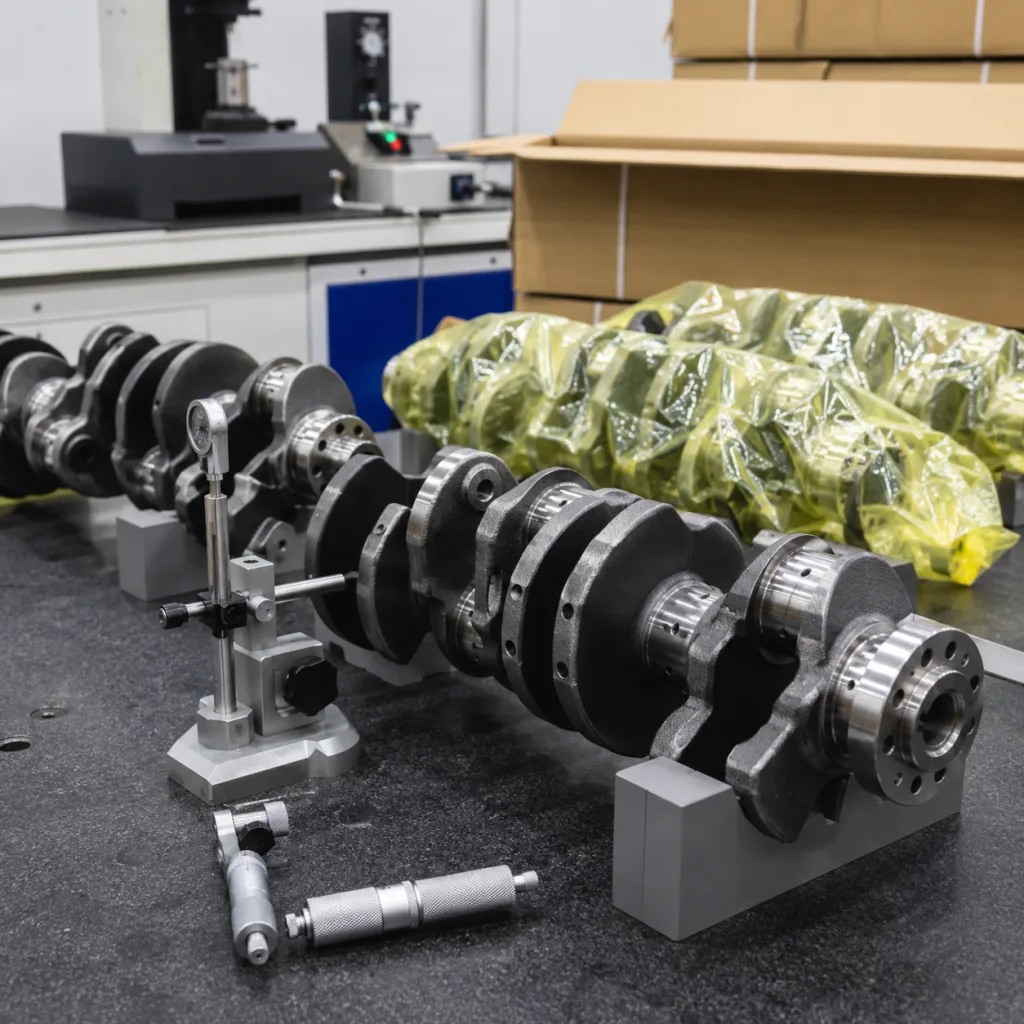
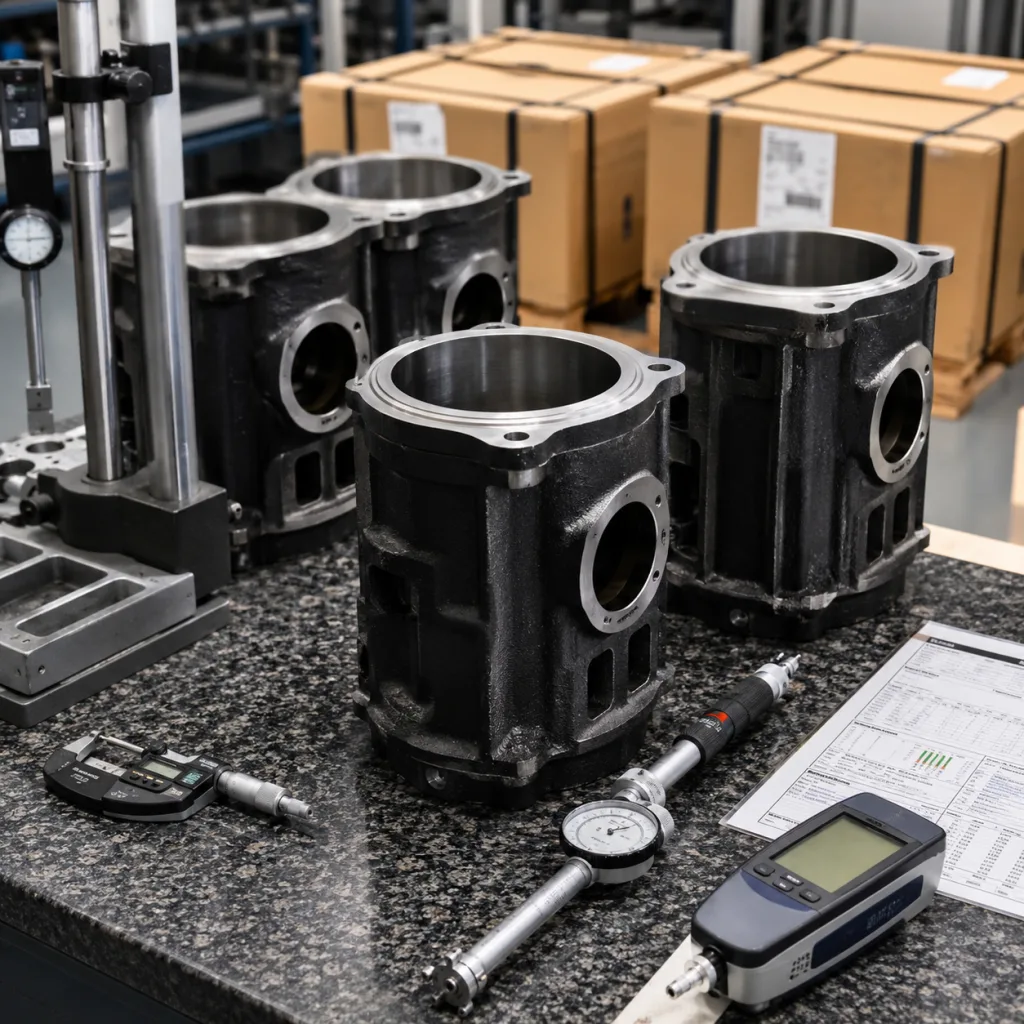
</tr></thead><tbody> </tbody></table>One diameter reading is not enough. For the big end, measure at 0°, 45°, 90°, and 135° at the front, centre, and rear of the bore after the cap is assembled to the specified bolt condition. Roundness, taper, cylindricity, and surface finish are more useful than a single pass/fail value. Bearing-contact bores normally require a controlled honed finish; buyers with internal requirements should state an Ra target, for example Ra 0.2–0.8 µm for precision bearing surfaces where compatible with the design.
For high-volume orders, define who checks what, how often, and what happens when a value drifts. A practical control plan may use 100% checks for appearance, marking, cap pairing, and bolt presence; first-piece and last-piece checks for every machining shift; and AQL or buyer-defined sampling for non-critical dimensions. Critical characteristics such as big-end bore, centre distance, and bolt torque condition need tighter frequency and documented escalation: line stop, segregation, rework approval, and reinspection records.
Failure Modes: Where Replacement Rod Programs Usually Go Wrong
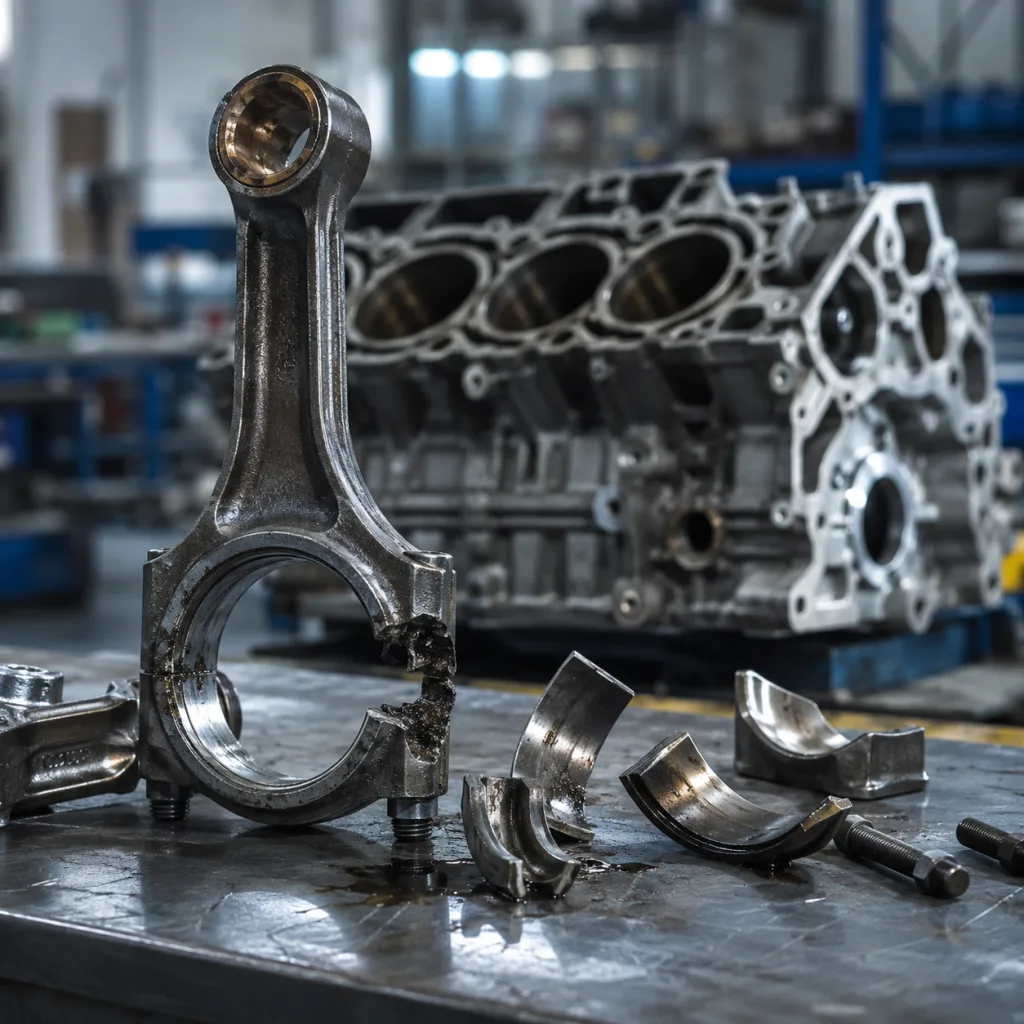
For the connecting rod for Infiniti Q50 replacement market, most claim risk starts with dimensional mismatch. A small error can change bearing oil clearance, piston deck height, compression balance, side clearance, and noise behaviour. In a rebuild kit, one wrong rod can also make the pistons, bearings, crankshafts, and other supplied parts look suspect.
The first control is a first-article inspection report before bulk shipment. It should compare actual measurements with the approved drawing, master sample, or buyer-supplied measurement sheet. If the buyer provides a used sample, the supplier should identify wear-related deviations and agree which dimensions are reference-critical before tooling, machining, or inspection limits are finalised.
Common failure points to control:
Centre-to-centre length measured with calibrated bore mandrels; typical aftermarket control is often within ±0.02–0.05 mm when agreed
Big-end bore diameter after rod bolts are tightened to the defined assembly condition; critical programs commonly target ±0.008–0.015 mm
Big-end bore roundness, taper, and cap parting-line condition; common roundness/taper controls are 0.005–0.010 mm where specified
Small-end bore diameter, bush alignment, and bush surface finish where a bush is fitted; piston-pin oil clearance should be defined by drawing or rebuild standard
Big-end width, small-end width, and side-clearance surfaces; width variation must allow crank side clearance to remain within the rebuild specification
Parallelism and twist between big-end and small-end axes; buyer programs often specify maximum bend/twist in mm per 100 mm or by fixture reading
Surface roughness of bearing and piston-pin contact areas, with Ra target stated where available
Bolt seat flatness, cap mating-face condition, and dowel, serration, or fracture-split engagement where applicable
Total rod weight and big-end/small-end weight split when balancing is specified; matched sets commonly require ±1–3 g total spread and controlled end-weight spread
Rod bolts deserve their own failure review. The rod is not just a machined forging; the clamping system controls big-end bore stability under load. Specify whether bolts are supplied, whether they are single-use, which lubricant condition applies, and whether tightening data is based on torque, torque-angle, or stretch. For example, require the big-end bore to be inspected only after bolts are tightened with light engine oil or specified assembly lube, using the agreed torque and angle. If the installer later uses a different lubricant or reuses torque-to-yield bolts, claim analysis becomes unreliable.
For rebuild kits, pack by set, not by loose component count. One carton or internal sleeve should contain rods from the same batch and weight group, with cap/body pairs protected from mixing. If pistons, pins, rings, bearings, and rods ship together, define the kit logic: one engine set per box, rod orientation marked, bolt instruction included, and inspection report tied to the kit batch. Driventus can align inspection documentation with the buyer’s internal rebuild requirements through its documented quality system.
Evidence Check: What Quality Documents Should Actually Prove
A credible supplier should provide process controls and validation evidence without exaggerating approvals. For replacement connecting rods, relevant checks may include material verification, hardness testing, dimensional inspection, surface-defect inspection, magnetic particle inspection where specified, and fatigue or endurance validation for representative designs. The test depth should match the buyer’s warranty exposure, order volume, and application risk.
Driventus operates under IATF 16949:2016 and ISO 9001:2015 for manufacturing management and quality documentation. These standards support process control, traceability, corrective action, internal auditing, and customer-specific requirements. They do not mean that a specific replacement rod is approved, endorsed, or supplied by a vehicle manufacturer.
Ask for documents that prove the part can be repeated, not documents that only look complete:
Dimensional inspection report for first article and production batches, listing actual values rather than pass/fail only
Material certificate or supplier material declaration with steel grade, heat number, and lot traceability where available
Heat-treatment record and hardness test results, with test location and acceptance range stated
Control plan covering forging, heat treatment, machining, cleaning, packing, and inspection
Process capability data for agreed critical characteristics where applicable, commonly targeting Cpk ≥1.33 for stable production characteristics and higher targets for safety-critical buyer programs when agreed
Surface-defect or magnetic particle inspection records when required by specification, including acceptance criteria and inspection percentage
Rod-bolt certificate or batch record when bolts are supplied as part of the assembly
Traceability code format and batch-retention policy, including how many years records are retained
Packaging specification for corrosion prevention during sea or air freight, including VCI bag, oil film, desiccant, carton strength, and pallet wrapping where required
Compliance declarations when required, including REACH (EC) No 1907/2006 for relevant EU market obligations
Agree the documentation package before deposit payment. That prevents shipment delays caused by missing test reports, incomplete labels, inconsistent carton markings, or compliance declarations that do not match the destination market. The contract should state which documents are due before mass production, before balance payment, and before shipment release.
Validation can be staged. For a catalogue item, start with sample dimensional approval, material confirmation, hardness check, and batch inspection. For a private-label or high-warranty program, add PPAP-style submission, measurement system analysis for critical gauges, capability runs, fatigue evidence for representative design, and packing transit tests. For launch orders, require pre-shipment inspection photos showing part marking, cap matching, rod bolts, corrosion protection, inner packaging, carton labels, and pallet condition.
Comparison Path: Standard Rod, Matched Set, or Custom Program?
There are three practical buying paths: standard aftermarket replacement, matched engine set, and custom production. The best choice depends on annual volume, fitment complexity, brand position, documentation level, and warranty exposure.
Sourcing route
Best fit
Typical MOQ logic
Typical lead-time logic
Main controls required
Standard replacement
Distributors covering common engine applications
Lower MOQ if tooling, forging route, and machining fixtures already exist; often 50–200 sets depending on stock and packaging
Samples often 2–4 weeks if parts are available; production commonly 30–60 days after approval
</tr></thead><tbody> </tbody></table>Compare landed, claim-adjusted cost, not only EXW or FOB unit price. A rod quoted 5–8% cheaper can become more expensive if it requires extra incoming inspection, repacking, corrosion rework, or warranty handling. Put every quotation on the same basis: material grade, bolt inclusion, bush material, weight grouping, inspection report, packaging, Incoterms, payment terms, and document package.
MOQ and lead time move with tooling status, material availability, forging route, machining capacity, inspection scope, and packaging rules. Established part families sample faster than a new forging, revised bush specification, or special rod-bolt design. When buyers request a quote, they should include annual forecast, first-order quantity, destination country, packaging requirement, target documentation level, and sample-matching expectations.
Separate one-time engineering cost from unit price. Ask for sample cost, tooling or fixture cost, first-order MOQ, reorder MOQ, price breaks at 100/300/500/1,000 sets where relevant, document charges if any, private-label packing cost, and estimated sea or air freight carton dimensions. That makes the sourcing choice visible: buy standard, approve matched sets, or invest in a custom part number.
Purchase Order Lockdown: Questions to Answer Before Money Moves
A purchase order should freeze the assumptions that affect installation quality and field performance. If the PO is vague, the dispute will appear later: bearing clearance, side clearance, rod-bolt tightening, corrosion, mixed variants, or missing documents.
Before release, answer these questions:
What target vehicle and engine family are covered, including model years, market coverage, and production-date range?
Which engine code, displacement, induction type, and variant notes affect rod dimensions?
Is an OE cross-reference used only as interchange data, and does it match the provided application information?
Which approved drawing, approved sample, or measurement report controls production, including inspection temperature and gauge method?
What are the critical tolerances for centre distance, big-end bore, roundness, taper, small-end bore, width, bend/twist, surface finish, and weight grouping?
What material, heat treatment, hardness range, surface condition, bush requirement, and magnetic particle inspection rule apply?
Are rod bolts included, and what tightening condition, lubricant assumption, single-use note, torque-angle data, or stretch data applies?
What inspection report format, sampling level, critical characteristics, AQL if used, and nonconformance reaction method are required?
Which certificates, compliance declarations, and traceability codes must appear on the part, box, and carton?
What carton labels, private-label artwork, barcode rules, inner protection, VCI or oiling requirement, pallet rule, and maximum carton weight apply?
What MOQ, price breaks, sample charge, tooling or fixture charge, payment terms, and quotation validity are agreed?
Which Incoterms, destination port, logistics route, corrosion-protection method, and pre-shipment photos or inspection are required?
For EU, UK, US, Canada, Australia, and Brazil import programs, documentation consistency is part of the cost structure. A lower-cost rod that lacks traceability, inspection records, or corrosion-resistant packing can increase claim cost, delay customs clearance, and slow customer release. For sea freight, specify route-appropriate corrosion protection, such as light anti-rust oil plus VCI bag and desiccant for 60–90 days where suitable. For air freight or urgent repair campaigns, confirm that oil, packaging, and labeling comply with carrier and destination rules.
Driventus is an independent aftermarket manufacturer; brand names are referenced for fitment only. No vehicle manufacturer approval or endorsement is implied.
Frequently asked questions
Confirm the engine code, model year range, market application, crankpin diameter, piston pin diameter, centre-to-centre length, big-end width, small-end width, and rod bolt specification. Vehicle model name alone is not enough for procurement approval.
Yes. Matched sets can be quoted with agreed weight grouping, bore-geometry inspection, packaging, and batch traceability requirements. Buyers should provide the target tolerance, engine application, documentation level, and order volume.
Driventus manufacturing management operates under IATF 16949:2016 and ISO 9001:2015. Compliance documentation such as REACH (EC) No 1907/2006 declarations can be discussed where relevant to the target market.
For fitment review, sample matching, or volume pricing on replacement connecting rods, send your engine details, target tolerances, annual volume, first-order quantity, target MOQ, packaging rules, and required documentation level to Driventus. Start with a soft enquiry at [request a quote](/contact.html).