Connecting Rod for Hyundai Sonata Replacement Guide
Sourcing a connecting rod for Hyundai Sonata replacement is a tolerance decision before it is a catalogue decision. Visual similarity is not enough. The rod must hold the correct centre distance, assembled big-end bore, small-end geometry, cap location, fastener clamp load, weight range, and material condition after real production handling. A 0.010-0.020 mm error in the wrong feature can change bearing crush, piston travel, oil-film stability, noise, oil consumption, and warranty exposure. This article gives B2B buyers a practical way to qualify Sonata replacement rods: define fitment by engine data, lock the manufacturing route, verify critical dimensions, request evidence that matches the order risk, and control packaging, labels, MOQ, price, and lead time before release. Driventus supplies connecting rods and related engine components for distributors, rebuilders, and repair-chain buyers, with production managed under IATF 16949:2016 and ISO 9001:2015. Driventus is an independent aftermarket manufacturer; brand names are referenced for fitment only.
Start With a Fitment Decision, Not a Model-Year Guess
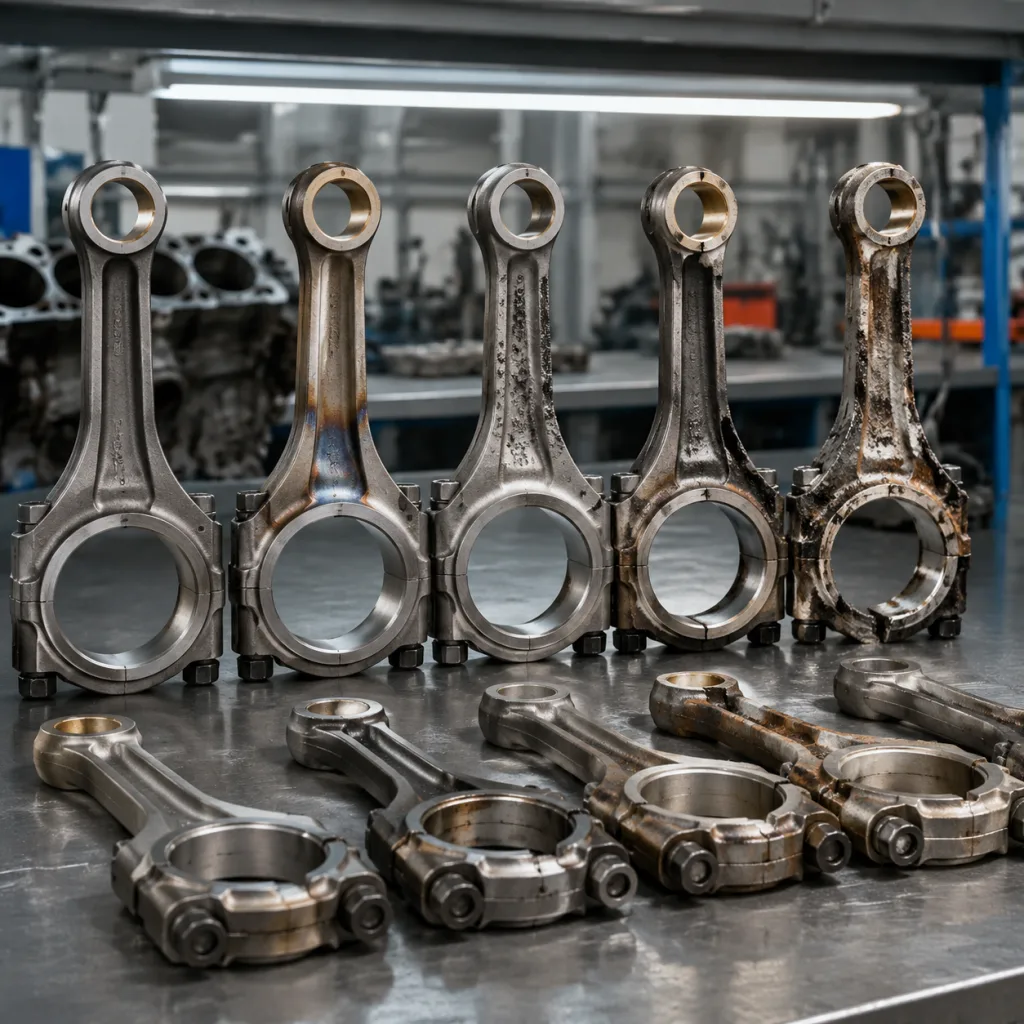
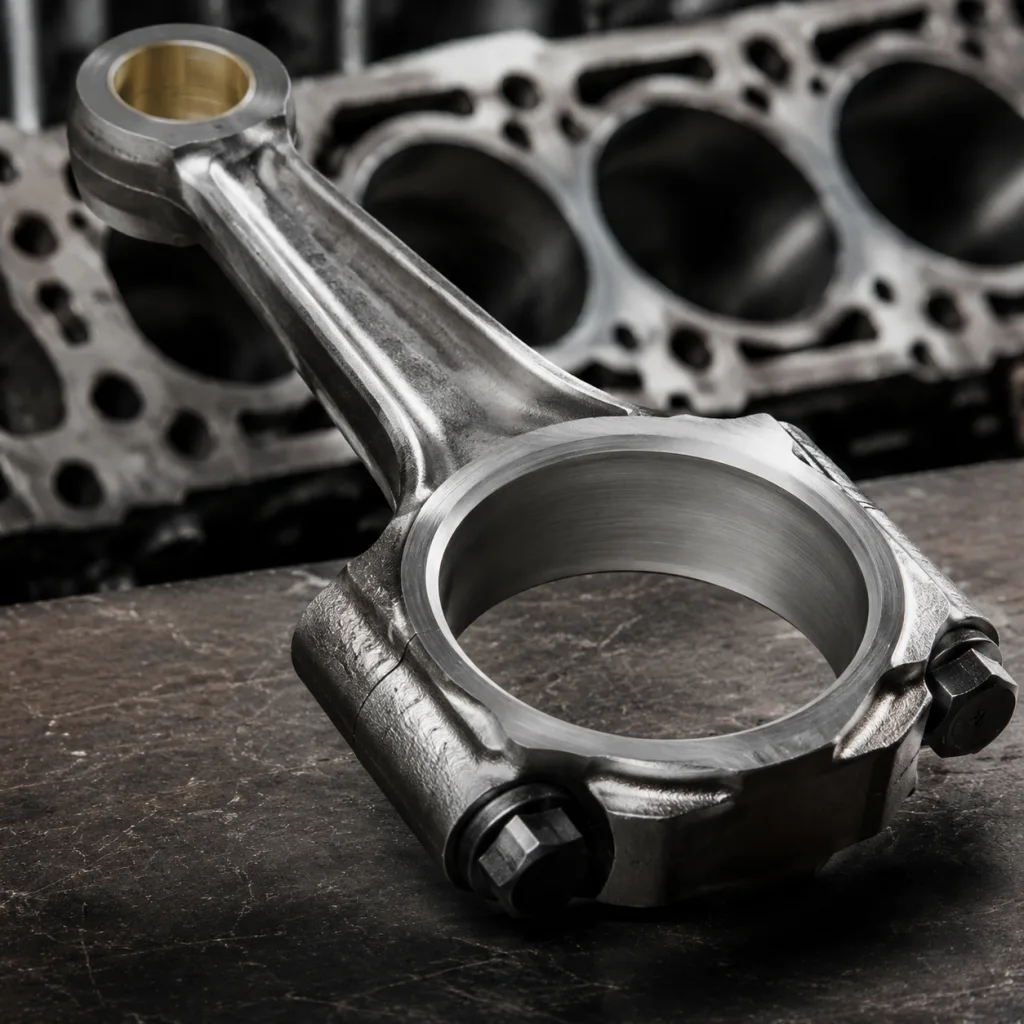
A connecting rod for Hyundai Sonata replacement programme should start with engine-code confirmation. Model year is only a clue. Sonata applications can differ by sales region, engine family, displacement, fuel system, production period, and repair-channel catalogue logic. Two rods may look close on a bench and still differ in centre distance, bore width, pin size, bearing match, bolt format, or weight class.
Build the RFQ around measurable features. Ask for samples or drawings that define centre-to-centre length, big-end housing bore, small-end bore, piston-pin diameter, bearing width, rod width, bolt specification, and weight class. Use millimetres and tolerances, not only a vehicle description.
As a first-article reference, many passenger-car rods are controlled to an agreed centre-to-centre length band such as +/-0.025 mm. Big-end housing bore should be checked after cap tightening, with roundness often controlled within 0.005-0.010 mm where the drawing allows. Matched-set weight variation should be agreed before price is fixed, commonly within 2-5 g per engine set depending on the original design and balancing requirement. These are planning examples only. Final values must follow the confirmed OE-equivalent drawing, not a generic tolerance table.
For catalogue planning, buyers can review related engine parts in our catalog and the engine-component range at /products/engine-components.html. If a buyer needs a part-number bridge, cross-references should be handled cautiously, for example OE 23510… or OE 23040…, only after the target reference, market, and engine details are confirmed.
Use this approval checklist before listing or buying:
- Engine code, displacement, fuel system, and production period by sales region
- Centre-to-centre length, datum method, and drawing tolerance
- Big-end bore diameter after cap tightening, including taper and out-of-round limit
- Small-end bore or bush internal diameter and piston-pin clearance target
- Rod width at the big end and small end, including side-clearance implications
- Bolt thread, under-head length, grade, coating, and tightening method
- Piston-pin compatibility, bearing shell family, and bearing width
- Oil-hole position, chamfer size, and burr condition, where applicable
- Individual rod weight, big-end/small-end balance split if required, and set weight variation
- Required packing unit, such as single rod, 4-piece set, or bulk service-pack format
No aftermarket supplier should claim vehicle-maker approval unless a formal approval exists. The realistic sourcing target is dimensional and functional equivalence to the original application, supported by drawings, first-article inspection, and batch records.
The Manufacturing Route Is the Specification
For connecting rods, process sequence is not background detail. It decides whether the finished part stays round, clean, strong, and repeatable after assembly. Most high-volume replacement rods are forged steel parts, followed by heat treatment, shot peening where specified, precision boring, honing, cleaning, corrosion protection, and final inspection. Some engine families use fracture-split rods. Others use machined cap-and-rod interfaces. The supplier must follow the original design intent because cap location, surface condition, and fastener clamp load directly affect bearing performance.
A procurement specification should define material grade or agreed equivalent, heat-treatment target, hardness range, surface cleanliness, machining datum strategy, and non-destructive inspection criteria. For forged steel replacement rods, buyers commonly request a medium-carbon alloy steel equivalent to the approved drawing, batch hardness reported in HRC or HB, and retained chemistry data for carbon, manganese, chromium, molybdenum, sulfur, and phosphorus. If the rod uses a bronze bush, specify bush material, press-fit, final honed ID, oil-groove geometry, and minimum edge chamfer to prevent pin scuffing.
A controlled route normally includes forging-lot identification, normalising or quench-and-temper heat treatment, hardness sampling, shot-peening parameter control where specified, cap separation or cap machining, bolt-hole machining, cap assembly, big-end semi-finish boring, stress relief if required, final boring/honing under the specified clamp condition, small-end bush installation if used, final washing, corrosion protection, and 100% visual/burr inspection before packing.
For EU importers, material declarations may also be required for REACH (EC) No 1907/2006 compliance screening, especially when products include surface coatings, corrosion inhibitors, preservatives, or packaging materials.
| Control point | Procurement requirement | Typical buyer target |
|---|---|---|
| Forging grain flow | Aligned with beam and big-end load path | Macro-etch or supplier forging-flow evidence for new tooling |
| Heat treatment | Lot-based hardness and structure control | Agreed HRC/HB range with no mixed-lot shipment |
| Big-end bore roundness | Controlled after bolt torque or stretch | Drawing limit, often 0.005-0.010 mm for roundness |
| Small-end bore finish | Honed to drawing requirement | Ra value and pin-clearance band agreed before PPAP/sample approval |
| Cap location | Matched to fracture-split or machined design | Cap-to-rod pairing maintained; no cap mixing allowed |
| Weight grouping | Supplied by matched set where required | Agreed class, commonly 2-5 g set spread unless drawing states otherwise |
| Hardness control | Lot-based test records | Minimum 3-5 readings per heat/lot or agreed sampling plan |
| Traceability | Batch code on packaging and records | Links forging lot, heat treatment lot, machining date, and inspector |
| Risk | Typical cause | Buyer control |
|---|---|---|
| Bearing knock after repair | Big-end bore out of round or wrong bearing match | Require assembled-bore inspection report and bearing-family confirmation |
| Piston height deviation | Incorrect centre-to-centre length | Confirm drawing, datum method, and sample measurement before bulk release |
| Pin seizure | Small-end bore finish, bush issue, or poor burr control | Specify bore finish, pin-clearance band, and lubrication-hole check |
| Rod imbalance | Mixed weights in one engine set | Require weight class marking, matched sets, or maximum gram spread |
| Bolt loosening or stretch error | Wrong fastener grade or tightening method | Define bolt specification, coating, torque procedure, and replacement rule |
| Assembly confusion | Weak part-number bridge or missing markings | Approve by engine code, drawings, sample fitment, and label artwork |
| High returns | Uncontrolled supplier change or incomplete records | Require change notice, batch code, retained sample, and 8D response timing |