Connecting Rod for GMC Acadia Aftermarket Replacement
A connecting rod for GMC Acadia aftermarket replacement has to do more than fit the crankpin and piston pin. It must match the engine's original geometry, preserve bearing crush, hold big-end roundness under load, and survive repeated high-cycle fatigue in a transverse V6 duty cycle. For distributors, repair-chain buyers, and import managers, the main sourcing risk is usually not the rod concept itself; it is inconsistent machining, incomplete material traceability, mixed revision control, or packaging that allows damage before installation. Driventus manufactures engine and powertrain components in Taizhou, Zhejiang, with process controls aligned to IATF 16949:2016 and ISO 9001:2015. This article covers the procurement checks that matter when sourcing replacement connecting rods for GMC Acadia applications, including OE-equivalence, dimensional validation, batch documentation, and supplier controls. Driventus is an independent aftermarket manufacturer; brand names are referenced for fitment only.
Fitment Scope and OE-Equivalent Design Intent
The GMC Acadia has used multiple V6 engine configurations across production years and markets. A replacement connecting rod should therefore be selected by engine code, model year range, piston pin diameter, crankpin diameter, centre-to-centre length, and bearing width rather than by vehicle name alone.
For aftermarket programmes, the correct target is OE-equivalence, not visual similarity. The rod must reproduce the functional geometry of the original component so that piston deck height, compression ratio, oil clearance, and bearing alignment remain within the engine builder's specification.
Key fitment data normally required before quotation:
Vehicle platform and production year range
Engine displacement and engine code where available
Rod centre-to-centre length
Big-end bore diameter and width
Small-end bore diameter and bush specification, if bushed
Crankpin journal diameter and bearing type
Fastener size, thread form, and tightening method
Sample, drawing, or OE-style cross-reference where available
Where buyers use OE part-number cross-references, they should be treated as fitment references only. For example, a generic reference such as OE 06A107065 illustrates the format used in cataloguing, but the actual Acadia application must be verified against the buyer's confirmed part data. Driventus does not claim approval or endorsement by any vehicle manufacturer.
Material, Heat Treatment, and Machining Controls
Connecting rods are highly stressed fatigue components. Material selection and process discipline are therefore central to an aftermarket replacement programme. Depending on the application and customer specification, rods may be produced from forged steel or other approved steel grades with controlled heat treatment and machining operations.
A procurement specification should identify not only the nominal material but also the control points that reduce lot-to-lot variation. These include steel mill certificate review, forging temperature control, normalising or quenching and tempering records, hardness checks, shot peening parameters where specified, and final machining capability.
Control item
Procurement requirement
Why it matters
Material traceability
Heat number linked to production batch
Supports containment and audit trails
Hardness range
Defined on drawing or control plan
Helps control strength and machinability
Big-end bore roundness
Verified after cap assembly and bolt tightening
Protects bearing oil film stability
Centre distance
Controlled against drawing tolerance
Maintains piston position and compression height
Surface finish
Defined for bearing and pin interfaces
Reduces wear and assembly variation
Rod weight grouping
Sorted where required
Supports engine balance in service kits
</tr></thead><tbody> </tbody></table>For category buyers, the most useful supplier response is a completed dimensional report against agreed drawings or samples, not a broad assurance that the part is compatible.
Validation Checks for Replacement Programmes
A connecting rod for GMC Acadia aftermarket replacement should be validated at both the component and production-process level. The exact validation plan depends on annual volume, application risk, and whether the buyer is launching a new SKU or transferring an existing one.
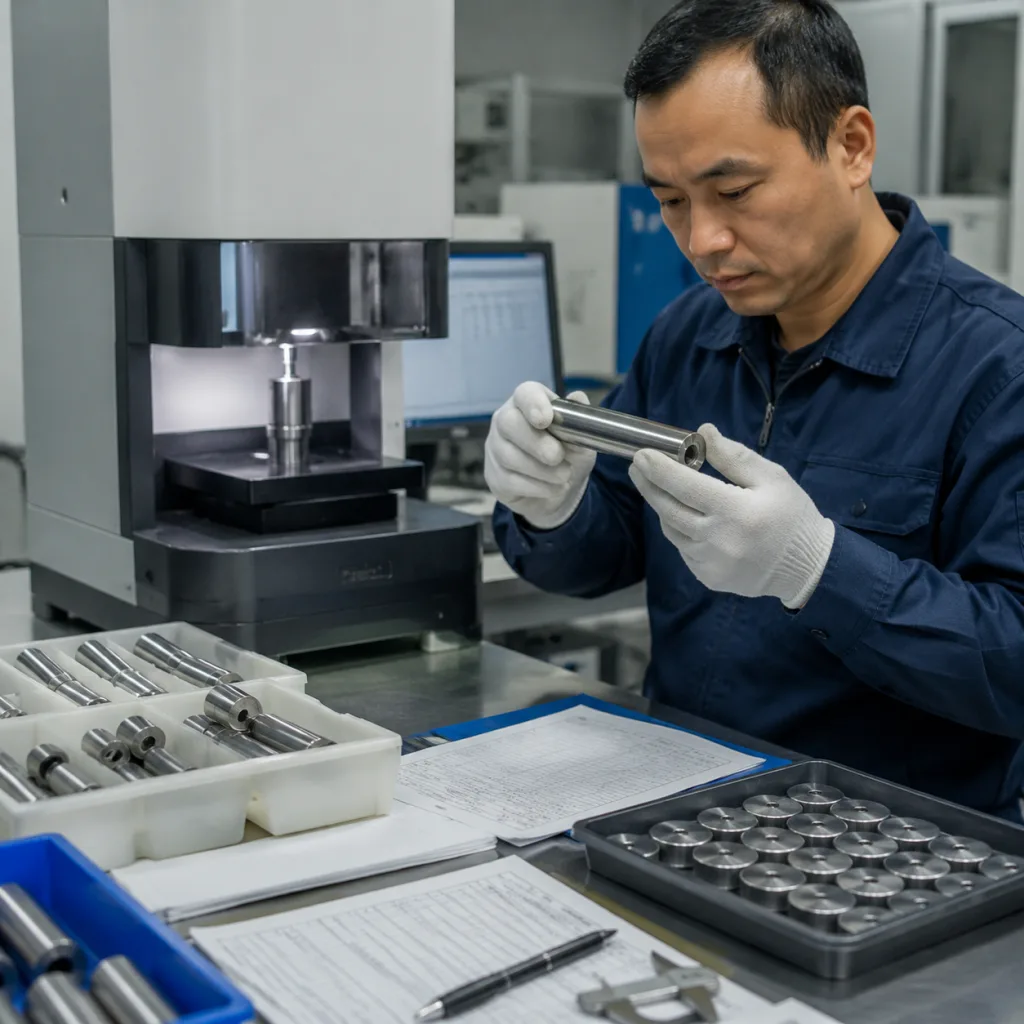
Typical validation steps include:
Incoming material verification against certificate data
Hardness testing after heat treatment
Magnetic particle inspection or other crack detection where specified
Dimensional inspection of big-end bore, small-end bore, width, and centre distance
Bolt torque-angle verification or clamp-load evaluation, depending on fastener design
Surface roughness checks on bearing contact areas
Weight measurement and grouping for matched sets
Trial assembly with bearing shell, piston pin, and sample crankshaft/piston where available
Packaging drop or vibration checks for export shipments
For high-volume replacement programmes, buyers may request production part approval documentation aligned with the principles used in IATF 16949:2016 supply chains. ISO 9001:2015 certification also supports documented process control, corrective action, calibration, and traceability. These certifications do not replace part validation, but they do give procurement teams a framework for supplier assessment.
Environmental and market-access requirements may also apply. For shipments into the EU, REACH (EC) No 1907/2006 is relevant to substances in products and packaging. Buyers should confirm any restricted-substance reporting requirements during sourcing rather than after goods are ready to ship.
Inspection Data Buyers Should Request
Import managers and sourcing engineers should ask for inspection data that can be checked against the application. A connecting rod is not a cosmetic component; small deviations can affect bearing life, oil pressure, piston alignment, and noise.
A practical supplier data pack may include:
Drawing or controlled specification revision
Material certificate with heat number
Heat-treatment record or hardness report
Final dimensional inspection report
Big-end bore data measured after cap bolts are tightened to specification
Small-end bore and bush data, if applicable
Parallelism and twist measurement
Weight data by piece and set
Surface finish readings for functional faces
Packaging specification and carton labelling format
Dimensional Match Is the Main Risk
For replacement rods, dimensional match is more important than adding unnecessary features. A rod that is visually stronger but changes reciprocating mass, width, bearing location, or small-end geometry can create new assembly problems. Repair chains and engine rebuilders need predictable installation, not a redesign unless it has been separately engineered and validated.
Driventus supports engine component sourcing through our catalog and the engine parts range at /products/engine-components.html. Where an existing sample or drawing is available, the engineering team can review feasibility and production controls before quotation.
Supplier Qualification for Aftermarket Distribution
For distributors and wholesalers, the commercial question is not only unit price. A stable connecting rod programme depends on repeatable production, controlled part revisions, export packaging, and clear non-conformance handling.
Recommended supplier qualification checks:
Area
What to verify
Evidence to request
Quality management
IATF 16949:2016 and ISO 9001:2015 scope
Current certificates and audit scope
Process control
Forging, heat treatment, machining, inspection
Control plan and process flow
Traceability
Batch link from material to shipment
Lot records and labels
Dimensional capability
Stability on critical bores and centre distance
Inspection reports or capability data
Export readiness
Carton strength, corrosion protection, pallet format
Packaging specification
Change control
Notification before material, tooling, or process changes
Written change-control procedure
</tr></thead><tbody> </tbody></table>Driventus operates as a vertically integrated Chinese manufacturer for engine and powertrain components, including pistons, crankshafts, gaskets, water pumps, turbochargers, and related assemblies. Buyers can review the quality system for certification and process-control context. For private-label, drawing-based, or sample-based programmes, custom manufacturing can support application development without implying vehicle manufacturer endorsement.
Procurement Notes for North America, Europe, and Brazil
Replacement connecting rods for GMC Acadia applications are commonly sourced for North American demand, but the same SKU may move through distributors serving the EU, UK, Australia, or Brazil. Documentation should therefore be prepared for customs, market surveillance, and customer technical review.
Commercial and technical details to confirm before purchase order release:
Exact application list and exclusions by year, engine, and market
Whether rods are sold individually or as matched sets
Rod bolt inclusion and replacement policy
Bearing shell inclusion or exclusion
Surface protection for sea freight
Inner box labelling, barcode requirements, and master carton quantity
Country-of-origin marking requirements
Inspection level for pre-shipment checks
Warranty handling process for distributor returns
For emissions-regulated markets, a connecting rod is not normally certified under vehicle emissions standards such as ECE R-83 by itself. However, engine repair components must preserve the intended mechanical function of the engine. Procurement teams should avoid suppliers that make broad emissions or vehicle approval claims without a specific legal basis.
Driventus is an independent aftermarket manufacturer; brand names are referenced for fitment only. Technical discussions should be based on drawings, samples, and verified application data rather than assumptions from vehicle names.
Frequently asked questions
Confirm the engine code, production year, crankpin diameter, piston pin diameter, rod length, big-end width, and bearing arrangement. Vehicle model name alone is not enough because engine variants and market specifications can differ.
Yes. Driventus can review customer drawings, samples, and application data for feasibility, tooling, inspection planning, and batch production. Validation requirements should be agreed before production release.
Buyers commonly request material certificates, hardness reports, dimensional inspection reports, traceability records, packaging specifications, and evidence of quality management under IATF 16949:2016 and ISO 9001:2015.
For application review, drawings, samples, or distributor sourcing requirements, contact Driventus to discuss a controlled replacement connecting rod programme. You can [request a quote](/contact.html).