connecting rod · 2026-05-28

Connecting Rod for Genesis G70 Aftermarket Replacement: OE Match Guide

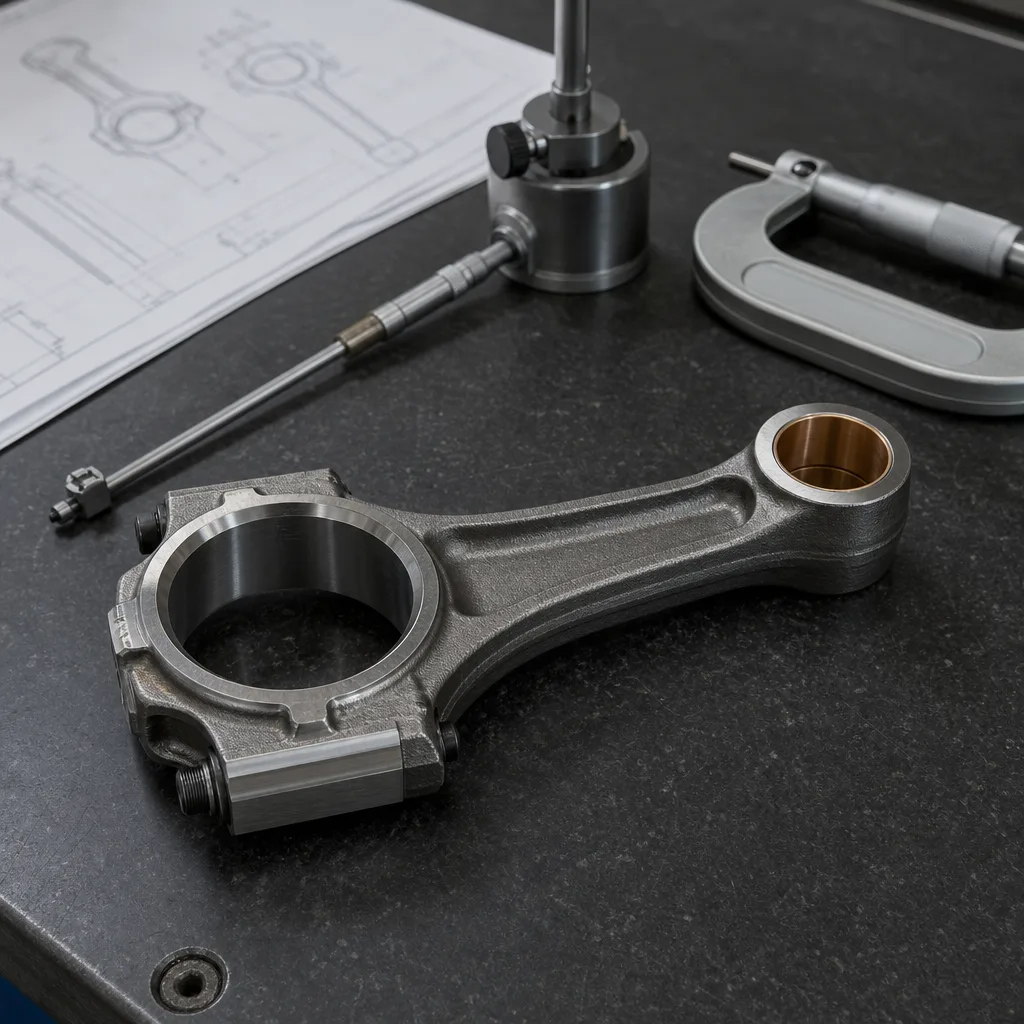
A connecting rod for Genesis G70 aftermarket replacement must match the OE geometry, mass, material condition, and bearing interface, not only the visible length. For procurement teams, the key is dimensional repeatability across batches and validation against the engine variant being sourced. Genesis G70 applications may differ by engine family, so the correct rod must be selected by VIN, engine code, and OE cross-reference before release to production or service channels. Driventus is an independent aftermarket manufacturer; brand names are referenced for fitment only. Our focus is OE-equivalent supply with controlled metallurgy, machined big-end and small-end bores, and traceable quality records under IATF 16949:2016 and ISO 9001:2015. This article explains the checks buyers should request, the specifications that matter most, and how to reduce replacement risk when sourcing for distributors, repair networks, and export programmes.

Why OE fitment matters for Genesis G70 rods

A replacement rod must do more than fit the crankshaft journal. For a Genesis G70 programme, the buyer should confirm:

  • centre-to-centre length
  • big-end bore diameter and roundness
  • small-end bore diameter
  • beam mass and matched-set variation
  • cap interface geometry
  • bolt specification and clamp load
  • rod side clearance compatibility

A mismatch in any one of these can affect bearing life, piston alignment, or NVH. For aftermarket supply, the objective is dimensional equivalence to the OE reference used in the vehicle application. That includes maintaining the same stack-up behaviour after machining and heat treatment.

Driventus supplies connecting rods for replacement channels with process control aimed at batch repeatability. If you need a broader view of related engine parts, see our catalog and engine components.

Key specifications buyers should verify

For procurement and technical approval, request a drawing pack and inspection report covering the following minimum points:

</tr></thead><tbody> </tbody></table>For programs sold into regulated markets, suppliers should also confirm restricted-substance compliance such as REACH (EC) No 1907/2006 where applicable. If the rod is intended to support emissions-related repair work, the broader engine system must remain compliant with local fitment rules, not just the component itself.

Validation testing for replacement programmes

A credible replacement rod should be supported by physical and dimensional testing, not catalogue claims alone. Common validation steps include:

1. Incoming material verification by heat number. 2. Dimension inspection with CMM or calibrated bore gauges. 3. Hardness check after heat treatment. 4. Fatigue or proof-load testing on representative samples. 5. Bolt preload verification. 6. Surface roughness measurement on bearing faces.

For export buyers, ask whether the factory has capability aligned with IATF 16949:2016 and ISO 9001:2015, plus documented control plans and PFMEA. Where programme requirements include durability correlation, ask for validation aligned to the relevant engine duty cycle. Standards such as SAE J2527 are often used for environmental durability contexts, while engine-installation compatibility should be confirmed against the actual application requirements rather than generic claims.

If you are comparing suppliers, review the operating controls in our quality system.

How Driventus supports replacement sourcing

Driventus is set up for B2B replacement supply and custom programmes. For Genesis G70-related aftermarket replacement, buyers typically request one of three formats:

  • OE cross-reference part only, for direct replacement channels
  • build-to-print rod, based on customer drawing and target tolerance
  • custom manufacturing, where a market-specific specification is required

Our custom manufacturing service is used when a buyer needs a controlled change to length, mass, coating, or packaging while keeping the functional interface stable. Production is based in Taizhou, Zhejiang, with export support for wholesalers, repair chains, and OE/Tier-1 adjacent programmes.

Driventus is an independent aftermarket manufacturer; brand names are referenced for fitment only. We do not claim vehicle-manufacturer endorsement or approval.

Procurement checklist before placing an order

Before release, the purchasing team should confirm the following items with the supplier:

  • exact engine code and VIN application
  • OE reference and any superseded numbers
  • rod quantity per engine
  • piston-pin size and bush configuration
  • bearing shell specification
  • packaging and traceability requirements
  • label format for warehouse and retail channels
  • sample approval criteria

If the part number is available as an OE cross-reference, use that reference only for fitment confirmation and not as a claim of OEM status. For example, buyers may specify an OE format such as OE 06A107065 when their internal catalogue already cites that reference. The same rule applies to other OE-style references used by the market.

For a production discussion, you can request a quote and share the drawing, target annual volume, and destination market so the correct build standard can be confirmed.

Frequently asked questions

Match the engine code, OE cross-reference, centre length, big-end bore, and small-end bore. VIN-based verification is recommended before ordering.

Yes, if it is dimensionally equivalent, validated for material and heat treatment, and packed with traceability suitable for the destination market.

Ask for dimensional reports, material certificates, heat-treatment records, control plans, and sample validation results under IATF 16949:2016 or ISO 9001:2015 controls.

Share your OE reference, engine code, and annual demand, and we will confirm fitment and supply options for your market. Contact us here: /contact.html

Request a Quote
Item What to verify Why it matters
MaterialForged steel or powder-forged equivalent, with heat-treatment recordStrength and fatigue resistance
Centre lengthOE-matched dimension within agreed tolerancePiston deck height and compression control
Big-end boreDiameter, roundness, and surface finishBearing crush and oil film stability
Small-end boreDiameter and bush fitWrist-pin control and wear rate
Rod weightIndividual and matched-set weightBalance and vibration control
Bolt specGrade, thread form, torque-angle dataCap retention under load
Shot peeningCoverage and process recordFatigue-life improvement