Connecting Rod for Lexus NX Aftermarket Replacement Guide
A connecting rod for Lexus NX aftermarket replacement has to clear more than a fitment check. Buyers need the right engine code, the right OE cross-reference, and enough dimensional control to avoid repeat failures in the field. Lexus NX applications vary by engine family, so the vehicle badge alone is not enough to release a purchase order. Driventus supplies engine and powertrain components for B2B buyers who need stable fitment data, documented inspection, and export-ready packaging. Driventus is an independent aftermarket manufacturer; brand names are referenced for fitment only. This article walks through the decision points, failure modes, validation data, and supplier comparisons that matter before you buy.
Start with the engine code, not the badge
The first sourcing mistake is treating the Lexus NX as a single application. It is not. Turbo, naturally aspirated, and hybrid programs can use different engine families, different rod dimensions, and different bolt requirements.
Confirm these items before you ask for pricing
Engine code and cylinder application
OE part number cross-reference, if available
Centre-to-centre length and big-end bore size
Small-end bush diameter and pin fit
Rod bolt specification and tightening method
Weight class pairing for the full set
A usable quote needs the engine family, not just the model name. If your request references an OE number such as `OE 13201-...`, that reference still has to be validated against the correct engine code before release. For catalog browsing, see our catalog and engine components.
Where aftermarket rods fail in real use
Most complaints do not start with a dramatic break. They start with a small mismatch that gets worse under load. The part may fit on the bench and still fail once oil temperature, rod stretch, and rpm rise together.
Common failure modes buyers should screen for
Big-end bore out of round, which pushes bearing edge loading
Small-end clearance mismatch, which creates pin noise or scuffing
Rod length drift, which alters piston position and compression relationship
Weight imbalance across a set, which shows up as NVH and durability loss
Weak rod bolts or poor clamp control, which can lead to cap movement
Inconsistent heat treatment, which reduces fatigue life
These failures are expensive because they are often discovered late. That is why the correct question is not “does it fit?” but “does it hold geometry, clamp load, and balance through a production run?”
OE-equivalent spec: the numbers that matter
For procurement teams, the useful comparison is not marketing language. It is the drawing-level data that controls loading, clearance, and fatigue life. A connecting rod for Lexus NX aftermarket replacement should be judged against the same functional spec used for OE release.
Item
Typical requirement
Why it matters
Centre-to-centre length
Match OE within drawing tolerance, commonly `±0.02 mm` to `±0.05 mm`
Controls compression-height relationship
Big-end bore
Match bearing shell fit; roundness typically `≤0.01 mm`
Affects oil clearance and seizure risk
Small-end bore
Match wrist pin fit to print tolerance
Prevents pin galling and noise
Rod bolt grade
Verify specified tensile class, often `10.9` or program-defined equivalent
Controls clamping under load
Weight match
Set-matched by cylinder; target spread typically `±1.5 g` or better
Reduces imbalance and NVH
Material
Forged steel or specified OEM equivalent, commonly microalloy or 4340-type steel by program
Affects fatigue life
Heat treatment
Quench-and-temper or equivalent, with hardness recorded by batch
Stabilizes strength and wear behavior
Surface finish
Shot-peened beam and controlled bore finish, per drawing
Improves fatigue resistance
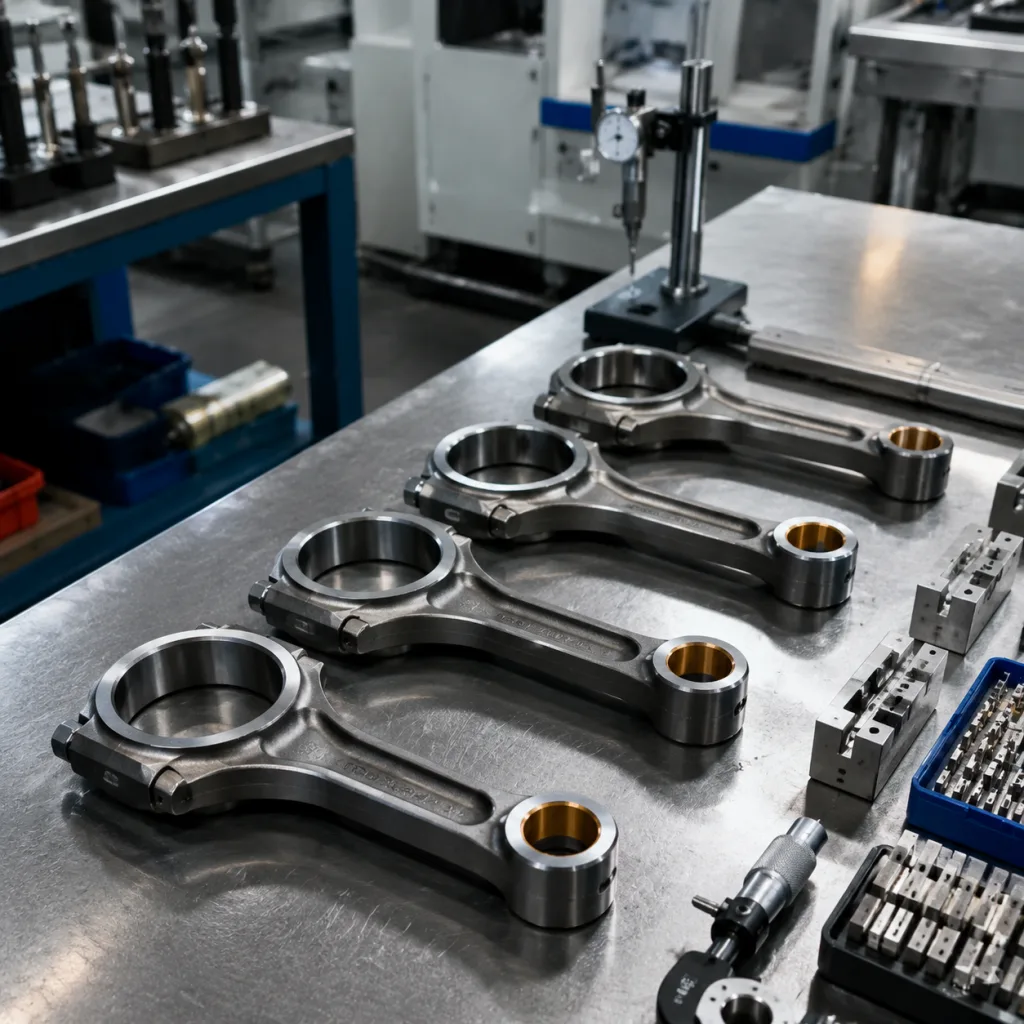
</tr></thead><tbody> </tbody></table>The best aftermarket rods do not just copy the shape. They hold the same critical interfaces in a repeatable way. That means forged material, controlled heat treatment, shot peening, and measured bore geometry—not just a matching catalog photo. For manufacturing controls and inspection expectations, see our quality system.
Validation data to request before purchase
A supplier should be able to show how the part was checked, not just state that it passed. If the supplier cannot provide inspection evidence, the replacement risk shifts to the buyer.
Minimum validation checks
Dimensional inspection of all critical features
Magnetic particle or equivalent crack detection on forged parts
Hardness verification after heat treatment
Rod bolt proof load confirmation
Mass and set-matching control
Packaging and corrosion protection for export
Production-release evidence buyers can request
First-article inspection report with nominal values, actual results, and tolerance limits
Material certificate showing heat number and chemistry range
Hardness report in the `HRC` band defined by the drawing
Rod-bolt lot report with proof-load or stretch verification
SPC summary for key bores if the run exceeds a pilot quantity
Photo record of final packaging, label, and carton count per box
For launch programs, align the inspection plan before mass production. Sample approval, in-process checks, and final audit criteria should all point to the same part number and drawing revision. That avoids disputes later in the program.
Supplier comparison: price is only one variable
When teams compare suppliers, the cheapest unit price often hides the most expensive risk. A lower quote is not useful if the rods arrive with weak traceability, poor weight control, or unclear acceptance criteria.
Use the same comparison checklist for every supplier 1. OE cross-reference evidence 2. Dimensional report and tolerances 3. Material and heat-treatment declaration 4. Batch traceability and carton labelling 5. Lead time and MOQ by part number 6. Auditability of the manufacturing site
Commercial terms to compare line by line
MOQ: pilot runs are often quoted at `50-100 sets` per part number, while production orders may start at `200-500 sets` depending on tooling and packaging
Price breaks: ask for tiered pricing at `100`, `500`, and `1,000+` sets so landed cost is visible before commitment
Lead time: sample builds may take `10-15 days`, while standard production is often `25-40 days` after approval
Tooling charge: confirm whether it is one-time, amortized, or waived at volume
Packaging: specify inner box, rust prevention, and carton quantity to avoid inbound rework
Acceptance standard: define what happens if a bore, weight, or hardness value misses the agreed limit
For repeat programmes, ask for sample approval, production control plan, and packaging specification before placing a bulk order. If your team needs a quotation for a specific engine code or volume target, use request a quote.
Compliance and export: what procurement teams should expect
Replacement engine parts sold into the EU, UK, US, Canada, Australia, and Brazil may be subject to customer-specific compliance checks. The component itself is not usually certified to a vehicle approval scheme, but the supply chain still has to support traceability and material declarations.
Common requests include REACH (EC) No 1907/2006 substance communication, customer quality audits, and controlled traceability under IATF 16949:2016 and ISO 9001:2015. If a buyer requests endurance or performance evidence, the test method should be stated clearly and tied to the programme specification.
Export and document pack buyers often ask for
Commercial invoice with full part description and HS code basis
Packing list showing carton count, net weight, and gross weight
Country-of-origin declaration
Material declaration and restricted-substance statement
Batch/lot traceability tied to the production record
Photo of pallet label and export carton marking
Driventus is an independent aftermarket manufacturer; brand names are referenced for fitment only. No vehicle manufacturer endorsement is claimed or implied. For regulated markets, buyers should confirm whether their import file requires additional declarations before shipment, especially when consolidating multiple engine part numbers in one order.
Q&A: the short answers buyers ask most
Is this sold as an OEM-approved component? No. It is an independent aftermarket replacement designed for OE-equivalent fitment, not manufacturer endorsement.
What information is needed to match the correct rod? Provide the engine code, OE reference if available, model year range, and any required dimensional data. For fleet orders, sample photos and old-part measurements help confirm fitment. Adding piston pin diameter, centre-to-centre length, and target volume makes the quotation more accurate.
Can custom specifications be supported? Yes. If a programme needs a revised material, coating, machining tolerance, or packaging format, Driventus can review custom manufacturing requirements and produce to drawing. Include the tolerance band, sample quantity, and target approval date so tooling, inspection, and lead time are quoted correctly.
Frequently asked questions
No. Driventus is an independent aftermarket manufacturer; brand names are referenced for fitment only. The part is designed for OE-equivalent replacement, not manufacturer endorsement.
Provide the engine code, OE reference if available, model year range, and any required dimensional data. For fleet orders, sample photos and old-part measurements help confirm fitment. Adding piston pin diameter, center-to-center length, and target volume lets the quotation reflect the correct spec and commercial terms.
Yes. If a programme needs a revised material, coating, machining tolerance, or packaging format, Driventus can review custom manufacturing requirements and produce to drawing. For custom RFQs, include the required tolerance band, sample quantity, and target approval date so the quote reflects tooling, inspection, and lead-time impact.
If you are sourcing a replacement rod for a Lexus NX programme, send the engine code and target volume for review. Start with a quote request at /contact.html.