Connecting Rod for Ford F-150 Replacement: OE Match Guide
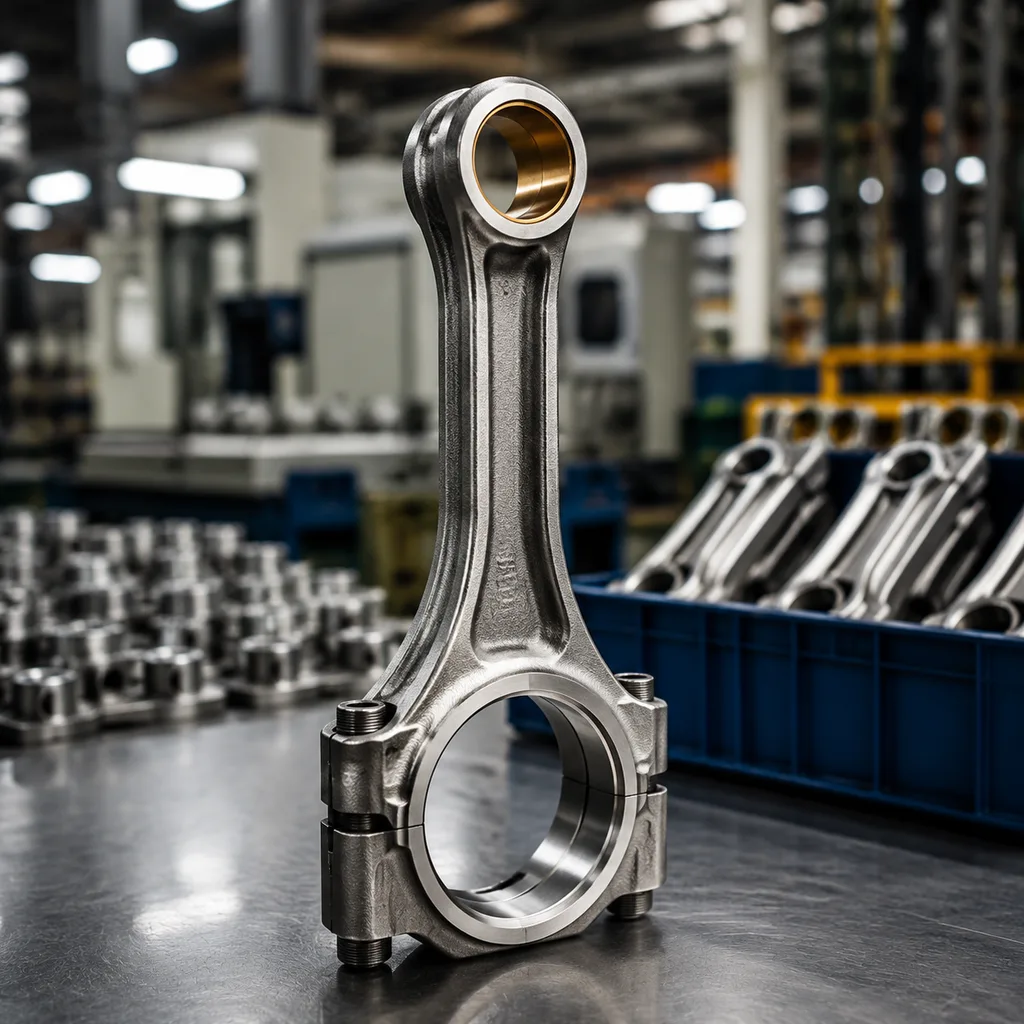
A connecting rod replacement for a Ford F-150 has to match the engine application, journal size, centre-to-centre length, big-end bore, small-end bore, and weight class. For procurement teams, the biggest risk is rarely unit price; it is dimensional mismatch, an incorrect material specification, or inadequate validation after fitment. Driventus supplies engine and powertrain parts for B2B buyers who need stable OE-equivalent replacement parts and documented quality control. Driventus is an independent aftermarket manufacturer, and brand names are referenced for fitment only. When comparing options, start with the intended engine code and verify the OE cross-reference before ordering. Our catalog, quality system, and custom manufacturing support are available for catalogue sourcing, audits, and special requirements. If you need a verified replacement path, this article outlines the checks that reduce returns and installation failures.
What matters in a replacement connecting rod
For replacement sourcing, the rod must match the original engine architecture, not just the vehicle model.
Centre-to-centre length
Big-end bore and bearing width
Small-end bore or pin fit
Beam profile and clearances
Fastener specification and stretch method
Target mass and balancing class
A Ford F-150 can use different engines across model years and trims, so the same truck nameplate may require different rods. Procurement teams should confirm the engine family, OE part reference, and any superseded numbers before release. When a buyer is working from a service part number, cross-reference the application against the machining drawing and inspection report, not only the sales description.
Dimensional checks buyers should request
Before approval, request a dimensional sheet and compare it with the removed part or the OEM drawing. A practical inspection list is below.
Check item
Why it matters
Typical buyer action
Centre-to-centre length
Affects piston deck position and stroke geometry
Match to OE drawing within specified tolerance
Big-end bore
Controls bearing crush and oil clearance
Verify with gauge report
Small-end bore
Controls wrist pin fit
Confirm finish size and roundness
Rod weight
Affects balance across cylinders
Request matched set data
Bolt grade
Influences clamp load and durability
Confirm fastener material and torque method
</tr></thead><tbody> </tbody></table>If the part is sourced as a direct replacement, ask for first article inspection data and a sample dimensional report. Under IATF 16949:2016 and ISO 9001:2015, traceable inspection records are standard expectations for controlled supply.
Materials and manufacturing details to verify
A replacement rod should be made from a defined steel or powder-forged specification, with heat treatment and surface finishing stated on the data sheet. Buyers commonly ask for the following:
Material grade and heat treatment route
Shot peening coverage, if applied
Machining process for bore control
Bolt supplier and lot traceability
Crack-split or cap-split construction, if relevant
For export programs, confirm compliance declarations where applicable, including REACH (EC) No 1907/2006 for material disclosure. If the rod is intended for a specific emissions-related application, the buyer may also need confirmation that the part does not alter the tested engine configuration. Driventus does not claim vehicle manufacturer approval; the focus is replacement equivalence and documented process control.
Validation testing before shipment
Replacement parts should be validated for geometry and durability before release to distribution. Common checks include:
Hardness verification after heat treatment
Magnetic particle or crack detection on critical sections
Concentricity and parallelism measurement
Bolt torque-and-angle validation
Sample bench testing for load and fatigue response
For some applications, buyers also request correlation against service conditions such as cyclic load and lubrication sensitivity. When the application is tied to emissions or road-use compliance, buyers may reference standards such as ECE R-83 or SAE J2527 where relevant to the wider test programme, although those standards do not replace part-level dimensional control. The key procurement point is that validation data should align with the intended engine build, not just with a generic vehicle label.
How Driventus supports sourcing teams
Driventus supplies engine components for distributors, OEM/Tier-1 supply chains, and multi-location repair networks. For Ford F-150 replacement programs, buyers can use our catalog for standard part families, our quality system for audit support, and our custom manufacturing service for special requirements.
``request a quote`` for pricing, lead time, and cross-reference review
For broader engine programmes, see ``engine components`` if you are consolidating pistons, rods, gaskets, and related parts under one supplier. A clear OE cross-reference such as OE 06A107065 format should be used only when the buyer already has a cited number for the application.
Frequently asked questions
Match the engine code, OE reference, centre length, bore sizes, and bolt specification. Confirm the exact service application before ordering because the same truck model can use different engines and rod designs.
Ask for dimensional inspection data, material confirmation, heat-treatment records, and traceability by lot. For controlled programmes, request ISO 9001:2015 or IATF 16949:2016 process evidence.
Yes. For drawing-based or special requirements, use our custom manufacturing service. We review the specification, tolerances, and testing plan before production.
If you need a verified OE-equivalent replacement path, send the engine reference and drawing details through our contact form. Start here: /contact.html