connecting rod · 2026-05-27

Connecting Rod for Dodge Durango Aftermarket Replacement

A connecting rod for Dodge Durango aftermarket replacement must match the engine’s bore, stroke, pin height, big-end width, and center-to-center length, not just the vehicle name. For procurement teams, the practical question is whether the part is dimensionally interchangeable, traceable by batch, and validated for fatigue and metallurgical consistency. Driventus supplies engine components for B2B replacement programmes, with production controlled under IATF 16949:2016 and ISO 9001:2015. We support buyers who need stable fitment, documented inspection, and export-ready packaging for distribution channels in the EU, UK, US, Canada, Australia, and Brazil. Driventus is an independent aftermarket manufacturer; brand names are referenced for fitment only. If you are sourcing against OE 06A107065 or a related application family, the focus should be on exact measurement control, material quality, and repeatable supply, not only the stated model coverage.

What a replacement connecting rod must match

For a replacement programme, fitment starts with geometry. A connecting rod must match the application’s center-to-center length, crankpin diameter, big-end bore, small-end bore, beam offset, and side clearance. If any one of these is out of tolerance, the engine can show noise, oil temperature rise, accelerated bearing wear, or piston skirt damage.

Key checks before placing a purchase order:

  • Center-to-center length: verify against the engine build sheet or sample part
  • Big-end bore and width: confirm with bearing shell and cap data
  • Small-end bore: confirm pin fit and bushing condition
  • Straightness and twist: inspect before assembly
  • Weight matching: verify within the customer’s balancing requirement

For multi-SKU fleets, procurement should lock the application by engine code, not by vehicle badge alone. That reduces mis-shipment risk when the same model uses multiple engines across production years.

OE-equivalent manufacturing criteria

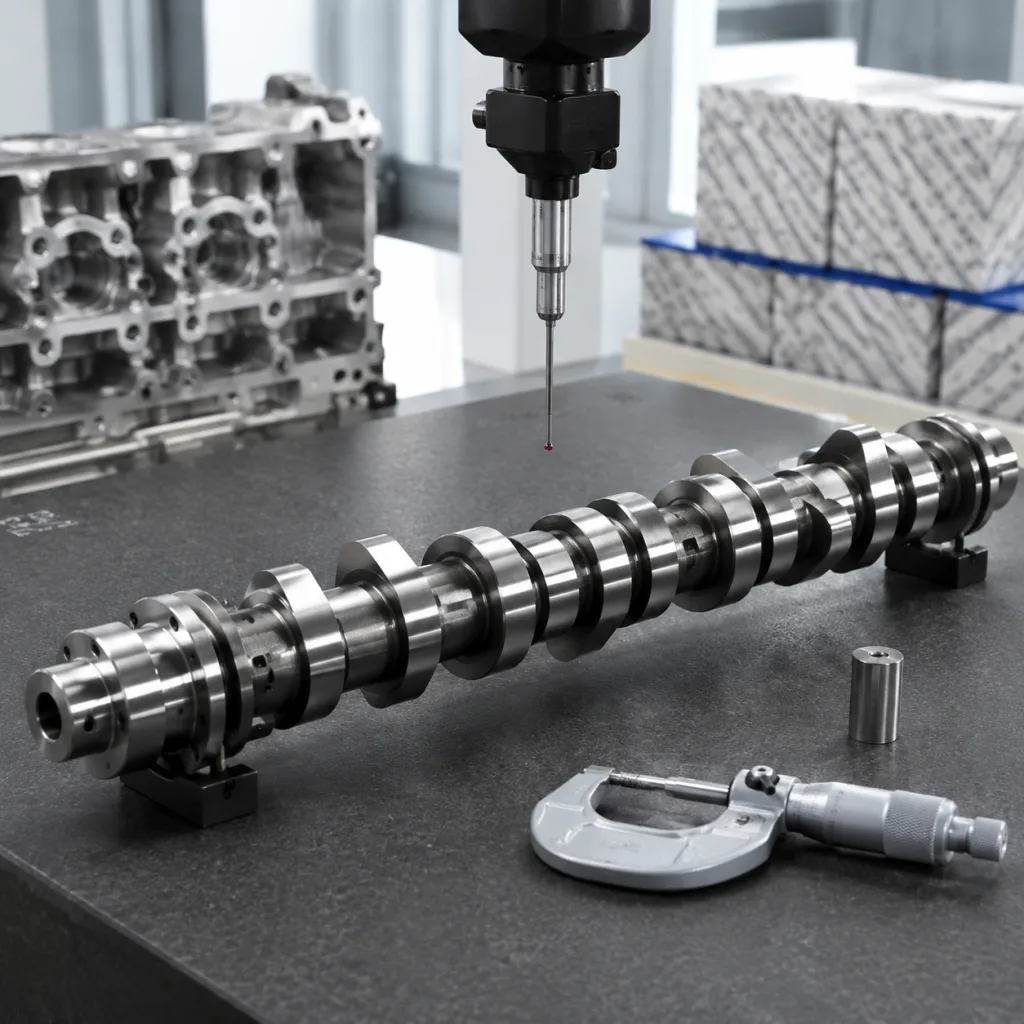
An aftermarket rod is acceptable only when the dimensions, material condition, and surface integrity support OE-equivalent service life in the intended engine. Driventus produces forged and machined connecting rods with controlled heat treatment, shot-peen processing where specified, and final inspection for bore geometry and crack-free surfaces.

</tr></thead><tbody> </tbody></table>If your team needs a direct replacement path for OE 06A107065 or another engine-family reference, ask for dimensional reports, material certificates, and sample approval before committing to volume.

Validation testing that matters to buyers

Replacement parts should be validated with the same discipline used for production supply. For rods, the most relevant checks are fatigue resistance, hardness consistency, dimensional stability after heat treatment, and non-destructive inspection of critical sections.

Common validation references include:

  • IATF 16949:2016 quality process control
  • ISO 9001:2015 documented management system
  • Material compliance aligned with REACH (EC) No 1907/2006 for regulated substance control
  • Application-level durability testing using engine duty cycles requested by the buyer

In practice, buyers should ask for:

1. First article inspection report 2. Material composition or mill certificate 3. Hardness test data by lot 4. Dimensional inspection record 5. Packaging and label traceability photographs

For fleet repair chains, the important point is repeatability. The first shipment and the tenth shipment should measure the same, package the same, and assemble without rework.

How sourcing teams should compare suppliers

A sourcing decision should compare process control, documentation, and lead-time stability, not price alone. Two rods with similar dimensions can behave differently if one has better heat-treatment consistency or bore control.

Buyer checklist

  • Confirm OE cross-reference and engine code coverage
  • Request a sample for fit check on the intended piston and bearing set
  • Compare weight spread across a lot, not just single-piece weight
  • Ask whether the supplier can hold repeat batches for programme continuity
  • Verify export packing, pallet spec, and carton labelling requirements
  • Review complaint handling and corrective action workflow

Driventus supports our catalog for standard engine parts, quality system for documented inspection controls, and custom manufacturing when a buyer needs a non-standard rod specification, logo-free packaging, or special balancing requirement.

For buyers managing mixed inventory, a clear part master with application notes is more useful than a broad vehicle listing. That is especially true when the same engine family appears across several model years and markets.

Replacement risk points during installation

Even a correct rod can fail if installation errors are not controlled. Buyers who supply workshop networks should include installation notes with the carton or service bulletin.

Most common risk points:

  • Reusing stretched rod bolts without checking specification
  • Mixing caps between rods
  • Incorrect bearing clearance after crankshaft polishing
  • Contamination from machining debris
  • Failure to verify rod side clearance and piston orientation

If the engine is already disassembled, replacement should include inspection of the crankpin, bearings, piston pin bushing, and oil condition. Rod replacement alone will not correct damage caused by lubrication failure. For that reason, procurement teams should define the rod as part of a repair set when the failure mode indicates broader engine contamination.

When the application is a Dodge Durango programme, the fitment record should state the engine code, model year range, and OE reference used for validation. That prevents return shipments caused by cross-platform confusion.

What Driventus can supply for B2B programmes

Driventus manufactures engine and powertrain components for aftermarket distributors, OEM and Tier-1 supply chains, and regional repair networks. For connecting rods, the commercial value is not only manufacturing capacity but also controlled repeatability, export documentation, and part-level traceability.

Typical B2B supply options:

  • Standard aftermarket replacement rods
  • Programme-specific dimensional matching
  • Batch marking and carton-level traceability
  • Packaging configured for distributor and warehouse systems
  • Private-label or neutral packaging under buyer instruction

If your team is planning a regional rollout or a line fill programme, use request a quote to share the target engine code, annual volume, sample photos, and required test standard. If the rod is part of a wider engine kit, the optional engine components page can help align related parts in one sourcing cycle.

The main objective is simple: a rod that fits, measures consistently, and supports warranty control across repeated shipments.

Frequently asked questions

Confirm engine code, center-to-center length, big-end and small-end bore sizes, and rod width. Do not rely on trim level or model name alone. Sample measurement against the existing part is the safest method.

Ask for dimensional inspection data, material certificate, hardness report, and batch traceability. For regulated markets, also check REACH (EC) No 1907/2006 alignment and export labelling.

Yes. Driventus can support custom manufacturing for size, balance, packaging, and traceability requirements, subject to technical review and sample approval.

If you are sourcing a connecting rod for a Dodge Durango programme or a related engine family, share your application details and target volume with Driventus. We will review the technical requirements and respond through /contact.html

Request a Quote
Control item Typical requirement Procurement note
MaterialForged alloy steel or specified cast steel variantMatch engine duty cycle
Center-to-center lengthApplication-specific, measured in mmVerify from sample or OE data
Big-end bore roundnessTight controlled toleranceCheck with gauge report
Small-end borePin-fit dependentConfirm bushing or fully machined eye
Surface finishMachined and deburredNo sharp edges at parting line
IdentificationBatch traceabilityRequired for warranty claims