Connecting Rod for Buick Regal OE Equivalent: Sourcing and Fitment Guide
A Buick Regal badge is not enough to identify the correct connecting rod. Across model years, engine families, and market builds, Regal applications can differ in rod length, big-end geometry, pin bore size, cap design, bolt specification, and weight class. For procurement teams sourcing a connecting rod for Buick Regal OE equivalent replacement, the buying decision has to start with the engine code and drawing-critical dimensions rather than the vehicle name alone.
Driventus is an independent aftermarket manufacturer; Buick and Regal names are referenced only for fitment identification. In practical sourcing terms, that means the supplier must demonstrate dimensional conformity, stable material control, and lot traceability before the part moves into distributor inventory, repair-chain stock, or export programmes. Treat the rod as an engineered rotating component, not a commodity SKU. The goal is straightforward: match the original geometry, confirm the metallurgy and bolt package, and verify inspection records before committing to volume orders. See our catalog and our quality system for the production controls behind that approach.
What OE-equivalent means for a Regal application
For a connecting rod to be OE-equivalent, it must install into the engine assembly without requiring changes to the piston, crankshaft, bearing set, or rod hardware. The Buick Regal nameplate covers different powertrains depending on year and market, so a catalogue match by vehicle name can be too broad for a reliable purchasing decision.
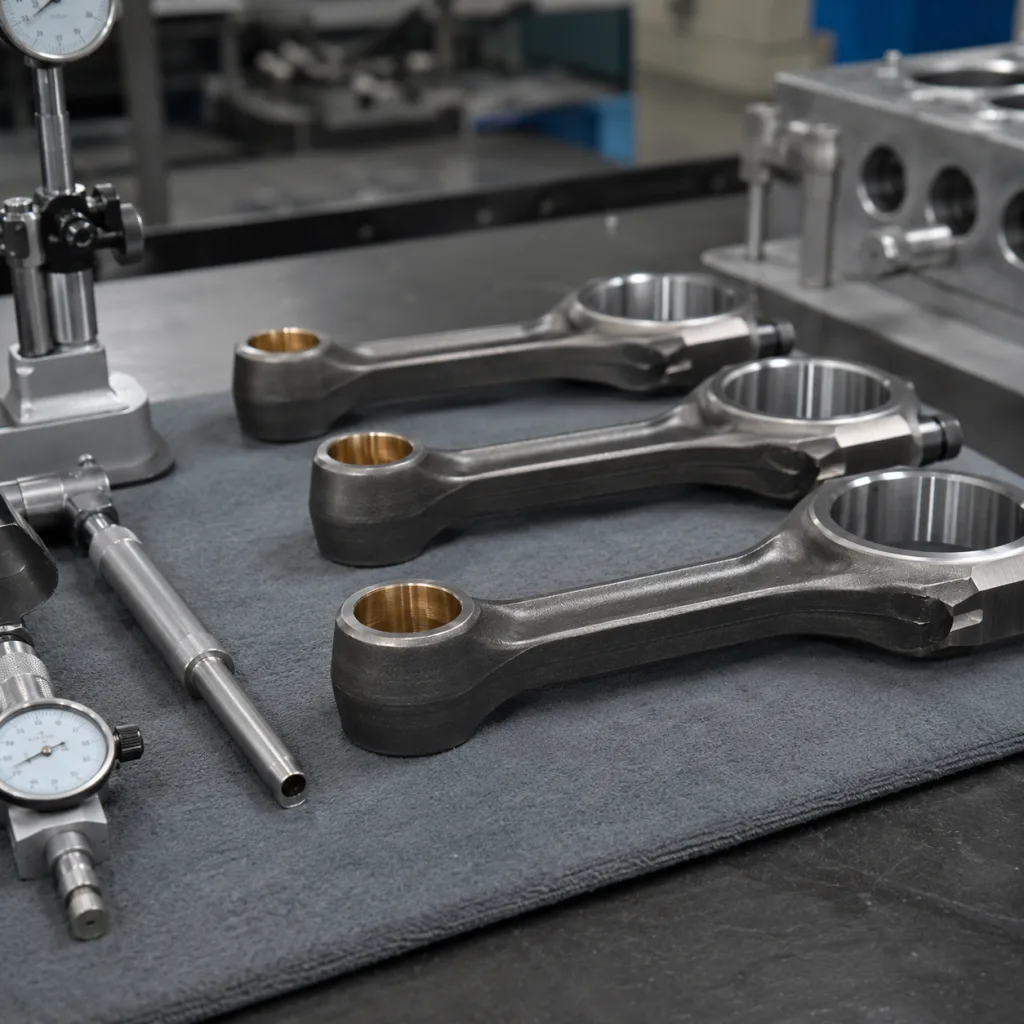
At minimum, the supplier should confirm these points against the target engine code or approved sample:
- Centre-to-centre length
- Big-end bore, housing width, and bearing-seat geometry
- Small-end bore, pin fit, and bushing type
- Beam profile, cap style, and parting-face design
- Rod bolt thread, length, material grade, and tightening method
- Finished weight and weight-matching class
- Surface finish at the parting face, bearing seats, and pin bore
An OE-equivalent rod should not require corrective machining on the rebuild line. It should fit the original clearance stack, maintain balance within the accepted range, and carry the intended combustion and inertia loads through the same structural path as the original component.
Measurements buyers should verify before ordering
A purchase order should be supported by measured data, not only by a catalogue description or broad cross-reference. If the supplier cannot provide dimensional evidence, the risk moves to your receiving inspection team and may appear later as bearing noise, imbalance, returns, or field failures.
| Check point | Why it matters | What to request |
|---|---|---|
| Centre-to-centre length | Controls piston deck position and compression height | Dimensional report or drawing match |
| Big-end bore | Determines bearing crush and oil clearance | Bore gauge result and tolerance band |
| Big-end width | Affects crankshaft side clearance | Width measurement and acceptable range |
| Small-end bore | Controls pin fit and pin-bore oil film | Pin fit specification and bushing data |
| Rod bolt spec | Sets clamp load and cap security | Bolt material, grade, and torque or stretch data |
| Weight match | Protects crankshaft balance | Individual weight range and matched set data |
| Roundness and parallelism | Reduces bearing wear, edge loading, and hot spots | Final QC inspection record |