connecting rod · 2026-05-27

Connecting Rod for Citroen Jumper OE Equivalent: Buyer Guide

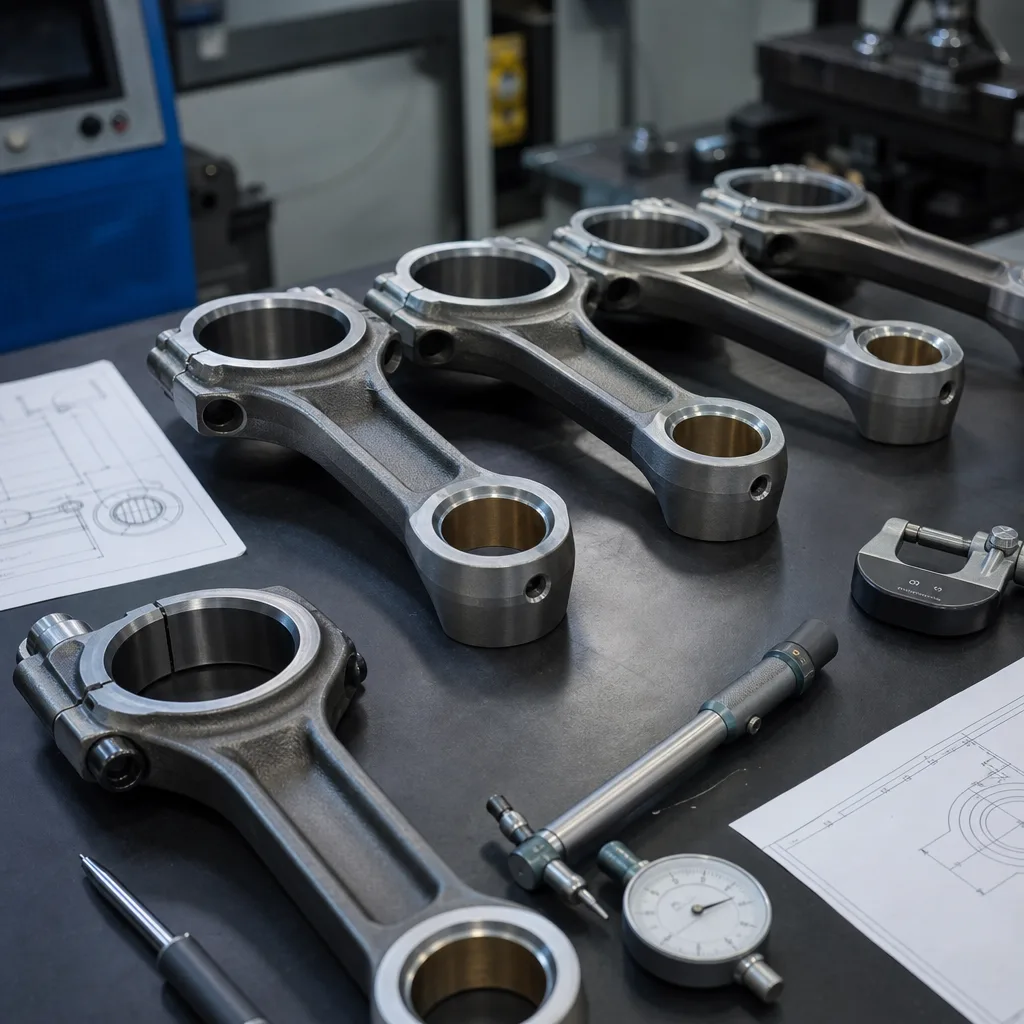
When sourcing a connecting rod for Citroen Jumper OE equivalent, procurement teams need more than a matching part number. The critical checks are centre distance, big-end and small-end diameters, bore geometry, beam section, mass matching, and heat-treatment consistency. For diesel applications, rod failure can quickly damage the crankshaft, pistons, and block, so the replacement must be verified against the engine code and measured against the OE sample or drawing.

Driventus is an independent aftermarket manufacturer; brand names are referenced for fitment only. We supply engine and powertrain components from Taizhou, Zhejiang, with production controls aligned to IATF 16949:2016 and ISO 9001:2015. For buyers in the EU, UK, US, Canada, Australia, and Brazil, the goal is the same: a dimensional match that installs correctly, holds load, and passes incoming inspection. If you are building an aftermarket catalogue or replacing a damaged rod in a repair chain, the following checks will help you source with less risk and fewer returns.

What “OE equivalent” should mean for a Citroen Jumper connecting rod

For a replacement rod, OE equivalent should mean the part matches the original application in geometry, fit, and functional performance. It should not rely on visual similarity alone.

Key points to confirm:

  • Centre-to-centre length
  • Big-end bore diameter and width
  • Small-end bore diameter and bush specification, if fitted
  • Rod cap joint accuracy and bolt specification
  • Mass class and pair matching within the engine set
  • Surface finish on the bearing seats and beam
  • Material grade and heat treatment route

If the buyer is matching an OE reference, the part should be checked against the engine family and the measured sample. Where available, cross-reference the OE number format such as OE 06A107065 only as a fitment reference. Do not assume all Jumper engines use the same rod design across model years or displacement variants.

Dimensional checks buyers should request before placing orders

A correct order starts with a dimensional sheet, not a sales description. Ask the supplier for a measured drawing and inspection report for the exact engine variant.

</tr></thead><tbody> </tbody></table>For procurement teams, the most useful documents are the drawing, CMM report, hardness data, and batch traceability. If the order is for a repair network, ask for consistent mass grouping and packaging by engine code.

Materials, heat treatment, and test data to request

A connecting rod for light commercial diesel use must handle high cyclic load, thermal cycling, and oil-film dependence. The supplier should state the base material, forging or powder route, and heat-treatment process.

Common buyer requests include:

  • Material declaration by grade or standard family
  • Hardness range after treatment
  • Shot-peening status, if applied
  • Magnetic particle or crack inspection method
  • Fatigue or load validation procedure
  • Coating details for the bore or beam, if used

Published standards are relevant here. Buyers often reference IATF 16949:2016 for automotive quality management, ISO 9001:2015 for process control, and REACH (EC) No 1907/2006 for chemical compliance in the EU. If the rod is intended for a diesel application with exhaust aftertreatment considerations, confirm the broader engine system meets the programme requirements; the connecting rod itself is normally verified through dimensional and mechanical data, not emission claims.

How Driventus supports aftermarket replacement buyers

We supply connecting rods and related engine components from a vertically integrated production base in Taizhou, Zhejiang. That matters when you need stable sourcing across more than one shipment.

Driventus can support:

  • OE-reference matching by application
  • Dimensional verification against sample parts
  • Batch traceability and inspection records
  • Packaging for distributor and repair-chain distribution
  • Private-label or drawing-based production through custom manufacturing

You can review our catalog and, for broader engine projects, our engine components range. The quality system page outlines our process controls and inspection flow. For buyers managing multiple SKUs, this is useful when you need fewer part-number errors and clearer inbound checks.

Inspection checklist for receiving and installation

Before release to stock or workshop use, a simple inspection process reduces claims.

1. Confirm the engine code and OE reference. 2. Check the rod against the approved dimensional drawing. 3. Verify bearing-seat finish and cap match. 4. Confirm bolt torque specification from the engine data source. 5. Check set mass and mark orientation before assembly. 6. Inspect for transit damage, corrosion, or packaging mix-ups.

If the part is installed in a rebuilt engine, the rod should be used with new bearings and checked crank journal clearance. Straightness and cap alignment should be confirmed before final assembly. A replacement rod that looks correct but fails on bore geometry will create early bearing wear, oil pressure loss, and secondary engine damage.

When to ask for custom production instead of stock supply

Some Citroen Jumper engine variants are difficult to source in stable volumes, especially when catalogue data is incomplete or when a repair chain needs consistent stock across regions. In those cases, custom production can be more efficient than repeated emergency buys.

Choose custom manufacturing when:

  • The OE reference is obsolete or inconsistent across suppliers
  • You need a specific mass class for engine balancing
  • The sample rod differs from catalogue stock
  • Your market requires labelled packaging and barcode control
  • You need a long-term supply plan for distributors or OEM programmes

For these projects, send the sample rod, engine code, target annual volume, and any inspection limits. We can then align the part to the required application and validate it against the agreed drawing and test plan. Driventus is an independent aftermarket manufacturer; brand names are referenced for fitment only.

Frequently asked questions

Match the engine code, OE reference, and measured dimensions. Centre distance, bore sizes, mass, and bolt specification must all align before approval.

Yes, if it matches the OE geometry and mechanical requirements and is supported by traceable inspection data. Many fleets require batch consistency and clear documentation.

Ask for a drawing, CMM report, hardness data, material declaration, and batch traceability. These help confirm fitment and reduce returns.

If you need a verified replacement or a drawing-based supply plan, contact our team for technical support and sourcing review at /contact.html.

Request a Quote
Check point What to verify Why it matters
Centre distanceMatch within the OE tolerance bandAffects compression height and piston position
Big-end boreID, roundness, and widthControls bearing crush and oil clearance
Small-end boreID and bush fitPrevents pin seizure and noise
Rod bolt holeThread class and seating faceInfluences cap clamp load
MassIndividual and matched set valuesReduces NVH and imbalance
StraightnessBend and twistPrevents accelerated bearing wear