Connecting Rod for BMW 1 Series Aftermarket Replacement
A connecting rod for BMW 1 Series aftermarket replacement has to do more than physically fit the crankpin and piston pin. For distributors, engine rebuilders, importers and procurement teams, the part must reproduce the correct OE-style geometry, bearing crush conditions, mass balance targets and material strength across repeated production lots. Small deviations in centre-to-centre length, big-end roundness, cap alignment or pin-bore finish can lead to noise, unstable oil film, vibration or early bearing damage after an engine rebuild.
This article sets out practical sourcing criteria for replacement connecting rods used in BMW 1 Series petrol and diesel engine families. It covers fitment definition, dimensional verification, steel selection, heat treatment, machining controls, validation testing, packaging and documentation expected by B2B buyers. Driventus manufactures engine components in Taizhou, Zhejiang under IATF 16949:2016 and ISO 9001:2015 systems, supporting aftermarket distributors, OEM/Tier-1 programmes and repair-chain sourcing teams. Driventus is an independent aftermarket manufacturer; brand names are referenced for fitment identification only.
Replacement Fitment Priorities for BMW 1 Series Engines
BMW 1 Series vehicles cover multiple four-cylinder and six-cylinder petrol and diesel engine families, depending on model year, market and platform generation. Because of that variation, a replacement connecting rod should be sourced by engine code and controlled dimensions, not by the vehicle model name alone. A listing that says “BMW 1 Series” is not enough to confirm crankpin diameter, piston pin size, rod length or bearing format.
Before requesting samples or a quote, procurement teams should define the fitment scope in a structured way. Useful data points include:
Engine family, engine code and displacement range
Production years and target sales markets
Centre-to-centre rod length target and tolerance
Big-end bore diameter after cap assembly and bolt tightening
Small-end bore diameter and bushing material, if applicable
Crankpin bearing width, locating-tab layout and oil-hole requirements
Fastener thread, grade, length and tightening method
Target rod weight and matched-set tolerance
Verified OE part-number cross-reference format, where applicable, such as OE 11251…
A correct dimensional match is critical because the connecting rod influences piston compression height, side loading, bearing alignment and reciprocating mass. If the part is longer or shorter than intended, piston-to-head clearance, compression ratio and combustion behaviour can change. If the big-end bore is out of round after bolt torque, bearing oil clearance may fall outside the engine builder’s specification, even when the rod appears correct before assembly.
Driventus supports engine-component sourcing through our catalog and related engine components. Final fitment confirmation should always be made against buyer-supplied drawings, measured samples, engine-code data or verified cross-reference records.
Material, Forging and Heat-Treatment Requirements
Most replacement connecting rods for modern passenger-car engines use forged steel because it offers a practical balance of tensile strength, fatigue resistance, impact toughness and machinability. Some OE designs may use powder-metal or fracture-split rods, so replacement sourcing must respect the original cap design, split-line method and bearing-bore behaviour under clamping load. A forged replacement should not be treated as interchangeable with a powder-metal design unless engineering checks confirm compatibility.
A procurement specification should go beyond the phrase “steel connecting rod”. It should define the alloy family or approved equivalent, mechanical-property targets and process controls. Common checks include chemical composition, tensile strength, yield strength, elongation, hardness range and microstructure after heat treatment. These controls help prevent lot-to-lot variation that may not be visible during a simple visual inspection.
Item
Procurement check
Why it matters
Material route
Forged steel, powder metal or buyer-approved equivalent
Controls fatigue strength, grain flow and cap behaviour
Heat treatment
Quench-and-temper or approved process route
Stabilises hardness, strength and toughness
Hardness variation
Controlled within agreed range
Reduces machining drift and fatigue variation
Big-end cap design
Machined cap, fracture-split cap or matched OE-style design
Maintains bore geometry under bolt load
Surface condition
No laps, cracks, folds or heavy decarburisation
Reduces fatigue-initiation risk
Traceability
Heat number, batch record and inspection status
Supports containment and root-cause analysis
</tr></thead><tbody> </tbody></table>Incoming steel verification should be backed by mill certificates and internal inspection records. Where required, magnetic particle inspection or other crack-screening methods can be added for forged and machined surfaces. For export programmes, material declarations may also be needed for REACH (EC) No 1907/2006 when requested by EU customers. REACH is not an engine-performance standard; it is a chemical compliance framework relevant to placed-on-market obligations and supply-chain documentation.
Dimensional Match and Machining Controls
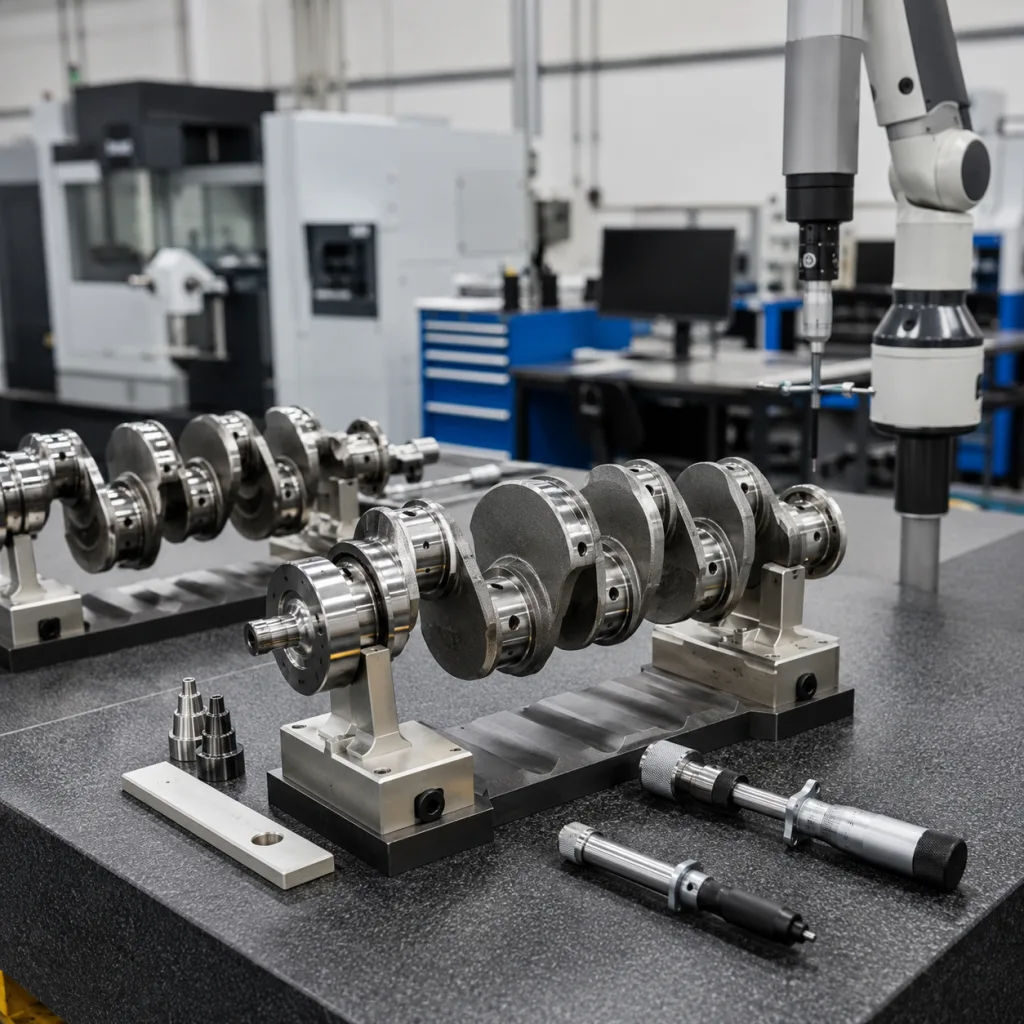
The most common risk in replacement connecting rods is often not the visible forging condition; it is machining variation. Big-end bore diameter, roundness, taper, cylindricity and surface finish must be measured after the cap is installed and the bolts are tightened using the specified method. Small-end geometry must be checked for bore alignment, pin clearance and bushing condition where a bushing is used.
Procurement drawings should define tolerances rather than relying only on sample matching. When the buyer does not own a complete drawing, a reverse-engineering report from verified samples can be used to build a controlled aftermarket specification. The report should identify critical-to-function dimensions, measurement methods and the condition in which each dimension is checked.
Typical inspection points include:
Centre-to-centre length measured on calibrated fixtures
Big-end bore diameter, roundness and cylindricity after assembly torque
Small-end bore diameter, bushing fit and surface roughness
Parallelism between big-end and small-end axes
Rod twist and bend limits
Bearing tang slot width, depth and position
Bolt-hole perpendicularity and thread quality
Parting-face contact and cap alignment
Oil-hole position and deburring, where applicable
Weight of each rod and matched-set spread
For replacement sets, weight control is especially important. A wide mass spread across rods can increase imbalance and vibration after rebuild, even if each individual rod is dimensionally acceptable. Driventus can sort rods into matched sets when the buyer defines the maximum acceptable spread, commonly specified in grams per set.
The production control plan should include gauge calibration, first-article inspection, in-process checks and final audit sampling. Driventus’ quality system is structured around IATF 16949:2016 and ISO 9001:2015 requirements, including traceability, nonconforming-product control, corrective action and continuous improvement.
Validation Testing Before Aftermarket Release
A connecting rod for BMW 1 Series aftermarket replacement should be validated before volume release, particularly when the part is part of a new fitment range, a private-label launch or a supplier transfer. Validation does not mean approval by BMW or any vehicle manufacturer. It means the aftermarket manufacturer has checked the rod against agreed engineering, durability and process-control criteria.
A practical validation package may include:
Dimensional report: full layout inspection against drawing, CAD data or approved sample specification
Material report: chemical composition, hardness and mechanical-property evidence
Microstructure review: confirmation of heat-treatment consistency and absence of harmful metallurgical defects
Magnetic particle inspection: crack screening on forged and machined surfaces where specified
Bolt clamp-load review: verification of torque-angle or torque-only assembly behaviour
Big-end bore stability check: bore measurement after the specified tightening process
Fatigue testing: cyclic loading based on buyer-defined loads or benchmarked OE-equivalent duty
Surface finish report: bearing bore and pin bore roughness values
Packaging validation: corrosion protection and export transit checks where required
For buyers supplying multi-location repair chains, batch consistency is often more important than a strong one-time sample result. A sample that passes inspection but cannot be repeated in production creates warranty and inventory risk. The approval process should therefore include pilot-lot inspection before the first container order, with the pilot run produced using the intended serial process.
Where buyer programmes require deeper engineering work, Driventus offers custom manufacturing based on drawings, samples, performance targets, validation plans and agreed documentation levels.
Sourcing Checklist for Distributors and Importers
Replacement connecting rods may be purchased as individual rods, matched sets, or as part of engine rebuild kits that include pistons, rings, bearings, gaskets and fasteners. The commercial specification should be as clear as the engineering specification, because packaging format, labelling, MOQ and documentation all affect warehouse handling and aftersales support.
Before issuing a purchase order, confirm the following:
Sourcing item
Recommended buyer action
Fitment data
Confirm engine codes, production years, fuel type and market coverage
Cross-reference
Provide OE 11251… style references only where verified
Sample approval
Approve against measured reports, not appearance only
MOQ
Define by engine family, forging route, machining setup and packaging format
Lead time
Confirm tooling, pilot-lot, approval and repeat-order timing separately
Documentation
Request inspection report, material record, batch traceability and packing list
Packaging
Specify VCI protection, separators, carton strength and pallet requirements
Labelling
Use buyer SKU, batch number, barcode and country-of-origin requirements
Warranty handling
Define claim evidence, return process, containment timing and responsibility
</tr></thead><tbody> </tbody></table>For EU, UK, US, Canada, Australia and Brazil importers, documentation should support customs clearance, warehouse traceability and field-claim investigation. If the programme is private label, artwork, carton markings and barcode data should be approved before mass packaging starts. Buyers should also confirm whether rods are supplied with bolts, bushings or bearings, since these details affect kit configuration and repair-shop installation expectations.
Driventus is an independent aftermarket manufacturer; brand names are referenced for fitment only. The use of BMW 1 Series fitment references does not state or imply vehicle-manufacturer approval, endorsement or a supply relationship.
How Driventus Controls Replacement Rod Production
Driventus manufactures engine and powertrain components in Taizhou, Zhejiang, with export supply to more than 60 countries. For connecting rods, the production route can include forging sourcing control, heat-treatment verification, CNC machining, bore honing, cap matching, weight sorting, surface protection and final inspection.
For replacement programmes, buyers typically require stable repeatability rather than custom racing specifications. Driventus therefore focuses on OE-equivalent geometry, controlled metallurgy and documented batch inspection. Each purchase programme can be aligned to the buyer’s required inspection level, from standard aftermarket QC reports to PPAP-style documentation where applicable.
Key controls include:
Supplier qualification for steel and forging inputs
Incoming material inspection and batch traceability
Heat-treatment verification by hardness and metallurgical checks
CNC machining with controlled fixtures for bore alignment
Torque-condition inspection for big-end bore verification
Statistical checks on critical dimensions
Weight sorting for matched-set supply where specified
Corrosion protection suitable for sea freight and warehouse storage
Export packaging designed for distributor handling
Published management standards such as IATF 16949:2016 and ISO 9001:2015 provide the framework for process control, but the buyer’s technical file remains essential. The strongest sourcing result comes from combining verified fitment data, measured samples, a clear validation plan and an agreed control plan before volume production.
Frequently asked questions
Yes. Driventus can review BMW 1 Series engine fitment data, buyer samples, drawings or verified OE 11251… style references to confirm whether an existing aftermarket rod or a custom production route is suitable.
Buyers should request a dimensional report, material certificate, hardness data, batch traceability, packaging specification and, where required, fatigue or magnetic particle inspection evidence. PPAP-style files can be discussed for higher-control programmes.
No. Driventus is an independent aftermarket manufacturer; brand names are referenced for fitment only. Any BMW 1 Series reference is used to identify application compatibility, not endorsement or vehicle-manufacturer approval.
If you are building a replacement connecting rod programme for BMW 1 Series applications, send fitment data, samples or drawings so our engineering team can review feasibility and quote accurately. [request a quote](/contact.html)