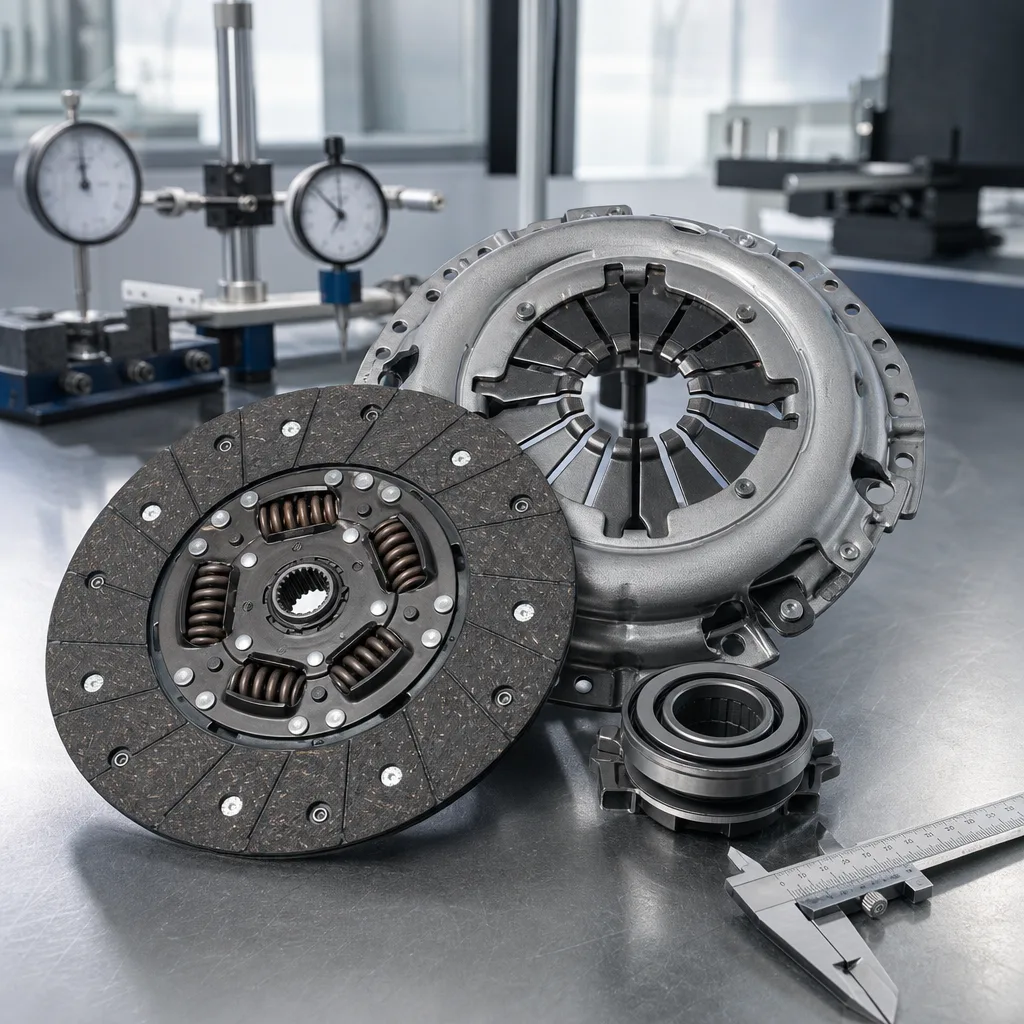
A clutch kit Toyota replacement needs to match far more than a model name, engine family, or catalogue description. Buyers should verify the whole operating package: driven-disc outside diameter, lining width, spline count and shaft diameter, hub offset, cover bolt circle, dowel position, release-bearing stack height, pressure-plate working height, clamp load, and the flywheel and gearbox combination fitted to that exact vehicle. One incorrect interface can lead to difficult installation, wrong pedal effort, a high or low bite point, incomplete release, clutch drag, early slip, bearing noise, or a kit that simply will not mount to the flywheel and bellhousing assembly.
Driventus is an independent aftermarket manufacturer; Toyota and other brand names are referenced for fitment only. We support replacement programs for distributors, repair chains, importers, and fleet parts buyers that need OE-equivalent geometry, stable friction materials, repeatable batch quality, and documented validation. For Toyota applications, the sourcing question is not just whether a catalogue line appears to cover the badge. The real test is whether the assembly matches the original clutch package in dimensions, wear behaviour, release travel, torque margin, and service life.
This article explains how to specify a clutch kit Toyota replacement with lower fitment risk: which dimensions to check, how material and construction choices influence service life, what validation evidence is worth requesting, and how sourcing teams can build a repeatable replacement program.
What must match in a Toyota replacement kit
Toyota clutch replacement is not a visual-match exercise. The assembly has to work as a system with the flywheel, transmission input shaft, release fork or concentric slave cylinder, bellhousing depth, and pedal-effort target. A kit can look correct on the bench and still fail in the vehicle if the driven-plate offset, release-bearing stack height, diaphragm finger position, or cover installed height differs from the original package.
For B2B buyers, the process starts with a precise application definition: platform code, engine code, gearbox code, production period, market, and measured part data. Toyota models can have regional drivetrain differences, mid-cycle transmission updates, dual-mass or solid flywheel variations, and multiple clutch diameters within the same broad vehicle family. A clutch kit Toyota replacement should therefore be approved against the actual technical package, not just a broad model listing.
Check
Typical sourcing requirement
Why it matters
Driven-disc outer diameter
Match the removed part or approved OE reference; common passenger/light commercial sizes are often in the 200–275 mm range, application dependent
Same bolt circle, dowel diameter, centring shoulder, and mounting-face geometry
Ensures flywheel mounting, centring accuracy, and safe clamp loading
Pressure-plate working height
Matched to flywheel step, disc thickness, and release system at the installed height
Maintains diaphragm angle, pressure-plate lift, engagement point, and clamp load reserve
Release-bearing height and contact face
Matched to fork or concentric slave cylinder geometry, including bearing ID/OD and retaining clips
Protects pedal feel, release travel, bearing preload, and bearing service life
Pilot bearing or bush requirement
Supplied only where the engine/transmission combination uses one, with correct crank bore and input-shaft pilot diameter
Supports input-shaft alignment and prevents rattle, noise, drag, or premature input-shaft wear
</tr></thead><tbody> </tbody></table>The most common sourcing error is assuming that every part listed under a model name is interchangeable. In practice, a single vehicle line may use different disc diameters, spline counts, release bearings, or flywheel steps depending on engine output, market, body style, or transmission supplier. Even a small release-bearing height difference can move the engagement point enough to cause complaints or incomplete disengagement.
When the dimensions align, the replacement behaves like the original unit in the vehicle, not just on paper. That is the practical meaning of OE equivalence for Toyota applications: the kit installs without machining or modification, releases cleanly, engages smoothly, carries the intended engine torque with adequate reserve, and keeps pedal effort familiar through its service life.
Core dimensions and assembly checks
Once basic fitment is confirmed, the next task is to examine the construction details that shape drivability and durability. The driven disc, damper system, pressure plate, diaphragm spring, release bearing, and any pilot component must be matched as an assembly. Change one element without checking the others, and the release point can move, launch vibration can increase, pressure-plate lift can fall, or slip margin under load can shrink.
A robust clutch kit Toyota replacement review should begin with a removed unit, OE sample, or verified drawing where possible. Measure the sample before it is damaged or discarded, and take photos from the flywheel side, transmission side, spline profile, hub projection, pressure-plate mounting face, diaphragm fingers, and release-bearing face. These records reduce catalogue ambiguity when several similar kits exist.
Verify these fields on the sample
Friction material: organic, reinforced organic, or ceramic hybrid, selected by engine torque, gross vehicle weight, heat exposure, towing frequency, hill-start duty, and stop-start cycles.
Disc diameter and lining width: measured across the working friction area with calipers; do not rely only on cover size or catalogue nominal diameter.
Spline profile: tooth count, major diameter, minor diameter, hub length, chamfer, and sliding fit on a gauge or known input shaft where available.
Hub offset: direction and depth from the friction surface or disc centreline to the hub face, because reverse offset can create immediate interference with the flywheel bolts or gearbox input housing.
Facing thickness and marcel height: controlled to support smooth take-up without excessive release drag; batch variation here can change the installed diaphragm angle.
Damper spring layout: spring count, spring rate, free play, stop position, and angular travel selected to reduce chatter while avoiding excessive driveline lash.
Clamp load: verified at the specified installed height, with diaphragm spring-rate control and a defined release-load curve rather than a single unloaded cover measurement.
Pressure-plate runout and flatness: controlled to prevent pedal pulsation, uneven bedding, hot spots, and cone wear.
Cover height and finger position: checked at installed height after the cover is bolted down on a test fixture, not only in the free state.
Bearing type: mechanical release bearing, sealed release bearing, pull-type bearing, or hydraulic concentric slave cylinder depending on gearbox design.
Pilot support: bearing or bush supplied only when the application requires it and sized to the crankshaft bore and input-shaft pilot diameter.
Practical installer details deserve attention as well. Alignment-tool spline fit, bearing clip compatibility, fork contact width, cover dowel clearance, bolt grade, installation notes, and packaging protection can all affect workshop success. A technically correct kit can still create field complaints if the bearing arrives contaminated, the disc is warped in transit, the cover fingers are impact-damaged, or the alignment tool does not suit the spline profile.
For mixed fleet use, the best replacement is usually the one that keeps pedal effort and engagement point close to OE while avoiding premature slip under load. Taxi, courier, light commercial, ride-hailing, and urban delivery vehicles often need predictable engagement and heat stability more than an aggressive initial bite. A disciplined dimensional review at the start of the program reduces warranty returns, catalogue corrections, and installer downtime later.
Materials and build choices that affect service life
Procurement teams should separate appearance from performance. Two clutch kits may look similar on the bench and behave very differently once heat, load, stop-start traffic, hill starts, and repeated launch cycles enter the picture. The material system and manufacturing consistency determine whether the clutch maintains clamp load, releases cleanly, resists judder, and wears at a predictable rate.
The friction lining is the most visible material choice, but it is only one control point. A clutch kit Toyota replacement also depends on cover steel quality, diaphragm spring fatigue resistance, rivet integrity, damper spring calibration, hub spline hardness, bearing sealing, grease retention, and pressure-plate surface finish. If these areas are not controlled, the kit may pass an initial installation check yet develop noise, judder, slip, release drag, or bearing roughness after a short service interval.
Lining bonding and riveting: controls resistance to separation, cracking, rivet loosening, and uneven wear under heat cycling.
Cover steel quality and stamping consistency: influence clamp stability, cover rigidity, bolt-hole accuracy, diaphragm seating, and cover distortion after tightening.
Diaphragm spring design and heat treatment: set release effort, clamp load, fatigue resistance, and the shape of the pedal-force curve as the disc wears.
Pressure-plate casting and machining: affect heat capacity, surface flatness, parallelism, surface roughness, and contact consistency during bedding.
Damper spring and hub assembly quality: governs torsional vibration control, gear-rattle reduction, spring pocket wear, and disc integrity under repeated launch cycles.
Release bearing sealing and grease retention: affect noise control, heat resistance, contamination resistance, and bearing life in dusty or high-temperature bellhousings.
Corrosion protection: protects stored inventory, cover straps, diaphragm fingers, rivets, and bearing surfaces in humid shipping or warehouse conditions.
Balance and runout control: reduce vibration, uneven contact, and high-speed drivetrain harshness.
For taxi, courier, ride-hailing, and urban delivery duty, a stable organic or reinforced organic lining is often more predictable than a more aggressive friction mix. These vehicles see repeated low-speed engagement and heat build-up, so smooth take-up, controlled wear, and resistance to glazing are critical. A harsh lining can increase driver complaints, drivetrain shock, gear rattle, and mount wear, even if it appears to offer higher static bite.
Higher-torque applications need a build that preserves clamp load and thermal stability without making the pedal unnecessarily heavy or the engagement abrupt. Raising clamp load without checking release effort can produce a kit that works mechanically but feels wrong to the driver and accelerates release-system wear. Similarly, a higher-friction lining without suitable damping can create chatter, gearbox rattle, or accelerated driveline wear.
Storage and logistics matter too. Clutch kits may sit for months in regional warehouses before installation. Packaging must protect the cover fingers, bearing face, pilot component, and disc flatness. Anti-corrosion treatment, sealed bearing components, desiccant or moisture-resistant packaging where needed, and batch identification help preserve quality from factory shipment to the repair bay.
Validation testing and standards
Validation should be documented, not assumed. For procurement teams, useful evidence includes dimensional data, material declarations, inspection records, functional test results, and batch traceability tied to the exact build being supplied. A supplier statement that a kit is “OE style” is not enough for a repeatable B2B replacement program.
A complete validation review should cover both first-article approval and ongoing production control. First-article approval confirms that the selected clutch kit Toyota replacement matches the target application. Ongoing control shows that later batches remain consistent in spline fit, cover height, release-bearing stack, clamp load, pressure-plate lift, friction material specification, and packaging configuration.
Reduces vibration, uneven bedding, and high-speed harshness
Corrosion screening
Salt-spray screening to ASTM B117 where plated or exposed hardware is supplied
Supports storage and shipping reliability
Compliance
IATF 16949:2016, ISO 9001:2015, REACH (EC) No 1907/2006 where applicable
Supports procurement, audit, and market access requirements
Traceability
Lot number, production date, inspection record, component source, packaging label
Enables field issue analysis, containment, and batch control
</tr></thead><tbody> </tbody></table>Where possible, validation should include installation feedback from the target market. Pedal-effort expectations, common vehicle age, flywheel resurfacing practices, traffic conditions, and workshop procedures vary by region. A kit that performs well in a controlled test may still need packaging notes or installation guidance if field failure patterns are linked to flywheel surface roughness, incorrect bearing clips, unmeasured flywheel step, or mixed gearbox variants.
Driventus builds to an audited quality process and can support buyer reviews with lot traceability, dimensional inspection data, and application-specific technical discussion through our quality system. For sourcing teams, this documentation reduces approval uncertainty and provides a clear reference if a field issue needs to be investigated later.
How buyers source the correct replacement
For buyers consolidating suppliers, the practical questions are straightforward: does the kit match the application, can the build be repeated across orders, and can the supplier support changes without rework? A structured sourcing process prevents the most common clutch kit Toyota replacement problems before purchase orders are placed.
Start with a complete application file. Include VIN where available, platform code, engine code, gearbox code, production year and month, market, body type, drivetrain configuration, flywheel type, and any OE or aftermarket references already used. Add photos and measurements from the removed unit whenever possible. If several variants exist, do not merge them into one line until the critical dimensions are proven to be the same.
Recommended sourcing workflow:
1. Identify the application precisely. Use VIN, engine code, gearbox code, production date, market information, and flywheel type rather than model name alone. 2. Measure the removed parts. Record disc OD, lining width, spline count, spline major diameter, hub offset, cover bolt circle, dowel location, release-bearing height, and pilot component size if used. 3. Confirm kit contents. Check whether the set includes the pressure plate, driven disc, release bearing, alignment tool, pilot bearing or bush, flywheel bolts, cover bolts, clips, grease, and installation notes. 4. Request drawings or inspection data. Use dimensional drawings, sample measurements, first-article inspection reports, or PPAP-style records before purchase approval where the program volume justifies it. 5. Review material suitability. Match lining type, clamp load, damper design, and bearing specification to the vehicle’s torque, load profile, duty cycle, and customer expectations. 6. Approve packaging and labelling. Ensure part number, batch number, component protection, barcode, application information, country-of-origin marking, and private-label requirements are clear for warehouses and installers. 7. Control changes. Require notification if the lining material, bearing supplier, diaphragm spring, cover design, damper design, corrosion coating, or packaging specification changes.
If the platform needs a non-standard cover, revised lining, private-label packaging, alternate bearing content, or market-specific kit configuration, use custom manufacturing rather than forcing a close fit. Buyers can also review our catalog and, where relevant, related engine components when building a broader drivetrain or service-parts program.
Driventus is an independent aftermarket manufacturer; brand names are referenced for fitment only.
Most fitment complaints trace back to one of five errors, not to the badge on the cover.
Disc spline matches the vehicle family but not the gearbox variant.
Release-bearing height changes after a transmission or release-fork revision.
Cover bolt circle is correct, but centring shoulder depth or dowel position is not.
Friction material is too aggressive or too low-capacity for the intended use profile.
Flywheel surface finish, step height, runout, heat cracking, or wear condition was not checked before installation.
A proper replacement program closes those gaps before shipment. It also creates a documented reference for repeat orders, distributor training, installer support, and warranty review. If you need a Toyota application reviewed against a sample part, send the removed-unit measurements, application details, photos, gearbox code, flywheel information, and any OE reference through request a quote.
Frequently asked questions
Match disc OD, lining width, spline count, spline diameter, hub offset, cover pattern, dowel location, pressure-plate working height, and release-bearing height against the removed unit or verified dealer data. If available, add VIN, gearbox code, engine code, production year, market, and flywheel type. We can then cross-check the application against records, drawings, and sample dimensions.
Not by name alone. Updates in flywheel depth, bearing height, transmission input shaft, cover geometry, release fork, concentric slave cylinder, or engine output can change the required kit. Verify by platform code, gearbox code, production period, market, and measured dimensions rather than badge or engine family only.
Ask for dimensional drawings, material declaration, functional test summary, clamp-load and release-load data where available, batch traceability, packaging specification, change-control commitment, and compliance references for IATF 16949:2016, ISO 9001:2015, and REACH where applicable.
If you are comparing Toyota replacement clutch kit options, send your application details, sample photos, removed-part measurements, gearbox code, flywheel information, and any OE reference through [request a quote](/contact.html).