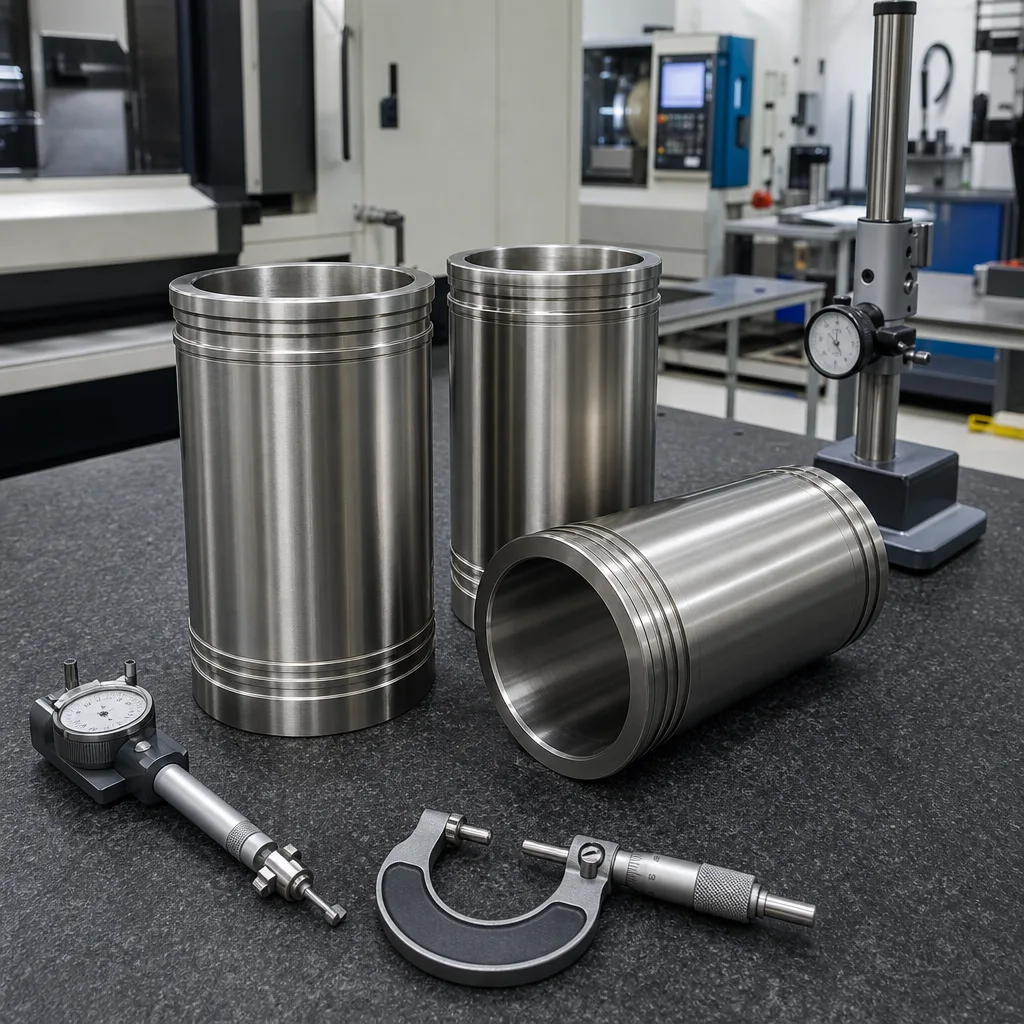
Cylinder Liner Volvo Wholesale: Sourcing and Specs
Procurement teams buying cylinder liner Volvo wholesale usually have three priorities running in parallel: controlled dimensions, reliable replenishment, and documentation that can stand up to a distributor, fleet, or remanufacturer audit. Driventus is an independent aftermarket manufacturer; Volvo and other vehicle or engine brand names are used only to identify fitment.
For engine rebuilders, regional distributors, fleet maintenance groups, remanufacturers, and OEM-adjacent supply chains, a liner is not a commodity part to be selected on unit price alone. Bore diameter, flange height, wall thickness, surface finish, material grade, coolant sealing, cleaning, and export packing all influence installation quality and service life.
Wholesale programs also carry risks that may not show up in a one-time sample order. If bore size, liner projection, counterbore seating, or groove location shifts between lots, the result can be machine-shop rework, delayed rebuild jobs, field complaints, or inventory tied up in the wrong application. We manufacture for export programs that require repeatable fitment, batch traceability, controlled labeling, and packaging that is ready for warehouse handling on arrival.
If your program includes mixed engine codes, legacy stock references, oversize repair practices, or private-label requirements, we can match the application data against drawings, samples, measured parts, or existing inventory before quotation. The goal is practical: reduce returns, protect margin, and keep cylinder liner replenishment stable across regions.
What wholesale buyers should verify before ordering
Wholesale sourcing starts with fitment control, not carton quantity. Within the same engine family, liners may differ in height, counterbore depth, sealing configuration, flange profile, or finish requirement depending on production year, emissions variant, rebuild practice, and regional service history. A cylinder liner that looks right in a catalog can still miss the purchasing objective if projection is wrong, the flange seat does not match the block, or the bore finish needs extra machining before installation.
Before placing a release order, confirm the following technical and commercial points:
- Nominal bore diameter, tolerance band, and whether the liner is supplied fully finished or semi-finished with honing allowance
- Outside diameter, wall thickness, cylindricity, and any press-fit or slip-fit requirement
- Flange or collar geometry, including seat width, radius, chamfer, underside profile, and perpendicularity to bore
- Installed height and liner projection above the deck after seating; projection is often controlled in hundredths of a millimetre on wet-liner engines
- Wet or dry construction and coolant sealing method, including O-ring groove diameter, width, depth, edge break, and axial position if sealing rings are used
- Bore surface finish values, such as Ra/Rz or plateau-hone parameters where specified, and surface condition of external contact areas
- Material specification, casting route, hardness range, microstructure expectation, and heat-treatment requirement if applicable
- Compatibility with piston diameter, ring pack material/coating, oil-control design, and the rebuild procedure used by the end customer
- Unit, engine-set, or kit packing; carton quantity; label fields; barcode format; pallet pattern; and export packing method
- Required inspection records, batch numbers, drawing revision, certificate language, and document format for downstream audit use
When comparing suppliers, ask for dimensional reports from production lots rather than relying only on a single golden sample. A sample can demonstrate basic capability, but it does not prove batch stability, gauge control, packing consistency, or claims response. For wholesale cylinder liner Volvo programs, a stronger sourcing file includes a reference drawing, approved sample photos, critical-to-quality dimensions, packing photos, inspection frequency, and the intended release schedule.
It helps to keep engineering approval separate from price negotiation. First establish that the part is technically correct, that the supplier can hold the critical dimensions, and that the documentation format suits your market. Then compare price, MOQ, and lead time. If you already buy other engine parts, you can review this product line alongside our engine components and broader our catalog before opening a new sourcing file. For quotation packs, we can align the offer to your BOM, drawing, engine code list, or sample set while keeping the commercial terms separate from the engineering review.
Fitment data and OE cross-reference control
A dependable cross-reference process matters more than matching a part by name. For cylinder liner programs, buyers should confirm engine family, displacement, cylinder count, bore size, liner type, sealing layout, and any machining features that affect block compatibility. When an OE reference is available, we use it as a fitment pointer, then validate the physical dimensions against the sample, drawing, or measured stock. We do not claim vehicle manufacturer approval, endorsement, or genuine-part status.
A practical workflow looks like this:
1. Collect the engine code, displacement, cylinder count, production range, emissions version where relevant, and destination market. 2. Record all available OE, aftermarket, fleet, and distributor references, but treat them as cross-check data rather than final proof. 3. Confirm whether the liner is dry or wet and whether O-rings, counterbores, step features, fire-ring interfaces, or shim practices are used. 4. Compare bore, outside diameter, flange diameter, flange thickness, groove dimensions, chamfers, total length, and projection values against the sample or customer print. 5. Check piston-to-liner running clearance, ring face material, ring end-gap practice, and whether final honing is performed by the supplier, the distributor, or the rebuilder. 6. Confirm whether the part will be sold as an individual liner, a cylinder set, an engine set, or a kit combined with sealing rings or other rebuild parts. 7. Confirm carton markings, barcode symbology, batch traceability, country-of-origin marking, and any private-label restrictions before mass packing.
This is where procurement and engineering need to work from the same file. Purchasing teams often start with a reference number and target price; engineering teams understand the installation risks behind that number. Combining both inputs prevents avoidable mistakes, such as approving a liner with the correct nominal bore but the wrong flange height, sourcing a wet liner without the correct O-ring groove stack, or accepting a dry liner with an outside diameter that cannot provide the required block fit.
Cross-reference control should continue after the first order. If a market uses several references that appear interchangeable, keep an approved application matrix showing which numbers are truly equivalent, which need separate stock, and which are not acceptable substitutes. Add notes on oversize variants, finished versus semi-finished supply, and kit contents. This protects sales teams from selling one SKU across applications it cannot safely cover.
A low unit price has little value if the liner requires machine-shop rework or triggers a warranty dispute after installation. If your team needs an application review before purchase, send the current reference data through request a quote. We will confirm whether the part should be supplied as a direct fit, a drawing-matched replacement, or a custom run.
Material, machining, and inspection requirements
Cylinder liners depend on metallurgy and machining consistency. For export supply, buyers should expect a controlled casting route, a stable machining process, calibrated measurement, and documented final inspection. Our production is managed under quality system controls aligned with IATF 16949:2016 and ISO 9001:2015, with material and chemical compliance managed for REACH (EC) No 1907/2006 where applicable.
Material selection affects more than wear life. It influences machinability, thermal stability, hardness consistency, ring seating, scuff resistance, and the liner’s ability to handle repeated heat cycles. A wholesale buyer should therefore avoid vague descriptions such as “cast iron liner” unless the supplier can define the grade, hardness range, and inspection method. Many heavy-duty aftermarket liners are produced from alloyed grey cast iron or an equivalent drawing-specified cast iron, with hardness commonly controlled in a defined HB range rather than left open. If the customer drawing specifies composition, microstructure, carbide distribution, or hardness target, those requirements belong in the quotation file before price is finalized.
Machining control is just as important. Critical operations may include casting inspection, stress relief where specified, rough turning, finish turning, flange machining, groove machining, boring, honing, chamfering, deburring, washing, rust prevention, and final inspection. Small errors in these steps can become large assembly problems. An uneven flange underside can affect seating. A sharp or rough groove can cut an O-ring. The wrong chamfer can damage rings during assembly, while an unsuitable hone pattern can delay ring seating or increase oil consumption.
| Control item | Typical buyer check | Why it matters |
|---|---|---|
| Cast material | Alloyed grey cast iron or drawing-specified grade, with hardness data where required | Affects wear resistance, machinability, scuff resistance, and thermal stability |
| Chemical composition | Material certificate or batch confirmation when specified | Helps verify the agreed grade and supports audit documentation |
| Bore finish | Ra/Rz target, crosshatch angle, plateau-hone requirement, and whether final honing is included | Impacts ring seating, oil retention, blow-by, and oil control |
| Roundness and taper | Lot inspection report with measured values at defined heights | Reduces compression loss, oil consumption, and piston scuffing risk |
| Flange height and flatness | Measured against sample or print with calibrated height gauge/CMM where applicable | Prevents deck protrusion errors, fire-seal issues, and coolant leakage |
| Outside diameter | Inspection against fitment or interference requirement | Supports correct block fit, heat transfer, and dry-liner retention |
| Groove and chamfer quality | Dimensional and visual check for width, depth, radius, burrs, and edge break | Protects seals and reduces installation damage |
| Visual quality | No cracks, open pores, burrs, rust, bruised edges, or handling dents | Lowers installation rejects and warehouse complaints |
| Cleaning and rust prevention | Clean bore, capped or sleeved ends where needed, protective oil or VCI as specified | Prevents abrasive contamination and corrosion during storage |
| Packaging | VCI, separators, bore protection, flange protection, carton strength, palletisation | Protects machined surfaces in export transit and warehouse handling |