Clutch Kit Subaru Supplier: Sourcing Guide for Buyers
If you are qualifying a clutch kit Subaru supplier, the real risk is not price. It is the gap between a part that fits on paper and a kit that performs consistently in the field. Subaru applications are sensitive to spline count, cover height, friction diameter, clamp load, and release travel, so small deviations can create noise, harsh engagement, or premature slip. Driventus is an independent aftermarket manufacturer; brand names are referenced for fitment only. We build clutch system components under IATF 16949:2016 and ISO 9001:2015 controls, with process checks aligned to export-market expectations in the EU, UK, US, Canada, Australia, and Brazil. The guide below follows the buying questions that matter most: how to verify fitment, where supplier failures usually happen, what to ask for in a sample and audit, and how to separate a workable offer from a risky one.
Where clutch programs usually fail
Most sourcing problems show up in the same places: fitment, release feel, and delivery discipline. A kit can match the catalog description and still fail in the vehicle because the hub offset is wrong, the cover geometry is inconsistent, or the friction disc does not align cleanly with the intended transmission.
That is why buyers should treat a clutch kit as a system, not a bundle of parts. The question is not only whether the supplier can quote the right reference. It is whether the factory can repeat the same dimensions and the same assembly standard across every lot.
Common failure modes to screen for:
- Wrong OE cross-reference for a mid-cycle transmission change
- Spline mismatch that prevents clean engagement
- Cover height variation that changes release travel
- Inconsistent pedal effort between lots
- Packaging errors that mix similar part numbers
When a supplier cannot explain where those risks are controlled, the offer is too shallow for B2B procurement.
What to verify before you request a quote
Before comparing suppliers, lock the application data. Subaru fitment is rarely safe to source from model name alone. For an RFQ, specify the model year, engine code, transmission type, drive layout, OE reference, and any known supersession history.
Then ask the supplier to confirm the exact kit content and the measured values for the critical dimensions. Do not accept a catalog match without sample or drawing support.
Use this checklist:
- Pressure plate: clamp load target, bolt pattern, finger height
- Driven plate: outer diameter, hub spline, plate thickness, damper type
- Release bearing: bearing style, contact face, guide compatibility
- Pilot bearing or bush: when the application uses one
- Hardware and labeling: bolts, alignment tool, carton mark, lot code
If your team sources by OE-style cross-reference logic, keep that reference visible in the RFQ and on the carton label. That reduces receiving errors and makes warranty handling cleaner if a field issue appears later.
Spec checks that separate good kits from near-misses
A Subaru clutch kit can look correct while still being wrong in a few decisive dimensions. That is why a spec review should focus on the values that affect torque transfer and release behavior, not just the part number.
For each key dimension, ask three things: what is the target value, how was it measured, and what tolerance is actually being held. If the supplier cannot answer those questions clearly, the control system is weak.
Practical validation points:
- Measure disc outside diameter and thickness
- Confirm spline fit on the intended input shaft sample
- Check cover height and diaphragm finger geometry
- Verify release bearing contact surface and travel range
- Review pedal effort and disengagement behavior during bench or vehicle testing
For endurance screening, many buyers start with 100,000 cycles for mainstream passenger applications and move to 150,000 cycles for harsher-duty use. The exact pass/fail limits for slip, chatter, and disengagement should be written before testing starts. That avoids arguments after the sample has already been approved or rejected.
Audit the factory, not just the certificate
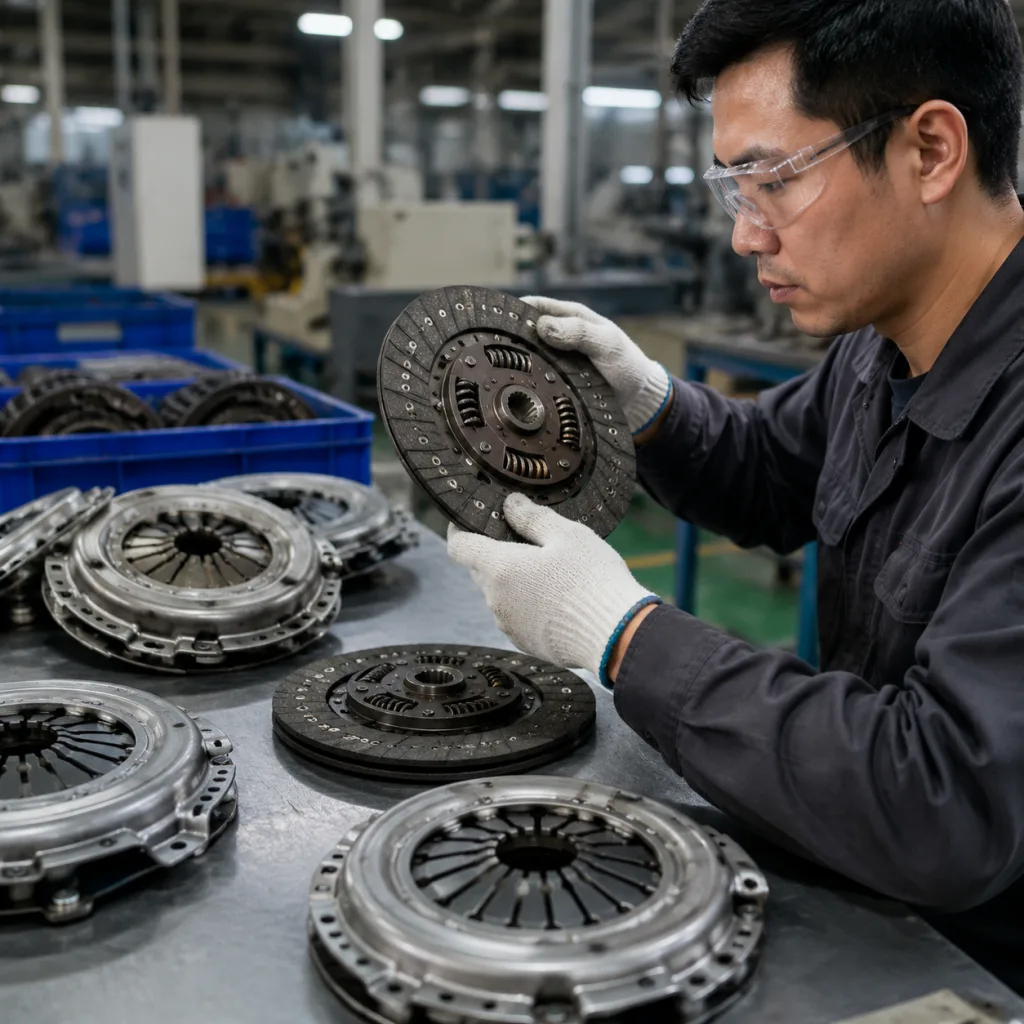
A certificate matters, but it does not prove day-to-day control. For export procurement, ask for evidence from the actual production line: incoming material checks, process records, final gauging, and lot traceability.
Driventus operates under IATF 16949:2016 and ISO 9001:2015. For regulated markets, material and chemical compliance should also be checked against REACH (EC) No 1907/2006 where applicable.
Documents to request:
- Quality manual or process map
- Incoming material inspection records
- Heat-treatment and surface-finish traceability
- Final inspection criteria for runout, thickness, and release geometry
- Lot coding and retention sample policy
- Packaging and palletization standard
A supplier should be able to link a finished lot back to raw material and inspection data. If that traceability breaks, problem-solving becomes slow and expensive. Also confirm whether the factory supports customer audits, remote document review, and third-party pre-shipment inspection.
Compare suppliers on supply, not only unit price
A low ex-works price does not help if the schedule slips or the cartons arrive wrong. For clutch programs, supply reliability often matters more than a small price gap.
Ask each supplier to quote the same commercial basis: currency, Incoterm, carton quantity, pallet count, sample charge, tooling charge if any, and payment terms. That makes bids comparable.
Typical planning questions:
- What is the MOQ by SKU or by kit family?
- What is the standard lead time after order confirmation?
- Which items are stock build versus make-to-order?
- Can cartons be mixed by SKU without relabeling errors?
- Are repeat runs held to the same inspection plan as first production?
A common structure is 1-2 sample sets for fitment confirmation, 20-50 sets for pilot validation, and then a production MOQ that may start at 100-300 kits per SKU depending on packaging and line sharing. Standard lead time is often 30-45 days for stable repeat items and 45-60 days for new or special-pack orders, but the supplier should commit in writing to the order date, not a vague month.

How Driventus supports B2B sourcing
Driventus supports clutch sourcing as part of a broader powertrain program, which helps buyers consolidate vendors without losing technical control. Our catalog is organized for B2B sourcing and can be reviewed through our catalog. For adjacent engine hardware, engine components may also help with line consolidation.
We support:
- OE cross-reference review for fitment screening
- Batch traceability and inspection records
- Export packing for pallet and carton control
- OEM and aftermarket program development
- Document packs for buyer approval and vendor onboarding
For quality and process details, see our quality system. If your team needs a quotation, sampling plan, or packaging specification, use request a quote. We can also align quotation inputs around target annual volume, regional mix, carton pack-out, and launch timing so buyers can compare offers on equal terms.
Pre-award checklist for procurement teams
Before awarding a clutch program, close the essentials in writing so the technical brief, the commercial offer, and the receiving process all match.
1. Approved vehicle and transmission list 2. OE reference mapping and revision control 3. Kit content and carton label format 4. Dimensional acceptance limits 5. Test method and sample size 6. MOQ, lead time, and delivery terms 7. Warranty response procedure
Add concrete values to each line item. Define the acceptable model-year range, state the spline count and diameter, name the inspection method for runout and thickness, and specify the response time for nonconformance, such as 48 hours. If a supplier cannot meet those terms, the issue is commercial risk, not paperwork.
That discipline helps buyers avoid parts that are technically close but operationally unsuitable. It also lowers claims, protects warehouse accuracy, and makes repeat orders easier to manage across regions.
Frequently asked questions
Look for traceability, stable lead times, documented inspection, and clear fitment control. Export buyers should also confirm packaging, palletization, and compliance documentation before placing repeat orders. A practical minimum is a written lot traceability scheme, agreed inspection points, and a lead-time commitment tied to the confirmed PO date.
Yes. We can review OE-style cross-references for fitment screening and confirm the kit content against the target application. Driventus is an independent aftermarket manufacturer; brand names are referenced for fitment only. Buyers should provide the OE number, vehicle range, transmission code, and sample or drawing when available so the cross-check can be validated faster.
Yes. Custom packaging and program-specific labeling can be handled through our OEM process. Share your carton spec, barcode format, target market requirements, and monthly forecast in the enquiry so we can confirm MOQ, lead time, and artwork approval timing.
If you are qualifying a new clutch program, send the application details, target volume, and packaging requirements through /contact.html and we will review the fitment and supply options.
Request a Quote