Clutch Kit Skoda Supplier: Complete B2B Sourcing Checklist
Choosing a clutch kit Skoda supplier is a purchasing decision that directly affects warranty cost, distributor reputation, service fill rate, and total landed cost. A price list or a broad claim that a kit fits "VAG applications" is not enough. Buyers need fitment confirmed by OE reference, engine code, gearbox code, flywheel type, release system, and production split, along with evidence of stable friction performance, dimensional control, batch traceability, and dependable export execution. For distributors, repair chains, and OE-service programmes, the supplier also needs to support consistent replenishment, compliant packaging, barcode accuracy, and batch-level documentation.
That matters even more in Skoda-platform aftermarket sourcing, where apparent interchangeability across Volkswagen Group vehicles can hide important differences in clutch diameter, spline count, hub depth, dual-mass flywheel versus rigid flywheel compatibility, pull-type versus push-type release design, and whether the kit includes a release bearing or concentric slave cylinder. A sound sourcing process starts with application mapping at VIN, engine, and gearbox level, then moves into audit, validation, commercial terms, and claim-response readiness.
When sourcing clutch cover, driven plate, and release bearing assemblies for European passenger vehicles, it makes sense to assess the supplier against measurable criteria: factory certification, incoming material controls, test capability, runout and balance limits, clamp-load verification, MOQ, lead time, packaging standards, and corrective-action discipline. This article explains what purchasing teams should check before adding a clutch kit Skoda supplier to their approved vendor list, with a focus on Skoda-platform aftermarket demand in the EU, UK, North America, Australia, and Brazil. Driventus is an independent aftermarket manufacturer; brand names are referenced for fitment only.
What procurement teams should verify first
A credible clutch kit Skoda supplier should be able to confirm application coverage and provide manufacturing evidence before commercial discussions go too far. With Skoda applications, the model name alone tells you very little. Octavia, Superb, Fabia, Rapid, Yeti, Karoq, and Kodiaq references can vary by engine code, torque rating, gearbox family, flywheel setup, and release bearing design, even when the vehicles look closely related on paper.
For the first RFQ round, ask the supplier to complete a fitment matrix covering:
- Model, platform, model year range, engine code, kW/PS output, and transmission code
- OE, OEM, and major aftermarket cross-references used to support the fitment claim
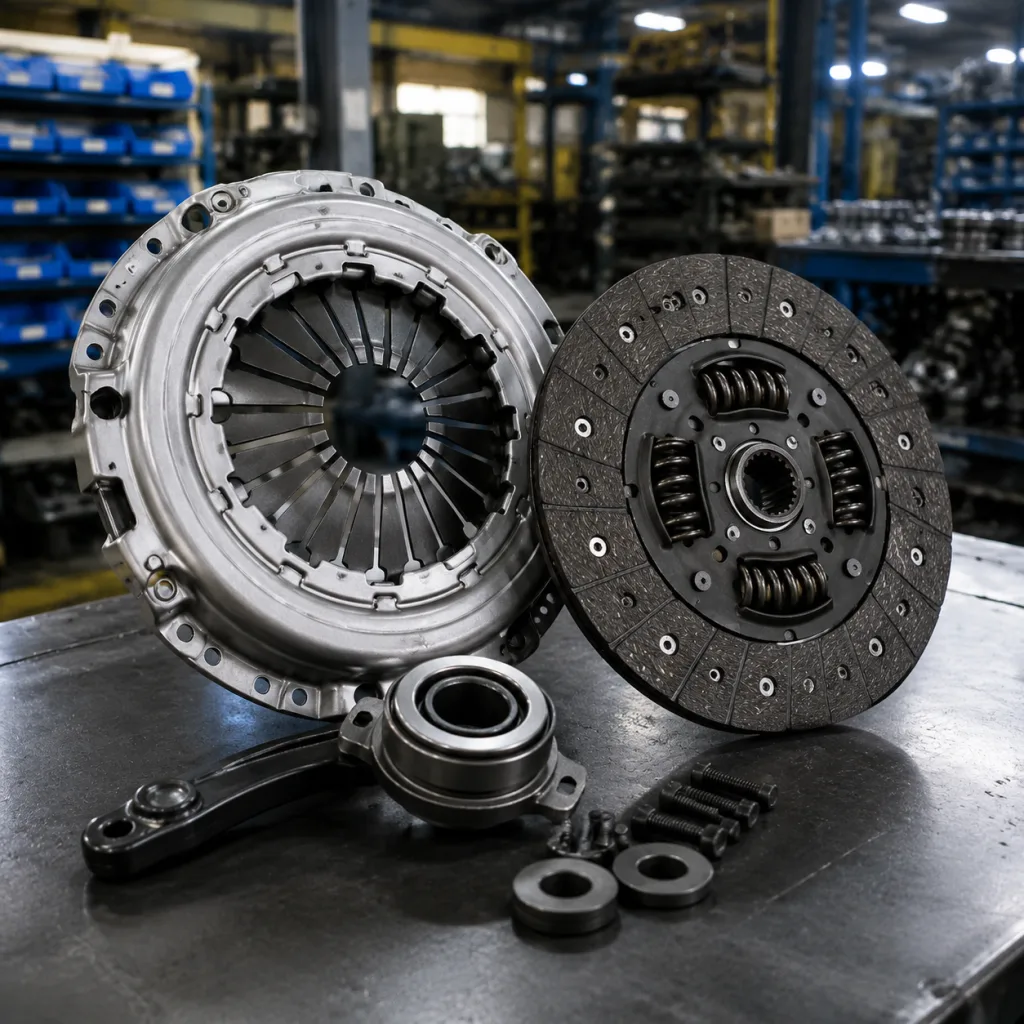
- Kit content: pressure plate, clutch disc, release bearing or concentric slave cylinder, bolts, alignment tool, grease, and any exclusions
- Core dimensions such as disc outer diameter, spline count, spline major/minor profile, hub offset, installed cover height, and mounting pattern/bolt quantity
- Friction lining material type, torsion damper configuration, and target clamp-load band
- Packaging format, barcode symbology, label data fields, and country-of-origin marking
- Batch coding method from incoming material through finished export carton
This first document set matters because many warranty problems begin before the first shipment ever leaves the factory. A quote may align with a vehicle family but miss the exact engine or gearbox variant, call out a 220 mm kit where a 228 mm assembly is required, or leave out bolts or CSC hardware the buyer assumed were included. A dependable clutch kit Skoda supplier should be ready to flag doubtful interchange, identify superseded references, and separate standard production items from make-to-order or under-development items.
For supplier approval, certification is a baseline, not a sales pitch. Buyers should request:
- Current certificates for IATF 16949:2016 and ISO 9001:2015
- Documented engineering change control and deviation approval procedures
- PPAP or ISIR support capability if the customer requires it
- Retained inspection records and a sample traceability file
- Material declarations relevant to REACH (EC) No 1907/2006 for EU and UK aftermarket programmes
One practical screening method is to send 10 to 20 target references, including both fast movers and slow-moving tail items, and ask the supplier to classify each one as stocked, scheduled production, or new development. Ask them to state whether fitment confirmation is based on drawing comparison, bench sample check, vehicle test, or catalog cross-reference only. Comparing that response with our catalog gives purchasing teams a clearer picture of true range depth rather than brochure-level coverage.
Factory audit points for a clutch kit supplier
A desk review is not enough for a friction and rotating assembly. If an on-site audit is possible, follow one part number from incoming material through to the finished packed kit. The aim is to verify process control, not presentation quality.
Key audit checkpoints
1. Incoming material control Review how steel stampings, diaphragm spring material, friction facings, rivets, hubs, damper springs, and purchased bearings are identified, sampled, and released. Ask to see supplier lot numbers, incoming inspection records, hardness checks, friction facing thickness checks, and dimensional verification against approved drawings.
2. Cover assembly process Verify stamping thickness control, diaphragm spring forming consistency, assembly torque or riveting controls, and final clamp-load inspection. Clamp load should be checked on calibrated equipment against a part-specific specification, not judged visually. Also check whether key process settings are locked by part number or adjusted manually each shift.
3. Driven plate production Inspect lining positioning, riveting integrity, cushion deflection measurement, spline hub hardness control, damper spring installation, and free-angle or torsional torque-window checks. Mixed-part prevention is critical because visually similar discs can still have different hub depths, spring packs, or spline geometry.
4. Runout, balance, and dimensional control Confirm how disc lateral runout, parallelism, assembled stack height, and dynamic balance are measured. Rejection limits should be documented on control plans and tied to actual batch records. For passenger-car clutch discs, buyers should expect clear gauges and part-specific tolerances rather than generic "within standard" wording.
5. Release bearing validation If bearings are sourced externally, verify incoming checks for rotational smoothness, abnormal noise, grease fill condition, and dimensional compatibility with the guide tube or release mechanism. Buyers should also ask whether the bearing source is fixed or may vary within an approved supplier list.
6. End-of-line inspection and packing Review final inspection frequency, kit completeness checks, barcode verification, label revision control, and segregation of non-conforming stock. For private-label work, audit teams should check artwork approval records, carton revision history, and scan verification for EAN/UPC or customer-specific labels.
7. Traceability drill Ask the factory to select one recent batch and show linkage back to material lots, machine or line, operator records, inspection data, and packaging records. If this takes too long or cannot be completed cleanly, traceability will be weak when a field claim appears.
8. Warranty handling and corrective action Review the returned-part analysis process, 8D or equivalent problem-solving format, containment timing, and evidence that corrective actions are verified before closure. Useful questions include current PPM, top recurring defects, average claim-response time, and whether failed parts are sectioned or bench-tested during root-cause analysis.
Audit teams should also review the supplier's quality system documents, calibration control, layered process audit routines, warehouse status controls, and containment procedures. This matters because clutch complaints often come from small process drift rather than obvious failure: clamp-load variation, facing thickness spread, hub spline deviation, incorrect damper spring build, or the wrong bearing in the kit.
If an on-site visit is not possible, request a live video audit plus sample records from one recent batch. A remote audit is not the same as a plant visit, but it still reveals whether the clutch kit Skoda supplier is working from controlled records or relying on sales presentation material.
MOQ, lead time, and supply model comparison
Commercial terms should fit the sales channel. A distributor launching a new range needs a different level of flexibility than a high-volume private-label programme, and a custom-specification project demands more engineering discipline than either.
| Sourcing factor | Stock range programme | Private label programme | Custom specification programme |
|---|---|---|---|
| Typical MOQ | Low to moderate, often by SKU/carton multiple | Moderate, usually driven by carton print run and label setup | Moderate to high, especially if unique components or tooling are needed |
| Lead time | Short if stocked | Medium, often tied to packaging approval | Longer during validation, sample approval, and first build |
| Packaging | Standard export carton | Customer artwork and labels | Customer artwork plus technical sign-off |
| Forecast requirement | Helpful but limited | Rolling forecast recommended | Forecast and launch plan usually required |
| Engineering changes | Limited | Revision-controlled | Formal approval and change notice required |
| Fitment expansion | Based on existing range | Based on existing range first | New references can be developed to fill gaps |
| Documentation | Standard inspection records | Standard plus label approval | Expanded validation package |
| Launch risk | Lowest | Moderate | Highest if demand or fitment is uncertain |