A clutch kit Seat replacement programme can fail long before a mechanic opens the carton. The usual causes are not dramatic: a catalogue line that covers too many variants, a bearing that fits the guide tube but sits wrong under load, a pressure plate height that changes the release point, or packaging that lets a disc arrive with runout. Seat applications need tighter control because 180 mm, 200 mm, 215 mm, 228 mm, 230 mm, and 240 mm clutch formats can appear across different engine codes, gearbox families, model-year changes, emissions variants, flywheel types, and release systems. Treat the kit as a controlled assembly, not a loose bundle of parts. Specify driven plate diameter, spline count, hub offset, pressure plate installed height, diaphragm load curve, bearing or CSC interface, kit contents, carton data, batch traceability, and approval limits. This article gives procurement teams a practical framework for sourcing clutch kit Seat replacement supply: where fitment goes wrong, which dimensions deserve hard tolerances, what validation evidence to request, how manufacturing controls reduce claims, and how MOQ, lead time, packaging, and landed cost should be judged. Driventus manufactures clutch kits and related powertrain components in Taizhou, Zhejiang, under IATF 16949:2016 and ISO 9001:2015 controls. Driventus is an independent aftermarket manufacturer; vehicle brand names and OE-style references are used only to identify fitment.
Start With the Variant Decision, Not the Part Number
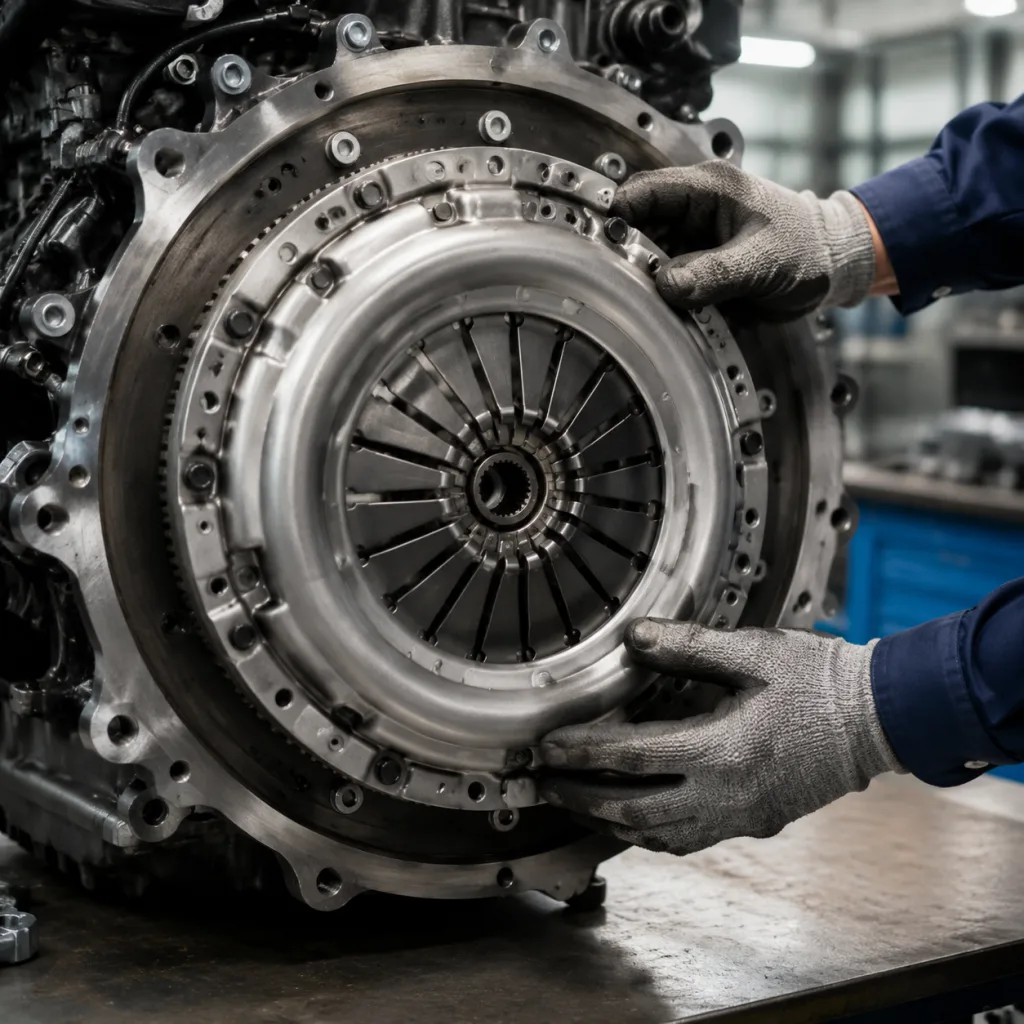
For B2B buyers, one workshop success is not proof of repeatable fitment. The real question is narrower: which Seat applications can this clutch kit cover without forcing installers into compromise? A kit normally includes the pressure plate, driven plate, release bearing or concentric slave cylinder where applicable, and installation accessories such as bolts, guide sleeves, alignment tools, grease sachets, or technical notes. Each item has to agree with the gearbox bell housing, flywheel interface, spline geometry, release mechanism, clamp-load envelope, and available pedal or hydraulic travel.
Use the part number only after the variant logic is clear. A workable approval file should identify model range, production dates, engine code, gearbox code, engine torque, flywheel type, driven plate diameter, spline count, hub offset, pressure plate bolt pattern, release bearing or CSC type, and excluded variants. If a buyer uses an OE-style reference such as OE 06A… or OE 11251…, treat it as a fitment clue. It is not a complete specification. Check it against measured parts, TecDoc-style application data where available, buyer catalogue records, and regional vehicle build information.
The common decision traps are easy to describe and expensive to fix:
Spline looks close, then binds: wrong tooth count, input-shaft diameter, hub offset, or profile angle; checks often involve 18T, 20T, 23T, or 28T spline counts depending on gearbox family.
Release point moves: pressure plate installed height changes enough to create heavy pedal feel, incomplete disengagement, or poor bite-point consistency.
Disc arrives slightly distorted: lateral runout creates judder, uneven contact, or early lining wear.
Bearing fits statically but fails dynamically: incorrect inner diameter, travel, clip geometry, connection type, or guide-tube contact causes noise, wear, leakage, or incomplete release.
Kit content changes by batch: bolts, guide sleeves, alignment tools, grease, multilingual instructions, or CSC retaining plugs are missing or inconsistent.
Catalogue coverage is too broad: one SKU is assigned across engine, gearbox, flywheel, or market variants that should remain separate.
For new range development, approve one golden sample set, freeze drawings or inspection dimensions, run first-article inspection on at least 5 kits, and release a pilot order before national distribution. Driventus supports aftermarket range planning through our catalog, including powertrain and engine-related product families used by regional distributors.
Dimension Deep-Dive: The Measurements That Decide Fit
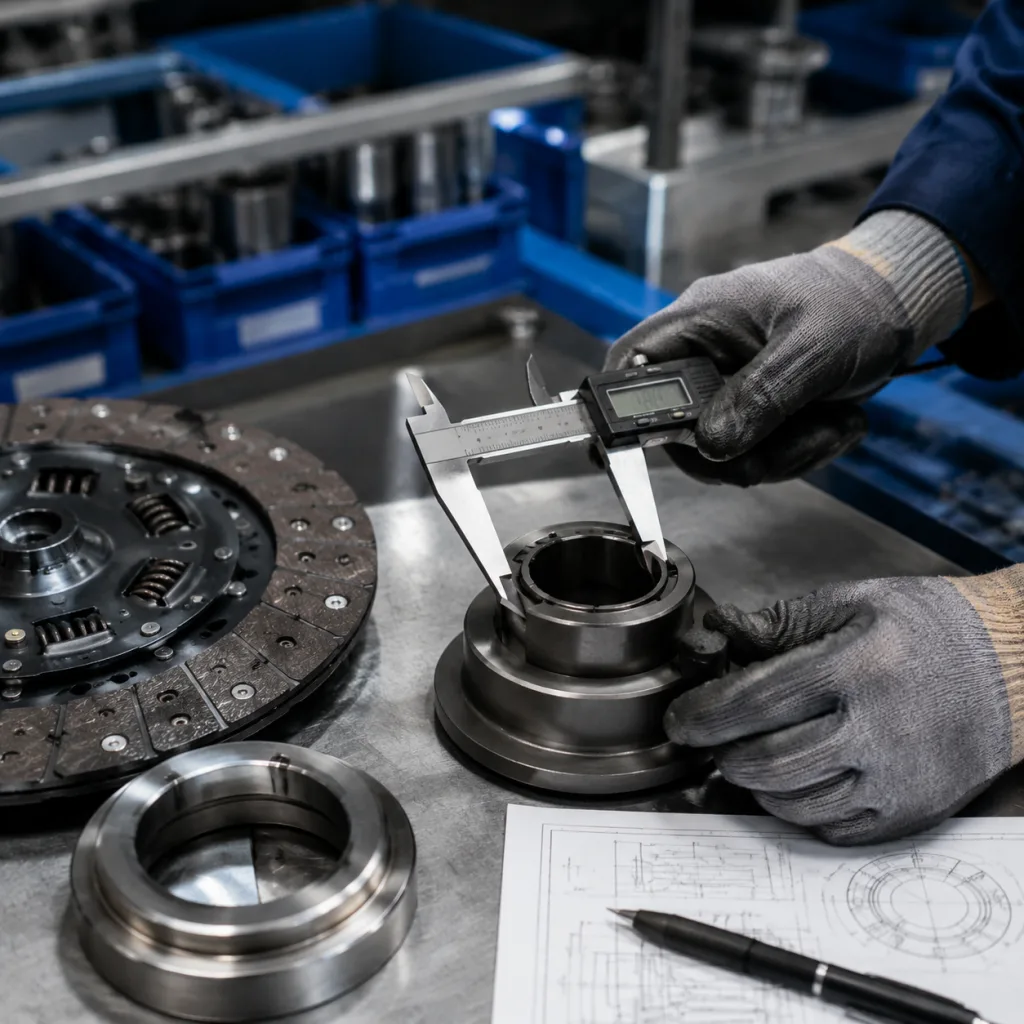
A clutch kit Seat replacement part should match the original functional envelope closely enough to install without modification and operate within the intended release and torque range. That sounds obvious. The sourcing mistake is leaving the word “match” undefined. Importers should put measurable characteristics into the purchase specification instead of relying on catalogue claims or application descriptions. The figures below are typical aftermarket control targets; final tolerances must be confirmed by application drawing, sample approval, and buyer standard.
Item
Typical verification point
Practical sourcing tolerance or limit
Driven plate outside diameter
Commonly 180–240 mm
Match approved sample; often ±0.3–0.5 mm on OD
Lining thickness, total disc
Application-specific
Common control band ±0.15–0.25 mm per buyer drawing
Spline count and hub profile
Tooth count, major/minor diameter, hub offset
100% tooth-count check; gauge-fit without rocking or binding
Hub offset and damper clearance
Flywheel and cover clearance
Confirm no contact through full release travel
Pressure plate cover height
Installed height and release finger position
Common first-article target within ±0.3 mm, tighter for high-risk kits
Diaphragm spring clamp load
Application torque requirement
Batch mean and minimum load recorded; buyer to define N range
Disc lateral runout
Measured near friction OD
Common acceptance ≤0.5–0.8 mm TIR unless drawing states otherwise
Release bearing interface
ID, OD, width, travel, guide-tube fit
Sliding fit on guide tube; no seal drag, tilt, or clip interference
CSC hydraulic ports
Connector, stroke, leak rate, mounting holes
Pressure-hold and stroke test required before packing
Fastener pattern
BCD, hole size, dowel position
Must fit flywheel without slotting, drilling, or rework
Kit mass and balance
Assembly weight and rotating balance
Buyer may require balance record for 228–240 mm and performance kits
</tr></thead><tbody> </tbody></table>Incoming inspection should change with risk. For repeat orders, inspect at least 3 kits per lot. For new supplier qualification, engineering changes, or high-claim applications, inspect 5–10 kits and tighten the checks around the release system and rotating parts. For critical dimensions, buyers can use ANSI/ASQ Z1.4 or ISO 2859-1 sampling, for example AQL 0 for missing or wrong components, AQL 1.0 for major functional defects, and AQL 2.5 for minor cosmetic defects. Wrong spline count, wrong bearing type, oil contamination on friction surfaces, cracked lining, or a missing CSC seal plug should be treated as critical non-conformance.
Higher-volume programmes often need PPAP-style evidence even when the kit is sold into the independent aftermarket. Useful documents include dimensional reports, material declarations, load-curve records, friction material batch data, bearing supplier certificate, CSC leak-test record, control plan, process flow, packaging specification, and change-control agreement. Driventus can review drawings, samples, and buyer-controlled specifications for custom manufacturing when a distributor needs a private-label kit structure, application-specific content, or market-specific packaging.
Validation Evidence: What Proves the Kit Survives Use
Visual inspection proves very little. A credible clutch kit Seat replacement source should show evidence that the kit installs consistently, releases within the available travel, handles repeated engagement, tolerates heat, and survives export handling. The validation plan should cover the interfaces that create field failures, not just the parts that are easiest to measure.
A practical validation sequence looks like this:
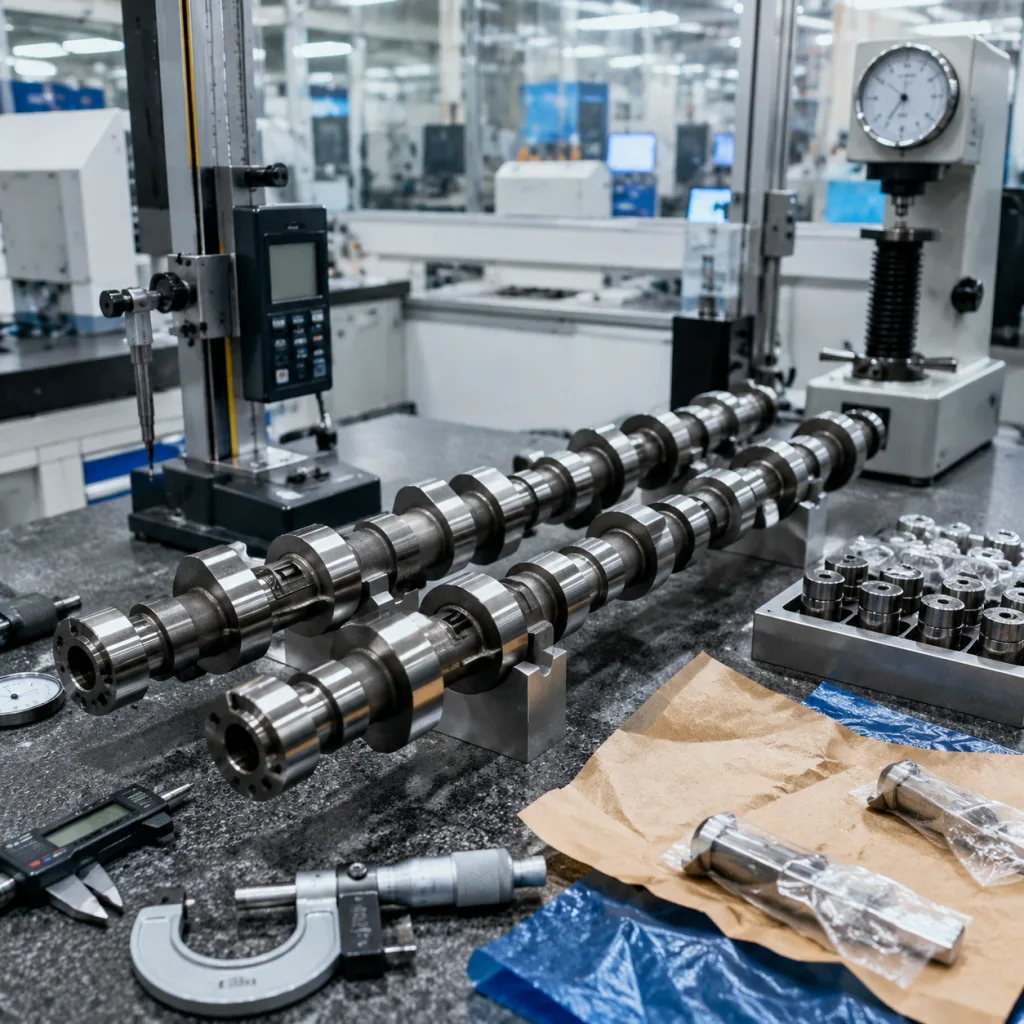
1. Confirm static geometry: CMM, height gauge, spline gauge, fixture checks, and first-article reports for all functional interfaces. 2. Map clamp load: pressure plate load-curve measurement across the release-travel range, with initial, peak, and release-load points recorded in N. 3. Check release margin: verify that disengagement occurs within available mechanical or hydraulic stroke, with clearance margin documented. 4. Stress the rotating disc: burst or overspeed testing at a defined safety margin above maximum engine speed, commonly 1.5–2.0 times rated speed for internal validation. 5. Measure friction stability: cold, hot, fade, and recovery-phase measurement, including torque capacity against engine-output requirement. 6. Run thermal cycles: heat soak, repeated engagement simulation, lining-bond review, rivet security, and post-test runout measurement. 7. Review NVH behaviour: release bearing noise, disc damper rattle, torsional behaviour, and take-up smoothness. 8. Test the hydraulic unit where supplied: CSC leakage, stroke, seal integrity, dust boot fit, quick connector compatibility, and pressure-hold performance. 9. Check storage and logistics risk: corrosion or humidity exposure for metal parts, grease stability for bearings and guide interfaces, and drop testing for inner carton, master carton, and pallet.
There is no single universal aftermarket clutch-kit standard equivalent to the way brake friction buyers may cite SAE J2527. That makes the buyer specification more important, not less. Require 100% kit-completeness checks, 100% bearing rotation checks, 100% CSC leak tests where supplied, batch clamp-load testing, first-article dimensional approval, and annual revalidation for top-moving part numbers.
Material compliance also needs early review. REACH (EC) No 1907/2006 matters for EU importers, especially for restricted substances in friction materials, rubber components, surface treatments, greases, adhesives, coatings, and packaging. Buyers selling into multiple regions may also require IMDS-style material reporting, conflict-minerals declarations, PFAS statements where requested, or equivalent compliance documents from the supplier. Quality management should be anchored in IATF 16949:2016 and ISO 9001:2015, with documented process control, traceability, corrective action, calibration, and supplier management.
Warranty Failure Modes to Remove at the Factory
Warranty returns on clutch kits are painful because the evidence is buried behind the gearbox. The distributor may face workshop labour, downtime, arguments over installation quality, and a customer who expects a fast answer. Many claims do come from vehicle-side or installation conditions: worn flywheels, contaminated friction surfaces, incorrect bleeding, misalignment, excessive crankshaft end float, gearbox input-shaft wear, missing dowels, or aggressive break-in. Still, supplier-side variation should be eliminated before parts enter the channel.
The factory controls that matter most are linked to known failure modes:
Slipping or lining separation: control friction lining bonding or riveting, shear strength, rivet setting, lining thickness, and contamination on the friction face.
Heavy pedal or poor disengagement: control diaphragm spring heat treatment, hardness, elasticity, load curve, fatigue resistance, and furnace records by batch.
Bolt-up problems: control cover stamping accuracy, mounting height, bolt-hole alignment, dowel location, and finger-position consistency.
Vibration or harsh take-up: control driven plate balancing, especially for 228 mm, 230 mm, and 240 mm applications.
Rattle or torsional shock: control damper spring rate, seating, end-stop clearance, and torsional damping behaviour.
Bearing noise: control grease fill, seal integrity, low-noise rotation, and temperature stability.
Hydraulic leakage: control CSC seal lubrication, port protection, stroke verification, pressure-hold testing, and contamination prevention.
Wrong or incomplete kits: control 100% kit completeness, surface defects, bearing movement, spline gauge fit, and handling damage.
Untraceable claims: apply batch identification on carton labels, product markings where practical, and internal records retained for the agreed warranty period.
A useful control plan separates critical, major, and minor characteristics. Critical characteristics include wrong application, wrong spline, missing bearing or CSC, hydraulic leakage, cracked lining, missing fasteners where required, and contaminated friction material. Major characteristics include out-of-tolerance cover height, excessive disc runout, noisy bearing rotation, incorrect label, weak carton, or missing installation note. Minor characteristics are non-functional cosmetic marks that do not affect fit, safety, or resale presentation.
Driventus applies process controls under its documented quality system, supported by IATF 16949:2016 and ISO 9001:2015 certification. For clutch kit sourcing, a practical audit should examine incoming steel and friction material checks, spring load testing equipment, rivet control, bearing supplier qualification, CSC leak testing where applicable, packaging line verification, calibration records, non-conforming material handling, and 8D corrective-action timing.
Define the warranty return process before volume supply begins. Require return sample labelling, mileage or installation date, vehicle application, engine and gearbox code, photos of flywheel and release system condition, installation notes, and batch code. A reasonable B2B timeline is 2 working days for claim acknowledgement, 10 working days for initial technical review after sample receipt, and 30 days for final 8D response when lab testing is required. This evidence helps separate fitment error, installation damage, vehicle-side faults, catalogue mistakes, and genuine product non-conformance.
Commercial Trade-Offs: MOQ, Packaging, Lead Time, Landed Cost
A technically correct clutch kit can still fail as a commercial product. The carton may crush in export handling. The label may not scan. The instructions may create brand-compliance risk. The MOQ may look low until a bearing or CSC subcomponent drives a second production lot. For importers and repair chains, the purchasing document should join engineering and channel requirements in one controlled specification.
A practical B2B sourcing checklist:
Confirm vehicle application by engine code, gearbox code, model year, market, flywheel type, torque rating, and release system.
Lock kit contents in the purchase specification, including pressure plate, driven plate, bearing or CSC, bolts, grease, alignment tool, and instructions where required.
Request dimensional reports for first articles, changed components, and high-risk applications.
Define friction material restrictions and REACH (EC) No 1907/2006 declarations where applicable.
Approve artwork, label language, carton size, gross weight, barcode format, QR or batch code, and pallet loading before mass production.
Set acceptable quality limits for visual defects, missing parts, corrosion, oil contamination, label error, and carton damage.
Require batch traceability, 60–90 days change-control notice for functional changes, and clear claim-handling time limits.
Keep installation notes neutral and technical, with no claim of vehicle manufacturer approval.
MOQ logic should be transparent before the first purchase order. For mixed aftermarket clutch kits, MOQs are often driven by pressure plate tooling, friction lining MOQ, bearing or CSC sourcing lots, packaging print quantity, and carton utilization rather than assembly labour alone. As a planning reference, buyers may see 100–300 sets per SKU for stocked standard items, 300–500 sets per SKU for private-label packaging, and 500–1,000 sets per SKU for new or low-run applications that require component production. Exact MOQ depends on kit structure, component stock, artwork, and annual forecast.
Compare landed cost, not only FOB unit price. Main price drivers include clutch diameter, pressure plate mass, diaphragm spring grade, driven plate damper design, bearing or CSC cost, fastener content, packaging grade, inspection level, and forecast stability. A kit with CSC can cost materially more than a mechanical-release kit because the hydraulic unit adds seals, casting, machining, leak testing, and packaging protection. Compare quotation basis clearly: EXW or FOB port, currency, validity period, tooling charge if any, sample cost, artwork cost, payment terms, and whether inspection reports and compliance documents are included.
Lead time should be treated as a launch variable. Repeat orders for stocked components may require 30–45 days after deposit and artwork approval. Private-label or mixed-SKU programmes may require 45–60 days. New development, tooling, or special validation can require 60–90 days before mass shipment. Add 1–2 weeks for first-article approval if samples must move between countries, and confirm peak-season capacity before launch.
The best sourcing choice depends on the channel. Multi-location repair chains need low variation, clear kit identification, and fewer installation disputes. Wholesalers need catalogue accuracy, durable cartons, scan-ready labels, and stable replenishment. OEM or Tier-1 service channels usually place more weight on audit readiness, change control, production documentation, and supplier corrective-action discipline. Driventus exports to more than 60 countries and can support importers with standard aftermarket supply, private-label packaging, application review, and sourcing documentation. Buyers can request a quote with sample photos, target annual volume, destination market, packaging requirements, preferred Incoterm, and any OE-style cross-reference data.
Frequently asked questions
Check engine code, gearbox code, model year, market, flywheel type, driven plate diameter, spline count, hub offset, pressure plate installed height, release bearing or CSC type, fastener pattern, torque requirement, and kit contents. Application descriptions alone are not enough for a controlled replacement programme.
No. An OE-style reference such as OE 06A… can support fitment mapping, but buyers should still verify dimensions, materials, release system interface, validation evidence, kit contents, packaging, and batch traceability. Driventus does not claim vehicle manufacturer approval.
IATF 16949:2016 and ISO 9001:2015 are important quality management references for process control, traceability, corrective action, calibration, and supplier management. EU importers should also review REACH (EC) No 1907/2006 declarations for friction materials, rubber, greases, coatings, surface treatments, and packaging.
If you are reviewing clutch kit Seat replacement supply for distribution, repair-chain, or private-label programmes, share your application list, engine and gearbox codes, target annual volume, destination market, packaging requirements, preferred Incoterm, and any OE-style cross-reference data with Driventus. Start a technical sourcing discussion at /contact.html