clutch kit · 2026-06-18

Clutch Kit Porsche Wholesale Sourcing Guide

A clutch kit porsche wholesale programme fails when buyers treat “Porsche-fit” as one tidy category. It is not. Rear-engine sports cars, mid-engine platforms, SUVs, transaxle models, hydraulic release systems, dual-mass flywheels, and performance-use expectations create different sourcing risks. Procurement teams need more than a catalogue match: they need confirmed dimensions, release geometry, friction stability, batch traceability, export-ready packaging, and documents that customs brokers and warranty teams can actually use. This article is written for aftermarket distributors, importers, repair-chain category managers, and sourcing teams evaluating Porsche-fit replacement clutch kits from an independent manufacturer. It covers kit definition, supplier failure modes, MOQ logic, validation, documents, and Driventus support for export programmes. Driventus manufactures engine and powertrain components in Taizhou, Zhejiang, and exports to more than 60 countries. Operations are managed under IATF 16949:2016 and ISO 9001:2015. Driventus is an independent aftermarket manufacturer; brand names are referenced only to identify replacement fitment.

Start With the Fitment Decision, Not the Catalogue Number

The first sourcing decision is not price. It is scope. Porsche-fit clutch demand should be mapped by platform type, engine layout, transmission, torque requirement, flywheel design, and release system before any RFQ is compared. A 228 mm, 240 mm, or 250 mm driven plate can change the kit. So can a 23-spline versus 28-spline hub, a pull-type versus push-type release system, or a concentric slave cylinder instead of a conventional release bearing.

Build the range in practical groups:

  • Rear-engine sports applications with specific cover height, release travel, and flywheel constraints
  • Mid-engine applications where packaging, bearing geometry, and transmission detail may differ by generation
  • SUV applications where torque load, vehicle weight, towing use, and hydraulic components need closer review
  • Transaxle or older references where lower volume may require different MOQ, tooling, or component sourcing logic
  • Performance-oriented kits where friction material, clamp load, pedal effort, and flywheel compatibility must be stated upfront

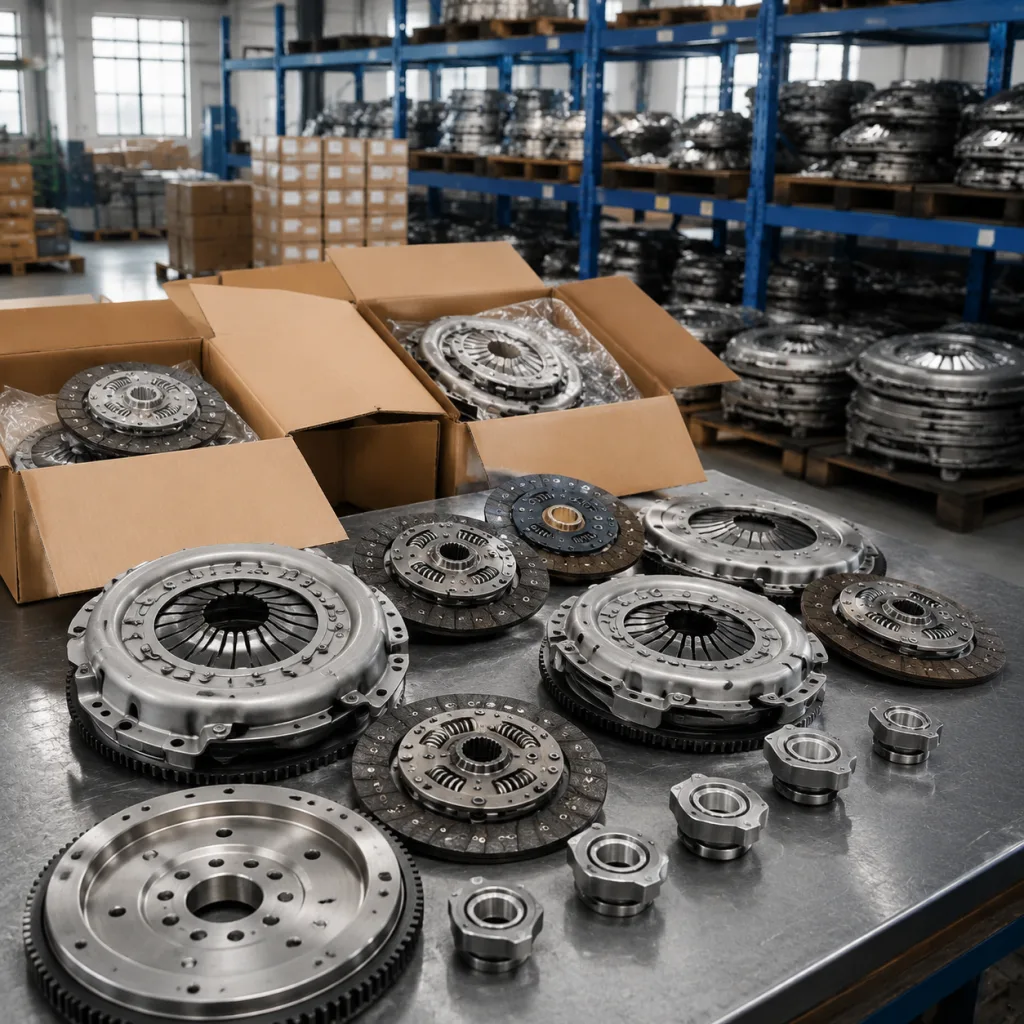
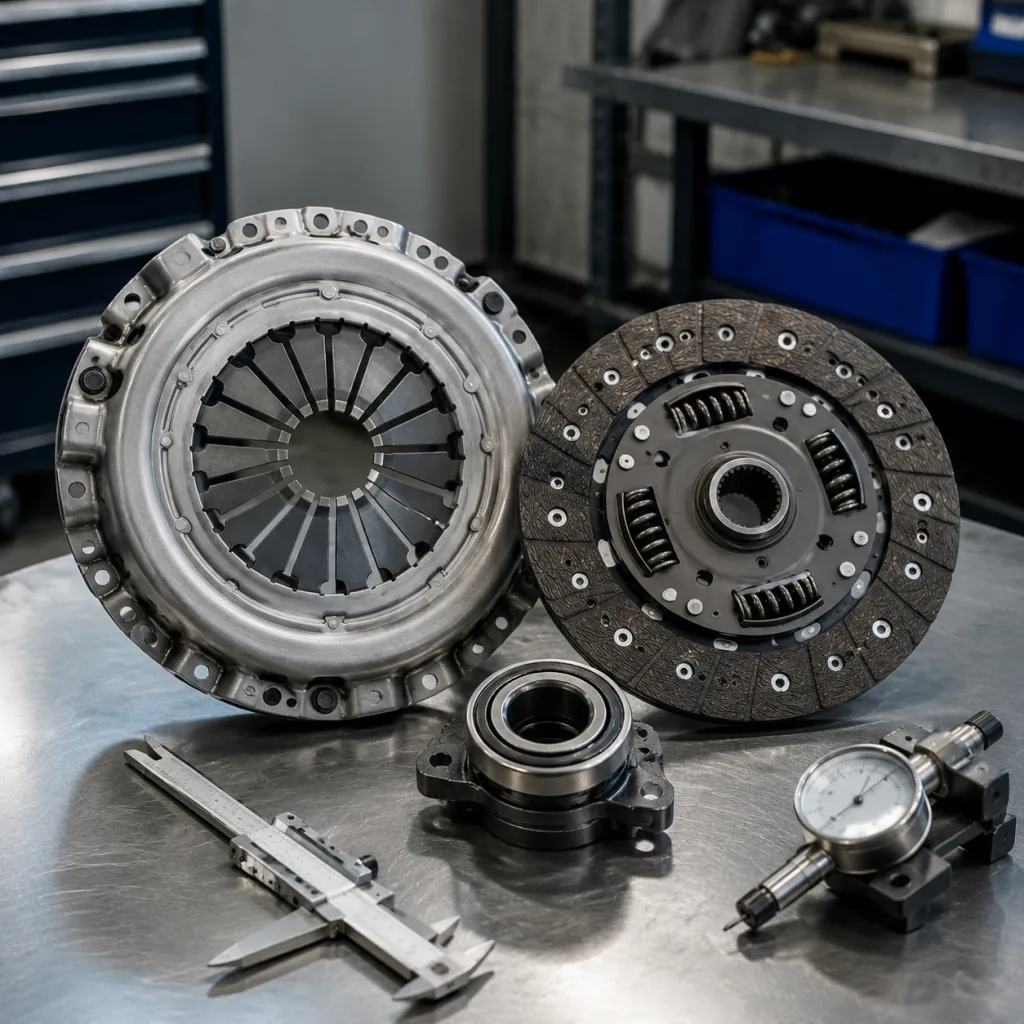
A typical aftermarket clutch kit may include:

  • Clutch cover assembly with diaphragm spring, pressure plate, rivets, and locating features checked to drawing
  • Driven plate with organic, reinforced organic, or ceramic/metallic friction facings and matched torsion damper specification
  • Release bearing or concentric slave cylinder where applicable, with bearing height and pipe or port orientation confirmed
  • Alignment tool, pilot bearing, cover bolts, flywheel bolts, grease sachet, or installation accessories when specified
  • Neutral export packaging or distributor private-label packaging with barcode, batch code, and application label

Before confirming a clutch kit porsche wholesale programme, define whether the offer is a basic cover-and-plate kit, a three-piece kit, a CSC kit, or a broader clutch-and-hydraulic package. Mixing covers, plates, bearings, and accessories from different sources without bill-of-material control can create release-travel errors, spline mismatch, bearing noise, or fitment returns.

A buyer file should list plate OD, spline count, spline major diameter, hub offset, cover bolt circle, locating dowel positions, release bearing overall height, and intended flywheel type for every SKU. Driventus can support programme mapping through our catalog, with application data reviewed against buyer-provided cross-reference files. We do not claim vehicle manufacturer approval or endorsement. Fitment references are used only to identify replacement applications.

Where Supplier Evaluation Usually Breaks Down

Factory evaluation often goes wrong when the audit stops at certificates and unit price. A clutch kit is a safety-relevant driveline component, so the real question is whether the supplier can repeat the approved sample across production lots and export shipments.

Start with current IATF 16949:2016 and ISO 9001:2015 certificates. Then verify the certificate scope, certificate number, issuing body, expiry date, manufacturing address, and last surveillance-audit status. If the audited address differs from the quotation, carton label, or shipment paperwork, clarify the production route before approval.

Common failure modes include:

  • Friction facings, springs, cover stampings, hubs, or bearings cannot be traced to batch, heat, or supplier lot
  • Clamp load is checked during sample approval but not recorded on production lots
  • Spline gauges, runout fixtures, torque tools, spring testers, or balance equipment are overdue for calibration
  • Non-conforming parts are reworked without segregation, root-cause review, or corrective-action records
  • PPAP-style files exist as templates but do not match the actual process flow, control plan, FMEA, dimensional report, material record, or sample test result
  • Export packaging is approved visually but not reviewed for carton compression, moisture exposure, rust prevention, pallet handling, or ocean freight

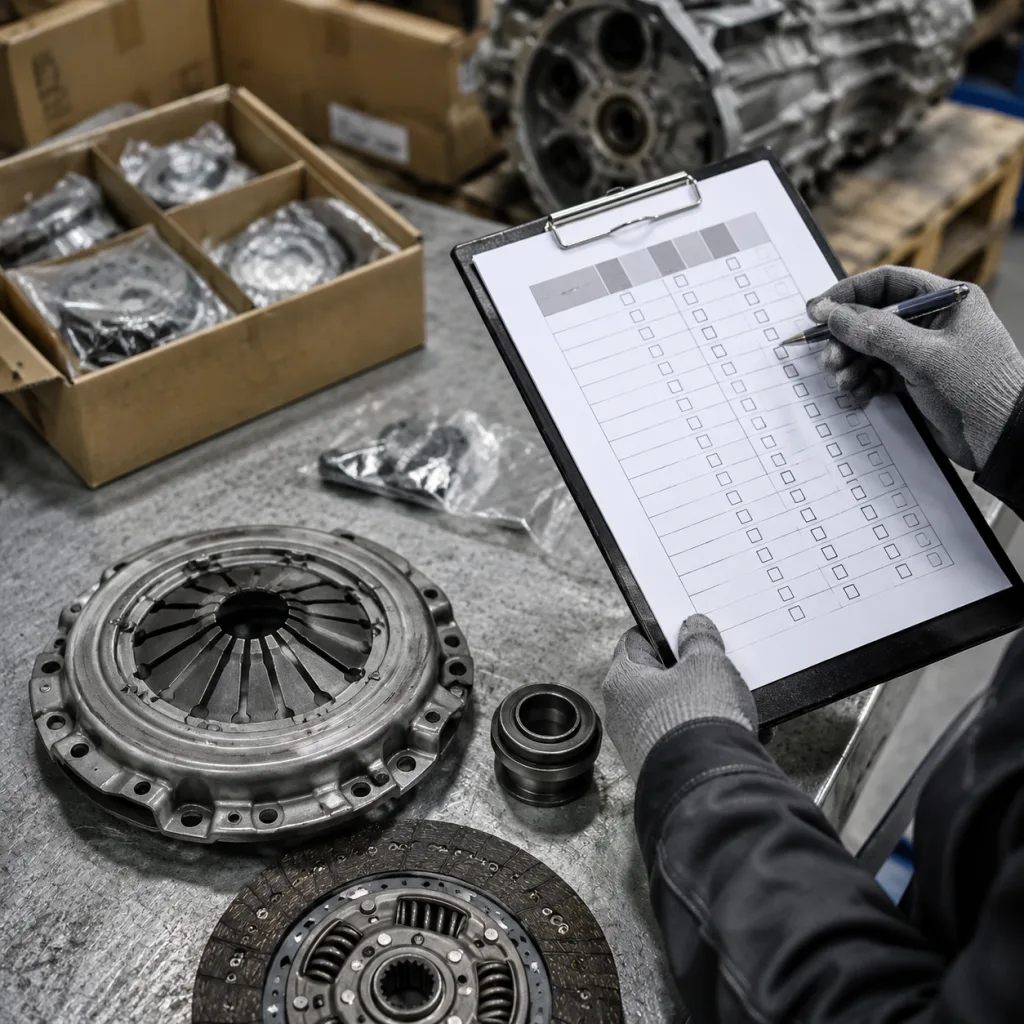
During an on-site or remote audit, follow one live production lot from incoming inspection to final packing. Check facing thickness, cover flatness, diaphragm spring free height, driven plate rivet staking, damper spring seating, bearing rotation noise, label accuracy, and final carton sealing. For low-volume Porsche-fit references, ask whether the supplier uses dedicated tooling, controlled shared tooling, or subcontracted components. Each route needs different approval evidence.

Regional expectations are not identical. EU and UK importers may request REACH (EC) No 1907/2006 material declarations, and some customers ask for RoHS-style restricted-substance statements even when the part is not electronic. North American buyers often focus on warranty return analysis, label accuracy, country-of-origin statements, and lot traceability. Australian buyers tend to scrutinise export packaging, product descriptions, and barcode consistency. Brazilian importers commonly review invoices, HS codes, wooden packaging rules, and customs documents before shipment.

Driventus maintains a documented quality system covering incoming inspection, in-process checks, final inspection, shipment release, and corrective action handling.

MOQ and Lead Time: Compare the Whole Programme

Wholesale planning for Porsche-fit clutch kits is a portfolio problem. One fast-moving SKU rarely justifies the whole programme. Distributors usually need a controlled mix of slow- and medium-moving references, enough availability to protect repair-chain confidence, and enough discipline to avoid 24 months of dead stock.

Use this comparison before accepting a quote:

</tr></thead><tbody> </tbody></table>Indicative MOQ depends on tooling status, component commonality, packaging, forecast quality, and inspection scope. Existing references with shared cover or plate components may be viable at 50–100 sets per SKU. Special friction material, low-run bearings, private-label cartons, or new tooling may push the economic MOQ to 200–500 sets per SKU. Treat these as planning ranges, not fixed offers.

For reorder planning, calculate demand before emotion. If a SKU sells 20 sets per month, production takes 60 days, sea freight and customs take 30 days, and the buyer wants 30 days of safety stock, the reorder point is about 80 sets. If MOQ is 100 sets, a quarterly reorder cadence is safer than waiting until the bin looks low. For slow movers selling 3–5 sets per month, consolidate compatible SKUs in mixed shipments and avoid private-label commitments that exceed 12–18 months of realistic demand.

Before final pricing, provide annual forecast, first-order SKU list, kit content, carton specification, barcode format, label language, destination port, preferred Incoterm, and target landed-cost range. Clear inputs reduce quotation revisions and expose hidden assumptions. Where a distributor needs special branding, torque capacity changes, friction material adjustments, or kit configuration revisions, Driventus can review custom manufacturing requirements before tooling, artwork, or packaging release.

MOQ and Lead Time: Compare the Whole Programme

Validation Deep-Dive: Prove the Kit Before the Container

Validation should answer three questions: does the kit fit, does it perform, and can the factory repeat it? A low price cannot offset clutch chatter, slip under torque, bearing noise, or returns caused by a mass-production lot drifting away from the approved sample.

Approve a reference sample first. Record the dimensions. Then require the first production lot to match the approved sample within agreed drawing tolerances.

Recommended validation checks include:

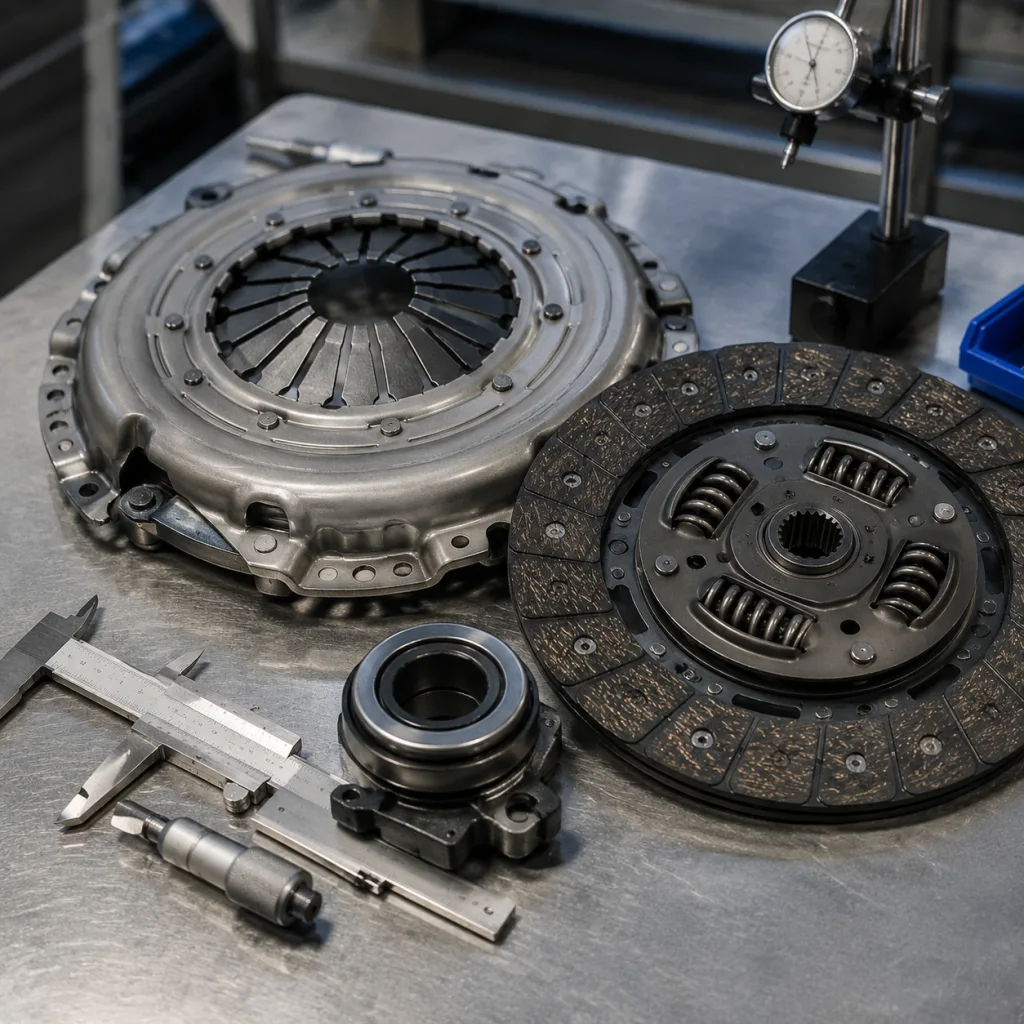
  • Driven plate outside diameter, thickness, parallelism, and facing condition measured against specification
  • Hub spline count, spline major diameter, spline minor diameter, and spline engagement checked with go/no-go gauges or a verified input-shaft gauge
  • Hub offset, cushion deflection, and torsion damper spring configuration compared with the approved sample
  • Cover assembly clamp load measured across defined deflection points, with minimum, nominal, and maximum values stated in the inspection report
  • Diaphragm spring height, finger profile, release load, and pressure-plate lift verified against drawing limits
  • Driven plate runout controlled before packing; many wholesale programmes target approximately 0.5–0.8 mm maximum total indicated runout unless the application drawing specifies otherwise
  • Cover balance and driven-plate dynamic balance checked where application sensitivity requires it, especially for high-RPM or performance-oriented references
  • Friction material bond strength, wear behaviour, coefficient stability, and thermal fade recovery reviewed by batch where test equipment is available
  • Release bearing rotation noise, grease retention, seal condition, axial clearance, bearing height, and contact-face profile inspected
  • Bolt thread fit, pilot bearing dimensions, alignment-tool fit, and accessory count verified against the kit content list
  • Packing condition reviewed after handling or transit simulation, including carton drop, compression, moisture, and rust-prevention checks

Warranty review needs the same discipline. Separate true fitment issues, installer error, vehicle-side wear, and confirmed part defects. Clutch replacement often happens alongside worn flywheels, leaking rear main seals, hydraulic faults, contaminated friction surfaces, damaged transmission mounts, incorrect release-bearing preload, or poor break-in. Those factors can look like product failure if the claim form is too thin.

A useful warranty form requests VIN or model details, mileage, installation date, flywheel condition, hydraulic-system status, photos of the friction surface, and whether the vehicle was used for towing, track use, or modified torque output.

Published standards used in supplier systems may include IATF 16949:2016 for automotive quality management and ISO 9001:2015 for quality management. Depending on market and customer requirements, material declarations can reference REACH (EC) No 1907/2006. Driventus can support inspection reports, dimensional summaries, batch records, and shipment traceability for approved wholesale programmes.

Document Pack Checklist by Buying Stage

A complete sourcing pack prevents avoidable delays. It also makes suppliers easier to compare during annual category review or range expansion. Do not leave commercial, technical, and logistics teams to rebuild the file one week before shipment. Split the documents by stage.

Pre-award documents:

  • Quotation with Incoterms, currency, validity period, MOQ, price breaks, tooling cost if any, sample cost, and payment terms
  • Application list with model, engine, transmission, production-year notes, engine code or transmission code where available, and market restrictions where relevant
  • OE-style cross-reference table where applicable, using buyer-supplied references such as generic 06A… or 11251… formats only when relevant
  • Exploded kit content list with cover, plate, bearing or CSC, bolts, pilot bearing, alignment tool, grease, instruction sheet, and accessory quantities
  • Certificate copies for IATF 16949:2016 and ISO 9001:2015, including certificate scope, address, expiry date, and issuing body

Sample-approval documents:

  • Drawing or dimensional summary showing plate OD, spline count, hub offset, cover bolt circle, cover height, release bearing height, and accepted tolerance ranges
  • Sample inspection report with measured dimensions, clamp-load values, runout values, release-load values, bearing checks, test date, and acceptance criteria
  • Material compliance declaration when required for the destination market or customer channel, including REACH-related declarations where requested
  • Warranty handling procedure, claim timeline, return-material authorisation steps, photo or video evidence requirements, and credit or replacement policy

Shipment documents:

  • Carton dimensions, gross weight, net weight, pallet plan, barcode rules, label layout, carton burst or compression information where available, and container loading estimate
  • Commercial invoice, packing list, certificate of origin where applicable, bill of lading details, product descriptions, wooden-pallet fumigation or IPPC status, and broker-ready data

The importer remains responsible for customs classification in the destination market. Suppliers can provide shipment documents and technical descriptions, but buyers should verify HS code use, origin treatment, anti-dumping exposure, local labelling rules, documentation language, and import requirements with their customs broker before release. If one shipment includes clutch kits, hydraulic components, flywheel parts, and separate service accessories, confirm whether they are declared as complete kits or individual components before the final invoice is issued.

Document Pack Checklist by Buying Stage

Scenario: Launching a Porsche-Fit Range With Driventus

A distributor planning a clutch kit porsche wholesale launch usually starts with a target application list and a sales forecast. Driventus reviews the file by SKU complexity, forecast volume, destination requirements, documentation needs, and packaging scope. The goal is not to force every reference into one template. The goal is to build a supply programme that can be quoted, sampled, inspected, packed, and repeated.

A typical process works like this:

1. Buyer sends applications, existing interchange data, required kit contents, forecast, packaging preferences, and destination market. 2. Driventus checks interchange, release-system details, spline specifications, cover dimensions, friction material needs, and BOM feasibility. 3. Samples, reference drawings, or dimensional summaries are confirmed for approval. 4. Quotation is issued with MOQ, lead time, Incoterm, packaging basis, and documentation scope. 5. Samples are inspected and approved before bulk production. 6. Artwork, labels, barcode rules, and carton specifications are released. 7. Mass production is inspected, packed, and prepared with shipment documents for broker review.

Support can include application review, sample supply, batch inspection, neutral packaging, buyer-specified cartons, barcode coordination, export documentation, and consolidation with other powertrain products.

Driventus does not position Porsche-fit clutch kits as universal replacements across unrelated applications. If torque capacity or friction material is changed for a performance-oriented programme, buyers should provide target torque, expected use case, pedal-effort constraints, and flywheel compatibility. That information affects friction choice, clamp load, warranty expectations, and fitment risk.

Driventus is an independent aftermarket manufacturer; brand names are referenced for fitment only. For current availability, MOQ, lead time, sample options, and documentation review, buyers can request a quote with their application list and annual demand estimate.

Frequently asked questions

Send the target application list, transmission type, required kit content, annual forecast, first-order quantity, packaging needs, destination port, and any existing cross-reference data. Photos or samples of current parts help confirm release bearing type, spline profile, cover dimensions, and installation accessories.

Yes. Private-label packaging can be reviewed for wholesale programmes after artwork, barcode format, carton specification, label language, and MOQ are confirmed. Neutral export packaging is also available when buyers want to manage final labelling in their local warehouse.

No. Driventus is an independent aftermarket manufacturer; brand names are referenced for fitment only. We do not claim approval, endorsement, or original equipment status from any vehicle manufacturer.

For MOQ, lead time, samples, and documentation review, send your target SKU list and forecast to Driventus through /contact.html. Our team will confirm sourcing options for your clutch kit porsche wholesale programme.

Request a Quote
Sourcing item Typical B2B consideration Procurement impact
MOQ per SKU50–100 sets for available references; 200–500 sets for special friction, bearing, tooling, or private-label packagingAffects launch range, cash flow, and reorder frequency
Price logicQuoted by kit content, friction grade, bearing type, accessories, packaging, Incoterm, and annual volume tierPrevents comparing a cover-and-plate kit against a full kit with CSC, bolts, and branded carton
Production lead timeCommonly 45–75 days after deposit, sample confirmation, artwork approval, and component allocationDetermines reorder point and safety stock
Sample lead time7–20 days for stocked or existing applications; 30–45 days if parts must be produced or reconfiguredSupports fitment checks before bulk order
PackagingNeutral carton, buyer label, barcode format, GS1-style EAN/UPC, QR code, or private-label artworkImpacts distributor branding, warehouse scanning, and marketplace readiness
Mixed container loadingMultiple clutch kit SKUs and compatible powertrain items in one shipment, often palletised by SKU or customer codeReduces freight cost per programme and improves container utilisation
Warranty reserveAgreed process for verified defects, evidence, credits, replacement parts, and debit-note timingPrevents unclear chargeback disputes