Clutch Kit Jeep Replacement: OE Match and Validation
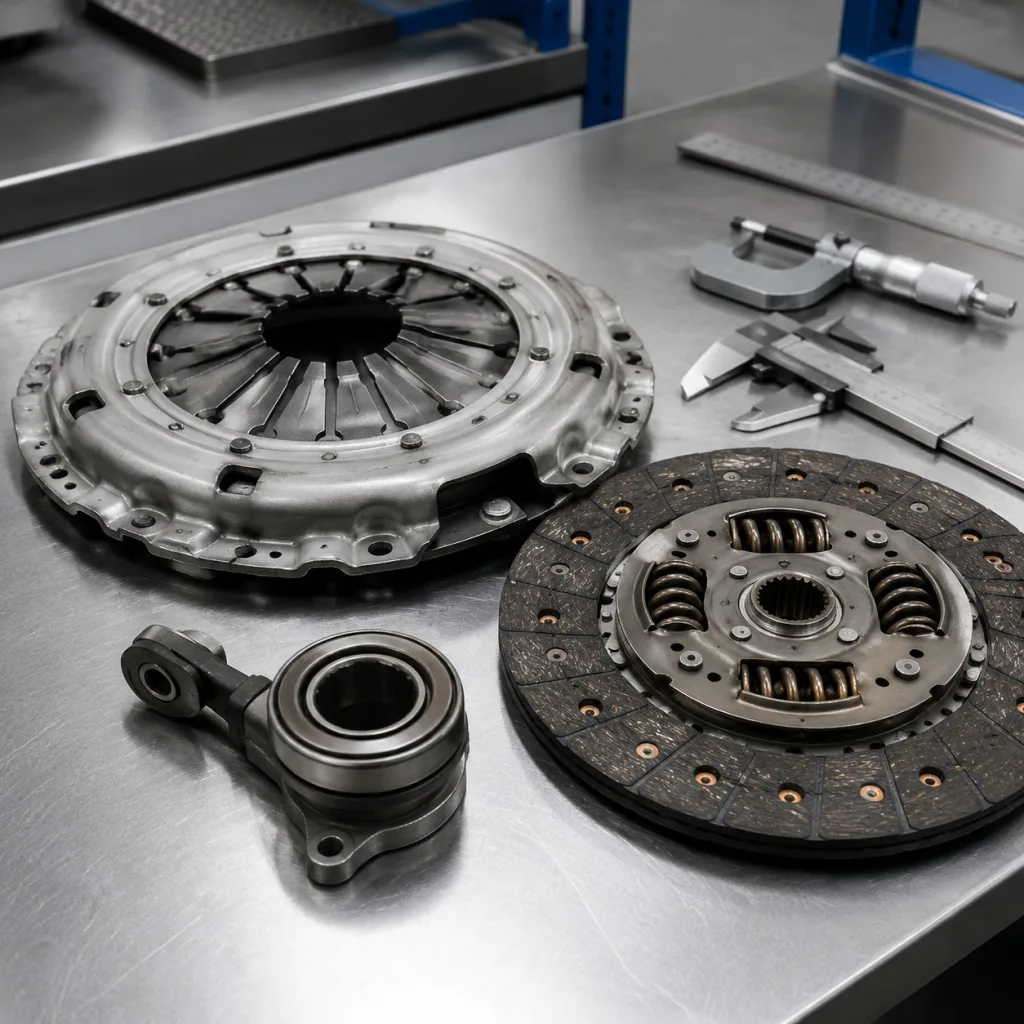
A clutch kit Jeep replacement should be sourced as a fit-and-function decision, not a catalogue exercise. The critical risks are usually hidden in cover load, friction material, release bearing dimensions, spline fit, and flywheel contact pattern. Driventus supplies clutch kits as an independent aftermarket manufacturer, and brand names are referenced for fitment only. For Jeep applications, buyers should validate OE cross-reference data, verify the VIN and engine/transmission code, and confirm whether the kit is for a manual gearbox with a single-mass or dual-mass flywheel. A practical sourcing spec should define disc diameter, spline count, hub type, release system, clamp-load window, and acceptable runout tolerance before sample approval. Driventus manufactures under IATF 16949:2016 and ISO 9001:2015 controls, with material and process documentation suitable for B2B sourcing. For catalogue review, see [our catalog](/products.html), and for process controls review our [quality system](/quality.html).
Start with the fit decision tree
A Jeep clutch replacement only works when the application variables are pinned down first. Dimensional match matters as much as the OE reference.
Use this order of checks:
- Confirm engine family, model year, and gearbox code
- Verify whether the vehicle uses a single-mass or dual-mass flywheel
- Measure disc diameter, spline count, and hub offset from the removed assembly
- Check release bearing style and mounting depth
- Confirm cover height and clamp-load target against the approved sample
- Review pedal effort and engagement feel for OE-style operation
If any one of these differs, the kit may install cleanly and still fail in service. For mixed fleets, the badge on the tailgate is not enough. The same Jeep line can use multiple clutch variants across petrol, diesel, and transmission revisions.
Where replacements usually go wrong
Most sourcing mistakes come from assuming catalogue similarity equals interchangeability. Jeep platforms make that assumption expensive.
Common failure modes include:
- Manual and automatic transmission confusion
- Flywheel type mismatch across engine codes
- Hydraulic release system changes
- Diesel and petrol load differences
- Mid-cycle changes in spline or bearing geometry
Catalogue photos are not validation. Buyers should request measured samples, stamped part data, and the installation envelope. For service networks, standardise the approved part list by VIN range and transmission code. That cuts counter sales errors, workshop delays, and repeat shipments.
Spec checks that separate a match from a near-match
OE equivalence is the first filter, but the spec file is what protects the programme. Driventus supports OE 06A107065-style cross-reference formats where the customer has an existing OE number to validate. When no OE number is available, work from build data and dimensions.
| Check item | What to confirm | Why it matters |
|---|---|---|
| Disc diameter | Match to flywheel contact area; common validation target is within ±1 mm of the approved sample | Prevents slip and edge wear |
| Spline count | Match to input shaft; verify tooth count and fit on a sample shaft | Prevents installation failure |
| Hub type | Sprung or rigid; confirm hub projection and spring pack clearance | Affects driveline NVH |
| Cover height | Within OE envelope; keep stack-up within the approved drawing tolerance | Protects release travel |
| Clamp load | Comparable to OE; document test load and release point | Controls torque capacity |
| Bearing type | Hydraulic, concentric, or external; confirm stroke and mounting depth | Affects system compatibility |