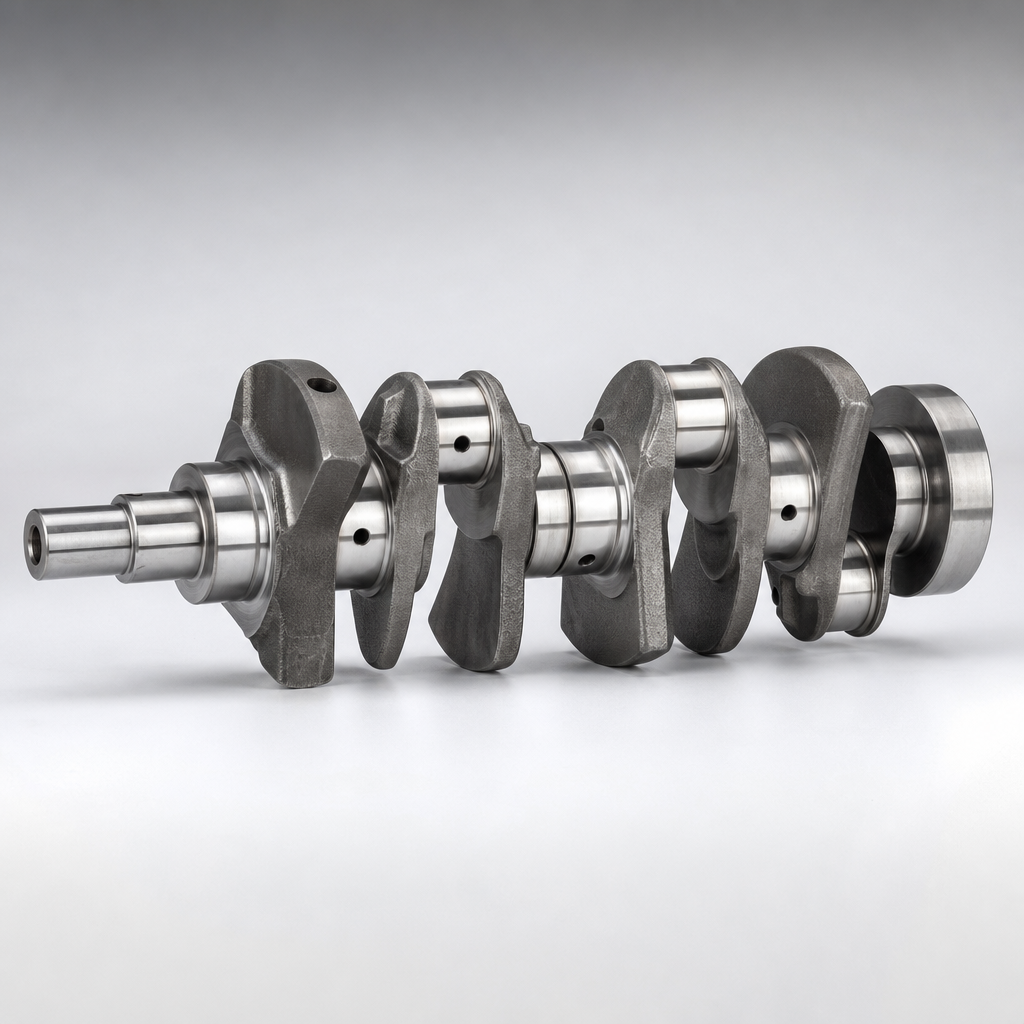
Connecting Rod for Chevrolet Suburban Aftermarket Replacement
Sourcing a connecting rod for Chevrolet Suburban aftermarket replacement is rarely a simple catalogue exercise. The Suburban badge covers multiple engine families across model years, and those engines do not share one universal rod design. For distributors, rebuilders, and fleet-focused repair groups, the real decision sits at engine level: journal sizes, centre-to-centre length, pin bore tolerance, big-end housing geometry, cap fastener specification, supplied condition, and the quality records behind the part. A rod that is nominally "for Suburban" but wrong on one of those points can turn into rework, returns, or field failures. This guide approaches the buying process from a practical B2B angle: how to identify the correct variant, what usually goes wrong in sourcing, which specifications deserve close review, how suppliers should be compared, and what evidence should be in hand before a volume order is released. Driventus is an independent aftermarket manufacturer; brand names are referenced for fitment only.
Start with the engine decision, not the Suburban badge
The first purchasing error is treating "Chevrolet Suburban" as a complete fitment description. It is not. The nameplate spans several petrol V8 generations, and those engines can differ on rod length, pin diameter, bearing arrangement, bolt design, and even the basic construction of the rod itself.
For connecting rod for chevrolet suburban aftermarket replacement, the decision framework should start with one question: *which exact engine architecture is being rebuilt or stocked against?*
Buyers should ask the supplier to map the part by:
- engine code or displacement
- model year range
- VIN-derived engine family where available
- big-end journal diameter
- small-end pin diameter
- centre-to-centre rod length
- rod bolt specification
- bearing shell type used in the target engine
- whether the rod is bushed or press-fit at the small end
- whether the cap is conventional split, cracked cap, or programme-specific variant
That list matters because a vehicle-level label can hide dimensional differences that only appear when the engine is on the bench. A quotation tied only to displacement or vehicle name leaves too much room for mismatch.
Procurement teams should also ask for nominal dimensions *with tolerances*. Nominal data alone is weak. Centre length may be reviewed in hundredths of a millimetre; pin bore size may be controlled in low hundredths or microns depending on fit class; big-end housing geometry needs finished bore, roundness, and taper, not just a headline diameter.
If an OE cross-reference exists, it should be checked against drawing data or inspection records rather than catalogue text. Many importers now request a first-article dimensional sheet covering at least 5 to 10 critical features before sample approval.
When several related hard parts are being sourced together, it is often more efficient to verify the wider application set through our catalog or the engine components range before locking the final purchase list.
Failure modes that expose a weak replacement rod programme
A connecting rod programme usually fails quietly at first. The part looks acceptable, installs without drama, then problems surface as machining variation, balancing labour, or short service life.
The most common failure modes in aftermarket sourcing are:
- catalogue-level fitment without engine-level confirmation
- big-end bore variation that changes bearing crush or oil clearance
- small-end bore tolerance drift that affects pin fit
- cap alignment problems after bolt torque
- inconsistent weight spread across a set
- unstable metallurgy or poorly controlled heat treatment
- missing traceability between lot, inspection record, and shipment
- surface damage in transit from weak packaging protection
Each one creates a different cost pattern. Some are obvious at goods-in inspection. Others appear later as workshop resizing, extra balancing, rejected builds, or claims.
A practical example: a low-price rod that arrives with big-end housing variation may still be usable, but only after the customer adds bore correction and 100% sorting. That is not a supply win. It simply moves manufacturing cost downstream.
This is why experienced buyers ask early about supplied condition. Is the rod semi-finished, fully machined, bushed, honed, weight-matched, or packed as a set? A semi-finished rod can be commercially valid if the buyer already intends to machine in-house. It is a poor choice when the receiving side expects drop-in replacement quality.
For mixed-inventory distributors, these failure modes have another effect: they make SKU control harder. If one source needs special receiving checks or workshop correction while another does not, the inventory may look interchangeable on paper but behave differently in service.
Spec deep-dive: what an OE-equivalent rod actually has to match
In this category, OE-equivalent does not mean visual similarity. It means the replacement rod stays inside the dimensional, material, and assembly limits required by the target engine.
Critical characteristics to verify
- Material grade and process route: forged steel is common for higher-load applications; powder-forged or fracture-split designs may apply to certain programmes
- Centre-to-centre length: must align with piston deck height and compression geometry; buyers often ask for nominal length with a tolerance such as +/-0.02 mm to +/-0.05 mm depending on design and supplied condition
- Big-end bore size and roundness: directly affects bearing crush and oil-clearance stability; roundness and cylindricity are often controlled within a few hundredths of a millimetre after bolt tightening to specification
- Small-end bore diameter: must suit the wrist pin under the intended fit class; a bronze-bushed bore may be reviewed at roughly 0.005-0.015 mm fit logic depending on materials
- Big-end width and side clearance: influences crank alignment and oil-film behaviour; even small width variation across a set can change final side-clearance outcome
- Rod weight and weight spread: matters for balance control; many rebuilders target 3-5 g piece-to-piece spread, with tighter matched-set targets where practical
- Beam profile and section thickness: should remain within the validated design envelope
- Bolt seat geometry and cap alignment: critical for clamp load retention and cap stability after assembly torque
- Twist and bend: usually checked in hundredths of a millimetre per 100 mm or by total reading across the rod length
A capable supplier should be able to support those points with drawing-based inspection data. A packing specification or a generic catalogue line is not enough.
For remanufactured or rebuilt engine programmes, one more question matters: what machining work remains after receipt? If the buyer must add bushing work, honing, bolt resizing, or full balancing, the apparent piece-price advantage may disappear very quickly.
Order-release workflow: the checks that should happen before volume approval
The cleanest way to buy is to treat the rod as a controlled engine component, not a general hardware item. Procurement, quality, and engineering should align on the release path before price negotiations are considered final.
The table below shows the checks most buyers use before approving supply.
| Check area | What to confirm | Why it matters |
|---|---|---|
| Application control | Engine family, year range, dimensional variant | Reduces catalogue mismatch risk |
| Material verification | Steel grade, heat treatment record, hardness range | Supports fatigue strength and wear resistance |
| Machining accuracy | Bore size, roundness, parallelism, twist | Controls bearing life and assembly accuracy |
| Fastener interface | Bolt fit, seat geometry, torque method | Protects cap retention under load |
| Weight control | Piece weight and set spread | Supports engine balance consistency |
| Surface condition | Shot peening status, burr control, edge condition | Affects fatigue life and assembly safety |
| Batch traceability | Heat number, lot code, inspection linkage | Needed for claims control and audits |
| Compliance file | REACH (EC) No 1907/2006 declarations where applicable | Supports import compliance in EU markets |