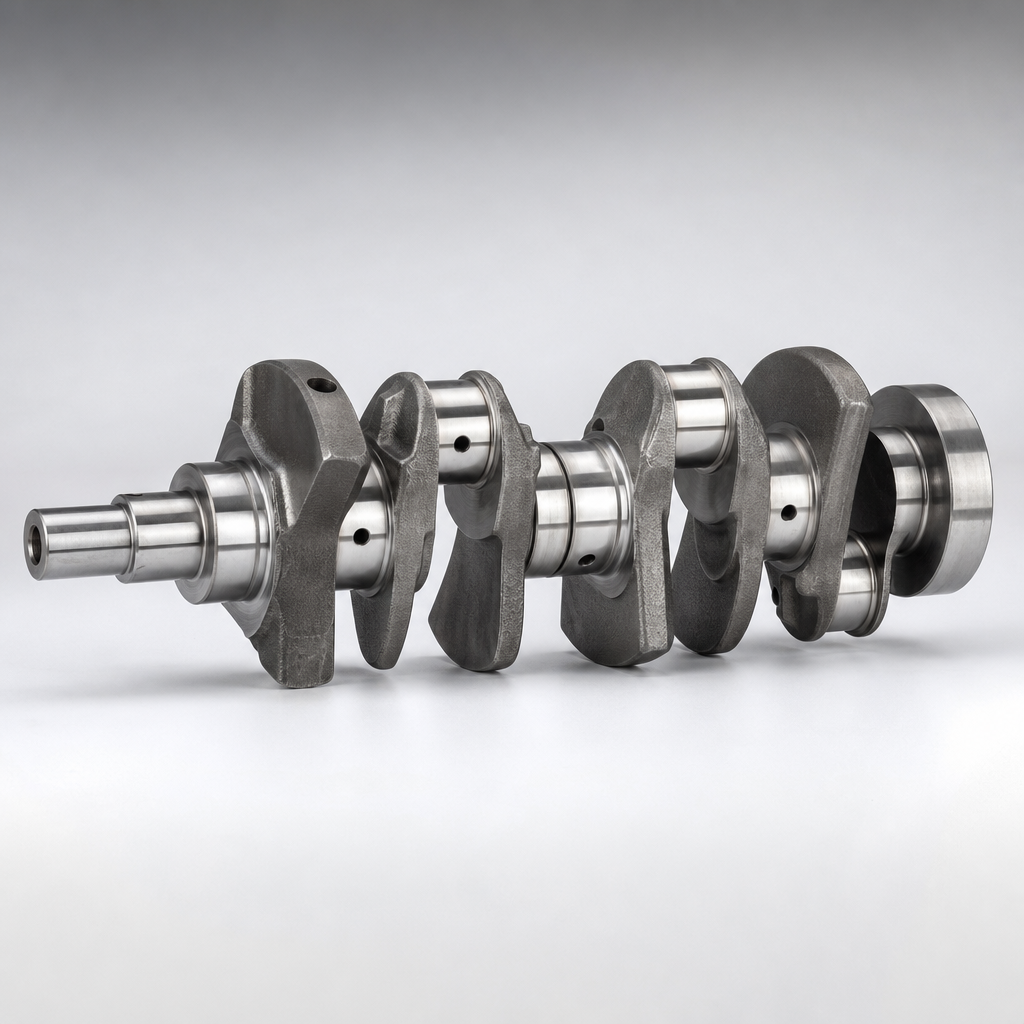
Crankshaft BMW Wholesale: How Buyers Separate Reliable Supply From Cheap Risk
In **crankshaft BMW wholesale** purchasing, the real decision is rarely price versus price. It is controlled supply versus preventable failure cost.
Procurement teams buying replacement crankshafts for BMW applications usually have to balance three things at once: dimensional consistency, replenishment reliability, and claim exposure. A part that drifts outside hardness, fillet finish, balance, journal size, or runout limits can create installation problems, warranty returns, and stock losses across more than one market. That risk tends to surface late, after freight, customs, warehousing, and customer commitments are already in motion.
So the useful question is not "Can this supplier make the part?" It is "Can this supplier prove, in measurable terms, that the part will stay inside control lot after lot?" This guide approaches crankshaft BMW wholesale sourcing from that angle. It covers the evidence buyers should ask for on material control, machining tolerances, balancing, documentation, MOQ, lead time, packaging, and audit discipline. It is written for importers, distributors, and private-label buyers evaluating aftermarket supply rather than retail end users. Driventus is an independent aftermarket manufacturer; brand names are referenced for fitment only.
In practice, credible suppliers turn broad quality claims into numeric limits. Buyers should expect clear acceptance standards for journal dimensions in the low hundredths or thousandths of a millimeter depending on the feature, finished runout commonly within 0.02 to 0.05 mm, journal surface finish often around Ra 0.2 to 0.4 um after grinding and polishing, and hardness ranges matched to the material and heat-treatment route. The exact values depend on the drawing and engine family. The point is simpler: if a supplier cannot state its limits before sample approval, the programme is not yet under control.
Start With A Decision Filter, Not A Price List
In crankshaft BMW wholesale procurement, the first screen should answer one question: does this supplier control the full route from raw material receipt to final packing, or does it mostly rely on end-of-line checking?
That distinction matters. A source with weak upstream control can still produce an acceptable sample. It is repeatability that breaks down later.
For BMW-oriented programmes, buyers usually need proof in five areas:
Material specification: forged steel or cast iron grade confirmation, chemical composition records, and incoming inspection logs
Critical dimensions: main journal diameter, rod journal diameter, stroke, flange dimensions, oil hole position, and keyway geometry
Metallurgical control: hardness range, heat-treatment record, microstructure checks, and surface integrity at fillets
Dynamic performance: runout, static or dynamic balancing results, and crack inspection method
Then push one level deeper. Do not ask only which characteristics are checked. Ask how each one is controlled, with what tool, at what frequency, and what happens when a reading falls out of spec.
A usable supplier file will usually show nominal size, tolerance, inspection method, sampling frequency, and reaction plan. Practical checkpoints often include:
Main and rod journals measured with calibrated micrometers or air gauges, often controlled within 0.005 to 0.015 mm depending on the drawing and finishing route
Total runout checked between centers or on V-blocks, commonly held to <=0.03 mm for finished inspection on many aftermarket programmes
Journal surface finish after grinding and polishing, often targeted around Ra 0.2 to 0.4 um
Fillet radius checked with profile gauges or CMM methods where required, because small fillet variation can materially affect fatigue life
Hardness verified by Rockwell or Brinell method, with forged crankshafts commonly managed in a documented range such as HRC 28-36 or equivalent per process plan
If parts are headed to the EU or UK aftermarket, confirm substance compliance declarations aligned with REACH (EC) No 1907/2006 where applicable to supplied articles and packaging materials. Supplier certification to IATF 16949:2016 and ISO 9001:2015 is a useful baseline for discipline, but it is not the approval itself.
A good first filter is simple: can the supplier tie its quotation to a documented inspection standard? If the quote only gives unit price and lead time, without dimensional limits, balancing method, NDT method, and traceability format, buyers still do not have a complete basis for approval.
Compare Quotations On Failure Risk, Not Just Cost
A workable RFQ review compares suppliers against the same technical and commercial criteria. Otherwise, two offers may look similar while covering very different levels of process control.
Criteria
What to ask for
Why it matters
Base material
Mill certificate or internal material verification
Confirms consistency in fatigue-critical applications
Journal tolerance
Drawing or inspection report with measured values
Controls bearing fit and oil film stability
Runout
Final inspection record, typically in mm
Excess runout can lead to vibration and premature wear
Surface hardness
Hardness test method and acceptance range
Affects journal wear resistance
Balancing
Static or dynamic balancing specification
Reduces NVH and return risk
NDT
Magnetic particle or equivalent crack inspection record
Screens for forging or machining defects
MOQ
Standard MOQ by part number and packaging option
Affects warehouse planning and mixed-container buying
Lead time
Sample lead time and mass production lead time
Supports replenishment planning
Packaging
VCI, rust-prevention oil, carton strength, pallet standard
Helps prevent corrosion and transport damage
Traceability
Batch code format and record retention period
Supports warranty root-cause analysis
</tr></thead><tbody> </tbody></table>MOQ for many programmes lands around 50 to 200 pieces per part number, but the number only means something in context. Forged crankshafts with dedicated fixturing, private-label cartons, or custom markings often push MOQ upward. Shared production on standard references can sometimes support 30 to 50 pieces on repeat orders.
Lead time also needs to be separated into stages:
7 to 15 days for sample preparation if the application is already in production
15 to 30 days for first sample on a new or revised programme requiring fixture confirmation or balance review
35 to 45 days for repeat mass production under standard packaging
45 to 60 days when the order includes private label cartons, pallet marks, or mixed inspection requirements
Price logic should be broken out, not accepted as a headline number. In many aftermarket programmes, the quoted unit cost moves most on five variables: material route, machining cycle time, balancing tolerance, NDT scope, and packaging standard. A supplier including 100% magnetic particle inspection, tighter runout limits, and export-grade VCI packaging is not quoting the same product as one that excludes them.
A practical comparison method is to ask each supplier to quote at 50 / 100 / 200 pieces per SKU with the same Incoterm and packaging definition. That exposes whether the source has real process cost control or is simply using a low entry price to open the discussion.
Where broader engine hard parts are being sourced together, combining crankshafts with related items from our catalog can reduce container fragmentation, simplify vendor management, and improve replenishment planning.
Audit The Failure Modes That Actually Create Claims
Factory audits are most useful when they are organized around what can go wrong. Presentation slides do not tell you where the process can drift.
Process controls to inspect
Check whether the factory can show:
incoming material identification and segregation by heat or batch
machining process flow for rough turning, finish grinding, drilling, chamfering, and polishing
calibrated gauges for journals, concentricity, stroke, and flange features
in-process inspection frequency by characteristic class
balancing equipment maintenance and calibration records
final cleaning, rust prevention, and packing controls
Walk the line in manufacturing order. For a typical crankshaft route, that means confirming how the supplier controls rough machining allowance, heat treatment or normalization where applicable, semi-finish turning, oil-hole drilling, finish grinding, polishing, balancing, NDT, washing, rust prevention, and packing.
The key question is where dimensions are actually locked in. If control relies mostly on final inspection, the programme carries higher rework risk and a greater chance of escapes.
Useful shop-floor details include:
whether journals are checked piece-by-piece, hourly, or by lot sampling
whether runout is measured before and after finish grinding
whether balancing correction is done by drilling, milling, or added heavy metal on applicable designs
whether washing includes oil-hole flushing and compressed-air verification
whether residual magnetism is checked after magnetic particle inspection when required by the control plan
Documents to request
Ask for copies or samples of:
PFMEA and control plan for the crankshaft family
gauge calibration schedule
final inspection report template
nonconformance and corrective action records
traceability label format
export carton specification
Strong suppliers can show measured data, not just pass/fail stamps. They can also retrieve prior batch reports quickly. If a lot code cannot be traced back to inspection records within a few minutes, traceability is weaker than the supplier claims.
Buyers should compare the supplier's quality system information with what is visible on the floor. A certified management system has value. Operator practice matters more.
For private-label projects or application-specific changes such as revised balance targets, surface-finish requirements, or packaging formats, review whether the supplier supports custom manufacturing with controlled drawing revision management and formal change approval.
Go Deep On The Specs That Drive BMW Fitment Risk
Even in wholesale programmes, fitment failures remain engineering failures. Buyers should confirm that the supplier uses a defined cross-reference method rather than broad engine-family descriptions.
If an RFQ includes an OE-style reference such as OE 1121..., the supplier should map that reference to its internal drawing, inspection plan, material route, and balance specification. Commercial positioning can vary by target market. The engineering baseline should not.
Typical technical checkpoints include:
Journal size control: measured against drawing nominal with recorded upper and lower limits
Fillet radius consistency: needed to manage stress concentration and fatigue performance
Oilway deburring: helps prevent contamination and lubrication problems at start-up
Flange and nose geometry: affects pulley, flywheel, and timing component alignment
Surface finish on journals: supports stable bearing contact pattern and oil film behaviour
Residual magnetism and cleanliness: relevant after magnetic particle inspection and final washing
For OE-equivalent aftermarket positioning, push the supplier to define the numeric standard. Typical examples include journal diameter tolerance bands in the 0.005 to 0.015 mm range, shoulder and flange position tolerances in the low hundredths of a millimeter, runout at <=0.03 mm or customer-approved equivalent, and surface finish around Ra 0.2 to 0.4 um on bearing journals.
Oil-hole edges should be fully deburred. Washed components should show no visible abrasive residue or trapped chips in lubrication passages.
Fitment validation should also consider associated components. A crankshaft can be close on core dimensions and still fail at assembly because flange location, keyway position, reluctor-related geometry, or pilot feature tolerance drifts outside the required range. That is why cross-reference review should include the exact application code, engine family, transmission interface where relevant, and any supersession note affecting the part number.
For higher-volume importer programmes, some buyers request retained samples from each batch and periodic third-party verification. That is usually justified when field-failure cost is higher than the added inspection cost. In practice, third-party checks often focus on 5 to 10 key dimensions, hardness confirmation, runout, surface finish, and one NDT witness sample per lot.
If you are sourcing across multiple engine component lines, our catalog can help align related fitment families under one supplier.
Set The Commercial Terms Before The PO Exposes The Gaps
Many wholesale programmes do not fail at quotation stage. They fail after order release, when assumptions about MOQ, lead time, packaging, or claims handling turn out to be different on each side.
Recommended points to confirm:
MOQ by SKU: standard and mixed-order options
Lead time definition: whether counted from PO, drawing approval, sample sign-off, or deposit
Marking: batch code, country-of-origin marking, and private-label requirements
Inspection release: pre-shipment inspection method and AQL agreement where used
Claims window: reporting timeline, evidence required, and debit note process
Replacement policy: credit, replenishment, or next-shipment offset
MOQ and price should always be read together. A supplier offering 50 pieces may quote higher than one offering 200 pieces because setup, balancing, inspection, and carton printing are being spread over fewer parts. Ask for a price ladder and confirm whether standard export packing, palletisation, and labeling are included.
Lead time needs a precise trigger. In crankshaft programmes, it is commonly counted from the last of these events: PO receipt, drawing confirmation, sample approval, packaging approval, or deposit receipt. If that start point is vague, the delivery promise is vague too.
For sea-freight programmes to Europe, North America, and Australia, anti-corrosion packaging should be treated as a technical requirement. Crankshafts are heavy, machined components. Poor protection turns into rust claims, journal damage, and avoidable sorting work at destination.
Typical packaging checkpoints include:
individual rust-preventive oil or coated wrap on each crankshaft
VCI paper or sealed poly bag at unit level
partition or end-cap protection to prevent journal damage
outer carton board grade matched to part weight
pallet stack pattern and maximum gross weight per pallet
desiccant or humidity-control measure for long sea transit where required
Claims handling should also be quantified. A usable process normally sets a reporting window such as 15 to 60 days after receipt for visible freight or packaging defects and a separate window for installation-related claims, with required evidence including batch code, photos, measured values, quantity affected, and failure description.
Buyers should also ask whether the supplier's response target is 24 to 72 hours for containment and 7 to 10 working days for formal corrective action. Sources with stable records under IATF 16949:2016 and ISO 9001:2015 often respond faster here because the documentation path already exists.
Use A Shortlist Test That Rewards Clarity And Control
A supplier is ready for shortlist status when it can produce the key evidence quickly, clearly, and without contradiction.
For crankshaft BMW wholesale programmes, the decision should rest on process visibility more than catalog breadth. Buyers should confirm that the source can hold repeatable tolerances, maintain batch traceability, support mixed-SKU planning, and deliver export packaging suited to the destination market.
As a practical shortlist test, buyers should be able to obtain all of the following before nomination:
a quotation with MOQ breaks such as 50 / 100 / 200 pieces per SKU
stated sample and production lead times tied to clear commercial triggers
at least one recent dimensional report with measured values for journals, runout, and key fitment features
defined hardness, surface finish, balancing, and NDT standards
packaging specification with unit protection and pallet details
batch traceability method from finished carton back to inspection lot
written claims workflow with response timing and settlement method
When two suppliers are close on price, the stronger choice is usually the one with less execution ambiguity. A source that is 3% to 8% higher in unit price can still be commercially better if it reduces rework, freight damage, claim handling time, and line-side fitment failures.
Driventus supplies engine and powertrain components for B2B customers in multiple export markets and can support RFQ review, drawing discussion, and factory capability checks. Driventus is an independent aftermarket manufacturer; brand names are referenced for fitment only.
Frequently asked questions
For standard aftermarket programmes, MOQ is often **50 to 200 pieces per part number**. The actual figure depends on the material route, machining setup, packaging format, and whether the order is standard stock or private label. Buyers should also ask for quantity breaks, because the unit price at **50 pieces** may differ materially from the price at **100 or 200 pieces** once setup and inspection cost are absorbed.
At minimum, ask for company certifications, a dimensional inspection sample, a material or process description, lead time, MOQ, packaging details, and the traceability method. For serious supplier qualification, also request the control plan, final inspection report template, hardness standard, runout limit, balancing method, and NDT process so the RFQ can be compared on a like-for-like basis.
No. Certification to **IATF 16949:2016** or **ISO 9001:2015** is a useful baseline, but buyers should still audit actual process controls, gauge calibration, inspection records, traceability, and claims handling before approving production supply. A supplier should be able to show measured values, inspection frequency, batch coding, and a documented response process for nonconforming lots.
If you are comparing suppliers for **crankshaft BMW wholesale** programmes, send your part list, target volumes, annual demand, and packaging requirements to [request a quote](/contact.html).