Car Shocks Replacement: B2B Fitment and Testing Guide
Car shocks replacement programmes succeed when procurement teams look beyond a vehicle application list. For distributors, repair chains, and importers, the main risks include incorrect mounting dimensions, unstable damping force, premature seal leakage, weak corrosion protection, and packaging damage during sea freight. A replacement shock absorber must fit the OE suspension envelope, deliver controlled rebound and compression forces across temperature and stroke cycles, and arrive with traceable batch records. This guide gives B2B buyers a practical way to evaluate aftermarket shock absorbers for passenger cars and light commercial vehicles. It covers dimensional checks, performance criteria, validation testing, materials, packaging, and supplier documentation. Driventus is an independent aftermarket manufacturer; brand names are referenced for fitment only. Use this article as a sourcing checklist when comparing quotations, auditing factories, or preparing a private-label shock absorber range for multiple markets.
Fitment Risk Starts With Dimensions
Shock absorbers are safety-related suspension components, so the first sourcing question should not be price. It should be whether the part matches the original installation envelope. Small dimensional errors can create bushing preload, top-mount noise, uneven tyre wear, restricted wheel travel, or contact with brake hoses, stabiliser links, and suspension arms.
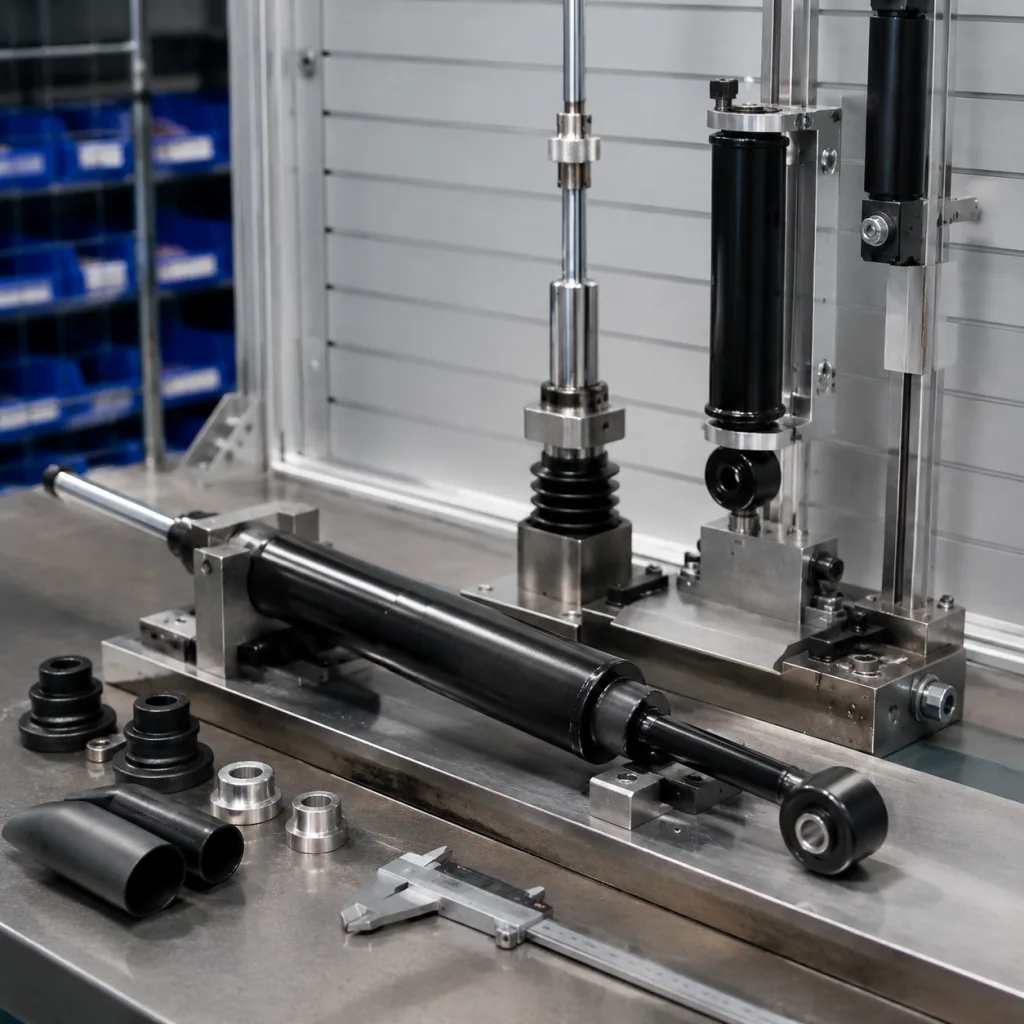
For car shocks replacement, Driventus engineering teams compare aftermarket samples with OE-equivalent reference geometry before tooling release. The review normally covers extended length, compressed length, tube diameter, rod diameter, mounting type, bushing hardness, bracket position, washer and sleeve design, and thread specification.
Fitment item
Typical check
Procurement risk if missed
Extended length
Overall length at full rebound
Reduced wheel droop or topping noise
Compressed length
Bump position allowance
Internal bottoming and seal damage
Piston rod diameter
Application-dependent
Lower bending resistance or seal mismatch
Mounting eye width
Caliper or CMM measurement
Bushing preload and installation difficulty
Bracket angle
Fixture or 3D comparison
Brake hose or stabiliser link interference
Thread specification
Gauge verification
Incorrect top-nut fitment
</tr></thead><tbody> </tbody></table>Procurement teams should also confirm left/right orientation, axle position, supplied accessories, and installation notes where the application requires them. OE part-number cross-references may be maintained in buyer systems for fitment control, using generic references such as OE 06A… or OE 11251… only where they are relevant to the customer data structure. Driventus does not claim approval or endorsement by any vehicle manufacturer.
OE-Equivalent Performance Criteria
A shock absorber is not simply a metal cylinder with mounts. Its valve system must control rebound and compression forces at defined piston speeds, while oil, gas pressure, seals, and bushings remain stable in service. If damping is too soft, the vehicle may float, nose-dive, extend braking distance, or lose tyre contact on uneven roads. If it is too firm, ride harshness, mount loads, and customer complaints increase.
For replacement programmes, buyers should request damping-force data from a calibrated shock dynamometer. The test should record force at low, medium, and high piston velocities across rebound and compression strokes. Production control limits, sampling frequency, and rework rules should be agreed before purchase order release.
A practical specification list should include:
Product type: twin-tube hydraulic, twin-tube gas-charged, or monotube, depending on application.
Rod surface: hard chrome or equivalent corrosion-resistant finish with controlled roughness.
Oil type: low-foaming damper fluid with stable viscosity across operating temperature.
Seal package: multi-lip oil seal and dust protection suitable for road contamination.
Bushing material: rubber or rubber-metal bonded design matched to OE-equivalent hardness.
Welding: controlled bracket welding with visual and dimensional inspection.
Marking: part number, batch number, and production date code for traceability.
For importers building their own range, the same engineering discipline should apply to both high-volume applications and slow-moving part numbers. Range gaps often appear in older platforms, but low-volume parts still create warranty exposure if the damping curve, fitment envelope, and sealing system are not controlled.
Validation Tests Buyers Should Request
Procurement teams should separate sample approval from production validation. A visually acceptable pre-shipment sample does not prove long-term durability. Driventus validates replacement shock absorbers through dimensional inspection, damping-force testing, leakage checks, corrosion testing, and fatigue-related procedures according to agreed customer specifications.
Test area
What it confirms
Typical evidence to request
Damping-force test
Rebound and compression consistency
Dynamometer curve and force table
Stroke cycling
Seal durability and internal stability
Cycle count, temperature, leakage record
Salt spray exposure
Resistance of painted and plated surfaces
Report aligned with ISO 9227 where specified
Weld inspection
Bracket and mount integrity
Visual criteria and fixture data
Rod corrosion check
Resistance to pitting at seal contact area
Surface finish and coating report
Packaging drop/vibration
Export transit protection
Carton and pallet test record
</tr></thead><tbody> </tbody></table>Published management-system standards also matter. IATF 16949:2016 and ISO 9001:2015 provide a framework for process control, corrective action, traceability, and production change management. They do not, by themselves, prove that a specific shock absorber is suitable for an application, but they help buyers assess whether a supplier can control repeat production.
Buyers should define acceptance criteria before samples are made, including force tolerance, leakage definition, visual limits, corrosion hours, and packaging pass/fail rules. For markets with chemical compliance obligations, declarations should be checked against REACH (EC) No 1907/2006. Depending on sales territory and customer requirements, packaging material restrictions, recycling marks, and labelling rules may also need review.
Sourcing Data for Distributors and Repair Chains
A repair chain or national distributor needs more than a part in a box. It needs accurate application data, clear interchange control, stable carton labelling, and repeatable availability. Poor data creates wrong-part returns even when the component itself is correctly manufactured.
Driventus supports buyers with part-level data for range planning, including application, position, mount type, gross weight, carton size, and barcode information where specified. Buyers can review related aftermarket programmes in our catalog, then align range priorities by vehicle parc, failure rate, and warehouse velocity.
When issuing an RFQ for car shocks replacement lines, include the following fields:
Target market and vehicle applications.
Annual forecast by SKU and first-order quantity.
Required packaging: neutral, private label, or customer carton.
Labelling language and barcode format.
Required certificates and compliance declarations.
Warranty target and claim-handling procedure.
Preferred Incoterms and destination port.
Sample quantity and approval process.
Strong RFQ data also helps avoid quotation gaps. Buyers should identify front/rear position, left/right differences, gas or hydraulic preference, accessory kit requirements, and any local catalogue format needed for e-commerce or branch systems. For non-catalogue variants, custom manufacturing may cover bracket redesign, private moulds, packaging engineering, or damping-force tuning to a supplied reference sample. Custom work should start with drawings, samples, or validated performance targets rather than only an application name.
Quality Controls From Incoming Material to Shipment
Shock absorber consistency depends on process discipline across several operations: tube cutting, rod machining, surface treatment, piston-valve assembly, welding, oil filling, gas charging where applicable, painting, and final inspection. Variation in any of these steps can change fitment, damping behaviour, noise performance, or service life.
Driventus applies supplier qualification, incoming inspection, in-process checks, and final audit controls under its quality system. For B2B buyers, the most useful audit questions are practical: How are piston rods checked for diameter and finish? How is oil volume controlled? How often is the dynamometer calibrated? What happens when damping force falls outside the control window? How are batch records linked to cartons and pallets?
Recommended supplier documentation includes:
IATF 16949:2016 and ISO 9001:2015 certificates, with current validity.
Control plan for the part family.
Inspection standard for key dimensions and damping force.
Material and surface-treatment specifications.
Traceability method from production batch to shipment.
Corrective action process for field or warehouse claims.
Change notification procedure for materials, tooling, or sub-suppliers.
Buyers should also define golden samples or signed boundary samples for appearance, paint coverage, weld acceptance, bushing finish, carton print, and label layout. This reduces subjective inspection disputes during repeat shipments and gives both parties a clear reference when quality claims are reviewed.
Commercial Planning for Replacement Ranges
The commercial case for a shock absorber range depends on coverage, minimum order quantity, tooling status, packaging complexity, and consolidation with other chassis or powertrain items. A narrow range of only fast-moving SKUs can be easy to launch, but it may not support a distributor’s service-level target. A broad range improves coverage but requires stronger demand planning, warehouse control, and phased cash-flow management.
For car shocks replacement procurement, the best starting point is usually a phased launch. Begin with applications that have high vehicle parc, known failure demand, available OE-equivalent samples, and confirmed catalogue data. Add slower applications after validating data quality, installation feedback, and warranty performance.
A typical buyer comparison should consider:
Sourcing factor
Lower-risk approach
Higher-risk approach
Range launch
Phased by vehicle parc and demand
Large SKU list without sample review
Packaging
Tested export carton and pallet plan
Thin cartons with no drop assessment
Data control
Fitment checked against buyer database
Supplier-only application list
Validation
Damping curves and leakage records
Visual sample approval only
Warranty
Agreed claim evidence process
Undefined return handling
</tr></thead><tbody> </tbody></table>Buyers should also compare lead time, MOQ by SKU, tooling ownership, carton artwork approval, spare-label policy, and consolidation options with other suspension items. Driventus is an independent aftermarket manufacturer; brand names are referenced for fitment only. For distributors, OEM/Tier-1 suppliers, and repair chains evaluating a shock absorber programme, the buying decision should be based on verified fitment, stable damping performance, traceable production, and clear after-sales support.
Frequently asked questions
Provide target applications, annual volume by SKU, packaging type, destination market, required certificates, sample expectations, and any OE-equivalent drawings or reference samples. If your database uses cross-references, include them for fitment comparison without implying vehicle manufacturer approval.
Request dimensional reports, damping-force curves, leakage and cycle-test records, coating or corrosion evidence, and traceability documents. Supplier management systems such as IATF 16949:2016 and ISO 9001:2015 support process control but should be reviewed alongside part-specific validation data.
Yes, private-label packaging can be discussed for qualified B2B programmes. Requirements should define carton strength, label content, barcode format, palletisation, language needs, and destination-market compliance. Custom damping or bracket work requires samples, drawings, or agreed technical targets.
If you are planning a replacement shock absorber range, share your SKU list, target market, and packaging requirements. Our team can review fitment and supply options when you [request a quote](/contact.html).