Acura OEM Parts Online: What Buyers Should Verify
Buyers searching for Acura OEM parts online are usually solving a procurement problem, not browsing for a single replacement item. A listing may show the right model name, but a purchasing team still has to confirm fitment, revision status, traceability, supply continuity, and whether the same specification can be repeated on the next order. For replacement programs, the real test is whether the part matches the OE drawing envelope, material requirement, finish, and functional target.
Driventus is an independent aftermarket manufacturer; Acura and other brand names are referenced for fitment only. For engine and powertrain parts, buyers should verify dimensions, sealing faces, surface treatment, validation data, lead time, packaging, and batch records before release. The sections below outline the checks that matter, the trade-offs between OEM and OE-equivalent options, and the documents worth requesting before approving a supplier.
What to verify before you place an order
Start the procurement review with the vehicle identity and part specification, not the storefront category. Acura applications can vary by model year, engine code, transmission, production region, and supersession history, so a familiar part description is not enough.
- Confirm the model year, engine code, transmission, and market region.
- Match the listing against the exact revision level, superseded number, and left/right orientation.
- Ask for critical dimensions such as bore, bolt pattern, connector layout, sealing face thickness, and mounting height.
- Review packaging labels, lot numbers, and any internal traceability code before shipment.
- Clarify freight terms, duty exposure, incoterms, and whether the quote is based on a sample, drawing, or released part number.
For repeat purchases, keep a controlled part file with the latest specification, approved sample photos, inspection notes, packaging requirements, and any supersession history. That file helps prevent avoidable returns when a catalogue image looks correct but a small installation feature has changed.
OEM, OE-equivalent, and aftermarket replacement
Sourcing language can be imprecise, so buyers should define each option internally before comparing quotes for acura oem parts online and equivalent replacements.
| Option | What it means | Best use | Main risk |
|---|---|---|---|
| OEM | Part sold through the original brand channel | Exact program continuity and brand-channel replacement | Higher cost, longer lead times, and supply volatility |
| OE-equivalent aftermarket | Part engineered to the same fit, form, and function targets | Repair chains, distributors, and private-label programs | Requires proof of dimensions, materials, and validation |
| Generic aftermarket | Broad fitment claim with limited technical evidence | Low-cost spot buys or non-critical applications | Inconsistent service life, fit, and traceability |
| Part family | What to check | Common failure mode |
|---|---|---|
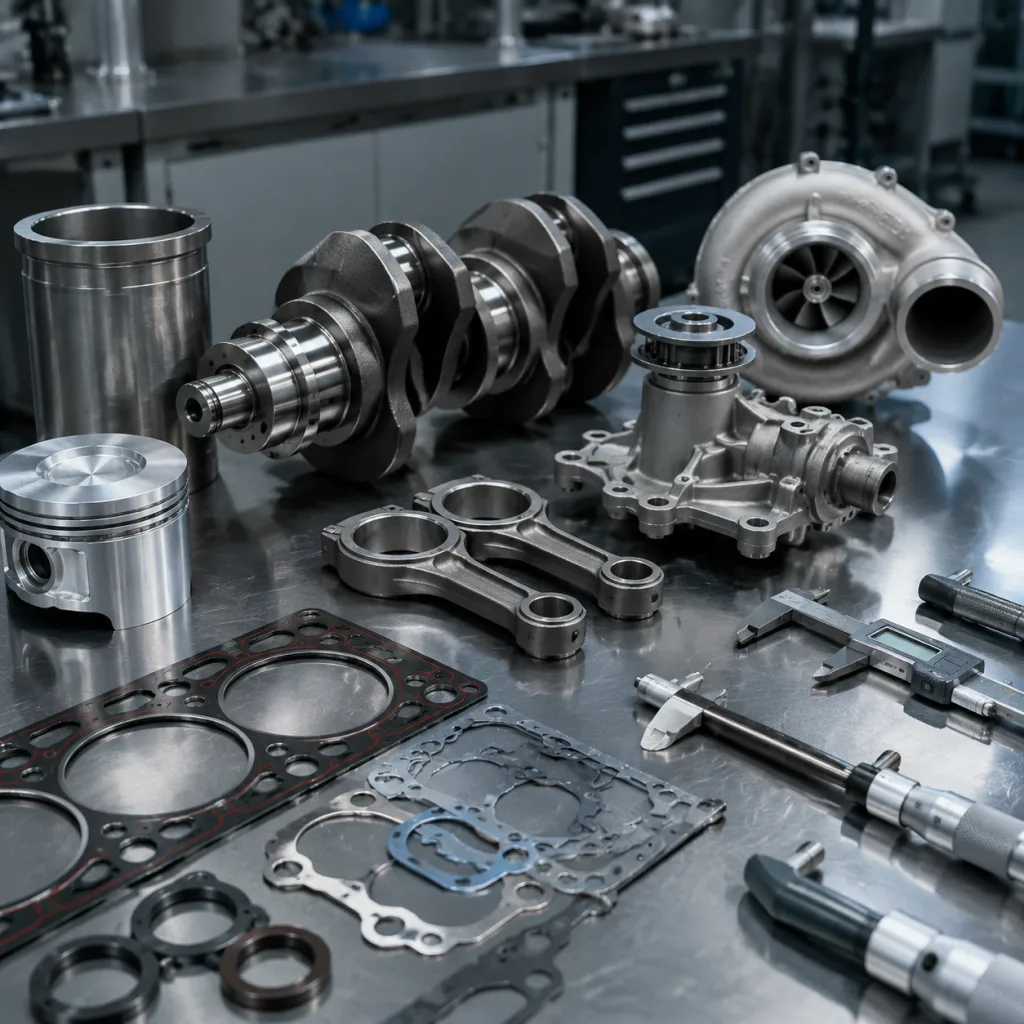
| Pistons and ring sets | Diameter, skirt profile, ring groove clearance, coating, weight match | Scuffing, blow-by, oil consumption |
| Crankshafts | Journal size, fillet radius, hardness, oil-hole finish, runout | Bearing wear, vibration, oil starvation |
| Gaskets and seal sets | Thickness, bead pattern, material compatibility, compression behavior | Oil leakage, coolant leakage, repeat repair |
| Water pumps | Bearing play, impeller geometry, seal type, casting finish, pressure test | Noise, coolant loss, overheating |
| Turbochargers | Shaft play, wheel balance, actuator calibration, oil passage cleanliness | Boost loss, oil leakage, contamination damage |
| Document or test | Why it matters |
|---|---|
| IATF 16949:2016 | Demonstrates automotive process discipline, corrective-action control, and traceability |
| ISO 9001:2015 | Confirms baseline quality management system control |
| REACH (EC) No 1907/2006 | Supports material compliance for EU import requirements |
| First-article inspection | Confirms the release sample matches the drawing or approved sample |
| CMM or micrometer report | Verifies critical dimensions and tolerance-sensitive features |
| Pressure, runout, or balance test | Confirms function on sealed, rotating, or pressure-loaded parts |
| SAE J2527 or ECE R-83, where applicable | Supports durability or emissions-related validation when relevant |