Car Parts Online Shopping: What Buyers Should Verify
Car parts online shopping should not be treated like a quick catalogue exercise. A photo and a low unit price are only the start. For B2B sourcing, each listing has to become a controlled purchasing record: application data, OE cross-reference, measured dimensions, material grade, finish, hardware, tolerances, packaging, inspection method, MOQ, price breaks, lead time, and traceability.
The risk is rarely obvious at checkout. It appears later as a connector that does not lock, a gasket that compresses too far, a bracket hole that sits 1 mm out, or a mixed carton that blocks receiving inspection. Parts affecting sealing, cooling, rotation, boost, or emissions need stronger proof: batch numbers, test evidence, inspection reports, and clear acceptance limits.
Driventus is an independent aftermarket manufacturer; brand names are referenced for fitment only. The sourcing goal is not the cheapest visible offer. It is repeatable fitment, predictable replenishment, and documented compliance with IATF 16949:2016, ISO 9001:2015, and REACH (EC) No 1907/2006 where applicable. Better verification reduces returns, chargebacks, receiving holds, and line stoppages.
Decision point: can the listing prove the exact application?
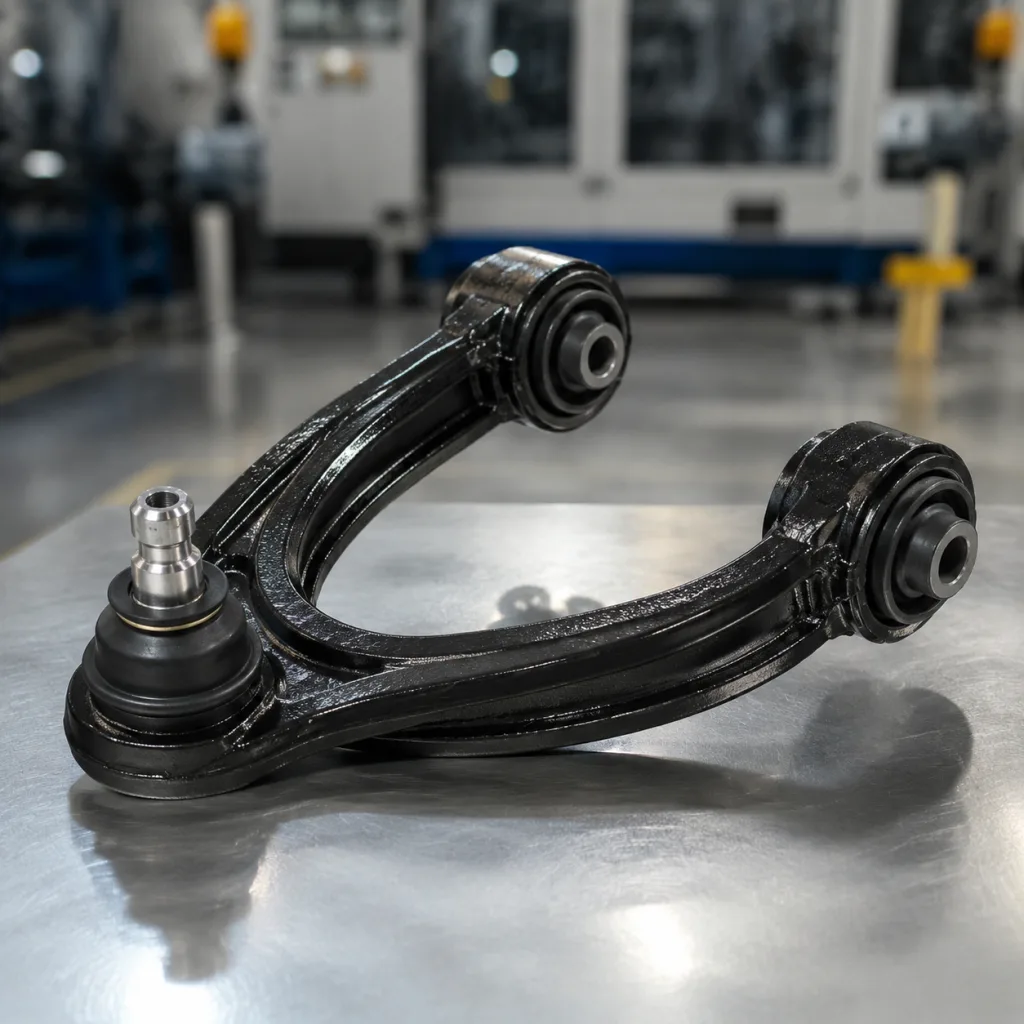
Ignore the product photo until the application is locked. A photo can show the part family; it cannot confirm a revision, bracket offset, connector key, emissions variant, or market-specific hose route. Start by building a fitment record that a supplier can confirm and your receiving team can inspect against.
Verify these inputs first:
- Vehicle make, model, production year, engine code, displacement, fuel type, and build date or VIN range
- Market region, because the same platform may use different emissions equipment, cooling layouts, brackets, sensors, or hose routing
- Transmission, drive type, steering position, accessory layout, and turbo/non-turbo configuration where relevant
- Removed part number, OE cross-reference, casting marks, connector colour, pin count, and any revision code on the old component
- Critical dimensions from the removed sample: flange thickness, hole centre distance, bore diameter, shaft length, groove width, port diameter, and gasket profile
Use numbers. “Same as photo” is not a specification. “3-pin connector, 8.0 mm mounting holes, 72.0 mm centre distance, 38.0 mm outlet OD, black EPDM seal, left-hand bracket” is something a factory can check.
For machined metal parts, define which dimensions are controlled at ±0.05 mm, ±0.10 mm, or ±0.20 mm. For moulded rubber or plastic parts, confirm whether tolerances follow the supplier drawing, ISO 3302, ISO 20457, or another agreed standard.
Engine and powertrain items deserve extra discipline. Check bore, stroke, flange pattern, connector type, gasket profile, torque interface, and clearance to nearby pulleys or brackets. Do not assume one version fits all because the vehicle badge matches. Our engine components page is most useful when the buyer already has this application data, not when the part is still being identified from a picture.
Failure modes hiding inside a weak product page
A poor listing usually fails in predictable ways. It shows a clean photo, a broad vehicle range, and a short description, but it does not state what will be shipped or how the part is controlled. Before you order, force the page—or the supplier—to answer eight practical questions.
| Check | What to confirm | Practical acceptance point | |
|---|---|---|---|
| OE reference | Full application coverage and revision status | Exact OE number, supersession note, and excluded variants | |
| Dimensions | Critical lengths, diameters, hole spacing, threads, and tolerances | Drawing or sample report showing values, not only nominal size | |
| Material and finish | Alloy, steel grade, coating, hardness, seal compound, or plastic grade | Example: aluminum ADC12/A380, EPDM/NBR/FKM, zinc-nickel, black e-coat, hardness range | |
| Kit content | Gaskets, seals, fasteners, sensors, clips, retainers, and installation caps | Quantity per kit and whether accessories are pre-installed or packed separately | |
| Traceability | Batch code, carton label, COO, barcode, pallet label, and date code | Lot traceable from carton to production batch and inspection report | |
| Test evidence | Dimensional report, leak, pressure, hardness, corrosion, torque, or endurance data | Test method, sample size, acceptance limit, and date of report | |
| Commercials | MOQ, price tiers, sample cost, tooling cost, payment terms, and incoterm | Compare landed cost, not only EXW unit price | |
| Logistics | Carton quantity, gross weight, pallet size, HS code, and lead time | Confirms freight cost, warehouse slotting, and reorder timing |
| Source type | Strengths | Risks | Best use |
|---|---|---|---|
| Marketplace listing | Fast search, small order convenience, broad selection | Mixed batches, weak document control, unclear revision history, limited PPAP-style evidence | Low-risk replenishment only after full verification |
| Specialist distributor | Local support, consolidated shipping, faster replenishment | Narrower range, variable stock depth, less control over upstream changes | Regular replenishment and multi-site buying |
| Direct manufacturer | BOM control, stable specification, custom packaging, batch traceability | Longer onboarding, MOQ planning, sample approval cycle | Repeat programmes, private label, and controlled sourcing |