Buying car parts on line is now a technical sourcing decision, not a simple catalogue transaction. Distributors, repair chains, and OEM service programmes need to confirm fitment data, production controls, compliance documents, packaging, and shipment reliability before committing to volume orders. A low unit price can quickly become expensive if dimensional variation, poor traceability, or weak after-sales support increases warranty exposure.
This guide explains how B2B buyers can evaluate aftermarket replacement parts through a manufacturer’s website, quotation file, and technical documentation. It focuses on engine and powertrain components such as pistons, crankshafts, gaskets, water pumps, turbochargers, timing parts, and sealing products.
Driventus Auto Parts manufactures in Taizhou, Zhejiang, exports to more than 60 countries, and operates under IATF 16949:2016 and ISO 9001:2015 quality management systems. Driventus is an independent aftermarket manufacturer; brand names are referenced for fitment identification only.
Start With Fitment Data, Not Price
For B2B buyers, fitment accuracy should be the first screen in online sourcing. A listing may show hundreds of applications, but purchasing teams still need to confirm the technical basis behind those matches. Engine code, bore size, stroke, gasket thickness, pump impeller design, turbo actuator type, and emissions configuration can all determine whether a part is usable in a specific market.
A structured RFQ should include:
Vehicle platform, model-year range, market region, and engine code
OE-style cross-reference format when available, for example OE 06A… or OE 11251…
Required material, coating, finish, and heat treatment
Annual forecast, first order quantity, and replenishment pattern
Packaging format: neutral, customer label, or programme-specific carton
Target market requirements, including EU, UK, US, Canada, Australia, or Brazil
Search rankings and online listings do not replace technical validation. Before buying car parts on line, procurement teams should compare catalogue data with sample drawings, inspection reports, and known failure modes from their own market. Buyers can review our catalog to identify part families, then submit a technical RFQ with the application details needed for confirmation.
Supplier Checks for Aftermarket Replacement Parts
A credible online supplier should make its manufacturing scope, quality controls, and export process clear. The objective is not only to find a part number, but to confirm repeatable supply. For importers, the larger risk is often not one defective sample; it is inconsistency across container shipments.
Evaluation item
What to request
Why it matters
Manufacturing scope
Process list, key equipment, outsourced operations
Shows whether the supplier controls critical steps
Certification
IATF 16949:2016 and ISO 9001:2015 certificates
Confirms the quality management framework
Traceability
Batch coding, raw material records, inspection logs
Supports claims analysis and recall control
Sample approval
Dimensional report, material report, photos, packaging proof
Reduces mismatch before mass production
Export capability
Incoterms, carton marks, pallet standard, loading plan
Prevents delays at booking and customs stages
Compliance support
REACH (EC) No 1907/2006 statements where applicable
Supports EU chemical compliance review
</tr></thead><tbody> </tbody></table>The supplier should also disclose whether it is a trader, assembler, or manufacturer. Driventus is a vertically integrated manufacturer of engine and powertrain replacement parts. Its quality system covers incoming material control, machining checks, assembly inspection, final testing, and shipment release. That structure matters for buyers who need consistent documentation across repeat orders.
Technical Validation Before Volume Orders
Online procurement should follow a staged approval process: catalogue match, quotation, document review, sample order, inspection, trial installation or bench validation, pilot order, and routine replenishment. This sequence takes longer than placing an immediate bulk order, but it reduces the probability of fitment disputes after distribution.
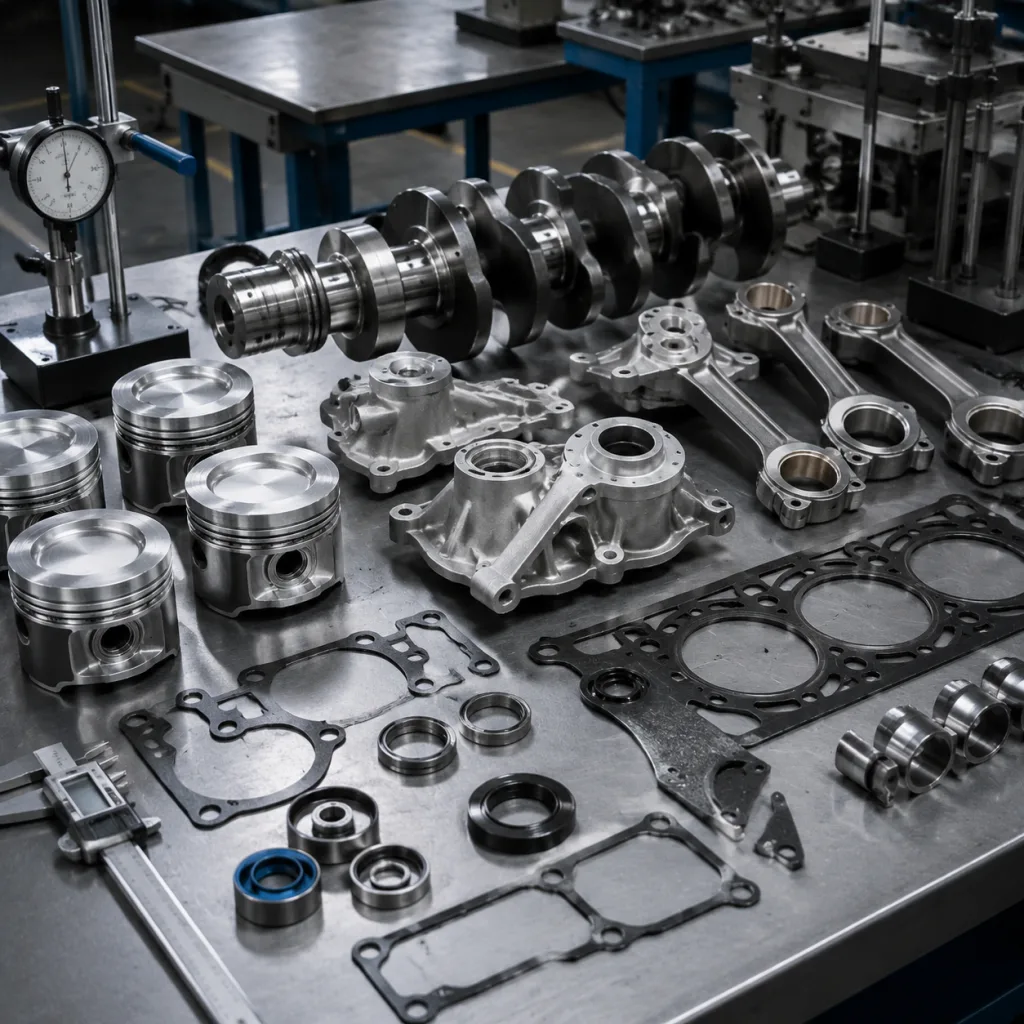
For engine components, validation normally focuses on dimensional stability, material specification, surface finish, and sealing performance. Pistons require checks for bore compatibility, ring groove control, pin bore geometry, crown profile, and skirt coating. Crankshafts require journal diameter, hardness, runout, oil-hole finish, and dynamic balance verification. Gaskets require compressed thickness, bead height, coating integrity, hole alignment, and heat resistance.
Typical validation evidence
First article inspection report with critical dimensions
Material certificate for casting, forging, rubber, graphite, steel, or aluminium alloy
Hardness and surface roughness results where relevant
Leak, pressure, or flow test results for pumps and sealing parts
Turbocharger balancing report when applicable
Packaging drop-test or transport simulation evidence for fragile or heavy components
Published standards should be used where they apply. IATF 16949:2016 and ISO 9001:2015 define quality management requirements, while REACH (EC) No 1907/2006 is relevant to chemical substances in the EU supply chain. For emissions-related vehicle context, ECE R-83 may be relevant to regulated vehicle categories. However, aftermarket mechanical components should not be described as vehicle manufacturer approved unless that approval is specifically documented. Driventus does not claim endorsement by any vehicle manufacturer.
Compare Online Sourcing Routes
There are several ways to buy replacement components online, and each route has a different risk profile. Procurement teams should choose based on order volume, liability exposure, technical support needs, and the level of control required after launch.
Sourcing route
Suitable buyer
Main advantage
Main limitation
Marketplace listing
Small reseller or urgent buyer
Fast search and broad item visibility
Limited process transparency and variable data quality
Trading company
Mixed-category importer
Consolidated sourcing across many lines
Less control over production and corrective action
Direct manufacturer
Distributor, repair chain, OEM service buyer
Better technical communication, traceability, and repeat supply
Requires clearer forecasts and approval process
Custom programme
Brand owner or Tier-1 service project
Controlled specification, packaging, and documentation
Longer development and tooling timeline
</tr></thead><tbody> </tbody></table>For high-volume buyers, direct manufacturer engagement usually gives better control of drawings, inspection points, batch traceability, and packaging standards. It also supports custom manufacturing when the buyer needs private-label packaging, modified specifications, region-specific cataloguing, or controlled consolidation across several part families.
When evaluating car parts on line, procurement teams should record the chosen sourcing route in the supplier file. This helps internal quality, logistics, and finance teams understand why a supplier was selected, which assumptions were accepted, and which controls are required before release.
Commercial Terms: MOQ, Lead Time, and Packaging
Commercial terms should be reviewed together with technical requirements. A low MOQ may not support stable production economics for machined or cast parts. A long lead time may be acceptable for planned replenishment but unsuitable for seasonal service demand. Packaging must protect components during ocean freight, inland transport, warehouse handling, and parcel redistribution.
Important commercial points include:
MOQ by item, by family, and by shipment value
Tooling or mould cost for non-standard parts
Sample lead time and mass production lead time
Payment terms, Incoterms, and preferred port
Carton size, gross weight, pallet height, and container loading plan
Barcode, label, country-of-origin marking, and customer SKU requirements
Claim procedure, evidence requirements, and response time
Buyers in the EU, UK, US, Canada, Australia, and Brazil should also review customs data accuracy. HS code, declared description, country of origin, and packing list consistency all affect import clearance. For engine and powertrain components, incorrect weights or carton counts can delay warehouse receiving and create invoice disputes.
Driventus typically supports B2B discussions with part-number lists, application data, packaging options, and production feasibility review. For large programmes, buyers should provide annual forecast and regional demand split so production planning can align machining capacity, material procurement, and shipment scheduling.
A Practical RFQ Checklist
A well-prepared RFQ reduces quotation time and prevents mismatched assumptions. It also gives the supplier a basis for engineering review instead of a simple price reply. Procurement teams buying car parts on line should treat the RFQ as a technical file, not only a purchasing email.
RFQ fields to include
RFQ field
Example format
Supplier response expected
Part family
Piston, crankshaft, gasket, water pump, turbocharger
Manufacturing availability and process route
Reference
OE 06A… or customer internal SKU
Cross-reference confirmation without brand approval claim
Application
Engine code, fuel type, model years, market region
Fitment check and exceptions
Specification
Material, coating, dimensions, tolerance where known
Confirmation, deviation, or drawing request
Quantity
Sample, first order, annual forecast
MOQ and tiered quotation
Documentation
ISO 9001:2015, IATF 16949:2016, inspection reports
Available certificate and report list
Packaging
Neutral, private label, bulk, repair-chain format
Artwork, carton, and pallet proposal
</tr></thead><tbody> </tbody></table>The strongest quotations include more than unit price. They should state validity period, tooling assumptions, sample cost, lead time, payment terms, shipment terms, and document availability. If a supplier cannot explain inspection controls for critical dimensions, the buyer should pause before issuing a purchase order.
Driventus can review RFQ files for aftermarket engine and powertrain replacement parts, including catalogue items and custom programmes. Buyers can request a quote with part numbers, drawings, photos, samples, or forecast lists.
Frequently asked questions
Verify fitment data, OE-style cross-references, material specification, sample inspection results, certification, packaging, MOQ, lead time, and claim procedure. For engine and powertrain parts, dimensional reports and batch traceability are especially important before volume orders.
No. IATF 16949:2016 defines automotive quality management requirements. It does not automatically mean a part is approved or endorsed by a vehicle manufacturer. Any approval claim must be supported by specific documentation.
Yes. Driventus supports B2B private-label and custom manufacturing projects for engine and powertrain components, subject to feasibility review, MOQ, tooling needs, packaging requirements, and validation scope.
Send your part list, samples, drawings, or annual forecast for a practical sourcing review. Contact Driventus at /contact.html to discuss fitment data, documentation, MOQ, and lead time.