Mini Cooper belt replacement demand is shaped by vehicle age, heat cycling, pulley wear, compact engine-bay temperatures and scheduled service intervals across aftermarket repair networks. For distributors and repair chains, the commercial risk is not simply whether a belt is in stock. It is whether each SKU delivers stable dimensions, correct rib geometry, reliable batch traceability, durable packaging and low return rates across several Mini generations and engine variants. This article outlines sourcing criteria for replacement accessory drive belts and related tensioner or idler components used in Mini Cooper applications. It is written for category buyers, sourcing engineers and import managers comparing aftermarket supply options for multi-market programmes. Driventus manufactures engine and powertrain components in Taizhou, Zhejiang, with export experience to more than 60 countries. Our production and inspection processes operate under IATF 16949:2016 and ISO 9001:2015 frameworks. Driventus is an independent aftermarket manufacturer; brand names are referenced for fitment only.
Fitment scope and OE-equivalent matching
Mini Cooper belt applications can vary by generation, engine family, engine code, air-conditioning layout, alternator specification and tensioner design. A belt that looks similar on a catalogue page may still differ in effective length, rib count, compound specification, pulley wrap angle or installation path. Procurement teams should therefore manage fitment through structured vehicle application tables, sample confirmation and OE-style cross-reference mapping rather than relying on visual comparison alone.
For aftermarket programmes, buyers normally request the following checks before placing volume orders:
Rib count and profile matched to the pulley system
Effective length measured under controlled tension
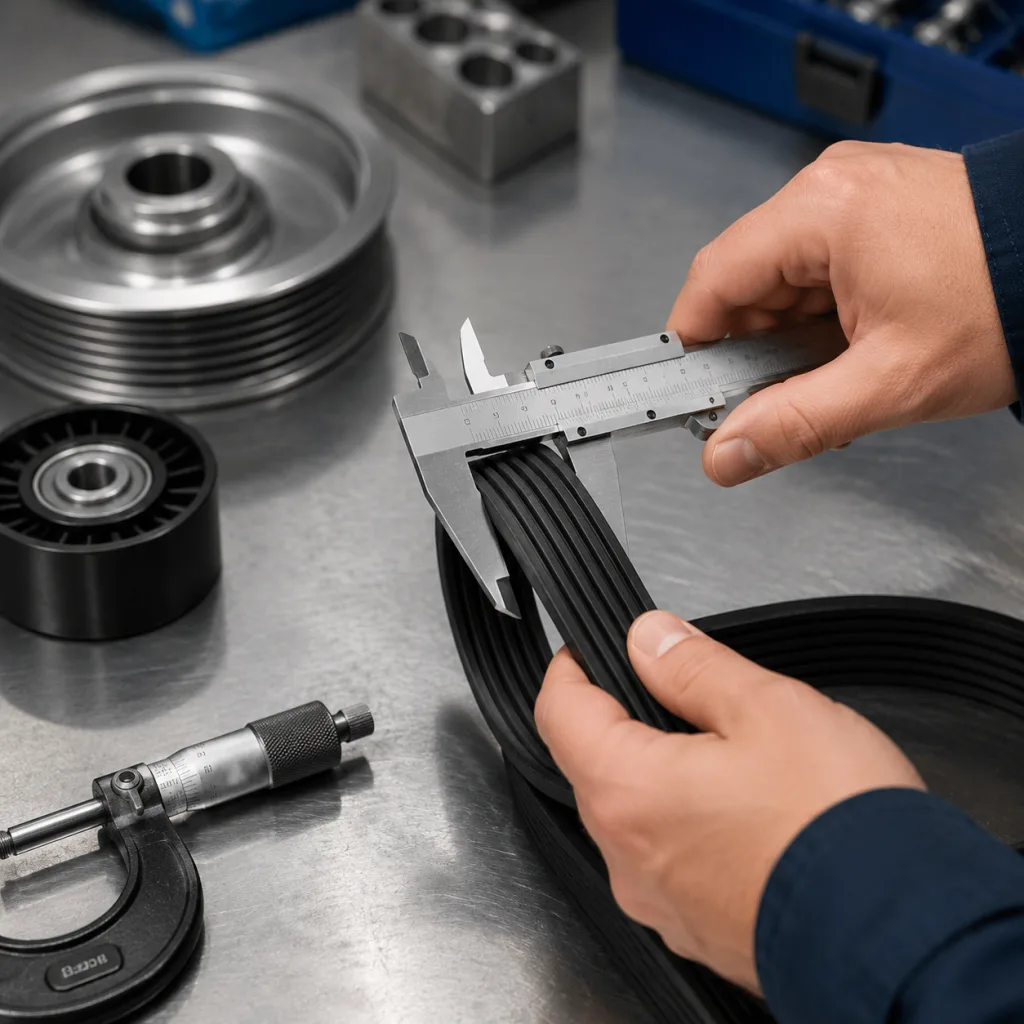
Belt width and backing thickness held within agreed tolerance
Heat, oil mist and ozone resistance suitable for engine-bay use
Compatibility with related tensioners, idlers and crankshaft pulleys
Clear application listing by model year, engine displacement and engine code
Where a buying file includes an OE reference, keep it in a neutral format such as OE 06A… or OE 11251… only when supplied by the customer. Driventus does not claim approval or endorsement by any vehicle manufacturer. Brand names are used only to identify fitment requirements.
Replacement belt construction and material controls
Accessory drive belts are routine wear components, yet premature failure is usually linked to uncontrolled compound quality, incorrect cord placement, poor rib geometry, unsuitable storage or defects in the pulley system. A credible aftermarket replacement part should be specified beyond simple length and rib count, especially for compact vehicles where belt routing and under-hood heat leave less margin for error.
Sourcing parameter
Procurement requirement
Why it matters
Rib profile
Matched to application pulley form
Reduces slip, noise and edge wear
Effective length
Controlled by production gauge
Supports correct tensioner operating range
Tensile cord
Stable elongation under load
Limits belt stretch and service complaints
Rubber compound
Heat and ozone resistant
Improves durability in compact engine bays
Surface finish
Consistent rib moulding and backing
Reduces vibration and abnormal noise
Marking
Batch, size and application code
Supports warehouse control and claims review
</tr></thead><tbody> </tbody></table>For programmes supplied into the EU or UK, material declarations may need to support REACH (EC) No 1907/2006 compliance requests. For North American and Australian buyers, the same technical file should also include compound data, inspection criteria, shelf-life guidance and packaging specifications suitable for sea freight, warehouse handling and multi-drop distribution.
Validation tests buyers should request
Mini Cooper belt replacement parts should be validated at component level and, where required, on a representative pulley system. Buyers should ask suppliers for test records that connect back to actual production batches rather than generic catalogue statements or one-time laboratory summaries with no lot traceability.
A practical validation file can include:
Dimensional inspection reports for length, width, rib count and rib geometry
Tensile strength and elongation checks before and after ageing exposure
Heat ageing tests using defined time and temperature conditions
Ozone resistance checks for cracking risk
Flex fatigue or dynamic running tests on a controlled rig
Noise and slip review under representative tension and load
Final appearance inspection for moulding defects, flash and contamination
Driventus operates a documented quality system aligned with IATF 16949:2016 and ISO 9001:2015. For B2B buyers, the useful evidence is not a certificate alone. It is the control plan, incoming material inspection record, process audit result, gauge calibration log, retained sample policy and corrective action process when a nonconformity is found.
Belt kits versus single belt supply
Distributors often list the belt as an individual SKU because it is easy to stock, price and replenish. Repair chains may prefer complete kits when worn tensioners or idlers are common in the local vehicle parc, because a kit can reduce bay time, prevent repeat visits and simplify warranty handling. The right format depends on vehicle age, workshop process, catalogue accuracy and the buyer’s inventory model.
Supply format
Advantages
Trade-offs
Single belt
Lower unit cost, simple stocking, high turnover
Does not address worn tensioners or idlers
Belt and tensioner kit
Better repair completeness, fewer repeat jobs
Higher landed cost and more fitment complexity
Belt, tensioner and idler kit
Suitable for older vehicles and chain workshops
Requires stronger application data control
Private-label boxed set
Supports distributor branding and shelf management
Needs artwork, barcode and MOQ planning
</tr></thead><tbody> </tbody></table>For engine-related replacement programmes, buyers can review our catalog and the engine parts range at /products/engine-components.html. Driventus can also support custom manufacturing where drawings, samples, validation targets and packaging specifications are supplied by the buyer.
Inspection, packaging and import documentation
A technically correct belt can still create commercial problems if packaging, labels or documentation are weak. Import managers should define these requirements before production release, particularly when the same shipment contains multiple similar belt lengths or private-label cartons for different sales channels.
Recommended purchasing controls include:
Approved sample retained by both buyer and factory
Pre-shipment inspection against agreed AQL level
Carton drop resistance suitable for export handling
Inner sleeve or banding to prevent deformation during storage
Barcode, SKU, batch number and country-of-origin marking
Neutral or private-label packaging confirmed by artwork proof
Packing list and invoice data aligned with customs requirements
For multi-location repair chains, carton and shelf labels should be easy to scan and should separate similar belt lengths clearly. A 5 mm length difference can be enough to cause incorrect tensioner position, installation difficulty, squeal or abnormal wear. Batch traceability should allow the buyer to isolate affected inventory without stopping sales across unrelated SKUs.
Commercial checks before volume orders
For a long-tail SKU with moderate search demand but high CPC, procurement teams should treat availability and return-rate control as equally important. A low purchase price can be offset quickly by fitment disputes, workshop labour claims, emergency air freight, excess obsolete stock or slow corrective action.
Before confirming a supplier, check:
Application table coverage for target markets such as EU, UK, US, Canada, Australia and Brazil
MOQ by SKU, packaging type and private-label requirement
Normal lead time for first order and repeat order
Production capacity during seasonal demand peaks
Inspection records available in English
Claim-handling process and response time
Ability to consolidate belts with adjacent engine and powertrain parts
Driventus is a vertically integrated aftermarket parts manufacturer with experience supplying distributors, OEM/Tier-1 buyers and repair chains. For mini cooper belt replacement programmes, we can quote by sample, drawing, application list or buyer specification, with supporting inspection and traceability documents.
Frequently asked questions
Provide model year range, engine code, rib count, effective length, sample or drawing, packaging requirement and target markets. If available, include customer-supplied OE-style cross-references, but Driventus will treat brand names as fitment references only.
Yes. Depending on application data and volumes, Driventus can support single belts, belt-and-tensioner kits, or wider engine service kits. Validation scope, packaging and MOQ should be confirmed during quotation.
Driventus manufacturing processes operate under IATF 16949:2016 and ISO 9001:2015. Material compliance requests can be supported for REACH (EC) No 1907/2006 where applicable to the destination market.
For application matching, samples, MOQ and lead-time discussion, send your belt programme details and request a quote at /contact.html