Car Brake Replacement: OE-Equivalent Sourcing Guide
Car brake replacement is a high-volume service category, but it should not be treated as a simple commodity purchase. For distributors, repair chains, and private-label programmes, brake pads, discs, drums, shoes, calipers, hoses, and hydraulic parts must match OE geometry, deliver repeatable friction performance, and arrive with traceable production records that support warranty control. The sourcing risk is broader than poor stopping performance: incorrect chamfers, backing plate thickness, disc runout, coating quality, sensor routing, or packaging errors can create fitment disputes across many vehicle applications. This guide explains the procurement checks Driventus uses when supplying brake system components for aftermarket replacement programmes, including dimensional confirmation, material validation, regulatory considerations, and the documentation buyers should review before adding a brake SKU to a regional catalogue. Driventus is an independent aftermarket manufacturer; brand names are referenced for fitment only.
Define the Replacement Scope Before Quotation
A brake programme should be quoted from a defined bill of materials, not from a broad vehicle description. Buyers need to separate fast-moving service parts from slower hydraulic or mechanical assemblies because each group has different validation routes, MOQ logic, and packaging requirements.
Typical replacement scope includes:
Brake pads and shoe sets by axle position
Brake discs, drums, and coated rotor variants
Calipers, wheel cylinders, and master cylinders
Brake hoses, wear sensors, clips, shims, and fitting kits
Private-label cartons, neutral cartons, and bulk service packaging
For each item, the RFQ should state vehicle application, axle position, disc or drum dimensions, friction material requirement, target market, expected annual demand, and any cross-reference format the buyer already uses. OE references should be used only for identification and fitment matching; Driventus does not claim approval or endorsement by any vehicle manufacturer.
Buyers can review our catalog for broader brake system coverage and adjacent powertrain categories. If a programme requires non-standard coatings, hardware kits, carton structures, barcode rules, or regional labelling, custom manufacturing should be specified at RFQ stage so samples and quotations reflect the intended supply model.
OE-Equivalent Fitment Checks That Reduce Returns
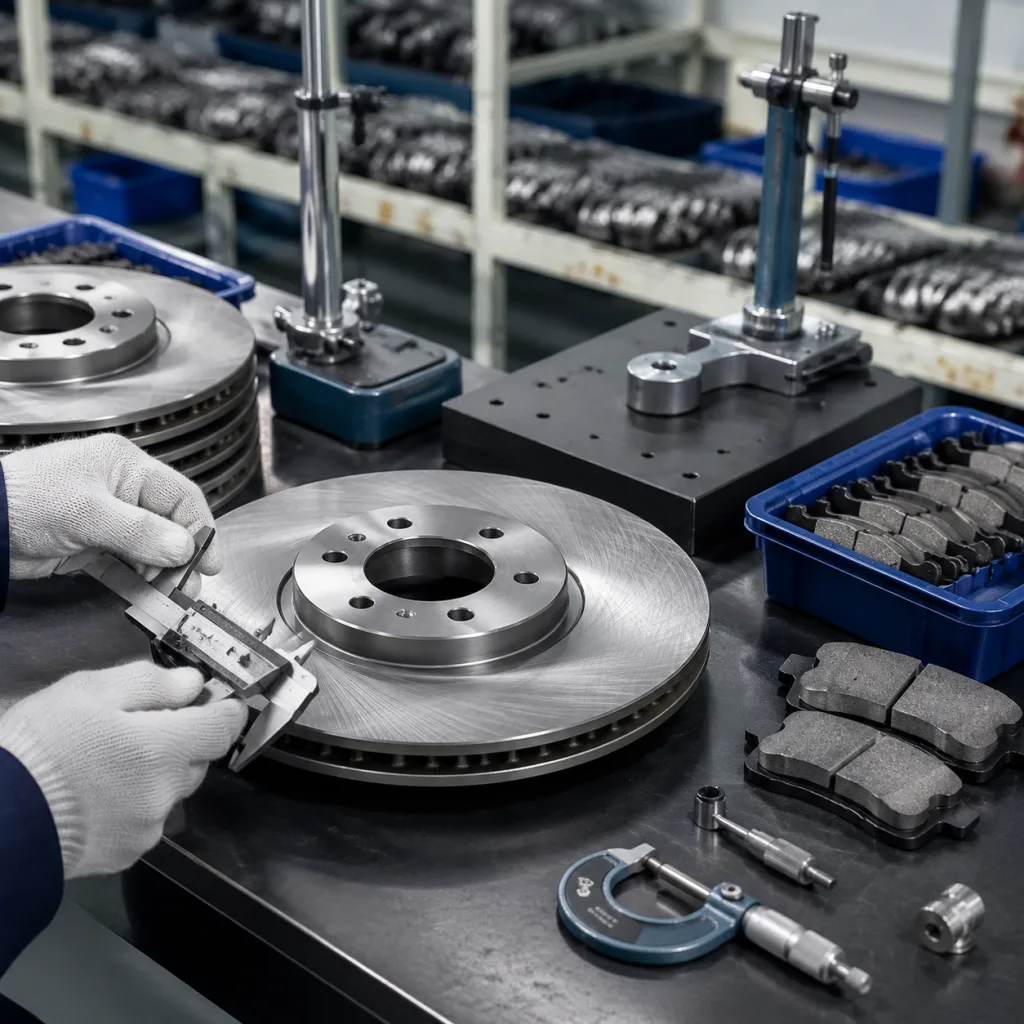
The first pass/fail point in car brake replacement sourcing is dimensional match. A pad set may look interchangeable by application, but return rates rise when backing plate geometry, abutment contact, sensor routing, chamfer design, or shim retention differs from the expected design. Disc and drum issues follow the same pattern: small deviations in centre bore, total height, bolt pattern, friction face finish, or runout can cause installation delays, vibration complaints, and unnecessary warranty claims.
Procurement teams should request inspection reports for the following dimensions:
Length, end fittings, thread, bracket position, burst performance
Routing conflict, fluid leakage, compliance risk
</tr></thead><tbody> </tbody></table>Driventus uses drawing review, sample measurement, and batch inspection to confirm these features before serial packing. For repair chains and distributors, this reduces bay time lost to parts that may be catalogued correctly but do not physically install cleanly. It also helps buyers identify whether a problem comes from catalogue mapping, part geometry, hardware selection, or handling after shipment.
Material and Performance Validation
Brake parts are safety-related replacement components, so material control must be supported by repeatable test evidence. For friction products, buyers should understand the formulation family, compressibility range, shear strength, fade resistance, recovery behaviour, and noise-control features. For discs and drums, the focus shifts to casting quality, hardness, graphite structure, machining consistency, balance, and coating adhesion. For hydraulic parts, seal material, bore finish, pressure integrity, and corrosion protection are central to service life.
Published standards and regulations should be cited accurately in sourcing files. Relevant references may include ECE R-90 for replacement brake linings and, in applicable markets, replacement discs or drums; SAE J2522 for brake effectiveness screening; SAE J2521 for brake noise evaluation; and SAE J2527 for accelerated corrosion testing. Quality management documentation should align with IATF 16949:2016 and ISO 9001:2015. Material and chemical compliance requests may also reference REACH (EC) No 1907/2006 for EU supply chains.
For a replacement programme, Driventus can support validation packages that include:
Dimensional inspection report against approved drawing
Material certificate or formulation control statement where applicable
Hardness, runout, parallelism, or balance data for discs and drums
Friction, noise, pressure, or corrosion test summaries where required by contract
Batch traceability from production lot to shipment carton
These records are practical procurement tools, not just formal paperwork. They help buyers compare suppliers on evidence, define acceptance criteria before production, and respond quickly when a distributor or fleet customer requests technical support.
Quality System, Traceability, and Packaging Control
Brake sourcing failures often appear after the part has passed basic inspection. Mixed axle positions, incorrect fitting kits, weak cartons, poor anti-rust protection, damaged coatings, or unreadable labels can create distributor chargebacks. For multi-location repair chains, label accuracy and kit completeness are as important as friction performance because the installer expects a complete service solution at the bay.
Driventus operates under IATF 16949:2016 and ISO 9001:2015 certified processes. Buyers can review our quality system when preparing supplier qualification documents. Core controls for brake replacement supply include incoming material checks, in-process inspection, final visual inspection, barcode or lot coding, shipment sampling, and corrective-action records for any repeated defect trend.
Packaging should be agreed before mass production. Common requirements include individual axle-set cartons, VCI or oil-based corrosion protection for machined iron parts, fitting-kit bagging, pallet labelling, private-label artwork control, and clear separation between left/right or front/rear variants. For export markets, carton strength should account for sea freight, inland warehousing, branch transfers, and courier distribution to installers.
A useful audit question is simple: can the supplier trace a customer complaint back to a production date, operator record, inspection result, and material batch? If not, warranty management becomes slow, subjective, and dependent on negotiation rather than evidence.
Commercial Sourcing Checklist for Import Buyers
For a brake system replacement project, the lowest unit price is rarely the lowest landed cost. Buyers should compare supplier quotations on validation scope, packaging specification, defect response, lead-time reliability, and catalogue support. This is especially important when launching a car brake replacement range across the EU, UK, US, Canada, Australia, or Brazil, where installers and distributors may expect different label formats, coating types, hardware inclusion, and compliance files.
Before issuing a purchase order, confirm:
Final application list and any supersession logic
Drawing or sample approval status
Minimum order quantity by SKU and by mixed container
Lead time for sample, pilot order, and repeat order
Test reports required for regional registration or customer file
Packaging artwork approval and barcode structure
Spare fitting-kit policy for service complaints
Warranty return process and defect analysis timeframe
Buyers should also confirm how engineering changes will be communicated after launch. Brake components can be affected by vehicle parc changes, catalogue supersessions, pad shape updates, coating revisions, and hardware kit improvements. A clear change-control process prevents old and new specifications from entering the same warehouse under one SKU.
For buyers consolidating brake parts with engine or powertrain components, supplier integration can reduce administrative work. Driventus manufactures and exports engine and powertrain components from Taizhou, Zhejiang, and supplies B2B customers in more than 60 countries. Brake system sourcing can be managed as part of a wider replacement-parts programme where documentation, packing rules, and shipment schedules are standardised.
When to Request Samples and Pilot Lots
Samples are useful only when they represent the intended production process. A procurement team should avoid approving hand-finished samples that cannot be reproduced at volume. The stronger route is to approve drawings, receive representative samples, perform bench and installation checks where possible, then place a controlled pilot order before full catalogue launch.
A pilot lot should test more than the part itself. It should verify carton strength, label scanning, pallet configuration, customs documentation, and branch-level receiving accuracy. For brake discs and drums, buyers should inspect corrosion protection after transit and confirm that machined surfaces arrive ready for sale. For pad sets and shoe kits, they should check hardware completeness, shim bonding, position-specific labelling, and whether the carton clearly supports the installer’s workflow.
Car brake replacement SKUs with high vehicle parc coverage deserve additional attention because one dimensional issue can affect thousands of annual sales. Conversely, low-volume parts should be reviewed for MOQ practicality, forecast accuracy, and consolidation with adjacent SKUs. Buyers can request a quote with sample requirements, target markets, expected annual demand, and private-label needs so that Driventus can propose a realistic validation and supply plan.
Frequently asked questions
Request drawings or key dimensions, inspection reports, material or coating data, batch traceability records, and relevant test summaries. For quality qualification, ask for IATF 16949:2016 and ISO 9001:2015 certificates, plus any market-specific compliance documents required by your customers.
Yes. Driventus can support private-label cartons, neutral packing, barcode requirements, fitting-kit configuration, and documentation packages. Artwork, labelling rules, MOQ, and pilot-lot requirements should be confirmed before mass production.
No. Driventus is an independent aftermarket manufacturer; brand names are referenced for fitment only. Parts are supplied for replacement applications based on dimensional matching, material control, and agreed validation requirements.
For brake system sourcing, sample review, or a replacement range quotation, send your application list and target market requirements to Driventus. Start the discussion at /contact.html