Auto Brake Replacement: OE-Equivalent Sourcing Guide
Auto brake replacement programmes depend on more than a vehicle application list. For distributors, repair chains, and importers, risk is concentrated in fit accuracy, friction stability, noise control, corrosion resistance, documentation, and repeatable supply. A brake pad, disc, drum, shoe, caliper repair kit, hose, sensor, or hydraulic component must match the original design envelope and perform consistently across different driving conditions, storage periods, and service habits. Buyers also need records that support customs clearance, market compliance, warranty analysis, and future reorders.
Driventus manufactures brake system components for aftermarket distribution and contract programmes from Taizhou, Zhejiang, with process control under IATF 16949:2016 and ISO 9001:2015. This guide explains the checks procurement teams should use when qualifying replacement brake parts, including dimensional match, material selection, validation testing, quality control, packaging, and supplier data. Driventus is an independent aftermarket manufacturer; brand names are referenced for fitment only.
Fitment Starts With Dimensional Equivalence
For replacement brake parts, the first sourcing gate is dimensional match against the OE design envelope. Application coverage alone is not enough. A pad set can appear correct in a catalogue but fail in the workshop if backing plate thickness, abutment geometry, wear sensor position, hardware fit, or chamfer profile differs from the expected shape.
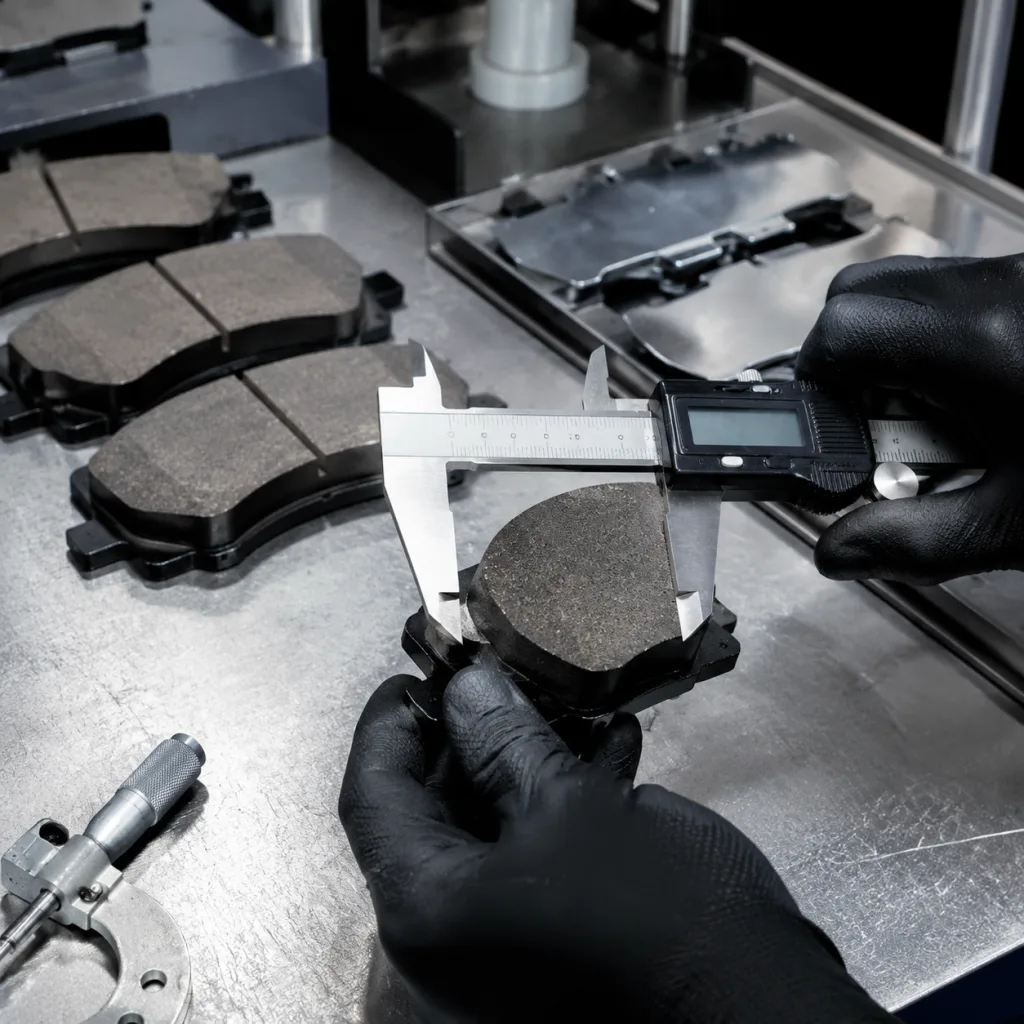
Procurement files should include drawings or controlled inspection reports for key dimensions. For disc brake pads, common control points include overall length, height, total thickness, backing plate thickness, ear width, slot geometry, spring clip location, shim interface, and sensor compatibility. For brake discs, buyers should check outside diameter, overall height, centre bore, bolt hole pattern, nominal thickness, minimum thickness, ventilation type, hub face flatness, and runout limits.
A structured cross-reference process reduces returns and protects workshop confidence. Use OE-style references only as fitment identifiers, not approval claims. Where a programme relies on catalogue mapping, cross-check vehicle generation, axle position, brake code, engine variant where relevant, and production year. Driventus can support replacement projects through our catalog and application data reviews for regional vehicle parc requirements.
Dimensional verification should be built into incoming sample approval, pre-shipment inspection, and change control. Any tooling change, friction material change, coating change, hardware change, or sensor supplier change should trigger buyer notification before shipment, because small geometry differences can create noise, drag, warning-light issues, or installation delays.
Materials and Construction Affect Field Performance
Brake replacement parts face heat cycles, water, road salt, dust, vibration, and long storage periods. Material selection should therefore be reviewed as a performance and warranty factor, not only as a cost line.
For brake pads, the friction formulation must balance fade resistance, recovery, wear rate, compressibility, noise tendency, pedal feel, and rotor compatibility. Ceramic, low-metallic, and semi-metallic formulations each have trade-offs. The correct choice depends on target market, vehicle segment, brake system design, road conditions, and local driving profile. Heavy urban use and sustained motorway use do not stress the material in the same way.
Brake discs and drums require stable casting quality, correct graphite structure, hardness consistency, and controlled machining. Poor metallurgy can contribute to hot spotting, judder, cracking, premature corrosion, or accelerated wear. Coated discs need defined salt-spray targets and masking controls so that mounting faces, friction surfaces, threaded holes, and hub areas remain within specification.
A useful replacement brake specification should define:
- Friction material family and target performance window
- Backing plate steel grade, thickness, and coating method
- Disc or drum casting material and hardness range
- Nominal and minimum service dimensions
- Surface finish, parallelism, and runout control points
- Accessory kit contents, including shims, clips, springs, grease sachets, and wear sensors
- Packaging protection for sea freight, inland transport, and warehouse storage
For B2B programmes, consistent bill-of-material control is critical. A low return rate depends on the same construction being supplied across repeat orders, not only on one approved sample. Buyers should also define what counts as an engineering change, so that substitutions in friction mix, coating, adhesive, shim design, or hardware are reviewed before they reach the field.
Validation Tests Buyers Should Request
Auto brake replacement components should be supported by a validation plan appropriate to the product and target market. The exact test package depends on whether the item is a brake pad, disc, drum, shoe, caliper component, hose, sensor, or related hydraulic part. Buyers should ask for test summaries, batch traceability, calibration status for measuring equipment, and the supplier’s retention sample policy.
| Validation area | Typical check | Procurement purpose |
|---|---|---|
| Dimensional inspection | Critical dimensions against drawing | Confirms caliper, hub, and axle fit |
| Dynamometer testing | Friction coefficient, fade, recovery | Checks braking stability under heat |
| Noise and vibration review | Squeal tendency, shim effectiveness | Reduces workshop complaints |
| Shear strength | Friction material bond to backing plate | Supports pad safety margin |
| Compressibility testing | Pad deformation under load | Checks pedal feel and pressure response |
| Runout and parallelism | Disc machining control | Reduces judder and uneven wear |
| Hardness testing | Disc or drum casting consistency | Detects metallurgy variation |
| Salt-spray testing | Coating corrosion resistance | Supports storage and winter-market use |
| Pressure or leak testing | Hydraulic sealing integrity | Confirms safety-critical sealing performance |
| Packaging drop or compression checks | Carton and pallet integrity | Reduces transport damage |