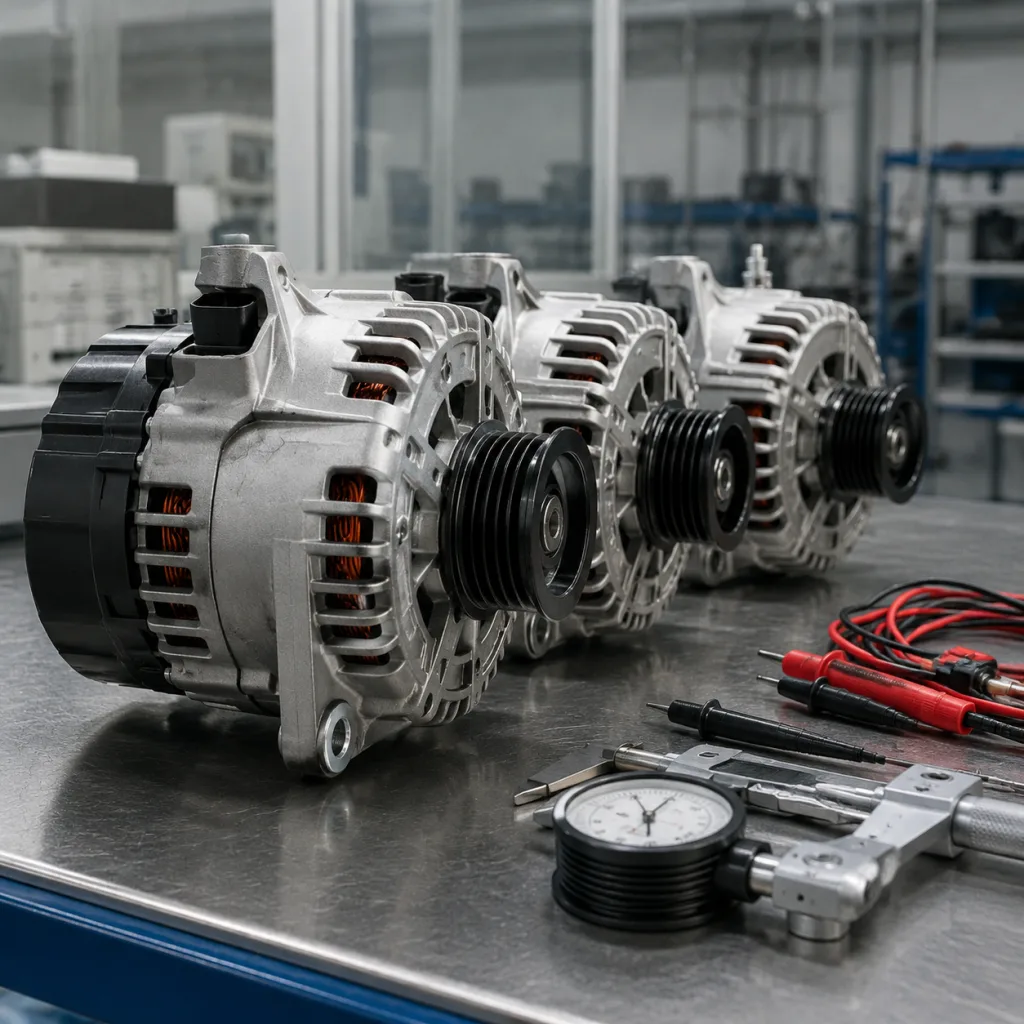
Car alternator repair cost is a practical procurement issue for repair networks, fleet service groups, and aftermarket distributors. A driver’s retail invoice usually bundles diagnosis, labour, the alternator assembly, belt or pulley work, taxes, and warranty handling. For B2B buyers, the more important question is how much of that cost is shaped by part quality, stocking strategy, catalogue accuracy, return rate, and supplier consistency.
This guide explains the main cost drivers behind alternator repair and replacement programmes from a sourcing perspective. It covers typical pricing components, new versus remanufactured units, technical validation, packaging requirements, warranty controls, and supplier audit points. Driventus manufactures powertrain and electrical rotating component programmes for export markets and supports aftermarket distributors, OEM/Tier-1 supply chains, and multi-location repair groups. Driventus is an independent aftermarket manufacturer; brand names are referenced for fitment only.
What Is Included in Alternator Repair Pricing?
A workshop invoice for alternator service usually includes more than the alternator itself. For procurement teams, separating the line items makes it easier to compare supply offers, set branch pricing, and estimate margin exposure across multiple repair locations.
Cost element
Typical role in the invoice
Procurement relevance
Diagnostic time
Battery, charging voltage, belt, wiring, and ground checks
Reduces no-fault returns when procedures are standardised
Alternator unit
New, remanufactured, or repaired assembly
Main controllable cost in distributor and repair-chain programmes
Labour
Removal, installation, and charging-system verification
Varies by engine-bay access, bracket layout, and pulley design
Belt or tensioner
Often inspected or replaced during alternator work
Aged belts and weak tensioners can cause repeat charging complaints
Core charge
Common for remanufactured units
Requires tracking, return logistics, deposit accounting, and inspection criteria
Warranty allowance
Parts replacement, labour credit, freight, or handling cost
Strongly affected by validation testing, packaging, and failure analysis
</tr></thead><tbody> </tbody></table>In North American and European repair channels, retail alternator replacement commonly spans a broad range because compact passenger cars, light commercial vehicles, and vehicles with dense engine bays require different labour times. From a B2B viewpoint, the more useful benchmark is landed unit cost plus expected claim rate. A low purchase price can be erased by regulator failures, pulley misalignment, connector damage, poor packaging, or inconsistent OE cross-reference data.
A realistic category model should include the alternator purchase price, freight, duty, packaging waste, warranty reserve, technical support time, catalogue maintenance, and the cost of stock-outs. Distributors can review related electrical and engine component programmes in our catalog.
New, Remanufactured, or Component-Level Repair
The sourcing route has a direct effect on car alternator repair cost and programme reliability. Component-level repair may suit a local workshop handling one vehicle at a time, but large repair chains and distributors usually need repeatable part numbers, stable packaging, documented test results, and predictable fill rates.
Supply route
Typical advantage
Main risk
Best-fit buyer profile
Component-level repair
Lowest immediate material cost when skilled labour is local
Variable workmanship, limited scalability, inconsistent records
Small workshops handling single vehicles
Remanufactured alternator
Lower material input and reuse of acceptable cores
Mature markets with established core return systems
New aftermarket alternator
Stable specification, clean appearance, no core tracking
Higher unit cost than some reman options
Distributors, fleets, and repair chains needing predictable supply
Custom programme
Controlled design, packaging, labelling, and test plan
Requires forecast, engineering review, and tooling where applicable
OEM/Tier-1, private-label, or regional range development
</tr></thead><tbody> </tbody></table>For B2B buyers, the decision is not simply new versus remanufactured. A reman programme requires core grading rules, return windows, deposit accounting, scrap handling, and clear rules for damaged housings or missing pulleys. A new alternator programme removes core administration but still needs careful validation of bracket geometry, pulley position, connector type, regulator function, and charging output.
Market expectations also matter. Some channels value the lower material footprint of remanufacturing, while others prioritise clean appearance, private-label presentation, and simplified warehouse handling. Driventus supports standard aftermarket supply and custom manufacturing where buyers require defined labels, packaging, private tooling review, or market-specific range development. Driventus does not claim approval or endorsement by any vehicle manufacturer.
Key Technical Factors That Change Cost
Alternators are not interchangeable commodities. Output rating, regulator strategy, pulley design, mounting layout, thermal load, and electronics compatibility all affect manufacturing cost, fitment risk, and field reliability.
Common alternator specification points to confirm:
Rated output: common passenger applications may range from about 70 A to more than 180 A, depending on vehicle electrical load.
Voltage set point: many 12 V systems are controlled around 13.5–14.8 V, subject to vehicle strategy, battery condition, and temperature compensation.
Pulley type: fixed pulley, overrunning alternator pulley, or decoupler pulley; each affects belt vibration, noise, and service life.
Connector configuration: pin count, clocking, plug shape, terminal design, and regulator communication type must match the application.
Mounting geometry: ear spacing, bolt-hole diameter, bracket offset, and case clocking require dimensional control.
Bearing and rectifier quality: weak components increase heat-related failures, ripple issues, and noise complaints.
Test data: output curve, rectifier check, regulator response, noise, vibration, and runout checks should be available by batch or programme.
A high-output unit for a vehicle with electric steering, heated glass, start-stop logic, auxiliary equipment, or high accessory load will normally cost more than a lower-output alternator for an older platform. Cost also rises when the pulley assembly is integrated, when the regulator uses LIN or other controlled charging communication, or when packaging must protect delicate rear connectors during long-distance ocean freight.
Buyers should request dimensional drawings, verified samples, or sample inspection reports before launching a range. An alternator that bolts into the bracket but has pulley offset error can create belt tracking problems, squeal, premature bearing wear, and warranty claims. Small specification mismatches are often more expensive than the original price gap between suppliers.
Quality Controls That Protect Margin
For importers and repair chains, the cheapest alternator is not always the lowest-cost part after warranty. Electrical rotating products need production controls that address mechanical fit, electrical performance, heat management, and export handling.
A practical supplier audit should check the following:
IATF 16949:2016 and ISO 9001:2015 certification status, scope, and issuing body.
Incoming inspection for housings, shafts, bearings, regulators, rectifiers, stators, rotors, pulleys, and connectors.
Rotor balance control, bearing press-fit process control, and case assembly checks.
End-of-line testing for charging output, ripple, regulator response, noise, abnormal vibration, and no-load/current-load performance.
Batch traceability on product labels, cartons, pallets, and internal production records.
Packaging validation for export handling, humidity exposure, carton strength, and stacked pallets.
Correct handling of restricted substances in line with REACH (EC) No 1907/2006 where applicable.
Driventus operates under IATF 16949:2016 and ISO 9001:2015 aligned production and inspection systems. Buyers can review our quality system before supplier qualification, sample approval, or factory audit planning.
The quality plan should also define no-fault-found return handling. Many alternator returns are caused by weak batteries, poor ground connections, belt slip, damaged battery terminals, parasitic drain, or incorrect installation. When the supplier provides clear test procedures, return evidence requirements, and failure analysis support, the buyer can reduce unnecessary credits and improve branch-level diagnosis.
How Buyers Can Estimate Programme Cost
A procurement calculation should go beyond the quoted alternator price. The target is a stable landed cost per successful repair, not just a low invoice value.
Programme cost model:
Unit purchase price from the supplier.
Tooling, sample, and approval cost where a new reference is developed.
Sea freight, urgent air freight, duty, insurance, and local inland transport.
Carton, pallet, label, barcode, and private-label requirements.
Minimum order quantity, order frequency, and supplier lead-time reliability.
Inventory carrying cost for slow-moving references and long-tail applications.
Warranty rate, labour-credit exposure, return freight, and branch handling time.
Core management cost if remanufactured units are used.
Technical data maintenance, including application tables and OE cross-reference mapping.
For high-volume references, a small reduction in return rate can be more valuable than a small price reduction. For example, a distributor selling 10,000 alternators per year with a 3% warranty rate handles 300 claims. If improved validation and packaging reduce that rate to 1.5%, the programme avoids 150 claim events, along with freight, credit notes, workshop dissatisfaction, and administrative time.
Repair chains should also consider bay productivity. If fitment data is wrong, connector information is incomplete, or pulley alignment is inconsistent, technicians spend additional time diagnosing belt noise and charging complaints. The apparent saving on the unit can create higher labour exposure across the network and weaken confidence in the parts programme.
Sourcing Checklist for Alternator Programmes
Before placing a production order, buyers should define a technical and commercial checklist. This keeps quotations comparable, clarifies responsibility, and reduces disputes after shipment.
Item to confirm
Why it matters
Evidence to request
Application list
Prevents wrong-part supply
Vehicle range, engine codes, model years, and fitment notes
OE cross-reference format
Supports catalogue mapping
Buyer-approved references only, with notes where market data differs
Output rating
Confirms electrical capacity
Test report, label data, and product specification sheet
Pulley specification
Prevents belt noise and vibration
Pulley type, grooves, diameter, clutch function, and offset
Connector details
Avoids regulator communication errors
Photos, drawings, plug view, pinout where available, and sample verification
MOQ and lead time
Supports stocking plan
Written offer by part family, shipment term, and production schedule
Warranty terms
Defines risk allocation
Claim period, evidence required, failure analysis process, and credit method
Packaging
Reduces freight damage
Drop, stack, humidity, pallet, and export carton review
</tr></thead><tbody> </tbody></table>The same checklist can be used during supplier comparison and pre-shipment inspection. For multi-location repair chains, it is useful to add technician feedback codes for noise, no charge, overcharge, connector damage, pulley concern, and fitment issue. This turns warranty data into purchasing intelligence and helps identify whether claims are driven by product, catalogue, installation, or vehicle-condition issues.
Driventus can quote standard alternator references and buyer-defined programmes for export markets. To discuss target references, forecast volume, packaging, and validation requirements, buyers can request a quote. Driventus is an independent aftermarket manufacturer; brand names are referenced for fitment only.
Frequently asked questions
The largest drivers are the alternator unit price, labour exposure, warranty rate, freight, packaging damage, catalogue accuracy, and core handling if remanufactured units are used. For distributors and repair chains, return rate and fitment accuracy often affect total cost more than a small difference in quoted unit price.
Not always. Remanufactured units can be cost-effective where core logistics, grading, and quality control are mature. New aftermarket units are often easier for importers and repair chains that want consistent appearance, no core accounting, stable packaging, and controlled batch traceability.
Send the target application list, annual forecast, required output rating, pulley type, connector photos or drawings, packaging requirements, destination market, warranty expectations, and any OE cross-reference data already used in your catalogue. Avoid relying on vehicle brand names alone.
If you are comparing alternator supply options for a distributor, repair-chain, or private-label programme, Driventus can review your target references, validation needs, and cost model. Contact our team at /contact.html