Camshaft for Volvo V40 Replacement: B2B Sourcing Guide
A camshaft for Volvo V40 replacement is a precision engine component, not a commodity casting. For distributors, repair-chain buyers, and import managers, the main sourcing risks are dimensional control, lobe hardness, oil-feed accuracy, packaging integrity, and repeatable batch quality. The replacement part must match the correct engine code, valve-train layout, timing interface, sensor trigger profile, and lubrication design used in the target vehicle population. Even small deviations can lead to valve-train noise, poor idle quality, accelerated follower or tappet wear, oil-pressure issues, or timing correlation faults after installation. This guide explains the technical and purchasing checks Driventus recommends before approving a replacement camshaft programme for Volvo V40 applications. It focuses on OE-equivalent performance, measurable inspection points, validation evidence, and the documentation typically needed for aftermarket distribution in the EU, UK, North America, Australia, Brazil, and other export markets. Driventus is an independent aftermarket manufacturer; brand names are referenced for fitment identification only.
Define the exact V40 application before quoting
The Volvo V40 nameplate has been used across different petrol and diesel engine families, model years, and regional specifications. A sourcing enquiry should therefore never rely on the model name alone. Before quoting, buyers should define the engine code, displacement, fuel type, emissions generation where known, camshaft position, and whether the shaft is for the intake side, exhaust side, inlet/outlet designation, or a combined layout.
For aftermarket distributors, the safest starting point is a structured cross-reference file that links vehicle attributes, buyer part numbers, market references, and any supplier-approved OE part-number references already used in the channel. This reduces the risk of consolidating two similar-looking parts that have different lobe profiles, trigger wheels, thrust faces, or oil-feed positions. Driventus can review existing line data against physical samples, drawings, 3D scan data, or inspection reports where available.
Minimum application data should include:
Vehicle: Volvo V40, production year range, and market region
Engine: petrol or diesel, displacement, engine code, and power output if available
Camshaft position: intake, exhaust, inlet, outlet, or combined shaft design
Buyers can check related engine lines in our catalog and the engine component family page at /products/engine-components.html. For gaps in catalogue coverage, custom manufacturing is available for validated aftermarket programmes with clear technical references and volume expectations.
OE-equivalence requirements for replacement camshafts
A replacement camshaft must reproduce the geometry, functional surfaces, and timing behaviour of the original part. For a camshaft for Volvo V40 replacement, this means much more than matching overall length or journal count. The supplier must control lobe lift, base-circle diameter, journal diameter, thrust face geometry, end-float surfaces, oil-hole position, dowel or keyway location, and any sensor trigger features used by the engine management system.
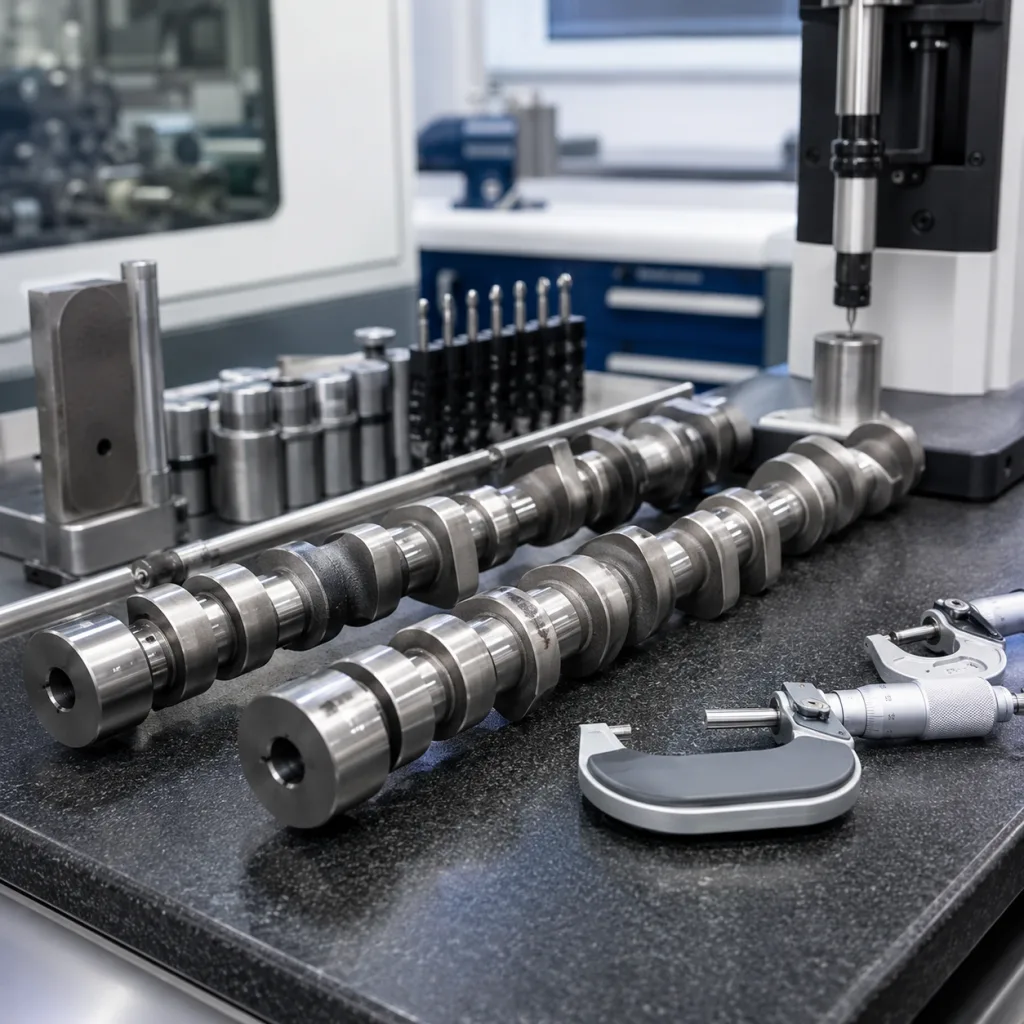
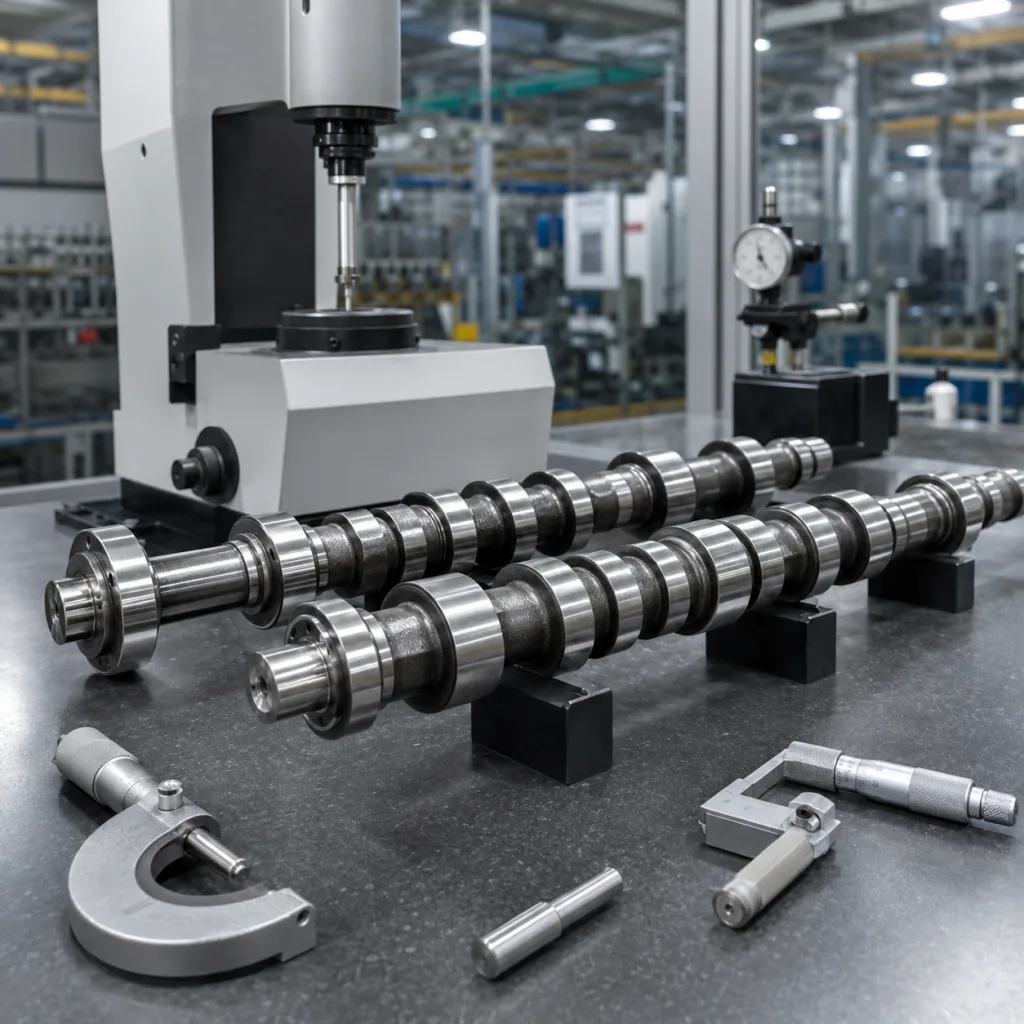
The table below shows common control points used during sample approval and incoming inspection.
Control point
Typical buyer requirement
Inspection method
Journal diameter
Drawing-specific tolerance, often requiring micrometre-level control
Air gauge, CMM, or calibrated micrometre
Cam lobe lift
Must match reference profile and valve event requirement
Cam profile measuring machine
Base-circle diameter
Consistent with valve lash, hydraulic compensation, and follower design
Profile measurement or calibrated micrometre
Surface hardness
Specified by material and heat-treatment route
Rockwell testing to ISO 6508-1 or agreed equivalent
Lobe surface roughness
Low-friction finish suitable for the follower type
Surface texture measurement to ISO 21920 series
Runout
Controlled to avoid timing variation and bearing load issues
V-block and dial indicator or CMM
Oil-feed holes
Position, diameter, cleanliness, and deburring are critical
Visual inspection, borescope, and fixture check
Timing feature
Sprocket, phaser, keyway, dowel, or sensor alignment must match reference
Functional gauge and CMM
</tr></thead><tbody> </tbody></table>For procurement teams, the practical question is whether the supplier has a repeatable process to hold these features across production batches, not only on a golden sample. Driventus uses controlled machining, heat-treatment verification, final grinding, washing, anti-rust protection, and batch inspection to support OE-equivalent aftermarket supply. Our quality system is structured around IATF 16949:2016 and ISO 9001:2015 requirements for process control, traceability, corrective action, calibration, and continual improvement.
Material, heat treatment, and surface finish checks
Camshaft material selection depends on engine design, load case, lubrication environment, follower contact pattern, and the original production route. Common aftermarket options include chilled cast iron, ductile iron, and forged or machined steel, depending on the reference part. Buyers should not approve a material substitution only because the dimensions appear similar. Wear compatibility with the follower system, oil film behaviour, heat-treatment depth, and surface finish all affect service life.
Key manufacturing checks include:
Material certificate for each production batch, heat lot, or casting lot
Chemical composition verification against the agreed specification
Heat-treatment record with furnace batch traceability where applicable
Surface hardness checks on lobes, journals, and other specified areas
Case-depth or chilled-layer verification when required by the design
Metallographic review for chilled layer, graphite structure, carbide condition, or case integrity
Magnetic particle, dye penetrant, or visual crack inspection for high-risk features where applicable
Oil-hole deburring, cleanliness inspection, and final washing before rust protection
Anti-rust treatment and controlled packing after final inspection
Lobe and journal surfaces require consistent finishing. Excessive roughness can accelerate follower wear and create early noise complaints. Over-polishing, however, can affect geometry, oil retention, or the intended surface texture. Buyers should request an agreed roughness range, inspection frequency, measuring location, and retained sample policy. For higher-volume programmes, it is also useful to define how long inspection records, heat-treatment data, and batch traceability documents will be stored.
Environmental and chemical compliance may also be relevant for importers. Driventus can support material declarations aligned with REACH (EC) No 1907/2006 where required for European customers. If packaging includes treated wood, moisture barriers, corrosion inhibitors, printing inks, adhesives, or private-label materials, those requirements should be defined during sourcing rather than after the first shipment is ready to dispatch.
Validation testing before production release
A camshaft programme should pass dimensional validation and functional risk review before bulk purchasing begins. For a camshaft for Volvo V40 replacement, validation should start with at least one known-good reference part, agreed drawings or CAD data where available, and an installation review for the target engine family. The objective is to confirm that the part can be manufactured repeatedly to the intended fit, timing, lubrication, and durability requirements.
A practical validation package normally includes first article inspection, material report, hardness report, surface roughness report, profile measurement data, runout measurement, and visual inspection records. Where the buyer requires higher confidence, endurance, rig, or fatigue testing can be added. Rotating bending fatigue testing may be specified with reference to ISO 1143, while hardness testing can be documented to ISO 6508-1. If the programme is supplied to a repair-chain network, pilot installation feedback is useful before national or multi-branch rollout.
Recommended approval sequence
1. Confirm application data and part family scope. 2. Compare physical sample, 3D scan, or drawing against the target part. 3. Identify critical characteristics such as lobe profile, journals, oil holes, and timing features. 4. Produce pre-production samples from the intended production process. 5. Complete dimensional, hardness, roughness, runout, and visual inspection. 6. Conduct fitment, rotation, end-float, and timing-interface verification. 7. Review packaging, labelling, barcode, corrosion protection, and carton-drop requirements. 8. Approve documentation, retained samples, and traceability rules. 9. Release the part for controlled batch production.
For emissions-sensitive markets, a replacement camshaft must not change valve timing or engine calibration behaviour versus the intended repair function. While a camshaft is not normally certified under ECE R-83 by itself, buyers should ensure the part does not create non-conforming vehicle emissions behaviour, diagnostic faults, or drivability problems after repair.
Purchasing controls for distributors and repair chains
Category buyers should evaluate the supplier’s ability to maintain stable production, not only the quality of the first sample. A strong first article is valuable, but ongoing supply depends on documented process control, gauge calibration, operator training, incoming material control, final inspection discipline, and a clear corrective action process when issues occur.
For aftermarket distributors, the most important commercial and operational points are:
MOQ by part number, engine family, and shipment consolidation plan
Lead time for samples, pilot lots, first production orders, and repeat production
Batch traceability from raw material or casting lot to final carton label
Inspection records available for critical dimensions and hardness results
Private-label carton, neutral carton, or repair-chain kit packaging options
Barcode format, country-of-origin label, and import documentation
Spare inventory policy for slow-moving V40 engine variants
Change-control process for material, tooling, heat treatment, machining, or packaging updates
Claim-handling process with photo, mileage, oil condition, fault-code, and installation data requirements
Driventus manufactures engine and powertrain components in Taizhou, Zhejiang, and exports to more than 60 countries. For camshaft sourcing, our role is to support distributors and professional repair networks with controlled production, technical cross-reference review, export-ready packaging, and documentation suitable for B2B import. We do not claim vehicle manufacturer approval or endorsement.
If a buyer needs a replacement camshaft supplied with related components, such as seals, timing parts, gaskets, followers, or water pumps, the programme can be reviewed as a broader engine repair basket. This approach can reduce inbound freight cost, simplify supplier qualification, improve carton utilisation, and make it easier for repair chains to order consistent parts for the same service job.
Packaging, logistics, and failure claim prevention
Camshafts are vulnerable to corrosion, impact damage, and bending if packaging is not engineered properly. A long, precision-ground component needs end protection, anti-rust oil paper or VCI treatment, and controlled immobilisation inside the carton. For export shipments, buyers should define carton strength, pallet height, humidity protection, container loading method, and acceptable transit handling conditions before production release.
Recommended packaging specification:
Individual anti-rust sleeve, oil paper, or VCI bag
Journal and lobe surface protection from hard contact
End caps, inserts, or moulded supports to prevent carton breakthrough
Immobilisation that prevents rolling, bending, and metal-to-metal contact
Single-part label with buyer part number, application reference, and batch code
Master carton label with quantity, gross weight, carton dimensions, and traceability code
Palletisation suitable for sea freight, air freight, courier sampling, or mixed consolidated loads
Moisture-control measures for long-distance or high-humidity routes where required
Many field claims begin with avoidable data gaps rather than a confirmed manufacturing defect. A repair chain should record engine code, mileage, oil condition, fault codes, replaced companion parts, and installation notes. If the original failure was caused by oil starvation, blocked oil passages, broken timing components, follower damage, incorrect installation, or contaminated lubricant, a new camshaft may fail again unless the root cause is corrected. Procurement teams should make these requirements clear in technical bulletins, warranty terms, and claim forms.
For a controlled sourcing review, buyers can send application data, expected annual volume, target market, packaging requirements, and any current sample to request a quote. Driventus will review feasibility, documentation needs, sample timing, and the next steps for a camshaft for Volvo V40 replacement programme.
Frequently asked questions
Provide model year range, market region, engine code, fuel type, displacement, camshaft position, timing interface, and any existing buyer cross-reference. A physical sample, drawing, or 3D scan improves accuracy, especially where the same model name covers several engine families.
Yes. Packaging can be specified as neutral, private label, or repair-chain kit format. Buyers should confirm carton artwork, barcode format, country-of-origin label, corrosion protection, traceability code, and palletisation requirements before production release.
No. Driventus is an independent aftermarket manufacturer; brand names are referenced for fitment identification only. Replacement parts are developed for dimensional and functional equivalence, but no vehicle manufacturer approval or endorsement is claimed.
Send your application list, volume forecast, target market, and sample requirements for a controlled sourcing review. We will respond with feasibility, documentation needs, and next steps at /contact.html