Camshaft for Volkswagen Polo OE Equivalent: Sourcing Guide
An OE-equivalent camshaft for Volkswagen Polo applications must match the original part in critical geometry, timing events, journal sizing, surface finish, and heat treatment. For procurement teams, the goal is not only nominal fit, but repeatable interchangeability across batches, stable lift and duration, and controlled runout so the valve train behaves as designed. Driventus supplies engine and powertrain parts for aftermarket and B2B channels, with production aligned to IATF 16949:2016 and ISO 9001:2015 requirements. Driventus is an independent aftermarket manufacturer; brand names are referenced for fitment only. This article explains how buyers verify OE equivalence, what to inspect on drawings and samples, and which tests matter before placing volume orders. If you source for distributors, repair chains, or engine rebuild programmes, the checks below help reduce claims, returns, and inventory confusion.
Camshaft OE equivalence: what actually counts
For a camshaft, OE equivalent means the replacement part reproduces the functional dimensions and performance of the original design within controlled tolerances. For Volkswagen Polo applications, that includes lobe lift, base circle, cam phasing, journal diameter, overall length, keyway or drive features, and sensor trigger geometry where fitted.
A buyer should expect a supplier to provide a dimensional report, material specification, and validation data. A part can look similar and still fail in service if the lobe profile, hardness depth, or axial positioning is off. For that reason, cross-reference by engine code and OE number when available, such as OE 06A107065, then validate against the actual sample.
Typical buyer acceptance logic should be tied to measurable limits, not visual similarity. In practice, that means defining a target tolerance band for every critical characteristic before the first quotation stage. A common purchasing format is to require nominal dimensions, tolerance, measurement method, and reaction plan if any sample falls outside the agreed window.
| Check item | Why it matters | Typical buyer evidence | Practical acceptance target |
|---|---|---|---|
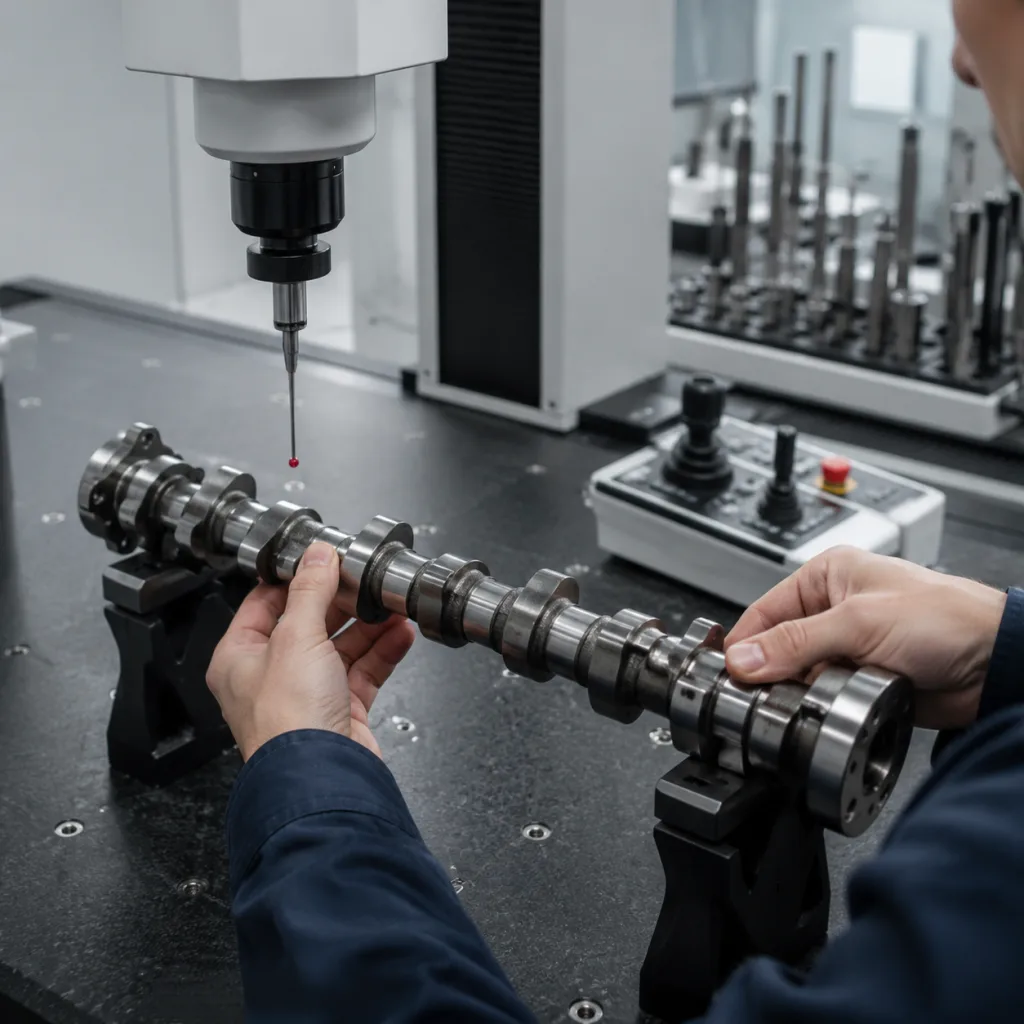
| Lobe profile | Affects valve timing and breathing | CMM or optical profile report | Profile match to OE master within agreed deviation band |
| Journal diameter | Controls oil film and bearing life | Micrometer inspection record | Usually held to tight micron-level tolerance by drawing |
| Runout | Influences noise and wear | Roundness/runout report | Low total indicated runout to avoid valve-train instability |
| Surface hardness | Resists scuffing | Hardness and case-depth report | Hardness range and case depth must match OE process window |
| End features | Ensures drive and sensor fit | Drawing with critical dimensions | No interference on sprocket, gear, or sensor interface |
| Supplier factor | What to ask | Buyer benefit |
|---|---|---|
| Traceability | Batch coding and lot records | Faster root-cause analysis |
| Process control | SPC, inspection frequency, gauge control | More stable dimensions |
| Certification | IATF 16949:2016, ISO 9001:2015 | Better system discipline |
| Validation | Sample test report and fitment evidence | Lower field risk |
| Lead time | Production and packing schedule | Better inventory planning |