Procurement teams looking for a camshaft Vauxhall manufacturer China typically have to balance three priorities at the same time: confirmed fitment, consistent manufacturing quality, and a supply chain that can stay on schedule from sample approval through production, packing, and export. For aftermarket distributors, repair networks, fleet maintenance channels, and OEM or Tier-1 programmes, a camshaft is not a simple commodity part. Lobe profile accuracy, journal roundness and surface finish, hardness depth, straightness, oil-feed geometry, thrust-face control, and timing relationship all influence valve lift, bearing oil film, NVH, wear life, emissions consistency, and long-term engine durability. A low unit price only matters if the supplier can prove that the same drawing revision and process controls will be repeated in the next batch.
Driventus manufactures engine and powertrain components in Taizhou, Zhejiang, and exports to more than 60 countries. Production operates under IATF 16949:2016 and ISO 9001:2015. Driventus is an independent aftermarket manufacturer; Vauxhall and other brand names are referenced only to identify fitment. This guide outlines how B2B buyers can assess specification control, validation testing, minimum order quantity, lead time, export documentation, and supplier communication when comparing Chinese camshaft suppliers for Vauxhall applications and OE cross-reference programmes.
What buyers should verify first
When sourcing a camshaft for Vauxhall applications, price should not be the opening question. Fitment, datum control, and process capability come first. Before moving into volume pricing or shipment windows, the purchasing team should confirm that the supplier understands the exact engine family, camshaft position, timing interface, and reference geometry.
Buyers should confirm:
OE or aftermarket cross-reference target, including the full reference number and supersession history where available
Vehicle application range, engine code, displacement, fuel type, aspiration type, and model year coverage
Camshaft position: intake, exhaust, single overhead camshaft, dual overhead camshaft, or matched pair
Valve-train layout, lobe count, firing-order relationship, cam sensor trigger features, and timing wheel or phaser interface
Whether the shaft uses a keyway, slot, dowel, gear, sprocket interface, vacuum pump drive, fuel pump drive, or sensor reluctor
Intake and exhaust phase relationship if supplied as a matched pair
Whether the camshaft is for a single replacement item, a catalogue programme, or a customer-specific drawing-controlled build
Material route: chilled cast iron, ductile iron, forged steel, hollow steel tube assembly, or billet steel
Surface hardening method, such as induction hardening, chilled-cast surface, carburising, nitriding, or specified equivalent
Target surface hardness and effective case depth where applicable, for example HRC/HV range and depth measured after grind
Journal diameter, lobe lift, base circle, lobe separation angle, phase angle, keyway, slot, gear, or phaser-interface tolerances
Oil passage, plug, thrust face, chamfer, edge-break, and end-face requirements if shown on the drawing
Packing standard for export cartons, VCI or rust-preventive oil, individual sleeves, label format, palletisation, and barcode needs
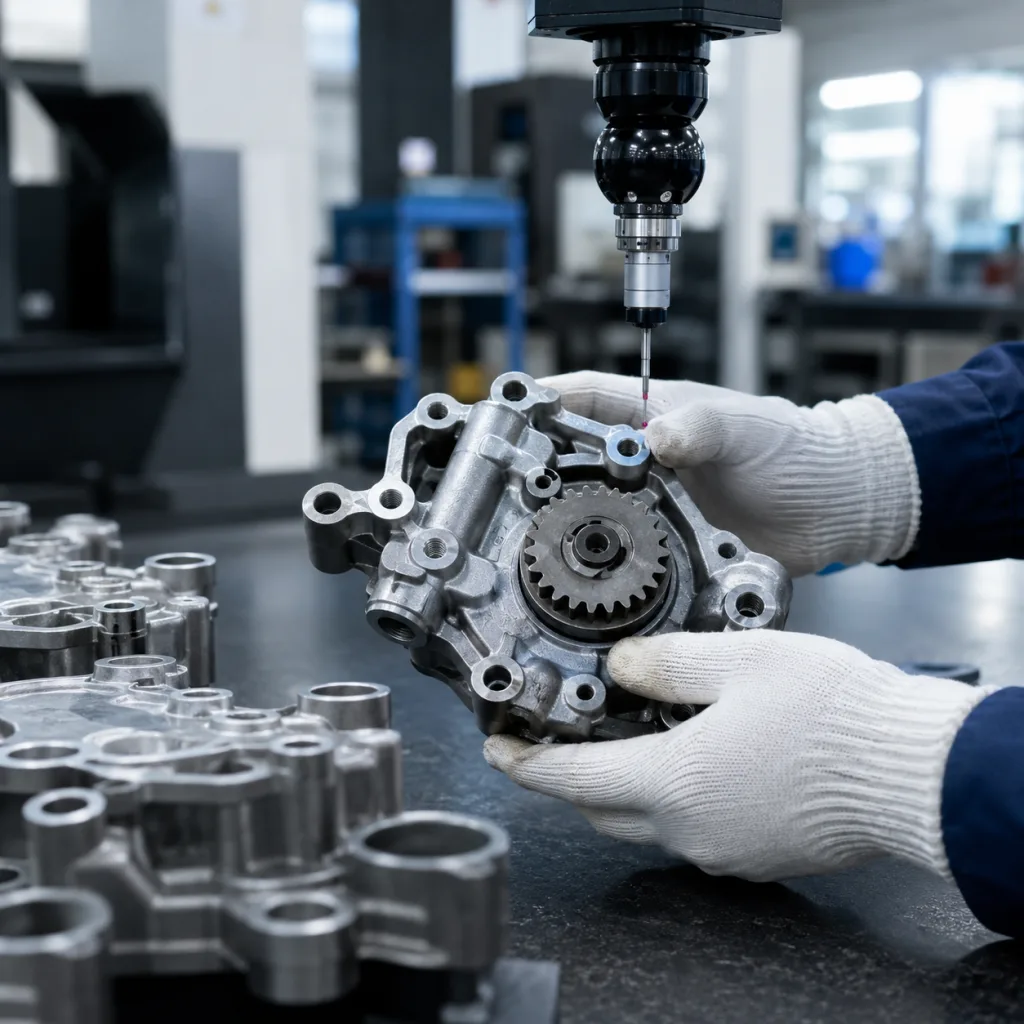
A capable supplier should be able to state whether the part is made from chilled cast iron, forged steel, assembled steel, or billet steel. They should also explain whether finish grinding is controlled by CNC profile grinders with in-process gauging or verified after the process by CMM/profile measurement. Ask how similar-looking references are separated. Camshafts for related GM/Vauxhall/Opel engine families may share overall length and journal count while having different lobe phase, trigger pattern, fuel-pump lobe, or timing-slot geometry.
For procurement teams, this is the difference between a part that can be re-ordered by controlled part number and revision, and a part that needs the same technical clarification every time. A strong supplier will record the application data, drawing revision, inspection plan, packaging requirement, batch size, AQL or 100% inspection characteristics, and agreed commercial assumptions before releasing a sample or production order.
Driventus supports buyer review with drawings, process flow, PPAP-style documentation where required, and lot traceability by material heat number, production batch, inspection record, and packing list.
Specification checkpoints for camshaft sourcing
A camshaft supplier should confirm measurable characteristics, not just application names. For a camshaft Vauxhall manufacturer China sourcing project, the specification needs to be clear enough for engineering, quality, purchasing, and receiving inspection teams to reach the same decision from the same documents.
Item
Typical buyer check
Why it matters
Material
Chilled cast iron, ductile iron, forged steel, assembled steel, or billet steel per drawing
Strength, wear resistance, machinability, and cost control
Journal diameter
Drawing-specific tolerance; often controlled in the micron range
Bearing clearance, oil film control, and installation reliability
Journal roundness/cylindricity
CMM, roundness tester, or precision gauge check
Reduces oil leakage, bearing hot spots, and seizure risk
Lobe lift
Drawing-specific tolerance, commonly verified by profile measurement
Valve opening, airflow, combustion stability, and engine performance
Base circle
Drawing-specific tolerance
Valve-train preload, lash setting, hydraulic lifter operation, and repeatable assembly
Lobe profile
Lift curve overlay against master profile or CAD data
Controls acceleration, valve seating velocity, noise, and wear
Lobe phase angle
Checked against datum, dowel, keyway, slot, gear, or sensor reference
Cam timing accuracy and emissions-related consistency
Hardness
Surface hardness with effective case-depth control, e.g. HRC/HV and depth after grinding
Wear life under load and resistance to scuffing
Runout/TIR
Measured between centres or on V-block/fixture at defined journals and lobes
Vibration, timing stability, seal wear, and bearing load control
Surface finish
Ground and polished finish on journals and lobes, normally specified as Ra/Rz
Reduced friction, lower wear, and improved oil-film behaviour
Straightness
Fixture or centre-based measurement after heat treatment and finish grinding
Assembly fit and rotational stability
Thrust face
Width, flatness, surface finish, and end-float interface
Controls axial movement and timing-component alignment
Oil holes/passages
Diameter, position, burr-free condition, and cleanliness
Prevents oil starvation, debris release, and early wear
Magnetic particle or crack inspection
Required where material/process risk justifies it
Reduces risk of grinding cracks, quench cracks, and fatigue failures
Balance
Dynamic check where specified by engine design
NVH control and high-speed durability
Identification
Part number, batch, revision, and production date marking where practical
Traceability and warehouse accuracy
</tr></thead><tbody> </tbody></table>If your buying team requires dimensional equivalence to a published OE reference, request a first-article sample with a measurement report and photo documentation. The report should include actual measured values, tolerance limits, equipment used, inspection date, inspector sign-off, and drawing revision. Pass/fail notes alone are not enough. For matched intake and exhaust camshafts, ask the supplier to confirm that the pair is inspected, packed, and labelled to the same revision level.
For catalogue sourcing, see our catalog and the broader engine components range. Buyers managing multiple European applications should also check whether one supplier can support related components such as rocker arms, hydraulic lifters, tappets, timing kits, valve-train parts, gaskets, and repair kits. Consolidated sourcing can reduce RFQ time, mixed-shipment complexity, and supplier qualification workload.
For European buyers, material and chemical control should align with REACH (EC) No 1907/2006 where applicable, including declarations for substances of very high concern when requested. Packaging may also need to meet customer or market requirements for moisture control, ISPM 15 wood packaging, carton drop strength, and pallet labelling. For emissions-related validation, suppliers may reference programme-specific engine test requirements when the camshaft affects calibration, valve timing, or EGR/combustion stability. The correct standard depends on the customer programme, destination market, and whether the part is being supplied for independent aftermarket replacement, repair network use, or a controlled engineering release.
Manufacturing process and repeatability
Camshaft quality depends on the stability of every process step. A capable factory should control the full route from raw material receiving to final packing. Profile accuracy can be lost through poor datum selection, inconsistent heat treatment, excessive grinding stock removal, wheel wear, residual stress, contamination, or weak final inspection.
A typical controlled sequence includes:
1. Raw material receiving, approved supplier control, material certificate review, and heat/batch identification 2. Positive material verification or chemical confirmation where required by the control plan 3. Pre-forming, chilled casting, forging, tube assembly, or billet preparation according to the selected route 4. Normalising, stress relief, or preliminary heat treatment where required by material route 5. Rough turning or CNC machining of journals, end faces, datum points, thrust faces, and reference features 6. Lobe roughing, CNC milling, rough profiling, or casting/forging profile preparation 7. Drilling, reaming, plugging, and deburring of oil holes or internal passages where applicable 8. Heat treatment or surface hardening, such as induction hardening, carburising, nitriding, or controlled chilled-surface processing 9. Straightening, stress-relief control, and runout check after heat treatment where required 10. Finish grinding of journals, lobes, thrust faces, seal surfaces, and reference datums 11. Superfinishing or polishing of journals and lobes to the specified surface finish 12. Chamfering, deburring, edge treatment, and cleaning of oil holes and machined passages 13. Metrology inspection for dimensions, lobe profile, phase angle, runout, surface finish, hardness, case depth, and visual condition 14. Crack detection or magnetic particle inspection where required by drawing, process risk, or customer control plan 15. Final cleaning, rust-preventive treatment, individual protection, export packing, labelling, and release against packing list
Repeatability comes from controlled fixtures, calibrated gauges, CNC grinding wheel dressing schedules, qualified operators, documented setup sheets, and clear reaction rules when measurements begin to drift. Buyers should ask for gauge calibration records, incoming material certificates, heat-treatment furnace or induction records, grinding setup records, and in-process inspection frequency. It is also worth confirming which characteristics are checked 100% and which are sampled by lot. Critical features often include timing datum geometry, cam phase, journal size, lobe lift, oil-hole cleanliness, and visual defects.
If a supplier cannot describe the measurement points for journal diameter, lobe lift, base circle, phase angle, total indicated runout, hardness, case depth, and surface finish, treat it as a sourcing risk. The same applies if the supplier cannot explain how nonconforming parts are identified, segregated, reviewed, reworked, scrapped, and kept out of packed stock. A good first sample is not enough if the batch-control system cannot prevent quality escapes.
For programmes that need special packaging, lot marking, revised surface treatment, or customer drawing control, Driventus offers custom manufacturing with technical review before production release. A practical factory audit should also confirm whether the plant uses documented nonconformance handling, rework segregation, corrective action tracking, engineering change control, tool-change records, preventive maintenance, and final release authority under a defined quality system.
MOQ, lead time, and commercial terms
A camshaft programme should be evaluated on total landed cost, not ex-factory price alone. The lowest quoted unit price can quickly become expensive if it leads to heavy receiving inspection, repacking, repeated claims, delayed shipment, or emergency air freight after a failed sample.
Typical sourcing variables include:
MOQ by material family, part complexity, tooling status, and whether the shaft is catalogue or drawing-controlled
Sample lead time versus production lead time, with separate milestones for technical review, first article, buyer approval, and mass production
Whether the part is existing catalogue stock, made-to-order from approved tooling, or customer-specific with new fixtures/gauges
Packing configuration for sea freight, LCL consolidation, FCL shipment, air freight, or courier sample dispatch
Anti-rust method, such as rust-preventive oil, VCI bag, end protection, internal supports, carton strength, and pallet standard
Tooling, fixture, cam-profile master, CMM programme, grinding wheel, or inspection gauge cost for special designs
Tooling amortisation for special profiles or low-volume parts
Forecast visibility for repeat orders, call-off schedules, and seasonal aftermarket demand
Claim handling process, 8D response expectation, spare quantity policy, and replacement lead time
For standard aftermarket camshafts, buyers often start with sample approval and then move to a production MOQ that supports stable batch control and economical grinding setup. For customer-specific profiles, lead time may include drawing review, material confirmation, fixture setup, inspection programme creation, first-article inspection, validation sampling, packaging approval, and production release. Agree on that schedule before award, with milestones for engineering review, sample dispatch, buyer feedback, corrective action if required, and mass production.
A practical quotation should state clearly what is included: part specification, drawing or reference revision, packaging, marking, inspection documents, export carton dimensions, pallet details, shipment terms, validity period, and any excluded tooling or test cost. If the buyer needs mixed SKUs in one container, barcode labels, private-label cartons, replenishment in smaller lots, or bonded-warehouse delivery, discuss it early. These details affect production planning, carton printing, inspection batching, and packing workflow.
If your team needs a supplier that can support both recurring catalogue items and customer-specific builds, ask for a documented commercial plan, export packing specification, target shipment window, and sample approval route. Use request a quote to start a technical review with application data, OE reference, drawing if available, destination country, packaging requirement, and annual volume target.
Driventus is set up for B2B export supply to distributors, wholesalers, OEM and Tier-1 buyers, and multi-location repair chains. For long-term programmes, Driventus can help align repeat-order planning, batch traceability, packaging requirements, and shipment schedules so the commercial offer reflects the real operating cost of the supply chain.
Validation testing and documentation
Procurement teams should not treat “inspected” as the same thing as validated. Inspection confirms that a shipment has been checked against selected criteria. Validation goes further: it shows that the part, process, and documentation support the intended application, drawing revision, and buyer requirement.
Useful validation documents include:
Dimensional inspection report with actual measured values, tolerance limits, drawing references, and inspection equipment noted
First-article inspection report for new or revised parts, including the approved drawing/revision level
Material certificate linked to heat number or batch number
Chemical composition record where required by the buyer, material standard, or market
Hardness test record, including test scale such as HRC or HV and measurement location
Effective case-depth data where applicable, with method and section location stated
Heat-treatment record or surface-hardening process confirmation, including furnace/induction batch identification where available
Lobe profile, base circle, lobe lift, phase angle, runout, concentricity, and straightness reports
Surface finish report for journals, lobes, thrust faces, and seal areas where specified on the drawing
Magnetic particle inspection, crack detection, or metallographic report where required by risk level or customer control plan
Visual inspection record for cracks, burrs, dents, rust, grinding burns, machining marks, and handling damage
Cleaning and oil-hole confirmation where passages are part of the design
Packing and corrosion protection confirmation, including VCI or rust-preventive oil method if used
Sample approval record with revision control and buyer sign-off
Control plan, process flow, PFMEA-style documents, and 8D/CAPA format where required for higher-level programmes
For higher-risk programmes, request comparative testing against the reference part or drawing target. The comparison may include lobe profile overlay, timing datum verification, hardness mapping, case-depth section, surface finish comparison, dimensional report, and installation feedback from the buyer’s technical team. In endurance programmes, buyers may also ask for wear observations after bench running, thermal cycling, oil-contamination checks, or engine test support. The exact test plan should follow the customer specification, engine type, usage duty cycle, and warranty risk.
For European supply, documentation may also need to support REACH material declarations, packaging requirements, customs data, and customer-specific compliance files. Export paperwork should be consistent with the commercial invoice, packing list, certificate of origin if requested, HS code, carton quantity, net/gross weight, and pallet count.
The essential rule is that the documentation must match the part revision shipped. If the drawing changes, the test package should change as well. If the supplier changes material source, heat-treatment route, profile tooling, grinding process, inspection method, or surface treatment, the buyer should be informed through an agreed change process before production shipments continue.
Why buyers choose a China-based camshaft supplier
China-based manufacturing can be a rational sourcing choice when the factory has stable process control, export experience, and clear technical communication in English. For a buyer comparing a camshaft Vauxhall manufacturer China with suppliers in other regions, the decision should rest on capability, repeatability, documentation, and total landed cost, not country of origin alone.
For purchasing teams, the main advantages are:
Access to integrated material sourcing, machining, heat treatment, grinding, inspection, cleaning, and packing within one coordinated supply chain
Flexibility for mixed-volume orders across aftermarket catalogue parts and customer-specific references
Lower logistics complexity when consolidating camshafts with related engine components from one supplier
Faster response for drawing updates, sample revisions, inspection-document changes, and packaging updates
Competitive cost structure when batch size, tooling amortisation, inspection scope, and shipping method are planned correctly
Export familiarity with commercial invoices, packing lists, HS code data, cartons, pallets, labels, marks, and destination-market documentation
Ability to support distributors that need broad catalogue coverage as well as buyers that need controlled technical programmes
Practical support for private-label packing, barcode labels, mixed SKU containers, and repeat replenishment planning
The trade-off is that buyers must audit carefully. A low quote without metrology control, traceability, documentation, or disciplined communication often creates higher total cost later through rejects, delayed container loading, technical disputes, emergency sorting, warranty exposure, and claim handling. The supplier should be able to explain not only what it can make, but how it controls repeat orders after the first acceptable sample.
That is why Driventus provides technical support, export documentation, and quality control evidence rather than relying on vague claims. Buyers can review application data, drawing requirements, inspection expectations, packing needs, and annual volume before committing to mass production.
Driventus is an independent aftermarket manufacturer; Vauxhall and other brand names are referenced for fitment only. We do not claim OEM endorsement or vehicle manufacturer approval. For buyers building a long-term supply base, a controlled Chinese source can support repeat orders if the supplier can prove dimensional consistency, certified systems, stable batch records, responsive engineering communication, and disciplined change management.
Frequently asked questions
Yes, where the application data and drawing requirements are clear. Buyers should provide the OE reference, engine code, model year range, camshaft position, timing interface details, and any dimensional target. Brand names are used for fitment only, not endorsement.
Driventus operates under IATF 16949:2016 and ISO 9001:2015. We can also support customer-specific documentation packages, batch traceability, inspection records, material certificates, and PPAP-style files where required by the programme.
Send the OE reference, engine code, drawing if available, target annual volume, required packaging, destination market, Incoterms preference, and expected shipment schedule. We will review feasibility, confirm lead time, and prepare a quotation through /contact.html.
If you are comparing suppliers for a camshaft Vauxhall programme, send your drawing, OE reference, engine code, camshaft position, destination market, packaging requirement, and forecast volume for review. Start here: /contact.html