Thermostat Housing Material: Cast Aluminium vs Plastic
Thermostat housing material is a sourcing decision with direct consequences for sealing stability, coolant compatibility, service life, and warranty exposure. For aftermarket distributors, OEM programmes, and repair-chain supply, the usual choices are gravity-cast aluminium, high-pressure die-cast aluminium, reinforced polymer, and glass-filled PA66 or PBT variants. Each option brings a different balance of thermal margin, dimensional stability, corrosion behaviour, tooling cost, cycle time, and lot-to-lot consistency.
The housing is small, but it works in a high-liability area of the engine cooling circuit. A weak bolt ear, unstable gasket land, porous casting, poor thread engagement, or unvalidated polymer compound can lead to coolant leakage, overheating complaints, repeat repairs, and high return cost. For B2B buyers, the right thermostat housing material is not simply the lowest-priced option. It is the material that fits the engine location, coolant chemistry, fastener load, service temperature, hose load, and expected warranty position.
Driventus supplies thermostat housings for engine cooling systems from Taizhou, Zhejiang, with production controlled under IATF 16949:2016 and ISO 9001:2015. We manufacture for B2B buyers who need predictable fitment, documented process control, and repeatable lot quality. Driventus is an independent aftermarket manufacturer; brand names are referenced for fitment only.
This article compares common materials, the technical checks buyers should request, and the standards typically used to validate coolant-system parts for export markets in the EU, UK, US, Canada, Australia, and Brazil.
Material options and where each one fits
For thermostat housings, the main procurement question is not just cost. The material must hold gasket load, resist glycol-water coolant, and keep bore, hose-neck, sensor-port, bypass-port, and flange geometry stable after thermal cycling. A housing that looks correct at 20 °C can still fail if it creeps around the bolt ears, loses flatness at the sealing face, or develops coolant-side corrosion.
Good mouldability, dimensional control when validated, cost-efficient for integrated features
Must be matched to coolant chemistry, peak temperature, pressure, and load path
Check compound data sheet, mould-flow review, coolant soak results, and moulding controls
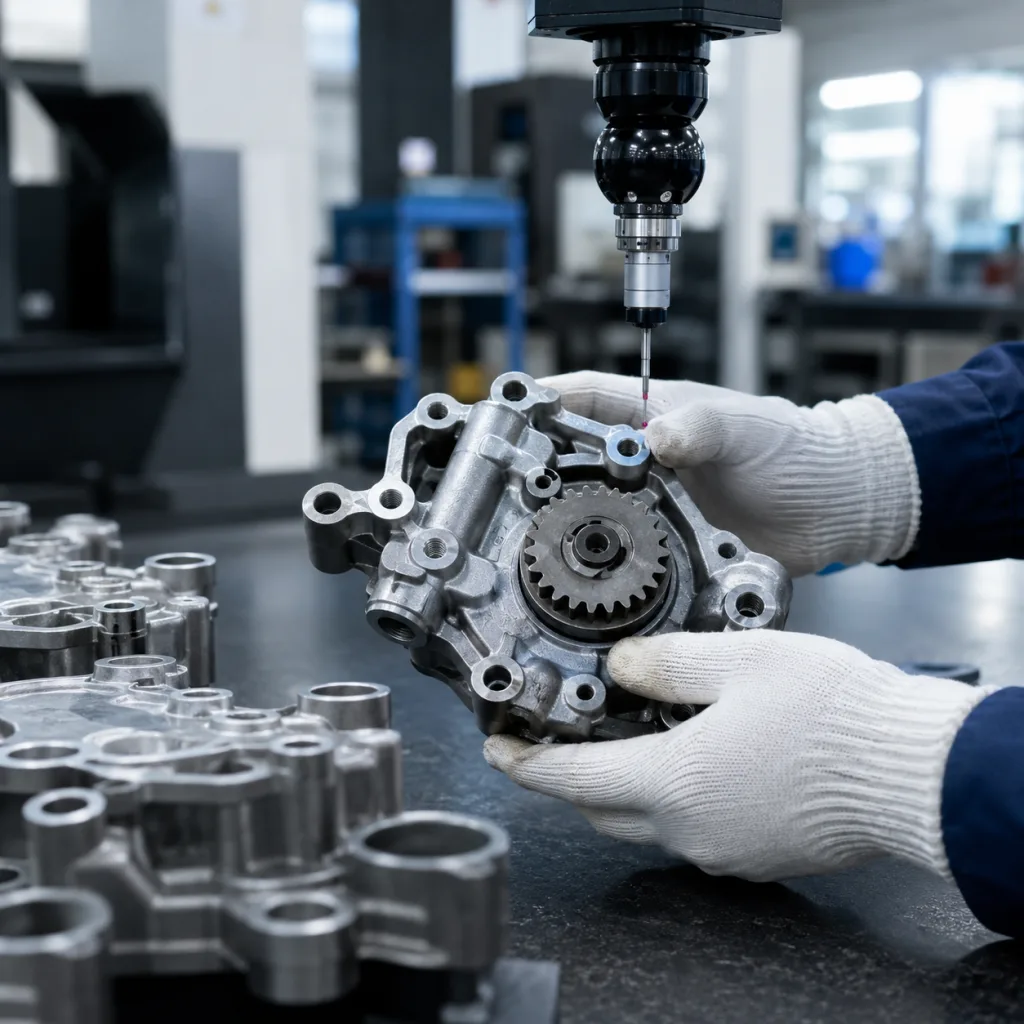
</tr></thead><tbody> </tbody></table>For many replacement applications, buyers choose aluminium because it better matches OE stiffness and sealing behaviour, especially when the housing bolts directly to the cylinder head or carries hose bending load. Aluminium is also straightforward to inspect dimensionally because sealing faces, threaded bosses, and thermostat bores can be machined after casting. Common procurement drawings specify functional flatness, bore concentricity, thread depth, and machined surface finish instead of relying on casting geometry alone.
Plastic housings are common where packaging, cost, and mass targets dominate. They can perform well when the compound, glass reinforcement, mould design, fastener strategy, and O-ring compression are engineered as one system. Problems usually appear when a polymer housing is treated as a simple cost-down substitute for aluminium without validating creep, heat ageing, clamp-load retention, and insert pull-out strength.
A practical sourcing decision starts with the installation environment. Parts near the exhaust side, turbocharger area, or cylinder head usually need higher heat margin and strong flange stability. Parts located in cooler zones, or designed with broad gasket support and lower mechanical load, may be suitable for reinforced polymer. In both cases, thermostat housing material should be selected against the operating profile, not by category preference alone.
What buyers should verify in the specification
A thermostat housing is only a simple part when the specification is complete. The drawing and purchase specification should define the functional surfaces that control sealing, assembly, coolant flow, and serviceability. Procurement teams should request the following data before approval:
Base alloy or polymer grade, including supplier-approved material code where available
Coolant contact compatibility with ethylene glycol and propylene glycol mixtures, typically 40-60% glycol in water
Maximum continuous operating temperature and expected short-term peak temperature at the housing location
Leak, burst, or proof-pressure test level for the assembled coolant path, with duration and allowable pressure drop
Flange flatness, gasket land width, surface finish, and allowable machining marks
Thread form, boss thickness, insert specification, thread engagement, and tightening torque limits
Sensor-port, bleed-port, bypass-port, thermostat-seat, and locating-feature dimensional tolerances
Hose-neck diameter, bead height, clamp zone width, roundness, and pull-off resistance
Traceability requirements for material batch, casting lot, moulding lot, tooling cavity, and inspection record
For aluminium housings, ask for porosity limits, minimum wall thickness, machining datum control, and leak-test method. Porosity close to the coolant path or threaded bosses can become a field leak even when the exterior casting looks acceptable. Buyers should also confirm whether sealing faces are machined in one setup, because datum variation can shift thermostat-seat position or create uneven gasket compression.
For polymer housings, ask for glass-fibre content, resin family, heat-deflection temperature, heat-ageing data, creep performance under clamp load, and moulding process controls. Weld lines, gate location, fibre orientation, moisture conditioning, and insert overmoulding quality can all influence performance. A polymer housing may pass initial fitment, then distort after extended exposure to coolant, bolt preload, and under-hood temperature.
If the design includes an integrated thermostat seat, bore tolerance matters as much as the external envelope. The thermostat must sit squarely, open without interference, and seal correctly against the seat. Where the housing includes a coolant temperature sensor, bleed screw, quick connector, or threaded plug, thread quality and sealing strategy should also be checked because these small interfaces often drive returns.
When comparing suppliers, insist on measurable acceptance criteria instead of broad claims such as “high quality” or “OE standard.” A useful specification defines dimensions, test pressure, test duration, temperature range, material grade, coating requirement, inspection frequency, sampling plan, and rejection limits. That detail gives buyer and supplier a shared basis for approval, production release, and dispute resolution.
Thermal, sealing, and corrosion trade-offs
The main difference between materials is not only temperature resistance. It is how each material behaves after repeated heat soak, cooldown, coolant exposure, pressure pulses, and bolt preload. Thermostat housing material must keep the gasket compressed, maintain thermostat alignment, and resist degradation while the engine cycles between cold start and operating temperature. Many modern coolant circuits operate around 90-110 °C, with local peaks above that depending on engine load, shutdown heat soak, and installation position.
Cast aluminium
Cast aluminium remains the preferred option when the part sits close to the cylinder head or exhaust-side heat. It resists deformation well, so gasket compression stays more stable over time. That matters in replacement channels because the vehicle mating surface may already have age, residue, corrosion staining, or minor damage. A rigid housing gives the installer a better chance of achieving an even seal.
The risk with aluminium is corrosion, especially if the alloy, coolant additive package, or coating system is weak. Coolant chemistry varies by market and vehicle age. Mixed, diluted, or depleted coolant can accelerate pitting, and galvanic interaction may occur where the housing mates with aluminium heads, steel fasteners, brass inserts, or other metal fittings. Buyers should confirm salt-spray results where exterior corrosion matters, coolant immersion results for internal surfaces, and coating adhesion if a protective finish is specified.
Reinforced polymer
Reinforced polymer can reduce weight and eliminate metal corrosion at the housing body. It also allows complex shapes, integrated clips, sensor bosses, quick-connect features, and routing details to be moulded efficiently. In high-volume programmes, this can reduce secondary machining and simplify assembly.
The main risk is long-term distortion at fastener ears, hose necks, thermostat seats, and sealing lands. Heat ageing can reduce toughness, while sustained clamp load can cause creep. Fibre orientation can also create directional strength: a housing may be strong along the flow direction but weaker around a weld line, knit line, or thin wall. For this reason, buyers should evaluate the exact moulded design, not only the polymer family listed in a material table.
Sealing behaviour
Sealing performance depends on the material, gasket design, bolt pattern, surface geometry, and assembly torque. Aluminium generally supports higher and more stable clamp load. Polymer designs often require wider gasket support, controlled fastener compression, metal sleeves, brass or steel inserts, or positive stops to prevent over-compression. If the part uses an O-ring, groove width, groove depth, compression rate, squeeze, and extrusion gap are critical. If it uses a flat gasket, flange flatness, surface finish, and bolt spacing become more important.
Practical trade-off
If the programme prioritises dimensional stability, heat margin, and easier OE-equivalent fitment, cast or die-cast aluminium is usually the safer option. If weight, moulding cost, corrosion resistance, and complex integration are more important, a validated polymer design can be appropriate. The final decision should follow validation data, installation position, warranty exposure, service temperature, coolant chemistry, and target market conditions, not material preference alone.
Standards and validation tests to request
Thermostat housing material should be validated with the same discipline used for other engine-cooling components. For export supply, published standards, customer-specific requirements, and repeatable test methods matter because they reduce dispute risk between buyer and supplier. They also help procurement teams compare quotations on a technical basis instead of relying only on unit price.
Relevant references include:
IATF 16949:2016 for automotive quality management, process control, traceability, and corrective action
ISO 9001:2015 for documented quality management where IATF scope is not required
REACH (EC) No 1907/2006 for chemical compliance in the EU
RoHS where the buyer or market requires restricted-substance declarations for supplied assemblies
SAE J2527 for accelerated outdoor weathering of exterior polymer surfaces and coatings, where applicable
ASTM B117 or ISO 9227 for neutral salt-spray testing of coated aluminium exterior surfaces, where specified
ECE R-83 only where coolant temperature control is part of an emissions-related homologated system or customer validation package
Typical validation requests include:
1. Pressure or leak testing of the assembled housing at a defined pressure, duration, temperature condition, and acceptance limit 2. Thermal cycling between cold soak and operating temperature to check leakage, distortion, and gasket compression loss 3. Coolant compatibility soak using defined ethylene glycol or propylene glycol mixtures and specified inhibitor chemistry 4. Dimensional inspection on critical datums, sealing faces, thermostat bores, ports, threads, and hose necks 5. Torque retention after heat ageing, especially around bolt ears, sleeves, and threaded inserts 6. Coating or corrosion resistance testing for aluminium parts, including coolant-side exposure where required 7. Burst or proof-pressure testing when the housing is used in a high-pressure cooling circuit 8. Vibration, hose-load, or pull-off evaluation where the connected hose creates bending force on the neck
For aluminium housings, validation should focus closely on casting quality and machining consistency. A supplier should be able to explain how porosity is controlled, whether vacuum assistance or impregnation is used, how leak testing is performed, and which dimensions are checked as critical-to-quality features. For polymer housings, the validation package should include compound identification, heat ageing, coolant soak, clamp-load performance, insert retention, and cavity-level moulding traceability where multiple cavities are used.
Buyers should also request production evidence, not only development evidence. First-sample results are useful, but ongoing supply needs incoming-material records, in-process inspection, final leak testing, batch traceability, and change-control records. If a supplier cannot provide test records, material declaration, and inspection reports, the part is not ready for controlled procurement.
Sourcing checklist for B2B buyers
Use a structured checklist before releasing a PO. This is especially important when one programme covers several engine codes, regional variants, superseded OE references, or mixed thermostat and housing assemblies.
Confirm OE cross-reference and application coverage, including model year, engine code, thermostat temperature, and sensor-port notes
Verify thermostat housing material grade, surface finish, and any coating or conversion-treatment requirement
Check flange flatness, gasket land, boss dimensions, hose-neck diameter, bead height, and sensor-port details
Review sample fitment on the target engine family, including hose routing, connector clearance, thermostat orientation, and access for tightening
Ask for PPAP-style documents or equivalent control records when the programme requires formal approval
Confirm leak-test pressure, test medium, inspection frequency, sampling plan, and acceptance criteria for production lots
Review packaging, labelling, corrosion protection, cavity or lot marking, and traceability requirements
Confirm lead time, MOQ, spare-tooling position, tooling ownership, and engineering change-control process
Check whether the thermostat, gasket, sensor, O-ring, bleed screw, hose connector, or fasteners are included or supplied separately
Compare warranty terms, return-analysis process, containment timing, and corrective-action response time
For broader cooling-system sourcing, see our catalog and our quality system. If you are consolidating multiple part numbers into one programme, our custom manufacturing team can support drawing review, tooling, and validation planning. For related engine products, you can also review engine components.
A practical buyer should compare total landed cost, not unit price alone. A lower-cost housing that leaks after thermal cycling creates far higher return, freight, workshop labour, claims handling, and reputation cost than a part with a slightly higher initial purchase price. The cost comparison should include inspection needs, packaging protection, corrosion protection, field-return rate, and the supplier’s ability to maintain the same thermostat housing material and process over repeat orders.
Where possible, approve the supplier against a pilot or pre-production lot rather than a single hand-selected sample. Inspect several pieces across different cavities or casting batches for flange flatness, port position, thread quality, surface finish, marking clarity, and packaging condition. Small variation in these areas often reveals whether the supplier can support distributor and repair-chain demand reliably.
How Driventus supports thermostat housing programmes
Driventus manufactures engine and powertrain components in Taizhou, Zhejiang, with export experience in more than 60 countries. For thermostat housings, we focus on dimensional repeatability, material traceability, pressure integrity, and controlled packaging to reduce transit damage, corrosion risk, and fitment disputes.
We support:
OE reference matching for fitment verification
Material selection for cast aluminium, die-cast aluminium, and reinforced polymer designs
Drawing review for flange, thermostat-seat, sensor-port, bleed-port, bypass-port, and hose-neck geometry
Batch traceability and inspection records linked to production lots
Pressure testing, dimensional checks, and production control documentation where required
Export packaging for distributor, e-commerce, fleet, and repair-chain networks
Private-label and drawing-based programmes where authorised by the buyer
Quotation support for single part numbers, range extensions, and consolidated sourcing programmes
When a buyer needs a new housing design or a revision to an existing assembly, we review the flange, gasket, hose connection, thermostat position, sensor interface, bleed feature, and fastener layout before tooling release. This helps identify risks such as weak bolt ears, insufficient hose-bead retention, difficult machining access, poor insert support, or gasket compression that is too sensitive to torque variation.
For existing aftermarket references, we can compare the requested thermostat housing material against application conditions and buyer requirements. For aluminium parts, that may include alloy, casting method, machining datum plan, leak testing, and coating review. For polymer parts, it may include compound selection, glass content, insert design, moulding controls, moisture conditioning, and heat-ageing expectations.
If you need documentation, testing alignment, or programme pricing, request a quote.
Frequently asked questions
No. Aluminium usually gives better stiffness, heat margin, and clamp-load stability, but validated reinforced polymer can be suitable when weight, corrosion resistance, and moulding integration are priorities. The better choice depends on engine location, coolant chemistry, bolt preload, temperature profile, hose load, and validation data.
Ask for material declaration, dimensional report, leak or pressure-test records, thermal cycling results, coolant compatibility evidence, traceability information, and quality system evidence such as IATF 16949:2016 or ISO 9001:2015.
Yes. We can build to OE reference dimensions and application data, but we do not claim vehicle-manufacturer approval. Driventus is an independent aftermarket manufacturer; brand names are referenced for fitment only.
If you are comparing thermostat housing material options for a current programme, send your drawing or OE reference for review. We can help with specification checks, sampling, and quotation through /contact.html