Sourcing a camshaft for Toyota Yaris OE equivalent use is less about finding a visually similar part and more about proving the shaft will behave like the original in the right engine, market, and duty cycle. For distributors, repair chains, and Tier-1 sourcing teams, the key questions are fitment, lobe geometry, material grade, heat treatment, surface finish, sensor features, oil-feed alignment, and repeatability across batches. Small deviations in base circle, lift, journal size, or runout can show up later as idle instability, noisy valve train operation, wear, emissions drift, or warranty claims.
Driventus manufactures engine and powertrain components in Taizhou, Zhejiang, and exports to more than 60 countries. Our camshaft supply process uses controlled drawings, incoming material checks, CNC turning and grinding, specified heat treatment, profile and dimensional inspection, and batch-level records. Buyers typically need drawing-based tolerances, first-article approval before bulk release, MOQ and packaging decisions by SKU, and lead-time planning that separates new development from repeat orders. Driventus is an independent aftermarket manufacturer; vehicle and brand names are referenced only to identify fitment.
OE-equivalent: what actually has to match
For a replacement camshaft, OE-equivalence means the component is engineered to match the relevant application in dimensions, material, and function. It does not mean approval, endorsement, or supply by Toyota or any vehicle manufacturer.
Before approving a camshaft for Toyota Yaris OE equivalent supply, buyers should lock down the engine code, displacement, fuel type, production year range, emission level, and regional application coverage. Intake or exhaust position matters too, especially where the engine uses separate shafts, VVT features, or different sensor layouts.
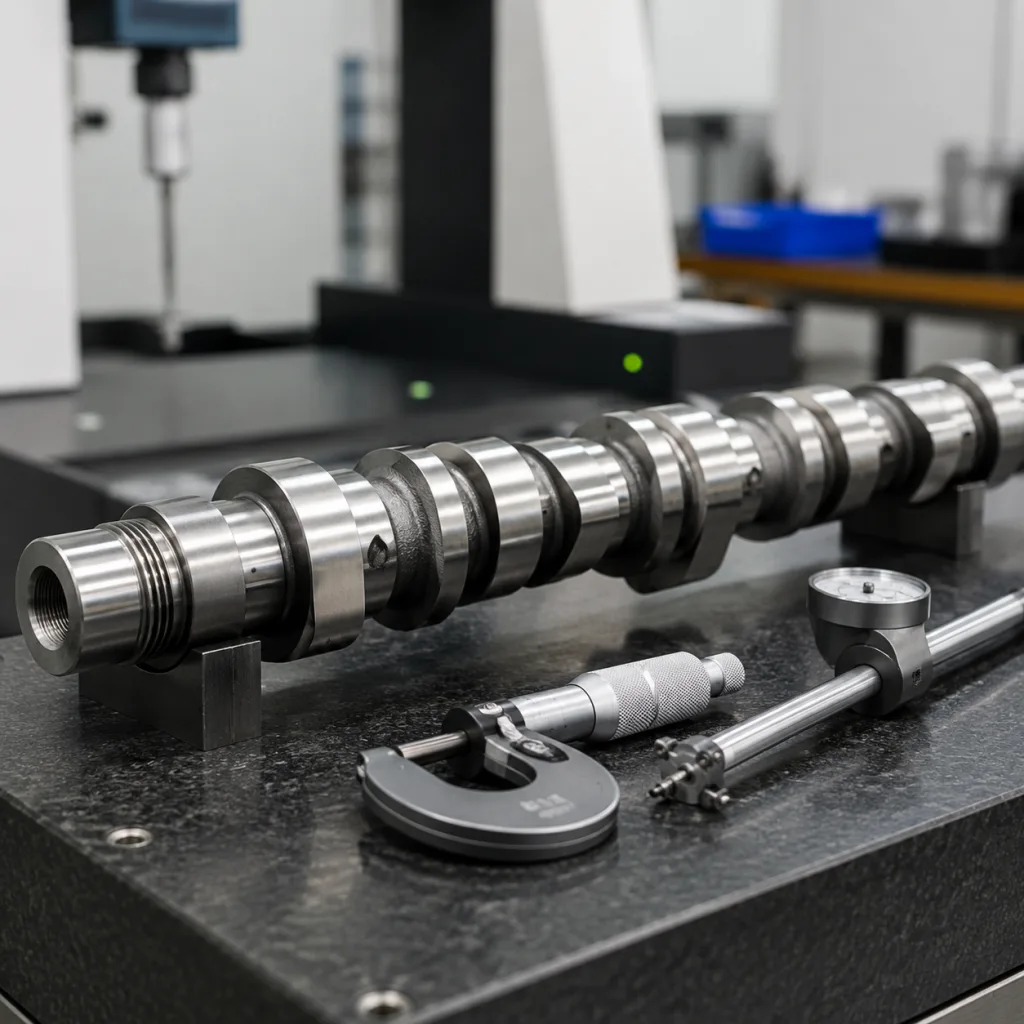
The sourcing file should also define measurable characteristics instead of relying on visual comparison. That usually includes lobe lift, base circle, journal diameter, thrust width, overall length, drive-end geometry, cam sensor trigger profile, angular position, oil-feed holes, keyway, gear interface, and thrust-control surfaces. Material grade, heat-treatment method, effective case depth where applicable, hardness range, surface finish, and corrosion protection belong in the same review.
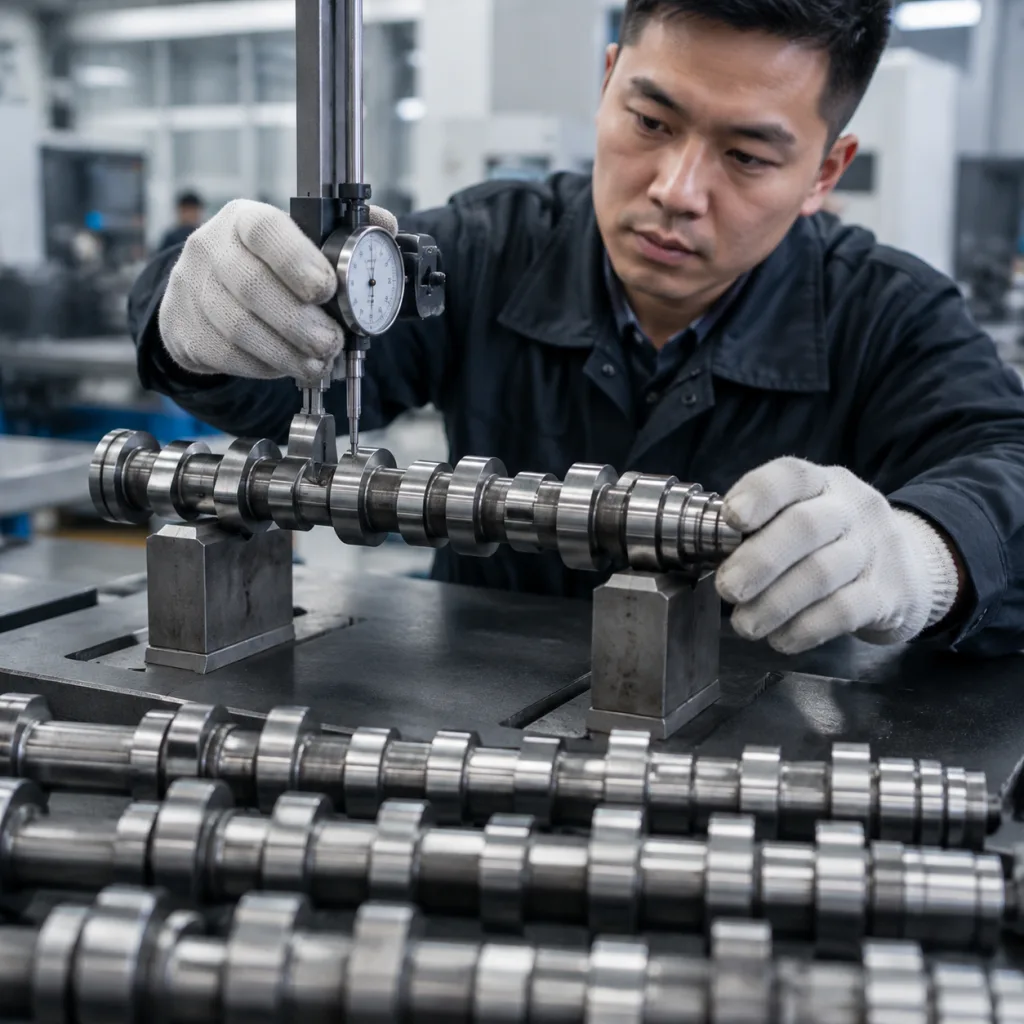
As a practical benchmark, buyers often control journal diameter in the 0.01-0.03 mm range where the drawing allows it, and total indicated runout below 0.03-0.05 mm depending on shaft length and engine design. Final values must follow the buyer drawing, OE sample data, or agreed inspection standard, not a generic catalogue claim.
Most camshaft claims do not start with obvious visual defects. They start with the wrong application data, incomplete traceability, or a process that looks acceptable on paper but drifts in production.
Check item
Typical buyer requirement
Procurement risk if missed
Journal diameter
Drawing-controlled tolerance, often checked to 0.001 mm instrument resolution
Low oil pressure at journals, seizure, noise, or rapid bearing wear
Lobe lift and base circle
Matched to OE valve-event geometry, commonly controlled within drawing tolerance of about ±0.02-0.05 mm
Power loss, unstable idle, emissions deviation, or valve-train noise
Runout
V-block or between-centres inspection, commonly specified below 0.03-0.05 mm TIR
Bearing wear, vibration, uneven loading, or abnormal follower contact
Surface roughness
Journals and lobes measured by profilometer; Ra targets commonly sit around 0.2-0.8 µm by surface function
Accelerated follower, bucket, or rocker wear
Hardness
Batch-tested after heat treatment against the specified range, with contact areas commonly validated in HRC or HV
Lobe scuffing, pitting, or premature wear
Cam sensor feature
Trigger tooth shape and angular position matched to approved sample or drawing
No-start condition, fault codes, or timing-correlation errors
Oil-feed and thrust details
Holes, grooves, shoulders, chamfers, and thrust faces matched to drawing
Poor lubrication, axial movement, or assembly interference
</tr></thead><tbody> </tbody></table>Material choice matters as much as geometry. Common aftermarket camshafts may use chilled cast iron, ductile iron, or forged steel, depending on load, follower type, lubrication regime, and OE construction. That choice should not be changed just to hit a lower cost; wear pairing, contact stress, oil quality, and expected service environment need to be reviewed first.
When comparing suppliers, ask for the proposed material grade, hardness method, heat-treatment route, lobe and journal roughness targets, and measuring equipment. A quotation that only says “OE quality” is not enough for a repair-chain or distributor programme.
Production controls that keep batches consistent
A credible OE-equivalent camshaft programme needs documented control from raw material release to final packing. Driventus operates under IATF 16949:2016 and ISO 9001:2015 quality management frameworks, with process records used to support batch approval and repeat supply. For customers in regulated import markets, documentation can also support material declarations aligned with REACH (EC) No 1907/2006 where applicable.
Typical control points include:
Raw material certificate review, incoming inspection, and batch identification before machining release.
Casting or forging visual inspection for cracks, porosity, deformation, surface defects, and excess stock condition.
CNC turning, milling, drilling, and grinding with in-process checks at defined operation gates.
Heat-treatment monitoring, furnace chart review where applicable, and hardness testing by batch.
Cam-lobe profile measurement against drawing data or approved master sample data.
Deburring, ultrasonic or solvent-based cleaning where specified, anti-corrosion treatment, and protection of machined surfaces.
Final visual inspection, packing verification, label check, pallet marking, and shipment documentation.
A useful first-article package includes dimensional report, material certificate, hardness report, roughness readings, profile comparison, photos of critical features, and packaging approval photos. For serial production, buyers can define AQL sampling, such as critical dimensions checked every batch and appearance or packaging checked by lot. High-risk features such as sensor trigger position, oil-feed holes, and thrust width should be treated as critical-to-function characteristics, not simple appearance items.
Our quality system is built for repeat supply rather than one-off trading. That matters for distributors and repair networks because claims often appear months after delivery, when traceability, retained inspection records, and clear batch identification are needed for technical review.
Catalog control for Yaris fitment
For Yaris applications, catalogue accuracy is as important as machining accuracy. A replacement camshaft can vary by engine family, production year, market, emission configuration, cam position, and sensor arrangement. Buyers should not rely on model name alone, because one vehicle nameplate can cover multiple engine generations and regional specifications.
A practical sourcing file should include:
Vehicle model, year range, displacement, fuel type, engine code, power output where available, and market region.
Intake or exhaust position, quantity per engine, and whether the shaft works with VVT, cam sensor, or specific drive components.
Buyer-verified OE part-number cross-reference, using the correct format only when it applies to the sourcing file.
Interchange references from existing distributor catalogues, TecDoc-style data, ERP records, and e-commerce listings.
Sample photos showing sensor trigger, oil-feed holes, thrust surfaces, drive end, casting or forging marks, and overall shaft layout.
Drawing revision, sample status, inspection report, approval date, and any blocked applications.
Packaging label requirements, carton quantity, pallet layout, barcode format, country-of-origin marking, and language requirements.
Before bulk supply, freeze one approved cross-reference sheet per SKU. Any later change to engine code coverage, OE number, production year, or market region should be treated as a catalogue revision with version number and approval date. That prevents a correct part from being sold into the wrong Yaris application after a distributor imports data from several sources.
Driventus can review customer drawings, samples, and application lists through custom manufacturing. For replacement programmes, first articles should be validated against both a physical sample and the buyer’s application data before bulk shipment, then the approved cross-reference file should be locked to avoid catalogue drift during reorders.
Commercial decisions that affect profit and claims
Replacement camshafts are often slow-to-medium rotation parts in aftermarket channels, but they carry high claim cost when fitment, surface quality, or documentation is wrong. A sourcing decision should therefore balance unit price with application accuracy, inspection discipline, batch consistency, and logistics reliability.
Procurement teams should define the following before price comparison:
Annual forecast by SKU, destination, and expected order frequency.
MOQ by finished part number, packaging type, private-label format, and mixed-SKU consolidation plan.
Target price logic by volume tier, such as sample order, trial order, 100-300 pcs, 300-500 pcs, and 500+ pcs where demand supports it.
Neutral packaging, customer-brand packaging, bulk service packaging, or mixed packaging requirements.
Inspection documents, material certificates, and shipment records required with each order.
Lead time for first order, repeat order, and urgent replenishment.
Warranty handling process, including installation evidence, oil condition, mileage, fault codes, and returned parts needed for technical review.
Consolidation options with other engine components to improve freight efficiency.
MOQ and price should be evaluated together. A low unit price can become expensive if it requires a full production batch for a slow-moving SKU, special carton colors, separate label stock, or non-standard palletisation. A better planning model splits tooling or development cost, first-article cost, unit price, packaging cost, inspection documentation cost, and freight allocation instead of comparing only EXW unit price.
Lead-time logic also differs between new and repeat items. New development may require sample confirmation and first-article inspection before bulk production, while repeat orders can move faster when material, fixtures, drawings, packaging artwork, and inspection plans are already approved. For planning, distributors often reserve longer lead time for first orders and keep reorder points based on sea-freight transit, customs clearance, and one to two months of safety stock for slower engine SKUs.
For multi-location repair chains, consistent fitment data and carton labelling reduce workshop delays. For wholesalers, stable cross-reference management lowers return rates caused by incorrect application selection. For Tier-1 and programme buyers, PPAP-style documentation can be discussed where the scope justifies it, without implying vehicle manufacturer approval.
How to qualify the supplier before release
A supplier audit should focus on process capability, not only product appearance. Clean grinding marks and attractive packaging do not prove that lobe timing, hardness, journal geometry, and traceability are controlled over time.
Use this qualification checklist:
Confirm IATF 16949:2016 and ISO 9001:2015 certificate scope, validity, issuing body, and relevance to the manufacturing site.
Request a drawing-based first-article inspection report, including profile, journal diameter, runout, overall length, thrust dimensions, and sensor feature position.
Check whether hardness testing covers the specified lobes, journals, or contact surfaces, and whether the method is suitable for the material.
Review how material batches, machining lots, heat-treatment lots, grinding lots, inspection records, and packing lots are linked.
Confirm gauge calibration status for micrometers, height gauges, roughness testers, hardness testers, and profile measuring equipment.
Test packaging under vibration, humidity, drop, stacking, or long-distance transport conditions when required by the channel.
Ask how nonconforming parts are isolated, corrected, re-inspected, and prevented from entering future shipments.
Confirm whether the supplier can support mixed engine component shipments to reduce freight cost and administration.
A useful audit request is one anonymised batch record from raw material intake through packing. The file should show material certificate, process route, heat-treatment record where applicable, inspection results, nonconformance handling if any, packing list, and traceability code. That gives buyers a realistic view of how a supplier controls repeat production rather than only how it prepares showroom samples.
Driventus is a vertically integrated Chinese manufacturer of pistons, crankshafts, gaskets, water pumps, turbochargers, and other engine components. For buyers sourcing a camshaft for Toyota Yaris OE equivalent replacement line, that wider powertrain base can simplify supplier consolidation while keeping technical review focused on the individual camshaft specification.
Frequently asked questions
No. OE-equivalent means the aftermarket part is engineered to match the relevant dimensions, material requirements, and function for the application. It does not mean approval, endorsement, or supply by Toyota or any vehicle manufacturer.
The best package includes a new or low-wear physical sample, buyer-verified fitment list, engine code, intake or exhaust position, and any available drawings. Photos of sensor features, oil holes, thrust faces, drive-end details, and casting or forging marks help reduce development risk.
Yes. Driventus can support neutral packaging, customer-brand packaging, barcode labels, export carton specifications, and pallet requirements after artwork, label data, MOQ, and compliance details are confirmed by the buyer.
For application review, drawings, samples, MOQ, price tier, and lead-time discussion, please [request a quote](/contact.html).