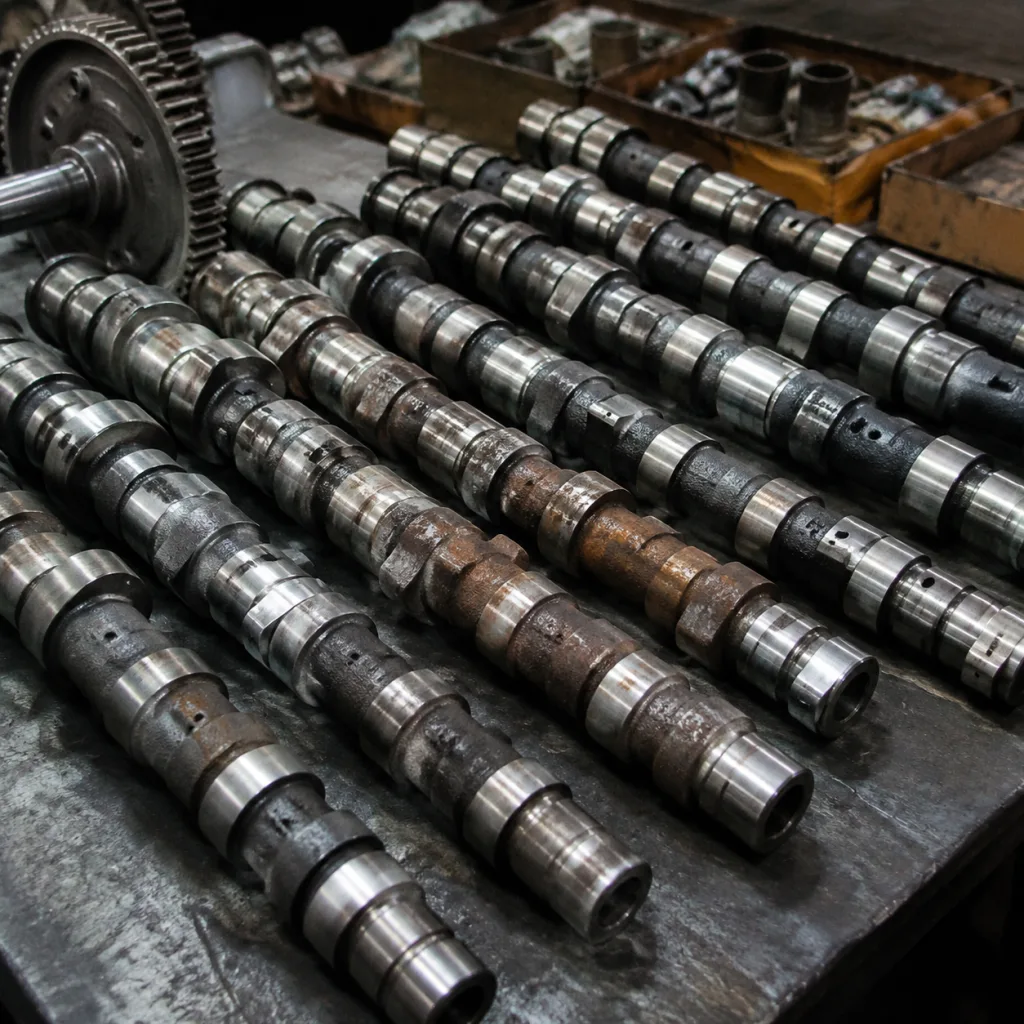
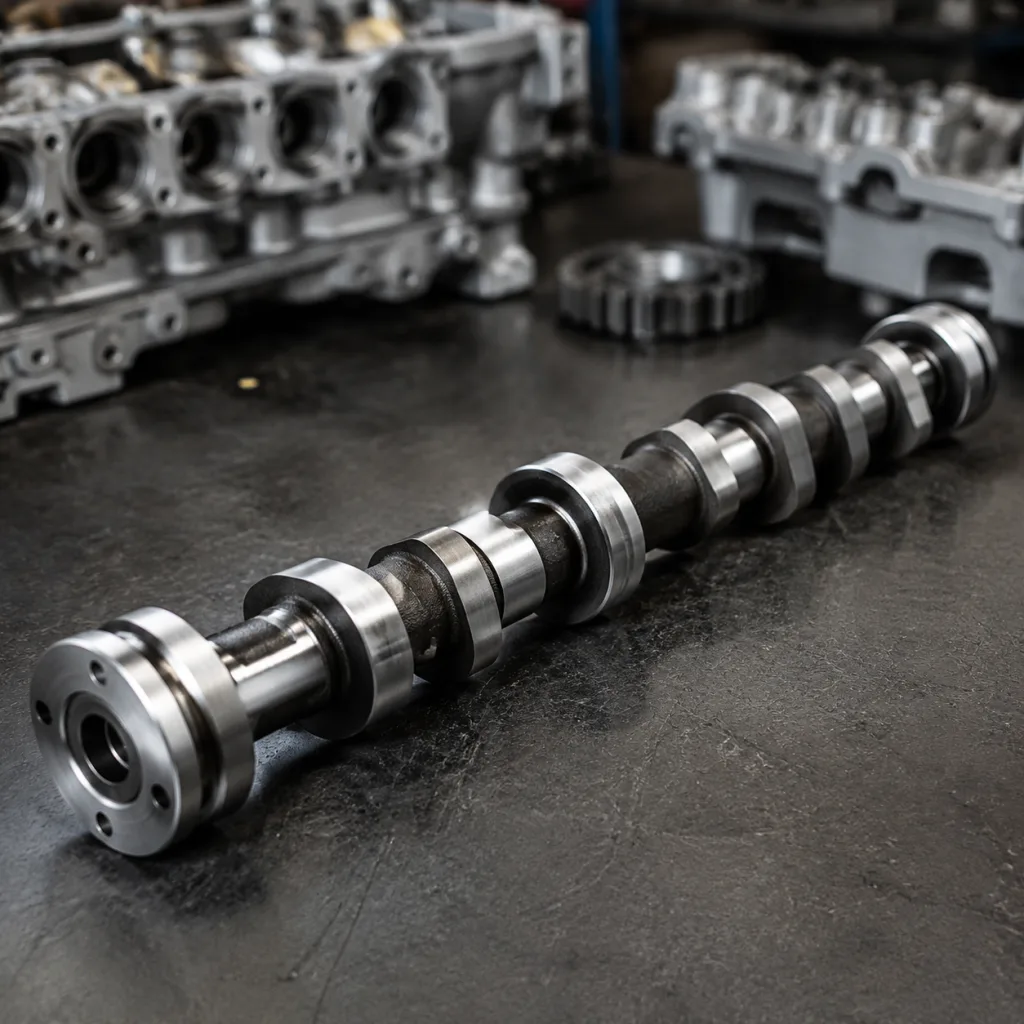
Camshaft for Toyota Land Cruiser OE Equivalent Validation Guide
When buyers source a camshaft for Toyota Land Cruiser OE equivalent replacement programmes, OE-equivalent needs to mean controlled conformity to the target engine specification, not simply basic fitment. Toyota Land Cruiser applications cover multiple generations, engine codes, regional configurations and valve-train layouts. A programme may involve an inline-six diesel, a petrol V8 or a diesel V8, each with different journal layouts, lobe maps, timing interfaces, trigger features and, in some cases, phaser-related details. A shaft that physically installs in one engine family can still be wrong in phase angle, base circle, oil-hole orientation or hardness pattern for another.
That distinction matters even more in fleets, wholesale programmes, importer networks and multi-branch repair groups, where consistency from shipment to shipment matters far more than a single successful installation. A camshaft can look correct in the workshop and still cause field failures later through accelerated lobe wear, abnormal valve-train noise, unstable idle, diagnostic faults or inconsistent timing behaviour.
This guide outlines what procurement teams should verify when evaluating camshaft for Toyota Land Cruiser OE equivalent supply, how OE-equivalence is validated in production, which documents to request from a manufacturer, and how to distinguish a production-ready part from a nominal interchange item. Driventus is an independent aftermarket manufacturer; vehicle and OE references are used for fitment identification only.
What OE-equivalent means for a Land Cruiser camshaft
In aftermarket sourcing, OE-equivalent does not mean vehicle maker approval or licensing. It means the replacement camshaft is engineered to match the intended OE drawing or an approved master sample within defined dimensional, metallurgical and performance limits, and that the supplier can demonstrate those limits are controlled in serial production.
That definition matters with Toyota Land Cruiser applications because the nameplate covers very different engine families. Programmes may involve engines such as 1HZ or 1HD-series inline diesels, 2UZ-FE petrol V8 applications, or 1VD-FTV diesel V8 programmes. Cam count, journal arrangement, thrust control, trigger features and timing-drive interfaces differ across these families. On V engines, intake and exhaust shafts, as well as left and right bank parts, are not interchangeable just because they appear similar.
A practical OE-equivalent review is best approached in three layers:
Application identity: exact engine code, production range, market or emissions variant, intake or exhaust position, and left or right bank where applicable
Technical match: geometry, material, heat treatment, surface condition and interface features match the target specification
Process repeatability: the same conformity is maintained lot after lot through documented process control and traceability
For a camshaft, the key engineering checkpoints are usually:
Base material: commonly pearlitic chilled cast iron for many cast-cam applications, or forged/alloy steel with induction hardening for higher contact loads or specific design requirements
Lobe profile, not lift alone: opening ramp, closing ramp, base circle, nose radius and acceleration rate all influence valve-event timing, tappet loading and noise
Lobe phasing and centerline accuracy: phase error is often controlled within about +/-0.5 to +/-1.0 deg cam angle on production parts, because even small angular errors can affect idle quality, emissions behaviour and calibration margins
Journal diameter and form: typical production controls are in the +/-0.010 to +/-0.020 mm range on diameter, with roundness/cylindricity often held to <=0.005-0.010 mm depending on print
Runout and concentricity: total indicated runout is commonly controlled around <=0.02-0.04 mm, depending on shaft length and support span
Thrust faces and axial geometry: face width, perpendicularity and overall length govern end-float and correct location in the head or carrier
Surface hardness and effective hardened depth: lobe and journal working zones are commonly in the 50-62 HRC range, with effective hardening depth often around 0.8-2.5 mm depending on material and process
Surface roughness: finish-ground lobes and journals are often held around Ra 0.2-0.4 um to support oil film formation and controlled break-in
Timing interface geometry: keyways, dowel holes, sprocket seats, phaser seats, gear fits and trigger relationships must match the intended timing system
Oil feed holes and lubrication features: location, chamfering and burr control matter because debris or misorientation can reduce oil delivery at start-up
Part marking and revision identification: lot/date code, part number and revision status are needed for warehouse segregation and field containment
*These figures are typical control windows seen on OES and aftermarket camshaft programmes; the approved application drawing or retained master sample always governs acceptance.*
A camshaft can be visually convincing and still fail in service if the lobe flank shape, phase angle, hardened depth or journal finish drifts outside target. That is why buyers should ask for measured inspection data and process evidence rather than relying on fitment claims alone.
Critical specifications buyers should verify
For Toyota Land Cruiser engine applications, the validation package should cover application definition, geometry, metallurgy, finish and traceability. The exact numeric values vary by engine code and cam position, but the control categories stay broadly the same.
Before requesting inspection data, lock the application first. Procurement teams should confirm:
engine code and displacement
model year, VIN breakpoint or production range
market or emissions variant where relevant
intake or exhaust designation
left or right bank on V-engine applications
existing OE, customer or warehouse reference number used internally
whether the requirement is for new manufacture or remanufactured supply
Once the application is fixed, the following characteristics should normally be reviewed:
Control item
Typical OE-equivalent control expectation*
Why it matters
Typical verification method
Lobe lift at controlled datum angles
Match drawing or approved master, often within +/-0.02-0.05 mm
Direct effect on valve opening and breathing
CMM or dedicated cam profile measurement
Lobe profile shape and ramp form
Overlay deviation commonly held within about +/-0.02-0.03 mm over controlled sectors
Controls opening and closing behaviour, noise and contact stress
Cam analyzer, profile tracer or approved master comparison
Lobe separation and phasing
Often within +/-0.5 deg cam angle, sometimes tighter on sensor-critical programmes
Affects timing, combustion stability and drivability
Angular inspection fixture or CMM
Journal diameter
Within print, often +/-0.01-0.02 mm
Determines bearing fit and oil clearance
Micrometer or air gauge
Journal roundness/cylindricity
Commonly <=0.005-0.010 mm
Prevents localized loading and unstable oil film
Roundness tester or precision gauge review
Total indicated runout
Commonly <=0.02-0.04 mm depending on length and support span
Rotational accuracy and timing stability
V-block and dial indicator or dedicated fixture
Thrust surface and overall length
Per print, often checked to +/-0.02-0.05 mm on critical faces
Controls axial location and end-float
Height gauge, CMM or fixture
Gear seat, keyway, dowel or phaser interface geometry
Positional tolerance often within 0.03-0.05 mm or angular equivalent
Ensures correct timing-drive installation
CMM, plug gauge or dedicated fixture
Surface hardness
Functional zones commonly 50-62 HRC or equivalent HV
Wear resistance at lobes and journals
Rockwell or Vickers hardness test
Effective hardened depth
Commonly 0.8-2.5 mm depending on design
Fatigue and wear life under repeated contact stress
Metallographic section check
Surface finish
Journals and lobes often around Ra 0.2-0.4 um
Lubrication retention and scuff control
Profilometer
Material composition
Approved chemistry band for the specified cast iron or alloy steel family
Mechanical integrity and heat-treatment response
Spectrometer or mill certificate review
Marking and lot identification
Must link part to batch, inspection and heat-treatment records
Supports field traceability and stock control
Visual check and ERP traceability review
</tr></thead><tbody> </tbody></table>*The figures above are illustrative control windows commonly used on OES/aftermarket programmes. The approved Toyota Land Cruiser application drawing, signed sample or customer specification is the acceptance standard.*
Recommended document pack
A capable supplier should be able to provide a document set that supports both technical review and routine purchasing control. Typical requirements include:
Dimensional inspection report for critical characteristics such as lift, phase, journals, runout and interface geometry
Lobe-profile report or overlay showing how the sample compares to the approved master or drawing
Material certificate or verified chemistry report showing the raw material grade or approved material family
Heat-treatment method statement or process confirmation identifying chilled-cast, induction-hardening or equivalent route
Hardness map by batch, with test locations defined on lobes, journals or other functional zones
Microstructure or hardened-depth evidence from a metallographic section when wear life is a major concern
Control plan or critical-characteristic list showing which dimensions are batch checked, setup checked or 100% checked
Traceability method showing how lot, date code or batch code is marked on the part, inner box and outer carton
Packaging and preservation specification covering VCI paper/oil, end protection, separators and storage condition
Change-control statement defining how the supplier handles tooling, material, subcontractor or process changes
Sample approval record for projects where the first shipment must match a signed reference sample
For higher-volume programmes, buyers often request a first-article package or PPAP-style documentation even in the independent aftermarket. That does not mean every order needs full OEM paperwork. It does mean the supplier should be able to show which characteristics are controlled, how often they are checked, which gauges are used and what reaction plan applies when a result falls out of limit.
If the part is sold into the EU or UK aftermarket, procurement teams may also ask for declarations related to REACH (EC) No 1907/2006 substance compliance for relevant materials, coatings and corrosion-protection products. REACH is not a performance standard, but it is part of routine import and customer-compliance review.
How OE-equivalence is validated in production
A replacement camshaft should go through far more than a final visual inspection. In a controlled manufacturing environment, OE-equivalence is built through incoming material checks, machining control, heat-treatment verification, profile grinding discipline, measurement-system capability and final metrology.
At system level, buyers should look for suppliers operating under IATF 16949:2016 and ISO 9001:2015, or at minimum using equivalent documented quality practices. These standards do not certify a single part as equivalent, but they do show that the manufacturer works within a structured framework for traceability, revision control, calibration, nonconformance handling and corrective action.
A robust production validation route usually includes:
Raw material verification against internal specification, including chemistry review, incoming identification control and certificate matching
Blank or preform inspection to confirm casting or forging condition before machining begins, with crack-risk screening such as magnetic particle inspection where the product or process warrants it
Rough machining control to establish stable datums before hardening and finish operations
Heat-treatment monitoring using locked process parameters such as induction frequency, power, scan speed, quench flow or chilled-cast acceptance criteria, so hardness consistency is not left to operator judgement
Intermediate inspection after operations that can introduce distortion or dimensional drift
Finish grinding of lobes and journals with defined wheel-dressing intervals, stock-removal control and profile verification to achieve final lift, form and concentricity without grinding through the hardened layer
Final inspection of critical-to-function characteristics such as lift, phase, journals, runout, interface geometry and marking
Measurement-system validation so the supplier can show gauge capability; on mature programmes, buyers often expect MSA discipline and gauge R&R results that are suitable for the tolerance being controlled
Batch retention and traceability so suspect lots can be isolated by material batch, heat-treatment batch, grinding batch and shipment date if a field issue appears later
Packaging verification to make sure corrosion protection and physical protection match the shipping route, storage period and redistribution model
The stronger suppliers back this up with calibrated masters, defined inspection frequency and a clear reaction plan when a measurement falls outside limit. That matters because many camshaft problems are not random. They usually come from drift in grinding wheels, heat-treatment variation, fixture wear or weak control of outsourced processes.
For higher-volume programmes, some buyers also request comparative validation against a retained reference sample. That may include:
profile comparison against an approved master
hardness mapping at multiple locations such as lobe nose, flank and journal
metallographic review of hardened depth and microstructure
fit confirmation in a mating head, bearing carrier or assembly fixture
limited bench or dyno-related evaluation where programme value justifies it
capability review on critical features, often targeting stable serial production indices such as Cpk >= 1.33 or a buyer-approved containment alternative
Change management is another essential part of OE-equivalence. A supplier should be able to state clearly whether tooling revisions, raw-material source changes, subcontract heat-treatment changes, grinder changes or process relocation would trigger reapproval. Without that discipline, a part can match the initial sample and still drift later without the buyer being informed.
Common sourcing risks with low-control replacement camshafts
The most common failures in replacement camshaft programmes are not always immediate breakages. More often, the first signs are early wear, abnormal valve-train noise, unstable timing behaviour, poor idle quality, sensor-related faults or inconsistent installation results across batches. For distributors, those issues are expensive because they create warranty administration, branch-level troubleshooting and reputational damage long before a formal root cause is confirmed.
Frequent risk points
Incorrect application consolidation: one catalogue part is assigned across too many engine variants, even when journal layout, phase relationship, trigger features or cam position differ
Intake/exhaust or bank mix-up: the part number may be close, but lobe order, thrust arrangement or timing interface can be different between positions
Incorrect lobe geometry: the shaft may physically install but still alter valve events enough to affect running quality, emissions margin or durability
Low or uneven hardness: rapid lobe or journal wear can occur even if the base material family is nominally correct
Insufficient hardened depth: the surface may pass an initial hardness check but lose durability after a short service period under repeated contact stress
Excessive stock removal after hardening: an aggressive final grind can reduce the effective hardened layer below design intent
Poor journal finish or form: rough grinding marks, taper or out-of-round journals can increase scuffing risk and destabilise oil film at start-up
Runout outside limit: abnormal bearing loading, valve-train noise and timing variation can appear despite apparent fitment success
Timing-interface errors: keyway, dowel, reluctor or phaser-seat mislocation can create timing offset, installation issues or diagnostic problems
Undeclared reground or repaired cores: remanufactured shafts sold as new can change base-circle geometry, repair history or material condition if process disclosure is weak
Weak control of outsourced processes: heat treatment, grinding or coating drift can create batch-to-batch inconsistency if subcontractors are not tightly managed
Mixed new and reworked stock: if segregation is weak, a buyer may receive parts from different process states under one label
Weak packaging protection: corrosion, end damage and impact marking can occur during sea freight or long warehouse storage
Poor traceability: when a problem appears in the field, the supplier cannot isolate the affected lot quickly enough to protect ongoing shipments
There is also a commercial risk in inconsistent interchange data. A part may be marketed as compatible with Toyota Land Cruiser in broad terms, while still being unsuitable for the exact engine code, production range, cam position or regional variant in your market. That is why application review should combine drawing control, sample validation and disciplined cross-reference management.
Another weak point is overreliance on goods-receipt inspection. Buyers can catch obvious transit damage, coating defects or marking errors at arrival, but they usually cannot confirm lobe-profile accuracy, hardened depth, journal roundness or process stability through warehouse checks alone. Those characteristics have to be controlled at source.
Where a standard catalogue part does not fully match your target-market requirement, a supplier with custom manufacturing capability can adjust inspection plans, marking, packaging and batch controls for your programme. In most cases, that is safer than forcing a broad-coverage aftermarket part into a controlled fleet, importer or wholesale replacement channel.
What procurement teams should ask before placing an order
For replacement demand, the supplier discussion should move beyond price very quickly. A disciplined RFQ checklist helps reduce warranty exposure, improves confidence in fill rate and shows whether the supplier actually understands the part or is simply repeating catalogue language.
Practical RFQ checklist
1. What exact engine code, displacement, production range and market variant does the camshaft cover? 2. Is the part for intake or exhaust duty, and if relevant, for left bank or right bank? 3. Is the product newly manufactured or remanufactured, and if remanufactured, what core-control and repair process is used? 4. Which OE or buyer reference numbers are being matched, and what engineering basis was used to confirm that mapping? 5. What is the base material, and is the shaft chilled cast, induction hardened or processed by another defined route? 6. What numeric limits are applied to critical characteristics such as lift, phase angle, journal diameter, runout, surface roughness, hardness and hardened depth? 7. Which dimensions are classified as critical-to-function in the control plan, and which of them are 100% checked versus batch checked? 8. Is lobe profile checked by CMM, dedicated cam analyzer, fixture or approved master-sample comparison? 9. What runout limit is applied in final inspection, and at what inspection frequency? 10. Are material certificates, hardness reports, profile records and dimensional reports available by lot, by initial sample only, or on every batch request? 11. How is lot traceability marked on the part, the inner packaging and the outer carton, and can that lot code be linked back to heat-treatment and inspection records? 12. What corrosion protection is used for sea freight, long storage and humid warehouse conditions: preservative oil, VCI paper, sealed bag, end caps or a defined combination? 13. What is the process for engineering-change notification, deviation approval, replacement, containment and corrective action if a field issue occurs? 14. What are the normal lead time, MOQ, annual capacity, reorder planning assumptions and private-label documentation options?
These questions are useful because they test three things at once: application clarity, manufacturing control and commercial discipline. When the answers stay vague, the technical and warranty risk is usually higher than the quoted price suggests.
For importers and repair chains, packaging quality is often underestimated. Camshafts are long, precision-ground components, and they are vulnerable to corrosion, nicking and edge damage. Individual rust prevention, end protection, internal separation, rigid cartons and clear external lot labels matter, especially for mixed-container shipments or regional redistribution after import. Asking for photos of the packed product, label format and pallet configuration before release is a sensible step.
Driventus manufactures engine and powertrain components for export programmes and supports aftermarket and project-based supply requirements. Relevant product categories are also available under /products/engine-components.html.
Choosing a manufacturer for long-term replacement supply
A reliable camshaft source should be assessed on three levels: part conformity, process control and supply continuity. Price alone does not tell you whether the supplier can hold profile consistency across batches, protect the product in export transit or maintain delivery performance across repeated reorder cycles.
Buyers should look for:
Documented inspection standards for camshaft geometry, hardness, finish, interface features and traceability
Real metrology capability such as cam profile measurement equipment, roundness testing, surface-roughness testing, hardness testing and calibrated angular fixtures or CMM support
Stable machining and grinding capability for repeatable journal accuracy, lobe form and phase relationship
Controlled subcontract processes if heat treatment, coating or specialist inspection is outsourced
Application-control discipline so cross-references are linked to the correct engine code, cam position and bank
Serial-production quality methods including retained masters, reaction plans, lot containment and engineering-change notification
Export packaging suited to long transit and warehouse storage rather than local short-haul delivery only
Clear response procedures for deviation, quarantine and corrective action if field issues are reported
Capacity to support private label, batch coding and tailored documentation for importer, distributor or fleet programmes
Commercial reliability in lead times, replenishment planning, OTIF performance and communication when demand changes
In practice, the best long-term suppliers are not simply factories that can machine a correct shaft once. They are partners that can lock the approved specification, keep the process stable, notify the buyer before relevant changes and provide usable evidence when technical questions arise.
For B2B programmes, the goal is not just to source a replacement that fits. It is to secure a repeatable product with measurable conformity, predictable lead times and manageable field risk. That is the real standard buyers should apply when evaluating a camshaft for Toyota Land Cruiser OE equivalent supply.
A sensible approval path is usually:
1. confirm engine code, cam position and reference mapping 2. review drawing, retained sample or CTQ list 3. approve a sample with dimensional, profile, hardness and material evidence 4. confirm marking, packaging and traceability format 5. release a pilot lot before full-volume orders
If you are comparing manufacturers for a camshaft for Toyota Land Cruiser OE equivalent programme, send the target engine code, required volumes and any existing inspection points so the technical review can start before quotation. You can request a quote for a review of drawings, samples or cross-reference data.
Frequently asked questions
Request a dimensional report covering lift, phase, journal diameter, journal form, runout and timing-interface geometry, together with a lobe-profile report or master-sample comparison. You should also ask for material certification, hardness results, hardened-depth or microstructure evidence where relevant, lot-traceability details, packaging specification and a change-control statement. For recurring volume programmes, it is reasonable to request a first-article or PPAP-style package and a summary of the supplier's control plan.
No. OE-equivalent means the replacement part is intended to match the original specification in fit, material and performance-related characteristics within controlled limits. It does not mean endorsement, licensing or approval by the vehicle manufacturer.
Runout affects rotational stability, bearing loading and timing consistency. If it is outside tolerance, the engine may show abnormal wear, noise or reduced service life even when the part appears to fit during installation. On many production camshaft programmes, buyers expect final runout control in a range such as <=0.02-0.04 mm TIR depending on shaft length and design, with the application print or approved sample setting the true limit.
If you need a technical review for a camshaft for Toyota Land Cruiser OE equivalent replacement programme, send the engine code, cam position, bank designation, target volume and documentation requirements. Contact our team here: /contact.html