Camshaft for Ford Focus Aftermarket Replacement Guide
Buying a camshaft for Ford Focus aftermarket replacement is not a catalogue exercise. The part must match the engine code, valve-train layout, intake or exhaust position, sensor trigger design, journal dimensions, lubrication route, and timing interface of the original application. Small errors matter: 0.02 mm on a journal, 0.05 mm on lobe lift, 1° on cam phase, or a shifted oil feed can lead to valve-train noise, cam/crank correlation faults, follower wear, poor installer confidence, and warranty returns.
Driventus manufactures and supplies engine components for B2B aftermarket and OE-service channels, including camshafts, pistons, crankshafts, gaskets, and water pumps. This guide approaches Ford Focus replacement camshaft sourcing from six buyer angles: fitment decisions, dimensional failure risks, material and surface requirements, validation steps, procurement trade-offs, and warranty control. The focus is OE-equivalent function, measurable inspection, export-ready packaging, batch traceability, realistic MOQ and lead-time planning, and cleaner claim handling. Driventus is an independent aftermarket manufacturer; vehicle brand names and OE references are used only to identify fitment compatibility.
Decision Framework: Lock the Exact Focus Application Before Price Talks
Ford Focus camshaft sourcing starts with scope control. The name “Ford Focus 1.6” is not a safe purchasing description. Focus applications vary by generation, engine family, region, production year, fuel type, valve count, timing drive, camshaft position, and variable valve timing design. Two parts may look close on a bench and still be wrong in the cylinder head.
For importers and programme managers, the practical rule is simple: do not approve tooling, samples, or bulk stock until the application is locked by engine code, OE or confirmed aftermarket reference, cylinder-head layout, and a physical sample or drawing where possible. OE-equivalence means the replacement camshaft is functionally interchangeable with the original geometry, installation points, and operating characteristics for the confirmed application. It does not mean approval, sponsorship, or endorsement by the vehicle manufacturer.
Use these fitment decisions before issuing a purchase order:
Engine family and displacement, such as 1.6L, 1.8L, and 2.0L petrol or diesel variants where applicable
Fuel type and regional market, because emissions and engine-management variants can affect camshaft details
Intake versus exhaust position; these are normally not interchangeable even when length appears similar
Cylinder-head and valve-count configuration, including 8V, 16V, and twin-cam layouts
Fixed timing versus Ti-VCT/VVT operation
Belt or chain drive interface
Number of lobes and journals, plus journal sequence and bearing saddle position
VVT phaser interface, including bolt pattern, locating pin, dowel, oil control route, and end-face geometry
Sprocket, gear, or timing component interface, including keyway or locating slot width and angular position
Sensor trigger wheel, reluctor, or target feature profile, including tooth count, edge shape, and angular relationship to No. 1 cylinder reference
Oil feed hole position, diameter, and direction; typical control is by drawing, often within ±0.10–0.20 mm where lubrication alignment is critical
Thrust face location and width, because incorrect axial control can affect phaser operation and timing stability
Lifter, follower, tappet, or rocker arm contact pattern; reused worn followers are a warranty risk
Label cross-reference using buyer-confirmed OE or aftermarket reference numbers only
Regional engine options and mid-cycle changes can create differences that do not appear in a short sales listing. Driventus recommends that buyers provide sample parts, technical drawings, VIN-derived application data, or a verified cross-reference list before production approval.
For a new reference, the normal approval path is application confirmation, sample or drawing review, quotation, prototype or first article inspection, buyer approval, pilot order, and repeat production. Related engine components can be reviewed in our catalog and the engine product group at /products/engine-components.html.
Failure Modes Hidden in Dimensions: Where Similar Camshafts Go Wrong
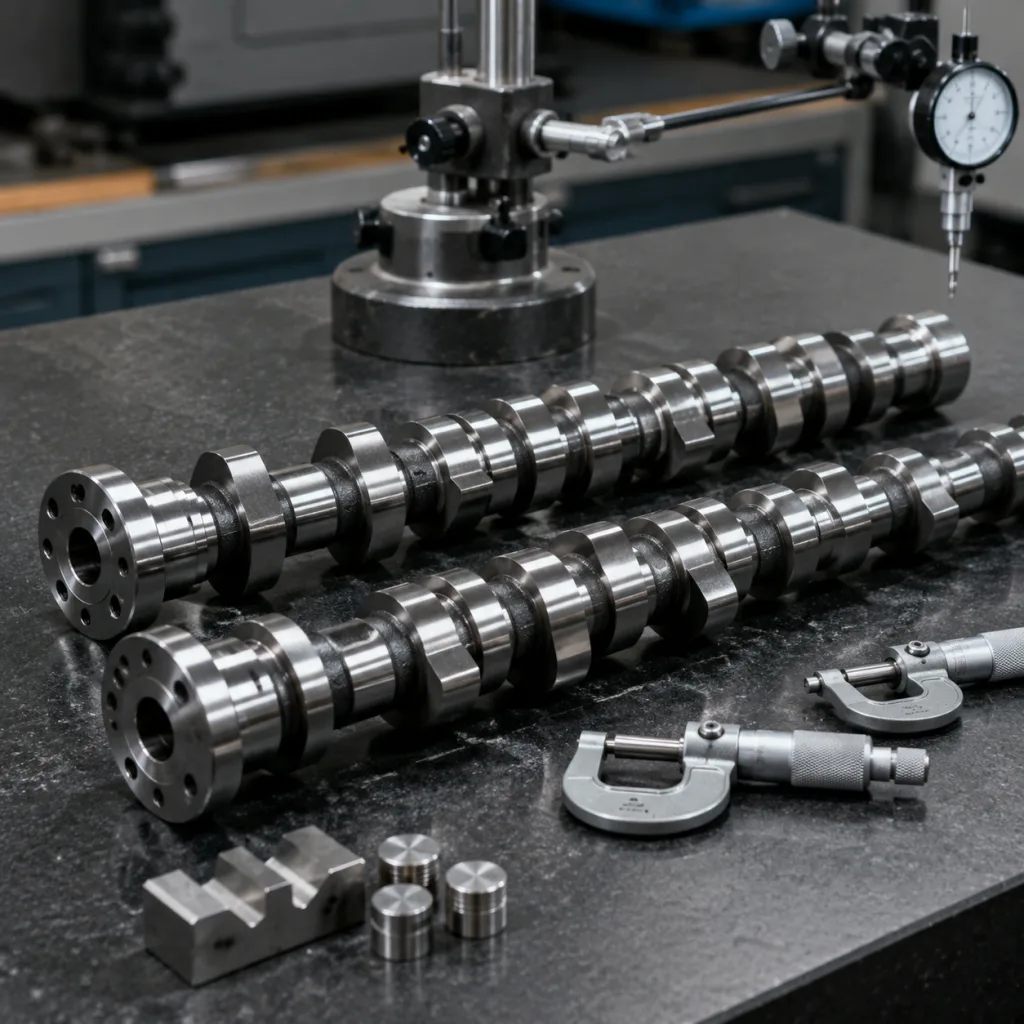
A Ford Focus camshaft can pass a quick visual check and still fail in service. The most expensive mistakes usually sit in the dimensions buyers do not see in catalogue photos: journal diameter, lobe lift, base circle, cam phase, trigger geometry, oil-hole position, runout, and surface roughness.
That is why B2B buyers should request a first article dimensional report and repeat-order batch inspection summaries. Photos confirm shape. Measurements confirm function.
Control point
What can fail if it is wrong
Typical inspection method
Practical control target
Overall length
Axial fit issues, end cover contact, incorrect end clearance
Vernier, height gauge, CMM
Drawing value, commonly ±0.10–0.30 mm
Journal diameter
Low oil pressure, high bearing load, seizure, noisy rotation
Micrometer, air gauge
Often ±0.005–0.015 mm depending on journal
Journal roundness
Local oil film breakdown and uneven bearing contact
Roundness tester
Commonly ≤0.005–0.010 mm
Journal runout
Timing instability, friction, abnormal rotation
Dial indicator, V-block fixture, CMM
Commonly ≤0.02–0.05 mm TIR
Lobe lift
Incorrect valve opening and altered breathing characteristics
Starved lubrication, accelerated journal or lobe wear
Optical inspection, plug gauge
Location and diameter by drawing; burr-free edge required
Trigger feature geometry
Cam/crank correlation faults and sensor signal errors
CMM, functional gauge
Tooth/profile and angular position checked 100% or by agreed sampling for critical types
Surface roughness
Start-up wear, follower noise, early scoring
Roughness tester
Journals and lobes commonly Ra 0.2–0.8 µm depending on design
</tr></thead><tbody> </tbody></table>For a camshaft for Ford Focus aftermarket replacement, Driventus treats lobe lift, phase angle, journal diameter, runout, trigger geometry, oil-feed alignment, and surface finish as critical-to-function characteristics. These points are built into control plans, in-process inspection, and final batch records so shipped parts can be linked to measured production results.
An importer’s incoming inspection plan can stay practical. Check 3–5 pieces per batch for full dimensions, 10 pieces for visual and packaging condition, and 100% of labels on mixed-reference shipments. Higher-volume repair chains may agree AQL levels such as 0 critical defects, AQL 1.0 for major dimensional or functional defects, and AQL 2.5 for minor cosmetic defects, subject to contract terms.
Spec Deep-Dive: Material, Hardness, Finish, and the Cold-Start Problem
A camshaft spends much of its life under repeated sliding or rolling contact. The most vulnerable moments are often cold starts, when the oil film has not fully stabilised. That is where material choice, heat treatment, surface finish, and cleanliness separate a robust replacement part from a high-return one.
Depending on the original design, a replacement camshaft may be produced from chilled cast iron, alloy cast iron, forged steel, or assembled tube-and-lobe structures. The correct route depends on follower type, lubrication conditions, hardness profile, manufacturing process, and the OE design being replaced.
Assess the specification in these areas:
Material grade: matched to the approved drawing or validated reference sample, with chemical composition verified by mill certificate or spectrometer check where required
Hardness: controlled on lobe nose, flank, base circle, journals, and thrust areas as required; common lobe surface targets may fall around 50–60 HRC or equivalent depending on material and OE design
Case depth or chilled layer: verified where the original design depends on a hardened surface zone; surface hardness alone is not enough
Microstructure: checked when the specification requires metallographic confirmation, including chilled layer, carbide distribution, decarburisation, or induction-hardened case quality
Surface roughness: controlled on lobes and journals to reduce start-up wear and noise, commonly in the Ra 0.2–0.8 µm range by application
Straightness: inspected after machining and heat treatment to reduce rotational stress; straightening may be required before finish grinding
Residual burrs: removed at oil holes, key slots, timing interfaces, and sensor features; burrs at oil passages are functional risks, not cosmetic issues
Cleanliness: controlled before anti-corrosion treatment and final packaging to avoid abrasive particles entering the cylinder head oil system
Repair chains often see valve-train complaints soon after installation. The root cause may be rough lobe flanks, sharp oil-hole edges, inconsistent hardness, soft spots, excessive case depth variation, grinding burn, contaminated oil, or worn reused followers. Some are part issues. Some are installation conditions. The specification and inspection records help separate them.
A typical Driventus process route is raw material incoming inspection, rough turning or casting clean-up, stress relief where required, CNC machining of journals and end features, heat treatment or chilled-surface validation, straightness correction, finish grinding of journals and lobes, oil-hole drilling and deburring, polishing, washing, anti-rust protection, final inspection, and controlled packaging. Private-label buyers should ask whether hardness readings, runout checks, and roughness values are recorded by batch and retained for warranty review.
Step-by-Step Release Plan Before the First Bulk Shipment
Bulk release should not depend on trust or a good-looking sample. For distributors, wholesalers, and repair networks, camshaft validation needs a controlled sequence that proves fitment, function, surface condition, corrosion protection, and packaging strength before inventory enters the market.
A practical release plan looks like this:
1. Confirm the application. Match engine code, model year range, market, fuel type, intake or exhaust position, VVT status, and reference numbers. 2. Approve the benchmark. Use a buyer drawing, validated OE sample, or agreed reference sample. 3. Inspect first articles. Check 100% of agreed critical dimensions on 1–3 pieces, including profile and phase data. 4. Confirm material. Review mill certificates or run spectrometer testing where required. 5. Map hardness. Record hardness on lobes, journals, and thrust areas by drawing zone where specified. 6. Verify cam profile and phase. Measure across all lobes, not only one reference lobe. 7. Check runout and straightness. Measure before and after finish operations where process risk exists. 8. Test surface roughness. Focus on lobe flanks, lobe noses, journals, and thrust faces. 9. Inspect lubrication features. Confirm oil passages are open, correctly oriented, clean, and burr-free. 10. Validate trigger geometry. Use CMM or a functional gauge to reduce cam/crank correlation fault risk. 11. Trial assemble where possible. Check representative cylinder head fixtures for axial end play and free rotation. 12. Confirm corrosion protection and packing. Review anti-rust performance, carton strength, and drop or handling risks for long parts.
Driventus production and inspection activities are managed under a documented quality system aligned with IATF 16949:2016 and ISO 9001:2015. For markets requiring chemical compliance declarations, buyers may request documentation related to REACH (EC) No 1907/2006. Emissions regulations such as ECE R-83 apply at vehicle system level; for replacement camshafts, the practical requirement is to maintain timing characteristics consistent with the intended application so the engine management system can operate as designed.
Lead time should include approval work, not only production. A typical schedule is 3–7 working days for feasibility and quotation after complete application data is received, 15–30 days for sample or first article preparation if tooling exists, and 30–60 days for first mass production depending on material availability, heat-treatment scheduling, inspection requirements, packaging artwork, and order quantity. Repeat production can often be shorter when raw material and packaging are already approved.
Procurement Trade-Offs: Price, MOQ, Documentation, and Range Building
The lowest camshaft quote is rarely the lowest total cost if it creates catalogue disputes, installer hesitation, rework, repacking, air-freight replacements, or warranty returns. Importers and repair chains should compare offers on the same technical and commercial basis, not just unit price.
Use this checklist before releasing a purchase order:
Confirm the exact application list, including engine code, production year, regional market, and camshaft position
Use engine code, displacement, fuel type, and position data, not only model name
Check intake versus exhaust use and whether variable valve timing is present
Request PPAP-style documentation where programme volume or customer requirements justify it, such as dimensional report, material certificate, control plan, process flow, and packaging specification
Agree critical inspection characteristics and AQL before shipment, including what is 100% checked and what is sampled
Define packaging requirements for sea freight, air freight, e-commerce handling, or mixed pallet shipments
Require batch codes on product labels, inner cartons, and master cartons
Validate the part with matching followers, tappets, seals, timing chains, belts, or phasers where applicable
Keep installation notes available for repair network customers, covering lubrication, timing, follower replacement, and oil-system cleaning
Set claim-handling rules that distinguish product defects from oil-system, timing, or installation problems
MOQ depends on the reference and packaging format. For an existing reference with standard neutral packaging, a practical MOQ may be 50–100 pieces per part number. Private-label cartons or new references may require 200–500 pieces depending on artwork, inserts, and production setup.
Price is normally driven by material grade, casting or forging route, heat-treatment method, number of machined journals and lobes, VVT or end-feature complexity, inspection level, packaging density, and annual forecast. Compare quotes using the same Incoterm, inspection requirement, packaging format, and warranty obligation. A lower EXW price may become more expensive after returns, repacking, rework, or emergency replacement shipments.
For distributors building a regional engine-parts range, Driventus can combine camshafts with related products such as gaskets, valve-train components, pistons, crankshafts, and water pumps to simplify consolidation. For application-specific projects, custom manufacturing can support drawing-based development, sample reverse engineering, private-label packaging, and agreed inspection documentation.
Scenario: A Correct Camshaft Becomes a Warranty Claim in Transit or Installation
A camshaft can leave the factory within specification and still become a claim before the vehicle returns to service. Two weak points cause many avoidable disputes: transport damage and incomplete installation information.
Start with packaging. Camshafts are long machined components with exposed functional surfaces. Journals, lobes, thrust faces, and trigger features must be protected from corrosion, impact marks, scratches, and bending during international transport and warehouse handling. If a carton allows metal-to-carton abrasion or end impact, the part may be unsellable even though production was correct.
Driventus packaging options typically include:
Anti-rust oil or VCI protection according to buyer storage requirements, often specified for 6–12 months of warehouse protection in dry conditions
Individual sleeves, trays, or shaped inserts to protect lobes and journals and prevent metal-to-carton abrasion
Inner cartons with part number, batch number, production date or lot code, and quantity labels
Export cartons sized for pallet stability and handling strength, with weight controlled to reduce manual-handling damage
Pallet wrapping suitable for container transport and warehouse storage, including moisture control where long sea transit is expected
Barcode, QR code, or buyer label formats where specified, including EAN/UPC or internal SKU mapping
Neutral or private-label packaging for distributor programmes where agreed
Traceability is the second control point. Each shipped carton should connect to production date, inspection records, heat-treatment batch, and material lot where applicable. That lets a buyer isolate a specific issue without blocking all warehouse inventory. A workable rule is one batch code per production lot and carton label, retained with inspection data for at least the agreed warranty period. For mixed shipments, the packing list should show part number, quantity, carton range, batch number, gross/net weight, and pallet number.
For a camshaft for Ford Focus aftermarket replacement programme, warranty control must also separate manufacturing defects from installation or engine-condition problems. Common non-product causes include low oil pressure, blocked oil galleries, reused worn followers, incorrect timing procedure, unsuitable lubricant, contaminated oil after engine repair, incorrect sealant use, and failure to prime the lubrication system.
A practical return process requests photos of the installed part, engine code, mileage after installation, oil and filter change evidence, timing setup information, companion parts replaced, and the carton batch label. If the part is returned, inspection should check lobe wear pattern, hardness, journal scoring, oil-hole blockage, runout, and abrasive contamination before the claim is classified.
Frequently asked questions
Provide engine code, model year range, displacement, fuel type, intake or exhaust position, quantity forecast, target market, packaging requirements, Incoterm, and any confirmed OE or aftermarket reference numbers. A sample or technical drawing improves quotation accuracy and helps confirm tolerances, trigger design, and VVT interface.
Yes. Driventus can support neutral or buyer-branded packaging, carton labels, barcode formats, export packing, and consolidated shipments, subject to confirmed order quantity, artwork approval, and compliance requirements. Private-label MOQ is usually higher than standard packaging because cartons, labels, and inserts must be produced and controlled by SKU.
No. Aftermarket camshafts are supplied for fitment compatibility and replacement use. Driventus does not claim vehicle manufacturer approval or endorsement. Brand names are referenced only to identify compatible applications.
If you are sourcing camshafts for Ford Focus aftermarket programmes, share your application list, forecast volume, target market, packaging requirements, and target delivery window. Our team can review fitment data, MOQ, inspection scope, and lead-time options to help you [request a quote](/contact.html).