camshaft · 2026-05-30

Camshaft Seat Aftermarket Replacement: OE-Match Guide

A camshaft seat aftermarket replacement must match the original geometry, hardness, and running clearance before it is released for production use. For procurement teams, the main risk is not the catalogue description. It is whether the part fits the head, retains oil film under load, and survives thermal cycling without abnormal wear. Driventus supplies camshaft and powertrain components for aftermarket and B2B programmes, with production controlled under IATF 16949:2016 and ISO 9001:2015. For any replacement part, buyers should confirm OE cross-reference data, journal diameter, axial location, surface finish, and material specification before ordering. Driventus is an independent aftermarket manufacturer; brand names are referenced for fitment only. If you are evaluating a new source for camshaft-related components, the checks below will help reduce returns, assembly delays, and inspection rejects.

What buyers should verify before ordering

For replacement sourcing, the camshaft seat is treated as a dimensional and functional match item. The part must suit the cylinder head design, lubrication path, and valve train geometry.

Minimum checks for procurement and engineering review:

  • OE reference or cross-reference: confirm the application by engine code and OE number where available, such as OE 06A107065 when it is already specified by the customer
  • Journal diameter and roundness: verify the mating diameter against the original print or sample
  • Axial location: confirm end play and spacing relative to the camshaft centreline
  • Surface finish: check for low friction contact and stable oil retention
  • Material and heat treatment: require a documented hardness window and microstructure control
  • Packaging and traceability: lot number, date code, and batch identification

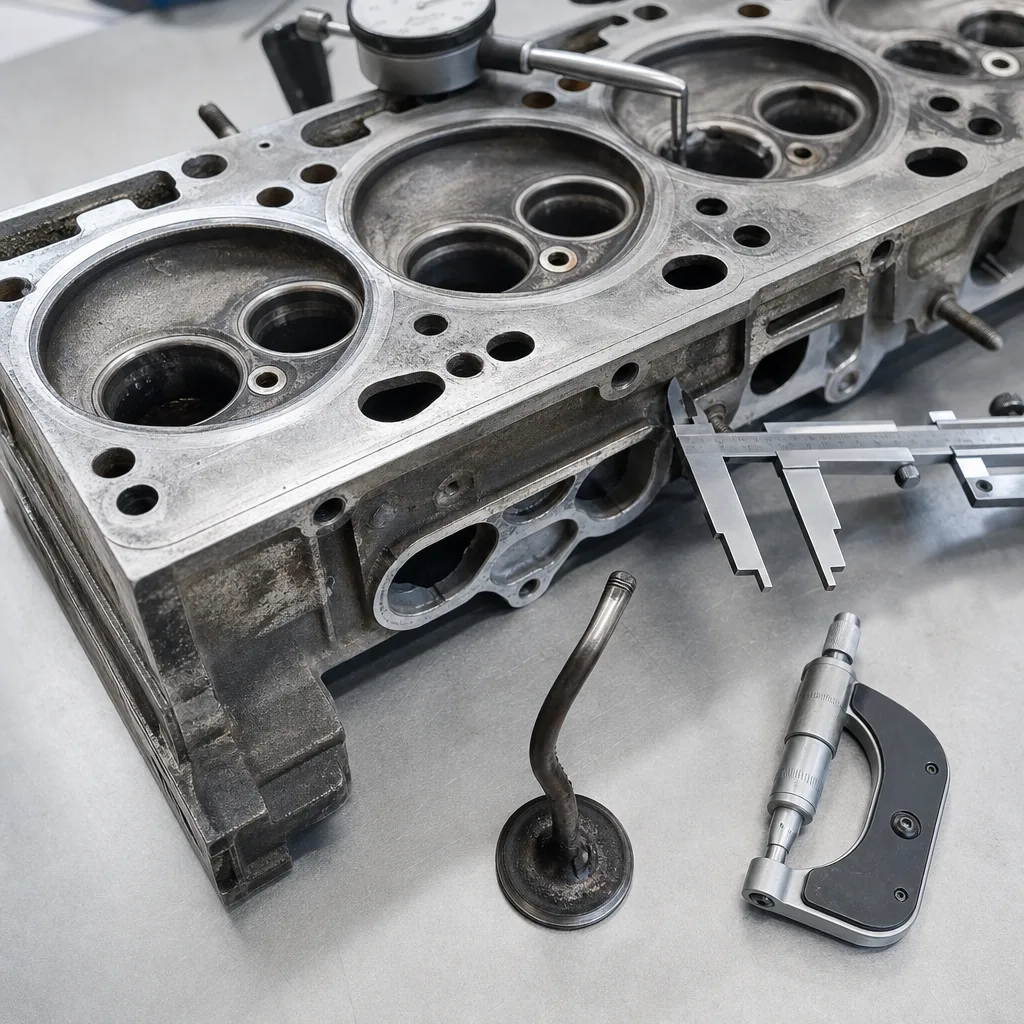
If the drawing is not available, a first-article sample should be measured against the removed component and the cylinder head bore. That is the fastest way to confirm interchangeability before bulk purchase.

Replacement fit depends on dimensional control

A camshaft seat aftermarket replacement can look correct and still fail in service if the tolerance stack is wrong. Small errors in bore size or seating depth can change oil clearance and accelerate wear.

Typical verification points

</tr></thead><tbody> </tbody></table>Driventus validates replacement parts against customer samples and drawing data where available. For programmes that need tighter control, we can align inspection criteria with customer-specific control plans and PPAP expectations.

Material and process controls for longer service life

The material system is as important as the geometry. Camshaft seat components operate under mixed lubrication, especially at cold start and during high-load operation. A stable manufacturing route helps maintain repeatable performance.

Common process controls include:

  • Controlled raw material chemistry
  • Heat treatment verification
  • Finish machining after thermal processing
  • Deburring and edge-condition control
  • Surface cleanliness before packing

For export markets, compliance documentation may also need to address REACH (EC) No 1907/2006 for chemical substance restrictions and buyer-specific restricted substance lists. Where the application is sensitive to emissions or durability testing, customers may request validation aligned with SAE J2527 for ageing or durability-related evaluation, depending on programme requirements. For regulated fitment discussions in Europe, reference the applicable vehicle and engine programme data rather than assuming approval.

How Driventus supports aftermarket replacement programmes

Driventus supplies replacement parts through a controlled manufacturing base in Taizhou, Zhejiang, with export experience in 60+ countries. For buyers, the value is in repeatable output and traceable inspection records rather than catalogue breadth alone.

We support three common sourcing models:

1. Catalogued replacement supply for distributors and wholesalers 2. OE-matched production for repair networks and importers 3. Custom manufacturing for special dimensions, material upgrades, or packaging requirements

You can review our catalog, check our quality system, or discuss custom manufacturing if your programme needs a controlled alternate source. For engine-side related parts, see engine components. Each batch can be inspected against agreed dimensional checkpoints, with certificate and traceability documents supplied on request.

Validation testing before release to production

Replacement parts should not move directly from sample approval to volume purchase without verification. A practical validation plan helps prevent field failures and returns.

Recommended checks before release:

  • Dimensional inspection of first articles
  • Fit trial in the target head or a confirmed master sample
  • Surface finish review on critical contact areas
  • Hardness and metallurgical confirmation
  • Packaging drop and corrosion protection review
  • Short-run field trial under representative duty cycle

When buyers request confirmation for high-volume orders, Driventus can support sample submission, inspection records, and production alignment under IATF 16949:2016 and ISO 9001:2015 processes. For procurement teams, this reduces the risk of purchasing a part that is nominally correct but unsuitable for assembly or endurance use.

When to replace instead of repair

Replacement is usually the safer option when the camshaft seat shows scoring, loss of roundness, heat damage, or repeated oil starvation. If the head bore is damaged beyond the repair limit, oversize repair alone may not restore correct oil clearance.

Consider replacement when:

  • The wear pattern is uneven across the contact band
  • The bore has visible galling or pitting
  • Measured clearance exceeds the acceptance window
  • The part has repeated overheating marks
  • The source component has no reliable traceability

For buyers managing repair-chain supply, consistent replacement quality matters more than a one-off low price. A stable part reduces rework, technician time, and warranty exposure. If your team needs a replacement source with dimensional control and documented inspection, request a quote for a sample evaluation or production enquiry.

Frequently asked questions

Match the engine code, OE reference where available, and the measured dimensions from the original part or drawing. Do not rely on catalogue photos alone. A first-article sample and fit check are the safest starting point.

For manufacturing control, ask for IATF 16949:2016 and ISO 9001:2015. For compliance documents, REACH (EC) No 1907/2006 may also be relevant. Always ask for batch traceability and inspection records.

Yes. If you need a dimensional change, material option, or packaging specification, Driventus can review custom manufacturing requirements. Use the contact page to share drawings, samples, or target volumes.

For sample review, dimensional confirmation, or production sourcing, contact Driventus and submit your part data for evaluation: /contact.html

Request a Quote
Item What to measure Why it matters
Inner diameterMicrometre or bore gauge readingControls running clearance with the cam journal
Outer diameterOD inspection against the head boreConfirms press or slip fit as designed
Width / axial lengthCaliper or CMMPrevents contact misalignment
ConcentricityCMM or roundness testerReduces uneven load and scuffing
Surface roughnessRa measurementSupports oil film formation
HardnessRockwell or equivalent methodImproves wear resistance under boundary lubrication